Racing Buoy Repairs

May 17, 2004
6,110
Beneteau Oceanis 37 Havre de Grace
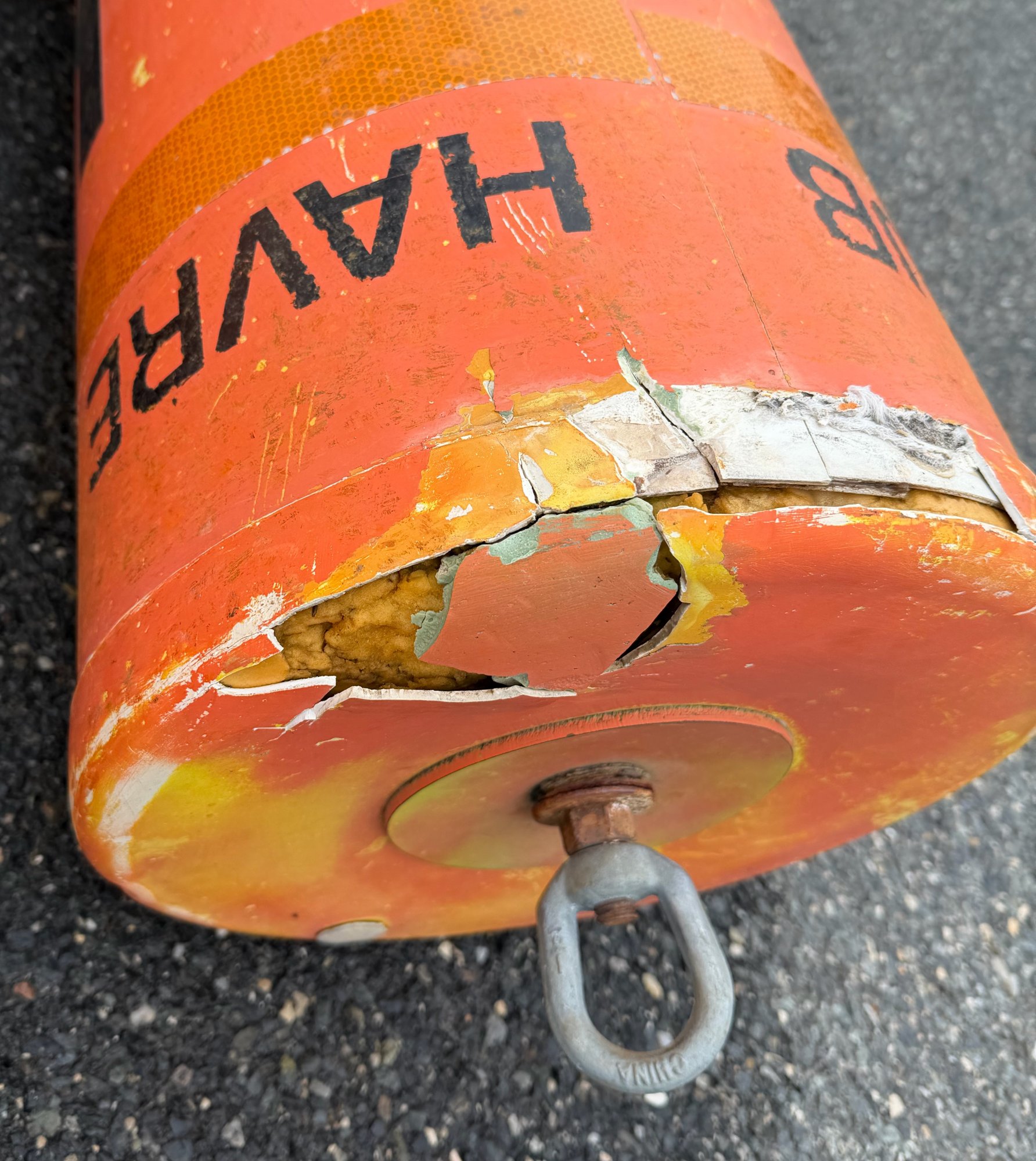
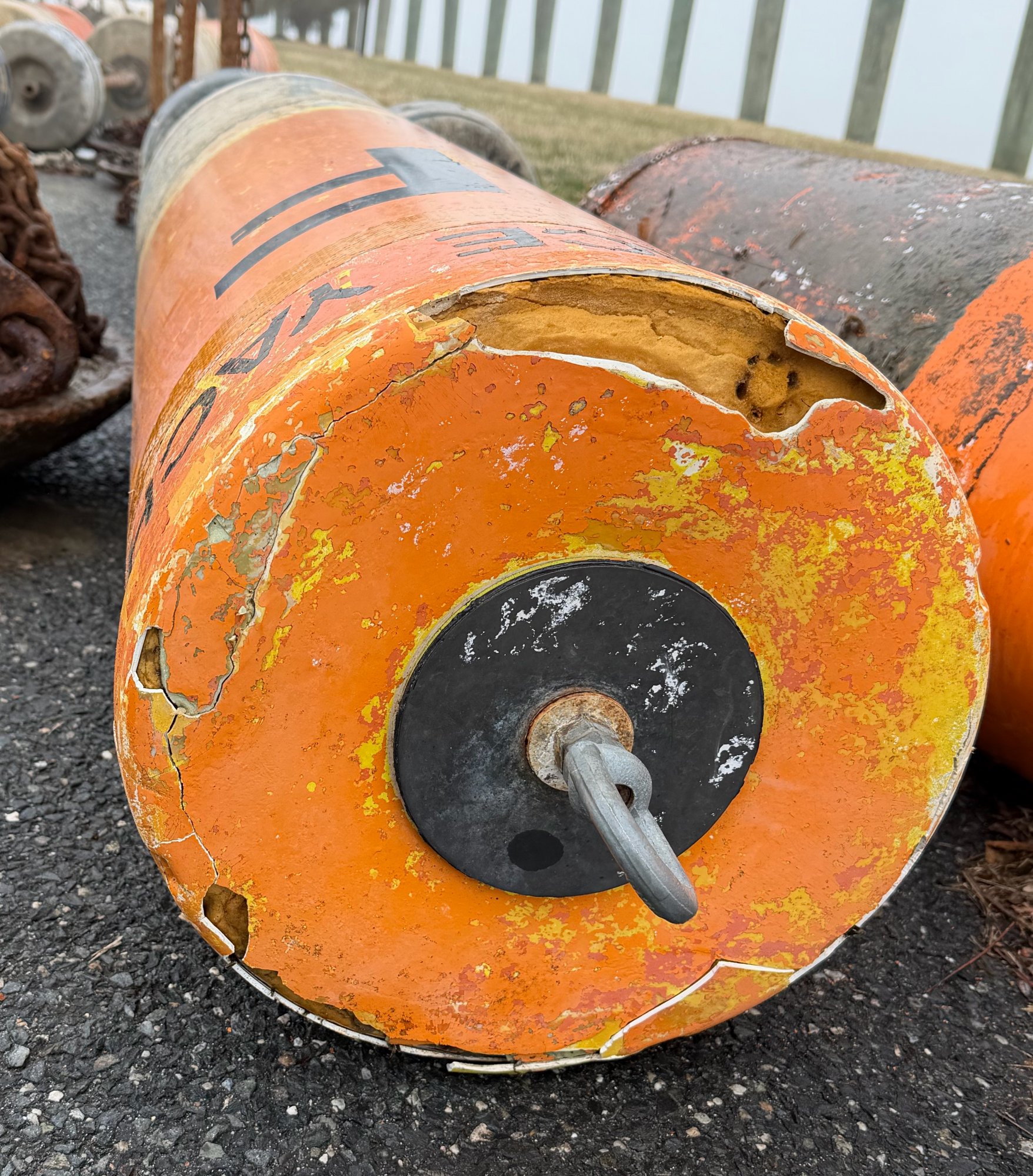
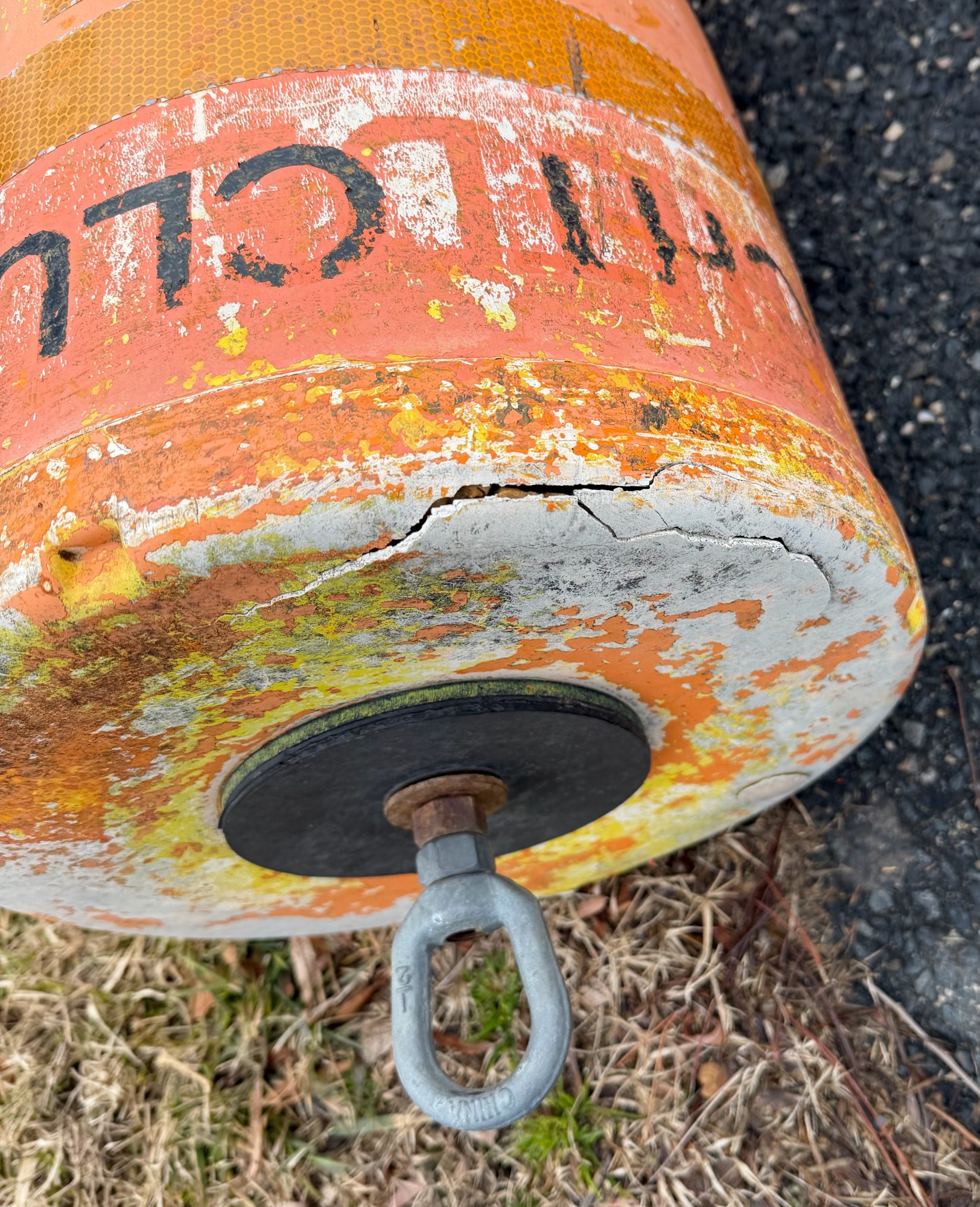
Three of our club’s racing buoys had a tough winter and developed cracks around their upper edges. The mark shells are ABS plastic, probably about 1/8” thick. The foam inside and bottom part of the shell seems to carry most of the loads from the chain and ballast; I don’t think the upper edges do too much structurally, though I’m not sure.

We’re going to try to repair them next weekend. My plan is to use two layers of 17oz fiberglass tape wrapped around the cracked parts of the edges and TotalBoat 5:1 epoxy. I’ve used 17oz biax and the 5:1 before on fiberglass dinghy repairs but never on plastic like this. I see West Systems recommends sanding and flame treating ABS for best adhesion. TotalBoat seems to say either flame treat, sand, or acetone wipe. I’m definitely going to sand; I’m not sure about the flame treating.

Anyone have experience with something like this and know of any gotcha’s I should watch out for?
1773457038540.jpeg


1773457095575.jpeg


1773457163925.jpeg
 
Jan 19, 2010
1,358
Catalina 34 Casco Bay
Our club transitioned to inflatable bag marks a few years ago and has never looked back. The bags easily inflate and stow. Because they float on top of the water they have less drag and don't require as heavy an anchor to keep station. Traditions are difficult to overcome. Making an award using the old marks keeps their history alive...
 
Jan 11, 2014
13,951
Sabre 362 113 Fair Haven, NY
Try using West System G-Flex epoxy, it will adhere to plastic.

The shell should not be carrying any load, there should be a metal rod connecting the eyes at the top and bottom of the mark.

Are these permanent marks, set once a season? If not, use inflatable marks with Danforth style anchors. Very easy to set and move as needed. The Danforth style anchor does not need to be fully retrieved, it can be towed and will surface and act like a wake board skim along the surface.
 
Mar 26, 2011
3,943
Corsair F-24 MK I Deale, MD
I've repaired plastic kayaks, sailboats, and fishponds. Some of the repairs are 20 years old.

I doubt the ABS is rigid enough to take a fiberglass patch. Conventional epoxy will peel off. G-Flex will do much better. The plastic is old and sunburned; welding won't work.

On something like that, I've had the best luck laminating using polyurethane sealant (Locktite PL S40 Window, Door, and Siding is cheap from Home Depot and adheres better to plastics than Sika or 3M, PS testing) and used Sunbrella (new Sunbrella has coatings that interfere with bonding) as the fabric. Sand. Flame treat. Then slop on lots, sort of like papier-mache.

(PL S30 is the same project in black. This was 10 years ago. Other repairs have lasted 20+ years. Use lots and prep carefully.)


  • Helpful
Likes: Leeward Rail
Aug 10, 2020
596
Catalina, Hunter C25 3559 Rocky Mount
Try using West System G-Flex epoxy, it will adhere to plastic.

The shell should not be carrying any load, there should be a metal rod connecting the eyes at the top and bottom of the mark.

Are these permanent marks, set once a season? If not, use inflatable marks with Danforth style anchors. Very easy to set and move as needed. The Danforth style anchor does not need to be fully retrieved, it can be towed and will surface and act like a wake board skim along the surface.
I like your comment.

I agree, most epoxy will not adhere to the plastic, g flex should do better. Be sure to paint afterwards. It is not uv stable.

The advice of towing a Danforth i am 100% against. I've pulled 3 of them out of transom over the years. One nearly killed a lady first. Every few years someone dies here from a Danforth coming loose and getting drug behind a boat or in the act of trying to retrieve one. Yes the plane out behind the boat, then the tension of the rode launches it into the boat. Last one I fixed went through the rear of a searay. Both sides of the rear locker and into the cockpit. I've seen the crossbar stuck into an 1 1/2 of plywood before. This technique kills people.
 
Aug 10, 2020
596
Catalina, Hunter C25 3559 Rocky Mount
Our club transitioned to inflatable bag marks a few years ago and has never looked back. The bags easily inflate and stow. Because they float on top of the water they have less drag and don't require as heavy an anchor to keep station. Traditions are difficult to overcome. Making an award using the old marks keeps their history alive...
We use inflatables. After 20 years we are finally due for new ones. Huge fan of being able to stow, launch and retrieve by myself
 
Jan 11, 2014
13,951
Sabre 362 113 Fair Haven, NY
The advice of towing a Danforth i am 100% against. I've pulled 3 of them out of transom over the years. One nearly killed a lady first. Every few years someone dies here from a Danforth coming loose and getting drug behind a boat or in the act of trying to retrieve one. Yes the plane out behind the boat, then the tension of the rode launches it into the boat. Last one I fixed went through the rear of a searay. Both sides of the rear locker and into the cockpit. I've seen the crossbar stuck into an 1 1/2 of plywood before. This technique kills people.
Where the anchors firmly set and then pulled out with a lot of force?

When I was doing a lot of RC work, we would get the anchor off the bottom and then plane them at relatively low speeds, just enough to get the boat on plane. The anchors were also pretty light, about 5 lbs. If an anchor was well set, we would use traditional methods of breaking it free.
 
Apr 25, 2024
828
. . .
I wouldn't use fiberglass. ABS is weldable with acetone, and the job is super easy. A solvent-welded repair will be stronger and more permanent than fiberglass. For the same thickness, it will be as strong or stronger than the existing structure.

Get some scrap ABS from anywhere. If you have to, you can buy sheets of it for cheap, but chances are you have some laying around.
  1. First, sand off paint around the repair.
  2. Shred/cut the scrap ABS into the cheese-grater sized pieces.
  3. Mix in acetone a bit at a time to dissolve the ABS and create a slurry of the desired thickness.
  4. Wet out the area of ABS surrounding the damage until the ABS develops a generous sticky layer (dissolved ABS).
  5. Use the slurry to fill cracks.
  6. For your large area(s), you might need to lay in a piece of sheet ABS cut to the approximate shape of the hole. Just wet both surfaces until well sticky, then stick them together with slurry.
  7. Fair everything out with slurry.
  8. Let it sit for a couple of hours to completely dry
  9. Sand
If you fill and sand well, and paint over it, your repair will be invisible and permanent.

Looking at that pattern of damage and not wanting to repeat this repair every so often, I would be tempted to cut a circle out of 1/4" ABS with a diameter a few inches larger than the buoy and, with a heat gun (and good ventilation) form a cap that goes completely over the top of the bouy. Then, solvent weld it the top of the buoy - completely covering the damaged area and making it much beefier.
 
Aug 10, 2020
596
Catalina, Hunter C25 3559 Rocky Mount
Where the anchors firmly set and then pulled out with a lot of force?

When I was doing a lot of RC work, we would get the anchor off the bottom and then plane them at relatively low speeds, just enough to get the boat on plane. The anchors were also pretty light, about 5 lbs. If an anchor was well set, we would use traditional methods of breaking it free.
Often a "we forgot to pull it up" or it came loose and fell from the bow. They will plane for a long time, stretch the rope and they are like a bullet when they break the surface. The amount of energy in the rope is crazy. They will rebound hard enough to catch up to your boat at 25mph. Seriously, people die from it here. The common Danforth here is 10-15lbs.
 
May 17, 2004
6,110
Beneteau Oceanis 37 Havre de Grace
I appreciate all the input. You’ve given me a lot to consider.

These are seasonal marks - They get set in early April and pulled in September. We have couple inflatable marks for races in a different area, but I don’t think we’d trust that for the whole year.
 
Oct 13, 2020
200
catalina C-22 4980 channel islands CA
I have found an easy way to break up abs is to use a chop saw and cut up abs pipe. You can make a lot of shredded abs this way. If you hook up a shop vac to the chop saw exhaust it is easily collected. You can then use acetone or abs glue to make the slurry and patch what ever is need. Dano
 
  • Helpful
Likes: LLoyd B

PaulK

.
Dec 1, 2009
1,522
Sabre 402 Southport, CT
Our marks are made of orange and white striped highway workzone drums that we mount on floating platforms made from styrofoam billets. The drum is bolted to the 3/4" plywood deck around its rim and the anchor line is bolted to the 2x framing of the platform so the drum has minimal stress. they hold up for about a decade or more.
 

capta

.
Jun 4, 2009
5,066
Pearson 530 Admiralty Bay, Bequia SVG
I appreciate all the input. You’ve given me a lot to consider.

These are seasonal marks - They get set in early April and pulled in September. We have couple inflatable marks for races in a different area, but I don’t think we’d trust that for the whole year.
I should think you would prefer to have the inflatable marks so you could set up different courses over the season.
 
May 17, 2004
6,110
Beneteau Oceanis 37 Havre de Grace
I should think you would prefer to have the inflatable marks so you could set up different courses over the season.
Between 4 club marks and 5 government marks we’ve got quite a bit of variety. We set separate courses for spinnaker and non-spin boats, so we’d usually need to launch a couple inflatables each week if we didn’t have the semi-permanent ones. They’re not always in exactly the right spots for perfectly square courses, but our RC duties rotate around each racing boat, so having the marks pre-set seems like the best compromise for us.