Question about the 220 uf 100v capacitor

Status
Not open for further replies.
Sep 30, 2012
224
macgregor 26s 1993 cranbrook bc
Hi
I didn't want to high jack the thread about the solar updates by Walt. I was using his schematic to update my boats wiring, as well as a bases to learn about 12 v wiring. I liked the idea of isolating the outboard motors charging system in case of a mistake and saw he used a 220 uf 100v capacitor. I had to look up what it looked like (like I said I am learning) my question is .....excuse me if it is a dumb question but how does it get connected to the 4 Gage battery wire. I am ordering assorted parts so I can work on the electrical and other items over the winter, but this has me a bit stumped.

Thanks

Dave
 

walt

.
Jun 1, 2007
3,546
Macgregor 26S Hobie TI Ridgway Colorado
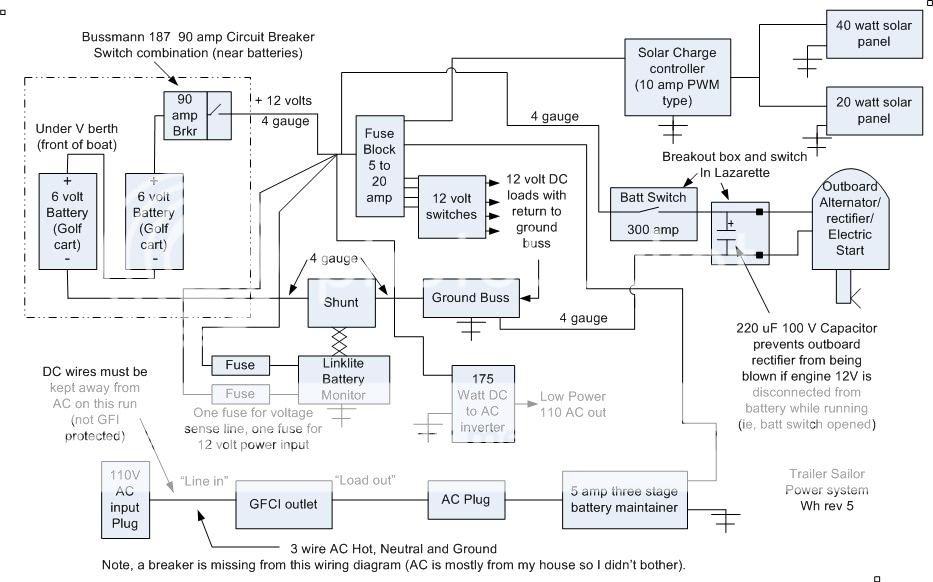
Here is the circuit diagram referred to


First thing Ill point out is possibly one of the most important electrical safety items in the DC wiring and that is the fuse near the battery. I have an electric start outboard and the batteries are in the bow of the boat under the V berth so run 4 gauge wires the length of the boat. There is a very important fuse close to the batteries that will protect the wires (shorted four gauge wire and two golf cart batteries can generate a huge amount of power) from burning the boat down from a short but the fuse wont trip when starting the outboard (about 35 to 50 amps for my 9.8 hp four stroke).


In the Laz area, I have a breakout box so that I can connect the outboard wires to the boat DC. This is where those caps are located. It looks like I made that cap value from a bunch of smaller caps (parallel caps to add the values, series the caps to increase the voltage rating). I also put a single pole switch back there so that I could turn off the DC power to the breakout box independent of the power to the rest of the boat.

What is the purpose of the caps? The outboard charging system uses a bridge rectifier to turn the AC pulses into "DC" pulses. If for some reason you disconnect the outboard charging system while the outboard is running, the coils in the alternator can generate a very large voltage spike that can reverse bias the diodes in the rectifier and damage them. But with the capacitor always on that outboard output, the capacitors should prevent the large voltage spike that can damage the rectifier. I have avoided actually testing this.


Attachments

walt

.
Jun 1, 2007
3,546
Macgregor 26S Hobie TI Ridgway Colorado
Also somewhat interesting related to the purpose of those capacitors is the regulator type that Fourpoints referred to in the other post.

The regulator on these small engines is different from the regulator/alternator on a car or larger engine in that they don’t control how much current is generated, they just "burn it up" in heat if there is excess.

The "regulator module" likely has the bridge rectifier and then a circuit that simply looks at the voltage on the battery and turns on a resistive load if the voltage exceeds some threshold such as 13.5 volts.. So if the outboard alternator is generating enough current to exceed the voltage trip, the excess current is just turned into heat by a resistive load in the regulator. Burning up 60 watts in a small area can really get things extremely hot but apparently the heat buildup isn’t a problem according to Fourpoints.

The interesting thing to point out is that if that regulator circuit has a fast response (and it likely does), it should also be able to turn on a dissipate the large voltage spike that is produced by the alternator when the power is disconnected.

So, there is some chance that if this type of regulator is used in newer outboards (and it could be), these might be much more tolerant of disconnecting the outboard from the battery while the battery is running compared to an outboard that has a rectifiier only.

I won’t be testing this myself to find out since I’m not sure at all and if wrong the rectifier would be toast..
 

walt

.
Jun 1, 2007
3,546
Macgregor 26S Hobie TI Ridgway Colorado
Another little tid bit that doesnt get mentioned much..

In the initial diagram, there is a 90 amp fuse on the 4 gauge wire (close to the battery). At mid-point in the boat, I have a distribution of the 12 volts that goes to various points in the boat using smaller gauge wire (such as for lights, radio etc). At this distribution, there is another fuse bank.

The point here is that any time you significantly change wire gauge, you need another fuse in the line. Fuses are in the line to keep the wire from getting so hot that it can start a fire. As an example, my 12 volt breakout goes from 4 gauge to 12 gauge wire. The 12 gauge wire can handle a maximum of about 40 amps. So if I didn’t have a fuse on the 12 gauge wire and it was shorted, the 12 gauge wire would burn up without tripping the 90 amp fuse on the four gauge wire.
 
Sep 30, 2012
224
macgregor 26s 1993 cranbrook bc
That is a perfect answer thank you. I am a bit out of my comfort zone with the electrical but it does make sense, and as I read through different articles it becomes more clear . I would be very interested where you bought the parts to build the capacitor. (probably not the correct term for it). I had one more question. This is probably elementry electronics but my plan is to have the battery in the laz (I know not the best spot, but it is convenient) My plan is to run directly from the outboard to the battery (with the factory wires) with a shut off and then from the battery to the rest of the boat. Should I have two large fuses? One that goes from the battery to the outboard and one from the battery to rest of the boat. My gut says no.....and at the same time Maybe???? I think it is safer to ask.

Thanks Dave
 

Sumner

.
Jan 31, 2009
5,254
Macgregor & Endeavour 26S and 37 Utah's Canyon Country
T... Should I have two large fuses? One that goes from the battery to the outboard and one from the battery to rest of the boat. My gut says no.....and at the same time Maybe???? I think it is safer to ask...

One option would be to put ...


http://shop.genuinedealz.com/Items/...ystems 2151 Fuse Block for Terminal Fuse Dual

...one of the above on the battery.

http://bluesea.com/products/2151

Then put a larger fuse...


...say a 50 amp or whatever is right for the outboard wiring on one of the posts and hook the outboard to it.

Then pick out ...


...a different size fuse ...

http://shop.genuinedealz.com/Marine Electrical Supply/Fuses and Blocks/Battery Terminal Fuse/

....that works for the wiring running forward. You could put a cut-off if you wanted in that line after the fuse or up at the main fuse panel.

I think if the outboard is wired direct to the battery there would then be no need for the capacitors. I think Walt has them in case the switch is thrown and the outboard isn't connected to a battery and someone starts it.

We have the alternators on both boats wired directly to batteries to avoid a possible problem. If needed they can be disconnected via the cable. Our selector (A-B-Off) switch connects the loads to one battery or the other or both or disconnects the loads from the batteries. The alternators are never disconnected,

Sum

[FONT=Arial, sans-serif]============================[/FONT]

Our Endeavour 37

Our MacGregor 26-S Pages

Our Trips to Utah, Idaho, Canada, Florida

Mac-Venture Links
 

walt

.
Jun 1, 2007
3,546
Macgregor 26S Hobie TI Ridgway Colorado
Since you likely have something like 6 or 8 gauge wire going to the outboard (electric start?) and some smaller diameter (higher gauge number) going to the boat electrics - you technically need a fuse for each distribution. The solution Sumner proposed looks like a good one.

I think Walt has them in case the switch is thrown and the outboard isn't connected to a battery and someone starts it.


You can start the outboard without the battery connected no problem. Ive done that before when the battery was very full and I didn’t want the outboard charger over-charging the battery (using the 300 amp switch in my setup). You just can’t connect or disconnect the battery while the outboard is running.

The actual reason I put that cap in there is because I have a switch that does allow me to disconnect the battery from the outboard. I know better than to throw that switch when the outboard is running at this moment (sitting in front of a computer) but know the confusion that can happen on a boat when it gets a little wild and you have other people helping you. One reason I put in that switch was from knowing about the overcharge problem with low hp outboards - I can just disconnect the outboard and pull start. I also like having that switch for when I leave the boat for long periods of time and want the outboard disconnected from the battery. If the outboard does have the regulator similar to what Fourpoints put in his outboard, it would turn on a load any time the battery voltage got above 13.5 volts. This would disrupt the solar controller trying to get the battery up to over 14 volts in the bulk charging phase and would also just sit there and cook the outboard regulator over a long period of time. There are other times when I could possibly have something go wrong with the outboard and I just want it disconnected from the rest of the electrical system - but leave the rest of the electrical system intact. Its simply that having that switch gives the risk of blowing the rectifier if I or someone else did something dumb- so I put in the caps.

Back a while ago, there used to be a product called the Zapstop which did the same thing. For some reason, the product seems to have gone away.
 
Sep 30, 2012
224
macgregor 26s 1993 cranbrook bc
Ok I think I almost have it. I was actually looking at those fuses last night. What you described is exactly what I want to do except I would like to put a selector between the battery and the outboard/alternator. The wires would never be physically unhooked from the battery, but what would happen if that selector was turned off while the outboard was running, or if the outboard was started with the selector turned off. I am still a bit unclear on this part....Would this be the same as physically disconnecting the wires from the battery? Would having the selector in the off position when I started the alternator be a harmful. The outboard is a 93 2stroke yamaha. I was thinking of getting a shut off with AFD, would this function the same as Walt capacitor. If you did actually had use it do you know if it destroys the selector?

Thanks for helping wrap my brain around this... . I just want to very sure of what I am doing before I order the parts and actually install everything.

Dave
 
Sep 30, 2012
224
macgregor 26s 1993 cranbrook bc
Since you likely have something like 6 or 8 gauge wire going to the outboard (electric start?) and some smaller diameter (higher gauge number) going to the boat electrics - you technically need a fuse for each distribution. The solution Sumner proposed looks like a good one.


You can start the outboard without the battery connected no problem. Ive done that before when the battery was very full and I didn’t want the outboard charger over-charging the battery (using the 300 amp switch in my setup). You just can’t connect or disconnect the battery while the outboard is running.

The actual reason I put that cap in there is because I have a switch that does allow me to disconnect the battery from the outboard. I know better than to throw that switch when the outboard is running at this moment (sitting in front of a computer) but know the confusion that can happen on a boat when it gets a little wild and you have other people helping you. One reason I put in that switch was from knowing about the overcharge problem with low hp outboards - I can just disconnect the outboard and pull start. I also like having that switch for when I leave the boat for long periods of time and want the outboard disconnected from the battery. If the outboard does have the regulator similar to what Fourpoints put in his outboard, it would turn on a load any time the battery voltage got above 13.5 volts. This would disrupt the solar controller trying to get the battery up to over 14 volts in the bulk charging phase and would also just sit there and cook the outboard regulator over a long period of time. There are other times when I could possibly have something go wrong with the outboard and I just want it disconnected from the rest of the electrical system - but leave the rest of the electrical system intact. Its simply that having that switch gives the risk of blowing the rectifier if I or someone else did something dumb- so I put in the caps.

Back a while ago, there used to be a product called the Zapstop which did the same thing. For some reason, the product seems to have gone away.
You have read my mind.....When I first started thinking about the wiring for my boat these where exactly the reasons I wanted the shut off. Just wasn't quite sure about the ramifications or quite how to do it. You wrote the reply the same time I was writing my other reply. Would a selector with AFP serve the same function as your capacitor?

Thanks

Dave
 

Sumner

.
Jan 31, 2009
5,254
Macgregor & Endeavour 26S and 37 Utah's Canyon Country
...You can start the outboard without the battery connected no problem. Ive done that before when the battery was very full and I didn’t want the outboard charger over-charging the battery (using the 300 amp switch in my setup). You just can’t connect or disconnect the battery while the outboard is running. ..
That is good to know. I've often wondered about that scenario.

I don't know how to tell if our batteries have ever been hurt or not, but there were a number of days in Florida where we motored for a number of hours and at some point between the outboard and 180 watts of solar the batteries were charged.

The charge controller indicator light showed that the controller had switched to float, so it was cutting off the solar array basically. We only run on 1/2 throttle or less as that gives us about 5 knots. I'm not sure what the outboard is putting out there amp wise at half throttle but kind of doubt if it is hurting the 2 batteries much if at all. They seemed to behave about the same at the end of 3 months use on the water as at the beginning,

Sum

[FONT=Arial, sans-serif]============================[/FONT]

Our Endeavour 37

Our MacGregor 26-S Pages

Our Trips to Utah, Idaho, Canada, Florida

Mac-Venture Links
 

Sumner

.
Jan 31, 2009
5,254
Macgregor & Endeavour 26S and 37 Utah's Canyon Country
... I am still a bit unclear on this part....Would this be the same as physically disconnecting the wires from the battery? Would having the selector in the off position when I started the alternator be a harmful. The outboard is a 93 2stroke yamaha. I was thinking of getting a shut off with AFD, would this function the same as Walt capacitor. If you did actually had use it do you know if it destroys the selector?...
I guess we won't know until you do it ;). Walt hasn't tried turning it off and on even with the capacitors according to his post.

If you are that worried about this why not put in a volt meter and see what is actually going on? If the voltage is going over 14-15 volts, about normal charging volts, then do something about it. You could put in a 5-8 amp load that you could turn on if you thought the outboard was putting out too much.

I'll bet you won't find a real problem. Keeping the switch out of the outboard circuit and keeping it wired to the battery is going to be the safest thing to do, outboard wise, and what the vast majority of people do,

Sum

[FONT=Arial, sans-serif]============================[/FONT]

Our Endeavour 37

Our MacGregor 26-S Pages

Our Trips to Utah, Idaho, Canada, Florida

Mac-Venture Links
[FONT=Arial, sans-serif][/FONT]
 

walt

.
Jun 1, 2007
3,546
Macgregor 26S Hobie TI Ridgway Colorado
Sort of on topic..

Sumner, just curious how you let your 26S sit (I don’t think you have used it for over1.5 years). Batteries in the boat? Outboard connected to the batteries all the time? How are the batteries kept charged?

My boat now is sitting idle for long periods (like 6 months) since its so far away but I also like mine ready to go quickly which means batteries in the boat and fully charged.
 
Sep 30, 2012
224
macgregor 26s 1993 cranbrook bc
I guess we won't know until you do it ;). Walt hasn't tried turning it off and on even with the capacitors according to his post.

If you are that worried about this why not put in a volt meter and see what is actually going on? If the voltage is going over 14-15 volts, about normal charging volts, then do something about it. You could put in a 5-8 amp load that you could turn on if you thought the outboard was putting out too much.

I'll bet you won't find a real problem. Keeping the switch out of the outboard circuit and keeping it wired to the battery is going to be the safest thing to do, outboard wise, and what the vast majority of people do,

Sum

[FONT=Arial, sans-serif]============================[/FONT]

Ok sounds good. I'll ditch the shut off. Keep the system a bit simpler and your right the outboard is probably putting out very little anyway. I was basically thinking more in the future when I added solar and had full batteries and I was still adding more current to the batteries with the alternator but realistically I am probably looking for problems that don't exist. Would this also mean I could eliminate the fuse from the battery to the alternator? yamaha didn't seem to think it was necessary or would you still add one? I have never used the electric start anyway, but like anything if it is there I guess it should be utilized just in case.

Thanks for everybody's help

Dave
 

Sumner

.
Jan 31, 2009
5,254
Macgregor & Endeavour 26S and 37 Utah's Canyon Country
...Sumner, just curious how you let your 26S sit (I don’t think you have used it for over1.5 years). Batteries in the boat? Outboard connected to the batteries all the time? How are the batteries kept charged? ..
The outboard is in the shop. The boat is sitting on the side of the lot towards the store on the side street (Walt has been to the house) so is sitting with the bow facing south.


http://purplesagetradingpost.com/sumner/macgregor2/outside-33.html

All of the panels (200 watts) are connected with the 40 watt tilted up like in the picture facing south. The other panels are flat and had snow on them when we left yesterday. They run through the Blue Sky MPPT controller and I'll check on them every couple months and it seems to always be on float when I do check. I do need to go out and check the water levels though.

I feel good about the controller doing its job. I don't feel so good about not getting the boat out. We were gone to Florida for about 5 months this past spring/summer working on the Endeavour and wanted to take the Mac out this fall to Lake Powell, but Ruth's eye problems have kept that from happening. She has had a couple operations, the latest this morning up in Provo, Ut (4th trip in the past couple months). We hope this one works. If so and the eye is ok we will go back down to the Endeavour and sure hope this time to get out with her. Then the plan is to use the Mac at home this summer and fall maybe in Colorado (Cortez) and Lake Powell. We sure do miss going out with her,

Sum

[FONT=Arial, sans-serif]============================[/FONT]

Our Endeavour 37

Our MacGregor 26-S Pages

Our Trips to Utah, Idaho, Canada, Florida

Mac-Venture Links
 

Sumner

.
Jan 31, 2009
5,254
Macgregor & Endeavour 26S and 37 Utah's Canyon Country
....Ok sounds good. I'll ditch the shut off. Keep the system a bit simpler and your right the outboard is probably putting out very little anyway. I was basically thinking more in the future when I added solar and had full batteries and I was still adding more current to the batteries with the alternator but realistically I am probably looking for problems that don't exist. Would this also mean I could eliminate the fuse from the battery to the alternator? yamaha didn't seem to think it was necessary or would you still add one? I have never used the electric start anyway, but like anything if it is there I guess it should be utilized just in case.

Thanks for everybody's help

Dave
I'll bet that the majority of the outboards that have the battery within reach of the stock cables are wired without a fuse. Would I do it. I don't think so considering how little the fuse and such costs.

You need to fuse the wire going forward, or should at least. Buy that 2 post fuse adapter and just do it. The ...


... two post fuse holder is about...


...$12 more than the single ($28.57 for the 2) and an extra fuse is about $12 so for $24 you wouldn't have to worry about 'what if'.

http://shop.genuinedealz.com/Marine Electrical Supply/

We have heavy cables, fused at the batteries by the v-berth and also a breaker back at the outboard in the Laz. Besides power for starting the outboard the Gen-set is...


...back there so have the potential for a pretty big output from back there forward also.

Sum

[FONT=Arial, sans-serif]============================[/FONT]

Our Endeavour 37

Our MacGregor 26-S Pages

Our Trips to Utah, Idaho, Canada, Florida

Mac-Venture Links
 

walt

.
Jun 1, 2007
3,546
Macgregor 26S Hobie TI Ridgway Colorado
I bought an electric trolling motor a few years back which of course had no fuse and a way to connect directly to the battery. But the several page manual that came with it of course showed a fuse being used.

To fuse or not on the DC power lines.. one other thing to also consider is that the battery is capable of a LOT of current and will mostly hold up its voltage even when a lot of current is supplied so the larger the wire diameter (small the gauge number), the more power and energy can be delivered in a short.

As an example and assuming the battery voltage is the same for both cases (not exactly true), if we have two equal lengths of 6 gauge wire and 14 gauge wire and then short each one, the power and energy delivered to the 6 gauge wire would be over six times what is delivered to the 14 gauge wire. Both wires melt at the same temperature but the larger diameter wire ends up with a lot more energy (power * time) which helps catch other stuff on fire.

I personally would fuse all DC runs if there was ever any chance of a short and think the larger the diameter the wire, the more important it is.
 

walt

.
Jun 1, 2007
3,546
Macgregor 26S Hobie TI Ridgway Colorado
Sumner, the reason I asked about how you store your boat is because I’m trying to understand something about the regulator in the 9.8 hp but since yours is removed from the boat, it won’t matter for you.

As mentioned, I have a switch that allows me to disconnect the outboard from the rest of the electrical system. And because of the switch, I have some protection in case the switch is thrown while the outboard is running.

One reason I originally put that switch in was because I was worried about the possibility of the unregulated outboard charging system over charging the batteries. You can’t dismiss this possibility as Fourpoints documented it happening on his older 2 stroke (including it damaging a cell phone charger). However, after watching the charging on my 2010 Nissan 9.8 for some time, I don’t believe it has this issue. I’ve attached the wiring diagram from the manual (actually this is the non-electric start model which has the same regulator set up but less clutter in the diagram).


In this diagram, there is shown a regulator/rectifier block and circuit wise, it looks the same as an older outboard with just a rectifier. The "regulator" part of this diagram may be why I don’t see the overcharging. I can see no feedback in the diagram like you would have with a larger engine alternator/regulator so it must regulate by simply turning on a resistive load when some voltage threshold is tripped.

In my case, I’m trying to keep the batteries topped off over a long storage period with a 10 watt solar panel. If I kept that outboard regulator connected to the battery all the time, it could also regulate what the solar panel and charge controller are trying to do - and screw up the multi stage charging which is likely important for making the batteries last as long as possible.

So I think I have another reason for the switch - to disconnect the outboard from the battery when I leave the boat for a while. The switch allows me a very quick reconnect so my setup time is short (in October, it took me 45 minutes from pulling into the parking lot to having the boat at the dock ready to cast off and this was for a two day trip).

Next time I get to the boat, I plan some testing to find out for sure if that outboard regulator does in fact also limit the solar charge controller from doing its job..
 

Attachments

Sumner

.
Jan 31, 2009
5,254
Macgregor & Endeavour 26S and 37 Utah's Canyon Country
....In my case, I’m trying to keep the batteries topped off over a long storage period with a 10 watt solar panel. If I kept that outboard regulator connected to the battery all the time, it could also regulate what the solar panel and charge controller are trying to do - and screw up the multi stage charging which is likely important for making the batteries last as long as possible. .
Is there a reason you don't leave it with the larger panel you have hooked up? At times we would sit 3-5 days on anchor some place and the charge controller seemed to work fine going from bulk in the morning to float late afternoon with the outboard attached and would turn off at dark. I didn't see any funny amp readings at night either. I think you have a pretty good controller (ours is a Blue Sky MPPT) so I would think there should be no problem,

Sum

[FONT=Arial, sans-serif]============================[/FONT]

Our Endeavour 37

Our MacGregor 26-S Pages

Our Trips to Utah, Idaho, Canada, Florida

Mac-Venture Links
 

walt

.
Jun 1, 2007
3,546
Macgregor 26S Hobie TI Ridgway Colorado
I wont be able to do this test for a long time (outboard is not close) but here is about the test I would do and why. The question is if the newer Nissan or Tohatsu 9.8 has what I will call a "non feedback" regulator, does it draw current when some other charging method on the boat exceeds some preset battery voltage level. I don’t know if this is the case but as an example of what this regulator might do - when the voltage exceeds say 13.5 volts, the regulator switches in say a 40 watt resistive load.

If it does, this is what both Sumner and I might see with our higher power panels. Let’s say you start off in the morning with batteries in the 12 volt range (very typical) and the sun comes up and the batteries start to charge from solar. The charger will go to bulk charging and try and take the batteries up over 14 volts dumping in as much extra current from the panel as possible.

However, during this stage and if the "non feedback" regulator does as per the example above (which we do not know), at about 13.5 volts, the regulator in the outboard (which is connected but not running) turns on and begins to dissipate 40 watts. For the 200 watts of panel, let’s say it’s putting out 150 watts. Since 40 of that is being burned up in the outboard regulator, 110 watts still charges the battery so you might not even know this is going on. But.. you are not getting a good portion of the solar output (losing way more than the boost from MPPT). With my 40 watt panel, the same example would have wiped out pretty much all the power from the panel.

As soon as the sun goes down, the battery voltage very quickly dips below 13.5 volts (remember that a 100% charged battery is less than 13 volts at rest and even lower when under a load). The non feedback regulator in the outboard shuts off, no more current drain and everything looks good again.

I won’t get around to this for a long time and it currently is not a problem for me but am curious about this since it could affect things when I have the 40 watt panel on the boat.. Below is the test I would do if I had my outboard close by. I think this would be interesting for both the new Nissan 9.8 four stroke and the regulator that Fourpoints added to his older 2 stroke..

Caution.. some chance you could damage your outboard doing this test.. Might be best to wait until I try it on my outboard :D:eek:


Attachments

Status
Not open for further replies.