Proposed sailboat rewire project

Status
Not open for further replies.
May 4, 2010
68
hunter 33_77-83 wilmington, NC
Hey, I have been researching and studying how to redo the 12V system on my 78 Hunter 33. If I could get a few people knowledgeable with the subject to take a look at my diagram and point out what I may have missed I would be grateful.
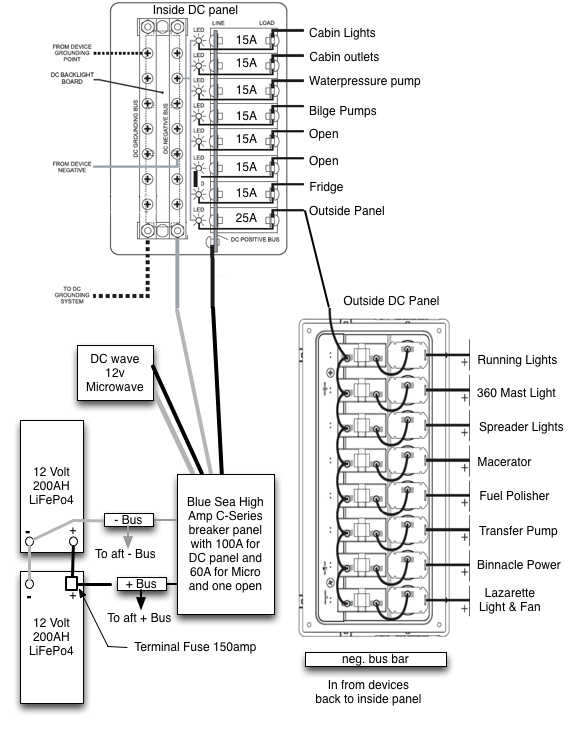


Also, there is a Ground buss on this blue sea 12v panel, where should that be connected to?
 
Sep 28, 2008
922
Canadian Sailcraft CS27 Victoria B.C.
I think it looks good except for the lack of battery and alternator output fusing. I would fuse both start and house banks with ANL fuses close to the positive post.

I usually use a separate ground bus for items on the panel as it keeps things neater, I run one wire to the panel's negative bus which is needed for it's back lighting.
 
May 4, 2010
68
hunter 33_77-83 wilmington, NC
Ah, good catch. I was looking at these:
http://bluesea.com/products/5191
One for each battery I assume. Sized to protect the wire not the battery.

I am using 4/0 cable from the aft bus bars to the forward bus bars so the Amp capacity of the wire should be way more then what I have available to put through it.
 
Sep 28, 2008
922
Canadian Sailcraft CS27 Victoria B.C.
The MRBF fuses you linked to are ideal - they can install on a battery or on a bus for individual loads. The house bank can be treated as one battery as far as fusing.

Normally the engine block is ship's ground. A heavy wire from one point on the engine runs to a bus and all other grounds terminate to it as well as battery negatives. I wouldn't use a keel bolt as an electrical ground. The keel makes a good lightning ground though which is separate from the electrical grounding.
 
Jun 6, 2006
6,990
currently boatless wishing Harrington Harbor North, MD
Lightning grounds.
There is new thinking about lightning grounding. Seems that cloud over head with the charges in it induce an opposite charge in the water. Nothing new there but the thickness of the charged up layer is VERY small. Only the topmost layer has a charge on it. This is why you see so many lightning strikes making holes in the hull AT the waterline. If you try and force the strike to the keel to discharge then you are actually driving the strike below the charged up surface layer and it does not like that path. It will try to find a shorter path to ground. Hence the new thinking of placing the discharge terminals outside the hull and at the water level. Kinda like a lightning rod in reverse. The strike enters at the lightning rod on the mast head and follows the shrouds to the toe rail and over the side to the water SURFACE.
FWIW
 
Jun 6, 2006
6,990
currently boatless wishing Harrington Harbor North, MD
It also keeps lightning out of the cabin and is more in line with lightning grounding we find in buildings. You would never design a building lightning ground so that it went through the living spaces, NEVER.
 
Sep 28, 2008
922
Canadian Sailcraft CS27 Victoria B.C.
Bill

If the mast is keel stepped the strike would be through if you wanted it to be or not I think.

My point was that the keel or its bolts should not be an electrical ground.
 
May 4, 2010
68
hunter 33_77-83 wilmington, NC
I understand the not using the keel as an electric ground. My confusion is why there is a ground bar AND a DC- bar on the Blue Sea DC branch circuit panel. If I connect that ground buss to the engine block then it ends up connected to the same spot as the DC- in effect making the two the same. And I do not recall ever seeing any 12 volt items with 3 conductors (DC+ DC- and Ground) anyways. Just seems illogical to me.

Also, I read in many places that the AC ground (green) is to be connected to the DC- which should be connected to the engine. Is there not a problem with the possibility of AC hot running down the AC ground into the DC- on the batteries and frying your batteries or making all your 12 items hot with 120V? I assume it has to do with the resistance of battery being greater then the engine to water route maybe....
 
Jun 6, 2006
6,990
currently boatless wishing Harrington Harbor North, MD
The AC ground should only be grounded to the DC at one spot, the common ground point. what you describe is not possible if you correctly wire the shore power (ground and neutral tied together at the shore), inverter or other "source" of AC (ground and neutral tied together at the source).
the common ground point is the engine in most cases.
West marine has a great discussion on all things that need grounding on boat in the WM advisor tab. covers AC, DC, corrosion, Radio, and lightning grounding and how to get the sometimes mutually exclusive grounds to coexist on a boat and not have it rust in short order.
 
Sep 28, 2008
922
Canadian Sailcraft CS27 Victoria B.C.
The section below from the Blue Seas DC panel installation instructions explains the extra ground bus.

The AC ground is connected to the DC negative bus per ABYC. It is an alternate path for a fault as the shore side ground cannot always be relied on. If a device like an AC charger had a fault internally it prevents the DC system from becoming AC hot. It is controversial. The Europeans disagree with it. They use a whole boat RCD which is a 30mA GFCI and do not connect AC and DC grounds. Many boats have neither. It does introduce the possibility of corrosion and a galvanic isolator is recommended.
The fault would take the path of least resistance and the batteries would not be damaged.

There are now RCD's available from Blue Seas and now called for by ABYC for new construction, as in Europe. http://bluesea.com/category/3/productline/365
ABYC still calls for the AC and DC grounds to be connected if an RCD (ELCI) is installed.
 

Attachments

Jun 6, 2006
6,990
currently boatless wishing Harrington Harbor North, MD
The ground bar is a chassis ground (non current carrying) while the DC - is the current return from the load.
It is identical to the safety ground and neutral on AC. Course there is not much risk with 12 volts and the chassis ground is more for corrosion and electrical noise prevention than anything else.
I've only seen one appliance that actually had a chassis ground, the stereo. It did make a difference as the noise level went down somewhat when I connected it.
FWIW
I've only seen one appliance that actually had a chassis ground, the stereo. It did make a differance as the noise level went down somewhat when I connected it.
FWIW
 
Sep 28, 2008
922
Canadian Sailcraft CS27 Victoria B.C.
You can put a chassis ground on any item in a metal box as they have screws holding them together.
 
Jun 6, 2006
6,990
currently boatless wishing Harrington Harbor North, MD
mitiempo
I agree about the electrical grounding of the keel, not real smart for a number of reasons.
the new lightning thinking is even with a keel steped metal mast the lightning conductor over the toe rail and to the water surface will provide a prefered path to ground as the mast end is the same for both circuits but the keel is further away (and on the opposite side of) from the surface charge than the cable going over the side and hanging in the water. So the masthead- shroud- toerail- cable to water surface experiences a greater voltage differance over a shorter distance and would be the prefered path even with a keel stepped mast. Unbonding the mast and keel would make that even less prefered from a lightning stand point.
 
Jun 6, 2006
6,990
currently boatless wishing Harrington Harbor North, MD
Additionally your marine HF radio ground does not need a lot of copper foil running around under foot but it does need to have a connection near the antenna tunner to the sea water surface. the same induced voltages only being in the topmost layer (read fractions of an inch) apply to RF as well as lightning.
A great read of someone who actuall compaired the two methods in a scientific fashion:
http://www.kp44.org/ftp/SeawaterGroundingFor_HF_Radios_byGordonWest.pdf
 
Jun 6, 2006
6,990
currently boatless wishing Harrington Harbor North, MD
I'd agree except I've observed that a lot of electrical stuff comes in plastic boxes/enclosures. Generally I beleive that you can ignore the chassis ground unless you think you are getting electrical noise from the unit. course if you have a good return current ground that should go a long way to eleminating those sources of noise. if the manufacturer did not think it was needed it probably isn't.
 
Sep 28, 2008
922
Canadian Sailcraft CS27 Victoria B.C.
Bill

There is seldom a need for a chassis ground in my experience on items without one.
 
Status
Not open for further replies.