Opinion on this sail trim

Ward H

.
Nov 7, 2011
3,833
Catalina 30 Mk II Cedar Creek, Bayville NJ
Here are a couple photos I took at the end of last season of my new sail. There are some wrinkles near the foot I could use some help with trimming out.

I have two ideas but first some details. The halyard was Samson XLS which has a 1.50% stretch at 10% breaking strength of 3,000 lbs. If I figure a 1/4 of that I get about 2" stretch on my 40' halyard. I don't have a halyard winch to take out the stretch when raising the sail, I just make it as tight as I can by hand.
I don't have a cunningham (my mistake) but I do have a sliding boom gooseneck. I have been tying it to hold the boom at the black stripe.

I already ordered a Samson Warpspeed II low stretch halyard. That should have no stretch for my length halyard.

I also plan on putting a 3-1 block arrangement on the boom downhaul to put on tension if needed.

Will this help to reduce these wrinkles? Is there something else I should prepare to try this season?
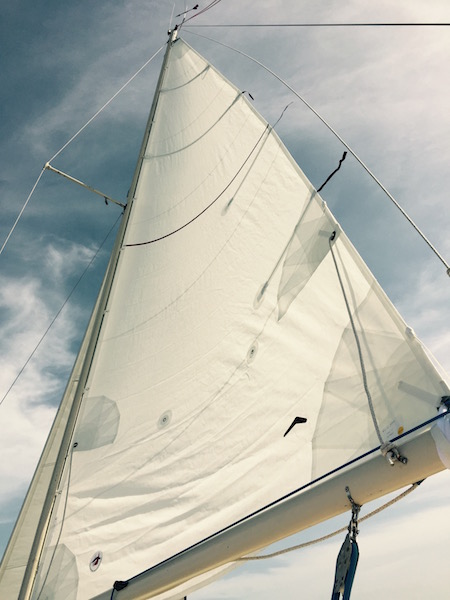

IMG_3512.jpg
IMG_3518.jpg
 
Aug 17, 2013
1,315
Pearson P30 202 Ottawa
I'm no expert but it sure can't hurt, I think it will help, but raising the sail more would help a lot as well, too bad you don't have a winch or any other mean to raise it more
 
Feb 20, 2011
8,062
Island Packet 35 Tucson, AZ/San Carlos, MX
I also plan on putting a 3-1 block arrangement on the boom downhaul to put on tension if needed.
:thumbup: You might be able to get away with even less mechanical advantage.
 
Nov 8, 2010
11,386
Beneteau First 36.7 & 260 Minneapolis MN & Bayfield WI
While its possible for them to mean other things, groups of parallel wrinkles normally indicate a stretch of the sail in that direction.

So the first thing I would check is to make sure you are raising the sail correctly, and see if they exist then.

To do so, ease EVERYTHING, vang, outhaul, cunningham and mainsheet. The first job is to get the sail up and luff tight without other controls pulling against it. There is no way you are adding noticeable stretch by hand on that length of warpspeed, but that's never the issue anyway. What you need to be able to do is raise it tight enough so you take true slack out, so the sail pressure is pulling against taunt line. That way the halyard can do its job and resist stretch from the sail loading up.

Once you are up and tight, add outhaul to shape the foot. Then you can sheet, and add vang and cunningham as needed.

EDIT - OH I see you have a boom downhaul. That might be too low. That would also cause the wrinkles for the reasons noted above. Raise it a bit and set it permanently. Then use a cunningham. Boom downhauls were not a great idea back in the day, and less so now.
 
Last edited:
Jan 1, 2006
8,008
Slickcraft 26 Sailfish
With regard to halyard tension, in looking at your sail it seems the draft position in the upper sail is far enough forward. So more halyard tension isn't needed or necessarily good. Remember the halyard tension is used primarily to move the draft of the sail forward and back. It's not to make the sail smooth although it will do that. In light air you can sail with a small amount of creases in the luff..
Your creases are in the foot of the sail seeming to begin at the last slide - those are slides, right? I would definitely rig a cunningham to try to remove them. Maybe adding another, lower slide would close the gap between the sail and the mast at the tack.
The top of the sail looks a bit deep in draft. Maybe some pre-bend would flatten that a little and help with the wrinkles. If you have an adjustable backstay it would be easy to play with that. You may have to slack the lowers a bit to allow the middle of the mast to move forward. After that I would bring the sailmaker down to the boat to see what he/she suggests.
Of course, while I'm writing this Jackdaw is probably using that nifty problem he has to create real numbers on draft and draft position. I expect he'll have some suggestions as will other posters.
We may even get a 10 page donny brook out of this which would nice after some of the dull threads of recent.
 

weinie

.
Sep 6, 2010
1,297
Jeanneau 349 port washington, ny
Draft is pretty far forward considering halyard tension may be less than optimal. Also leach looks tight too so I'm thinking poorly cut sail?
 
Nov 26, 2012
1,654
C&C 40-2 Berkeley
You really need to put the halyard on a winch. You are not going to get it tight without one. Also it looks like the topping lift holding the boom is a bit tight and it looks like the wrinkle is below the first sail lug which may be hanging up in the track.
 

Joe

.
Jun 1, 2004
8,323
Catalina 27 Mission Bay, San Diego
Have a sail loft install a grommet for Cunningham then rig the 3:1 assembly for that, instead of boom downhaul (not very effective with a loose foot mainsail).

Ease the topping lift so it will not be lifting the boom when sailing.
Ease everything else when hoisting.
 
Feb 26, 2004
23,353
Catalina 34 224 Maple Bay, BC, Canada
I agree with Joe, but have found that a 3:1 is not required. I used to have one, but the crappy Lewmar blocks disintegrated in the sun after a year and a half, so I simply ran a line from one side of the mast through the cunningham cringle and back down the other side aft to the cockpit. I have a 34 foot boat. That should be more than adequate for yours.

Your 25 footer should not need a winch for the main halyard.

Could a slug be caught somewhere lower down?
 
Nov 8, 2010
11,386
Beneteau First 36.7 & 260 Minneapolis MN & Bayfield WI
Guys,

He's got that loose cloth on the tack side because the leech is pulled so tight its supporting the sail, not the luff. Thats why the parallel wrinkles are there pointing up and in from the clew. The gooseneck is too high. The tack is higher than the clew.
 
Last edited:

Ward H

.
Nov 7, 2011
3,833
Catalina 30 Mk II Cedar Creek, Bayville NJ
EDIT - OH I see you have a boom downhaul. That might be too low. That would also cause the wrinkles for the reasons noted above. Raise it a bit and set it permanently. Then use a cunningham. Boom downhauls were not a great idea back in the day, and less so now.
He's got that loose cloth on the tack side because the leech is pulled so tight its supporting the sail, not the luff. Thats why the parallel wrinkles are there pointing up and in from the clew. The gooseneck is too high. The tack is higher than the clew.
Jackdaw, your comments about the gooseneck/downhaul seem contradictory so I am interpreting one of them incorrectly.
I do loosen the vang and main sheet before raising the main and I tighten the luff hard enough to pull the boom up tight against the down haul line that is tied off to a cleat. I didn't think about loosening the outhaul and will start doing that.
Could the sliding gooseneck be causing the tack cringle to be too far from the mast throwing off the luff alignment? I don't get those wrinkles when the main is reefed and the luff reef cringle is closer to the mast.

The topping lift does have some slack, just hard to tell due to angles but in the first pic you can see it bowed out a bit.


The sail was ordered on line and I made a mistake of not asking for the Cunningham cringle because I thought the adjustable gooseneck did the same thing. Hope the local sail maker doesn't mind putting one in after I decided to go with another supplier.
I appreciate the help!
 
Nov 8, 2010
11,386
Beneteau First 36.7 & 260 Minneapolis MN & Bayfield WI
OK let's try this. Ideally the tack and the clew of a sail should be under the same pressure when the sail is raised all the way and then trimmed. The wrinkle evidence suggests that yours is not. it suggests that the tack is higher than the clew, causing there to be excess sail area on the luff and not enough on the leech. That condition would cause those wrinkles. Now one of the ways that that can happen is the tack actually being higher than the clew. Normally that's not possible on boats but it is on boats with sliding goosenecks it is. Yours might be set too high. Another way to cause it is to raise the sail with the main sheet on hard. This causes the leech to harden up before the luff can. And finally, maybe the sail is just cut like crap! ;-/
 
Nov 8, 2010
11,386
Beneteau First 36.7 & 260 Minneapolis MN & Bayfield WI
PS - it is very easy to add a cunningham attachment to a mainsail. You can do it yourself with a length of nylon webbing and a hand stitcher that you can buy at a marine or camping store. Simply take a foot of the webbing and fold it in half; place it along luff near the bolt rope about a foot from the bottom of the sail. Leaving a loop down, sew it on heavily using multiple stitches. You can put a stainless steel ring on the loop if you want, but you really don't need it. That will work perfectly as a cunningham eye.
 
Last edited:

Ward H

.
Nov 7, 2011
3,833
Catalina 30 Mk II Cedar Creek, Bayville NJ
OK let's try this.
Now I get it. I will bolt the gooseneck in place to end the problem of it rising up.
The sail came from a Florida dealer who received high praise from many including a respected member of this forum and from a competitor who posted on this forum a while back. (one via email and the other on another forum)
Of course I was nervous it might be a crappy cut but now I have several things to try.

it is very easy to add a Cunningham to a mainsail. You can do it yourself
I didn't realize it would be that simple. That's what I will do.
Thanks for the tip!
 
Feb 26, 2004
23,353
Catalina 34 224 Maple Bay, BC, Canada
Now I get it. I will bolt the gooseneck in place to end the problem of it rising up.
Ward, before you do, have you tried simply to pull the sliding gooseneck down?

I'd do that and find the right spot before you bolt it in.

Good luck.
 

Ward H

.
Nov 7, 2011
3,833
Catalina 30 Mk II Cedar Creek, Bayville NJ
Stu, I've played with it some and pulling it down under more tension is why I thought maybe a 3-1 downhaul would work but it sounds like I should just lock it and use a Cunningham instead. I plan to fully raise the main then drop it a few inches to mark where to lock the gooseneck.
Thanks
 
Nov 8, 2010
11,386
Beneteau First 36.7 & 260 Minneapolis MN & Bayfield WI
Ward, Stu's (correct) point is the the goal will be to find the correct place and secure it there. One way is fix with hardware, the other with a soft downhaul. Secured and in the right place are the keys.
 

Ward H

.
Nov 7, 2011
3,833
Catalina 30 Mk II Cedar Creek, Bayville NJ
And the right place would be at a point that allows the proper tension on the luff by the halyard without the halyard shackle/knot bottoming out on the masthead sheave, correct?
The gooseneck/boom always settles onto a bottom stop and it rises up about 4 inches when I raise the main. It's travel is limited by a line to cleat to hold the tack cringle at the black strip.

But this discussion (Stu's point) does raise a good point. I never checked to see if the new sail might be topping out at the mast head. You guys are right, I might be allowing the gooseneck to come up too high. The gooseneck setting was fine for the old sail but I should have checked it with the new one. The few times I have tried putting tension on it were after I was under sail and other forces may be putting too much friction on the slide for me to pull it down tight enough.

How do I determine the correct height for the boom? If I raise the sail full height allowed by the halyard shackle when it tops out at the sheave, then pull down on the boom until taught, how much lower should I set the boom?
 

weinie

.
Sep 6, 2010
1,297
Jeanneau 349 port washington, ny
New sail.. ahhh!
Did you check with your sailmaker or did you use an online loft?
 
Nov 8, 2010
11,386
Beneteau First 36.7 & 260 Minneapolis MN & Bayfield WI
Ward,
The black bands are a start. If they are positioned correctly on the mast, a sail should fly BETWEEN them. The tape should be below the foot of the sail at the tack.

For sure the sail should not be so high it allows the main halyard to run into the sheave. That's bad for everything. But looking at your picture you are not there. I know you need more tension which will pull it up a bit, but most rigs are designed to allow room for the top of the sail to clear the backstay when tacking.

Again, loosen EVERYTHING and raise the mainsail, with the tack position set so it has the foot just above the back tape. The bolt rope should be quite taunt.

Adjust your outhaul to fairly tight, to flatten the foot.

The sail should hang naturally without any funny wrinkles

You can do the next check at the dock, but better sailing upwind in moderate breeze.

Trim on your mainsheet, and bring the boom to the centerline. There should be some slight twist to the main, and the top batten should be slightly to leeward relative to the boom.

Now go hard on the mainsheet. It will pull the clew a few inches below the tack, and the twist will be removed. The top batten should now be parrell with the boom.

If you can get all of this trim you're golden.