Need advice: Access Kenyon mast wiring

Brazil

.
Aug 16, 2017
26
Hunter 37C Forked River, NY
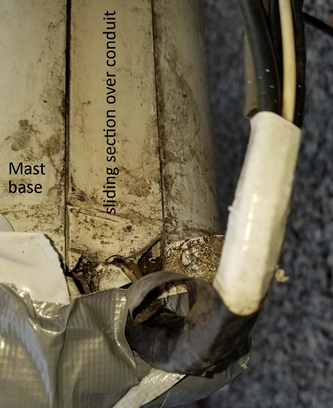
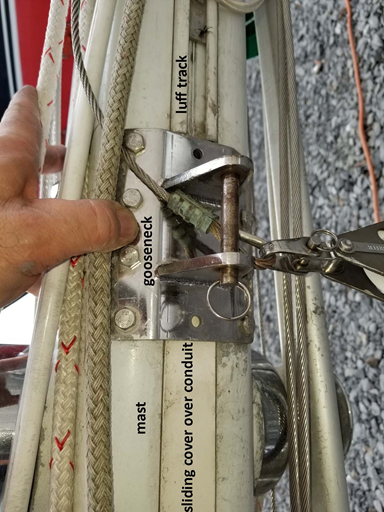
This regards a 1980 Hunter 37 cutter. Spreader lights and anchor light wires show open circuit, so I need to get at the wiring and repair or replace. My question is how to gain access. Based on Rig-Rite, I believe the mast is a Kenyon 6092. See attached pictures that show aft views of the area of the base of the keel-stepped mast, as well as the gooseneck. Wires run in a conduit just fore of the luff track. It appears that the flat track below the gooseneck will slide out the bottom. After removing the gooseneck, it looks like the luff track will also slide out. Before I start tearing into this, I wonder if any of you has any insight into the operation. Thanks very much.
upload_2018-5-7_21-26-15.png
upload_2018-5-7_21-31-7.png
upload_2018-5-7_21-31-35.png
upload_2018-5-7_21-26-15.png
upload_2018-5-7_21-31-7.png
upload_2018-5-7_21-31-35.png
 
Jan 11, 2014
13,994
Sabre 362 113 Fair Haven, NY
Not familiar with your mast section, however, typically the wires are run through the base of the mast and into the conduit. There is usually a hole near the base where the wires exit. A photo of the base of the mast, looking up the mast would be helpful.
 
Oct 26, 2008
6,432
Catalina 320 Barnegat, NJ
What is your goal? Are you attempting to pull new wiring all the way thru? I'm not sure why you would want to remove the gooseneck and slide the track out. If the wires are inside a conduit, that wouldn't seem to give you access anyway, unless I'm missing something obvious. Why wouldn't you simply pull all new wiring to replace all wiring, good and bad, while you have the mast down? Seems like the time to do it.
 

Brazil

.
Aug 16, 2017
26
Hunter 37C Forked River, NY
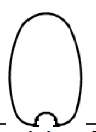
Maybe the configuration is unique to the Kenyon design. As shown in the drawing, there is not a separate tube for a conduit. Rather, there is about 300 degrees of a tube forming a channel to hold wires. The balance of the circumference is comprised of a track that slides in. In the photos, I have labeled those as sliding cover or luff track, depending on whether above or below the gooseneck. I am not adverse to entirely new wire. That is not my question. I am concerned that after many years of service, these covers might not slide off as easily as originally designed. The cap at the top of the mast is welded in place, with no apparent good access for pulling new. I understand that on some masts, this top cap is bolted, giving access. There may be an opening where the anchor light is attached, but it looks pretty small. The size of the channel forming the conduit is also pretty crowded, making a tight fit for pulling. I will get a better picture of the base of the mast next time I am at the boat. So, I would welcome advice on opening up that track. Thanks.
 

Johnb

.
Jan 22, 2008
1,505
Hunter 37-cutter Richmond CA
This is what the end of the mast looks like with the wires going in there. It is said to be possible to slide the luff track out of there. The other picture is the top end where the wires come out.
 

Attachments

Oct 24, 2010
2,405
Hunter 30 Everett, WA
I'm wondering if you could attach and use pull strings on the old wires to pull individual wires or as a group in. I'd hate to see it come partway then break something.

Ken
 

Brazil

.
Aug 16, 2017
26
Hunter 37C Forked River, NY
Turns out the 1980 Hunter 37 cutter has a Kenyon 5280 mast. The luff track slid out very easily, exposing the entire conduit channel. The track above the gooseneck is the for the sail slides, and is metal. The channel filler below the gooseneck is plastic. I replaced the old lighting untinned 16 gauge wire with Ancor 14/2, the old Navman wind instrument 20/5 with Ancor 20/8, and the old VHF RG 58G with Ancor RG 8X. All of these cables were somewhat larger than the originals, but they fit OK. I used WeatherPack connectors for the spreader lights, and will use them also for the connector beneath the cabin sole. Used the Shakespeare crimp connector for the VHF. Normally, I 'd prefer soldering the PL 259 connector, but I was concerned about melting the foam insulation of the RG 8X. In retrospect, since all of the lights are low current, I would have used 16/2 for the power lines and RG 8U for the VHF. It would get more power to the antenna, and I would have no issue soldering the large connector.

One of the reasons the old wire corroded, in addition to being untinned, is that the wires were led all the way to the base of the mast at the keel, so frequently wet. I have cut the plastic track to make an opening a few inches beneath the cabin sole, and left enough extra wire to make a drip loop while keeping all wires and connections at least 12 inches from the bottom of the bilge. This should also help make the new wiring last longer.

Thanks for your consideration.