

So goes a day in the life of me... Over the weekend I get a call from a customer, whom I have recommended do some much needed upgrading to the vessels charging, wiring and battery systems, that the batteries are dead.. To this customer it has always been, "they start the engine, so they're fine"..... I can only do what I can do and some customers don't seem to care much beyond "does my motor start"...
The Symptoms:
So the call comes in that the batteries will no longer start the engine and they need BOTH to get the diesel started, even after motoring for well over 6 hours on BOTH.. I told customer last year the batteries were beyond useful life and could fail at any moment but they still "started the engine" so they chose not to replace them.
The long and short of this story is that it cost $780.00 for a tow to get the boat from where they were to open ocean where the wind finally woke up and they could sail back to the mooring because after an overnight even BOTH would not work. They now have Sea Tow coverage...
What I Found:
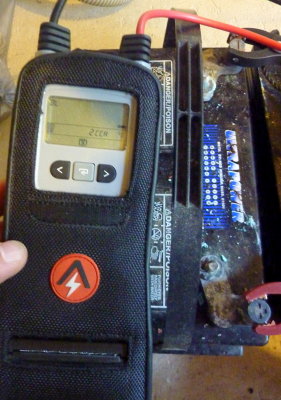
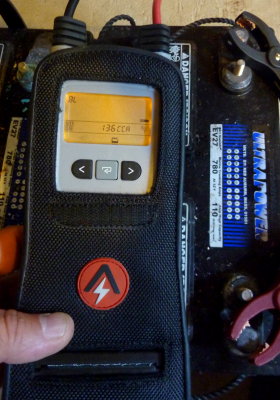
When I got to the boat yesterday and removed the batteries they tested as:
Start/Reserve = 167 CCA / Rated At - 575CCA
House #1 = 10.21V & 2 CCA / Rated At - 575 CCA
House #2 = 10.26V & 136 CCA / Rated At - 575 CCA
Testing:
By industry testing standards batteries are considered "dead" when they can no longer produce 80% of the original CCA rating. For these batteries this is 460 CCA which is 80% of 575 CCA. This does not mean they are actually "dead" but that they could fail at any moment and that batteries, once below 80% of the new CCA rating, can be very unpredictable..
Most boat owners do not have sufficient test equipment to determine a failed or failing battery so they use the "will it start the motor" test.
The problem with the "will it start" test is that with a large house bank of two or more batteries, or by using the BOTH feature as many do, they may still have sufficient cranking amps as a "bank" because when when you parallel batteries you also parallel or add up the available cranking amps. Despite being able to start the motor as a "bank" the individual batteries may be WELL BEYOND the safe useful life span. I see this nearly every day.
In a well designed system, which normally includes a battery monitor, properly sized wiring, proper voltages for charging as measured at the batteries, proper cycling behavior, solar or alternate means of charging when away from the dock other than just the alt, and properly sized, I can easily see run of the mill batteries at 4-7 years still producing 80% + of the new CCA rating.
In poorly designed and executed systems, like the factory Sabre system I need to work on today, I rarely see batteries beyond year two or three still producing 80% + of CCA, regardless of brand.
Other Contributory Issues:
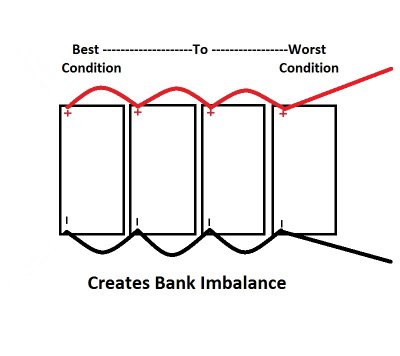
Up to year four the house bank on this boat was "end connected" meaning all charging and loads pulled off just one of the parallel batteries rather than across or through the bank. This leads to an unbalanced bank. If we look at the two house batteries above we can see how they became "unbalanced". The battery with 2 CCA was the battery that was connected to the system at the + & - posts. It saw the most use. The battery at 136 CCA was furthest away from the system connections and is in better shape as it saw slightly less use.
Up to year four this is how they were connected:
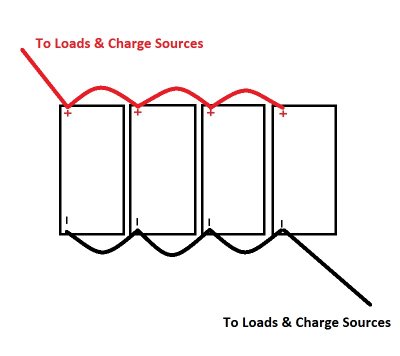
By the time the wiring was corrected it was already too late:
Charging Failing Batteries:
One of the biggest problems with batteries that are below 80% of new CCA is that they have formed hard lead sulfate on the plates. This sulfation drastically limits the amount of current that the batteries will take from a charge source or deliver, when needed, to loads. The snowball effect then takes over. Less accepted current, due to sulfation and a failing battery, means SLOWER charging and the cycle just continues to worsen. Yesterday the alternator was feeding these batteries less than 5A of charge current with all three batteries in parallel or BOTH, it then rapidly declined to just 3A within a few minutes.. So the customers 6 hour engine run theoretically pumped less than 20Ah's of charge into a 200Ah bank that was flat dead. Because of the "condition" this is all the current the batteries could take, even at just 10.3V!!!!
By contrast the new bank was at 12.6V when installed and the alternator was feeding it over 26A of charge current. Full for the new bank is around 12.72V.
Charging voltage:
Charging voltage is CRITICAL to a banks ability to charge. I measured the new bank when the the alternator was in absoption/voltage limiting mode. The alternator, as measured at the alternator output post or B+ was 14.38 to 14.41 V which is right where the internal regulator is set for. Even with just 5A of charge current passing thought the piss poor wiring the voltage at the battery bank was 13.6V. That is a voltage drop of 0.8V at just 5A... NOT GOOD. IF issues like this are not corrected the new bank will also suffer the same fate of chronic undercharging. This boat has the dreaded "ammeter circuit" which is causing the voltage drop issues and the owner is not ready to pony up to fix it after just spending $780.00 with Sea Tow and a new bank and lots of new cabling.
Voltage drop issues are one of the most common causes of short battery life in boats wired in "factory" fashion because the alternator "senses" itself, not the battery bank. The regulator then adjusts the voltage to itself and not what voltage the batteries are at..
What Can I Do?
1 - With the batteries taking less than 10A of charge current measure the voltage at the back of the alternator then measure it at the battery terminals. The voltage at both places should be within +/- 0.1V.
2- Have your batteries tested by a shop that uses industry standard capacitance testers like those by Midtronics or a pulsed load digital tester like the Argus 500. Old school carbon pile testers can work but the newer testers are considerably more accurate.
3- For a seat of the pants test separate the bank and test the individual batteries one at a time and see how they start the motor. Does it "jump to life" or is it sluggish to turn over? Is there a difference in the way the motor starts between BOTH, or the entire bank, and just one battery? If there is then your batteries are likely beyond "useful life"...
4- Connect house banks using the cross connection method shown above. The vast majority of battery "banks" are incorrectly connected and wired. My tester does not lie and I see this SAME scenario over, and over, and over again. Batteries cross connected are in much better balance than those "end connected". Just last night I measured a bank of 2k GEL batteries at 1000 CCA and 800 CCA. The 800 CCA battery was the "end connected" battery...
5- BUY A BATTERY MONITOR SO YOU CAN SEE WHAT IS GOING ON. In the whole scheme of things they are CHEAP.
6- Size your bank appropriately so you do not discharge below 50% of capacity. If you can add another battery to the bank for even shallower bank cycling. Shallower discharges lead to significantly longer battery bank life.
7- Check the water level and add distilled water when necessary.
8- Equalize wet cells when they need it or when the cells are out of balance as tested by measuring specific gravity.
9- Use a temp compensated "smart charger" if "plugged in" at a dock.
10- If your boat is mooring sailed add solar!!!
The Symptoms:
So the call comes in that the batteries will no longer start the engine and they need BOTH to get the diesel started, even after motoring for well over 6 hours on BOTH.. I told customer last year the batteries were beyond useful life and could fail at any moment but they still "started the engine" so they chose not to replace them.
The long and short of this story is that it cost $780.00 for a tow to get the boat from where they were to open ocean where the wind finally woke up and they could sail back to the mooring because after an overnight even BOTH would not work. They now have Sea Tow coverage...
What I Found:
When I got to the boat yesterday and removed the batteries they tested as:
Start/Reserve = 167 CCA / Rated At - 575CCA
House #1 = 10.21V & 2 CCA / Rated At - 575 CCA
House #2 = 10.26V & 136 CCA / Rated At - 575 CCA
Testing:
By industry testing standards batteries are considered "dead" when they can no longer produce 80% of the original CCA rating. For these batteries this is 460 CCA which is 80% of 575 CCA. This does not mean they are actually "dead" but that they could fail at any moment and that batteries, once below 80% of the new CCA rating, can be very unpredictable..
Most boat owners do not have sufficient test equipment to determine a failed or failing battery so they use the "will it start the motor" test.
The problem with the "will it start" test is that with a large house bank of two or more batteries, or by using the BOTH feature as many do, they may still have sufficient cranking amps as a "bank" because when when you parallel batteries you also parallel or add up the available cranking amps. Despite being able to start the motor as a "bank" the individual batteries may be WELL BEYOND the safe useful life span. I see this nearly every day.
In a well designed system, which normally includes a battery monitor, properly sized wiring, proper voltages for charging as measured at the batteries, proper cycling behavior, solar or alternate means of charging when away from the dock other than just the alt, and properly sized, I can easily see run of the mill batteries at 4-7 years still producing 80% + of the new CCA rating.
In poorly designed and executed systems, like the factory Sabre system I need to work on today, I rarely see batteries beyond year two or three still producing 80% + of CCA, regardless of brand.
Other Contributory Issues:
Up to year four the house bank on this boat was "end connected" meaning all charging and loads pulled off just one of the parallel batteries rather than across or through the bank. This leads to an unbalanced bank. If we look at the two house batteries above we can see how they became "unbalanced". The battery with 2 CCA was the battery that was connected to the system at the + & - posts. It saw the most use. The battery at 136 CCA was furthest away from the system connections and is in better shape as it saw slightly less use.
Up to year four this is how they were connected:
By the time the wiring was corrected it was already too late:
Charging Failing Batteries:
One of the biggest problems with batteries that are below 80% of new CCA is that they have formed hard lead sulfate on the plates. This sulfation drastically limits the amount of current that the batteries will take from a charge source or deliver, when needed, to loads. The snowball effect then takes over. Less accepted current, due to sulfation and a failing battery, means SLOWER charging and the cycle just continues to worsen. Yesterday the alternator was feeding these batteries less than 5A of charge current with all three batteries in parallel or BOTH, it then rapidly declined to just 3A within a few minutes.. So the customers 6 hour engine run theoretically pumped less than 20Ah's of charge into a 200Ah bank that was flat dead. Because of the "condition" this is all the current the batteries could take, even at just 10.3V!!!!
By contrast the new bank was at 12.6V when installed and the alternator was feeding it over 26A of charge current. Full for the new bank is around 12.72V.
Charging voltage:
Charging voltage is CRITICAL to a banks ability to charge. I measured the new bank when the the alternator was in absoption/voltage limiting mode. The alternator, as measured at the alternator output post or B+ was 14.38 to 14.41 V which is right where the internal regulator is set for. Even with just 5A of charge current passing thought the piss poor wiring the voltage at the battery bank was 13.6V. That is a voltage drop of 0.8V at just 5A... NOT GOOD. IF issues like this are not corrected the new bank will also suffer the same fate of chronic undercharging. This boat has the dreaded "ammeter circuit" which is causing the voltage drop issues and the owner is not ready to pony up to fix it after just spending $780.00 with Sea Tow and a new bank and lots of new cabling.
Voltage drop issues are one of the most common causes of short battery life in boats wired in "factory" fashion because the alternator "senses" itself, not the battery bank. The regulator then adjusts the voltage to itself and not what voltage the batteries are at..
What Can I Do?
1 - With the batteries taking less than 10A of charge current measure the voltage at the back of the alternator then measure it at the battery terminals. The voltage at both places should be within +/- 0.1V.
2- Have your batteries tested by a shop that uses industry standard capacitance testers like those by Midtronics or a pulsed load digital tester like the Argus 500. Old school carbon pile testers can work but the newer testers are considerably more accurate.
3- For a seat of the pants test separate the bank and test the individual batteries one at a time and see how they start the motor. Does it "jump to life" or is it sluggish to turn over? Is there a difference in the way the motor starts between BOTH, or the entire bank, and just one battery? If there is then your batteries are likely beyond "useful life"...
4- Connect house banks using the cross connection method shown above. The vast majority of battery "banks" are incorrectly connected and wired. My tester does not lie and I see this SAME scenario over, and over, and over again. Batteries cross connected are in much better balance than those "end connected". Just last night I measured a bank of 2k GEL batteries at 1000 CCA and 800 CCA. The 800 CCA battery was the "end connected" battery...
5- BUY A BATTERY MONITOR SO YOU CAN SEE WHAT IS GOING ON. In the whole scheme of things they are CHEAP.
6- Size your bank appropriately so you do not discharge below 50% of capacity. If you can add another battery to the bank for even shallower bank cycling. Shallower discharges lead to significantly longer battery bank life.
7- Check the water level and add distilled water when necessary.
8- Equalize wet cells when they need it or when the cells are out of balance as tested by measuring specific gravity.
9- Use a temp compensated "smart charger" if "plugged in" at a dock.
10- If your boat is mooring sailed add solar!!!


