Live Aboard

Jan 10, 2015
12
Hunter 27 Galveston
Ok, I admit it I could use some help! I want to sail to other countries and I have a 27 ft Hunter. What size boat would be recommended for my travels, this size or bigger. There will be 2 adults aboard, I've done short runs 20 days sails...
Help Please..
 
Jan 22, 2008
551
NorSea 27 Az., Doing the To-Do list
Zig,

Same size, different boat. ;)

Look into a Nor'Sea 27. Can go around the world, then trailer it in all 50 states and keep it in the driveway for free! :dance:

Been working for my wife and I for many years, Full time working, then full time cruising, then half time cruising - from the West Coast to the East, - - - Tampa area next. :D

Greg
 
Oct 24, 2010
2,405
Hunter 30 Everett, WA
In terms of size and amenities, only you will know what you can tolerate long term.

In terms of what boat is worthy of blue sea travel, that's a different question. What is your tolerance for risk? There are cases where the ocean throws more at you than you are able to deal with. The other side of that: Most crossings are a bit less eventful. There is a great range of what constitutes an ocean worthy vessel. As for me I'd begin by looking at what the manufacturer says about a boat and then go from there.

Ken
 
Jan 10, 2015
12
Hunter 27 Galveston
I've been told this 27 ft Hunter is a good blue water boat, but I think it might not be a bad ideal to get a 37 ft. I fee safe in mine but is bigger better
 
Jun 6, 2006
6,990
currently boatless wishing Harrington Harbor North, MD
I agree with the other posters, only you can tell how much 27' boating you are willing to take. On a related note there are some items that you do need to address;
water tankage, do you have enough or a water maker/rain chatchment to make the longest worst case passage?
fuel tankage and the ability to charge batteries, doing a loads-production-storage balance can your means of production support your loads (storage starts to factor in when you start using loads when you are not producing electricity). So do you have enough fuel to run the motor to charge the batteries if you don't have enough solar/wind/hydro to keep the batteries charged?
onboard storage of food, similar to water, do you have enough to stow away all the food you will eat between port calls?
A 27' is going to be tight on a long cruise till you can eat your storage areas free of food.
 
Jun 6, 2006
6,990
currently boatless wishing Harrington Harbor North, MD
and don't forget storage of spare parts

good luck
 
Jan 22, 2008
551
NorSea 27 Az., Doing the To-Do list
Zig,

Don't mistake size for safety. You said there will be two aboard. Size the boat so that the weakest member will be able to handle the boat - IN BAD WEATHER AND WITH NO ELECTRICITY. If you can't do that, the larger boat is less safe.

If you don't think a Nor'Sea can handle it, take a look at the Zacko's web page ( http://www.enezacko.com/ ). They have made many Atlantic and a Pacific crossing. There are a number of others who have gone all the way around in one.

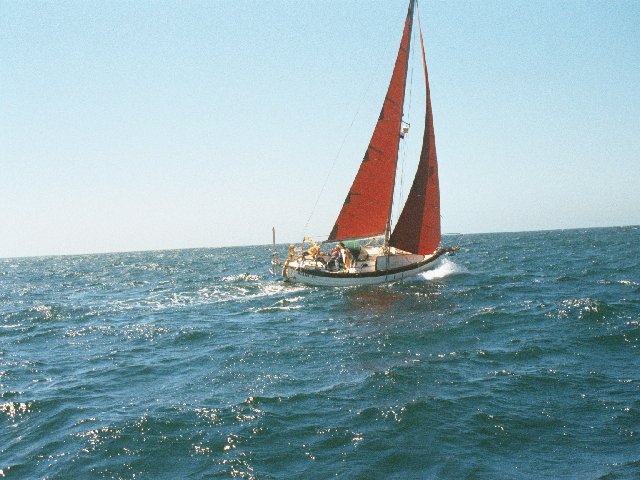
A quick shot of us going down the Pacific......


Greg
 
Feb 20, 2011
8,062
Island Packet 35 Tucson, AZ/San Carlos, MX
Zig,

Don't mistake size for safety. You said there will be two aboard. Size the boat so that the weakest member will be able to handle the boat - IN BAD WEATHER AND WITH NO ELECTRICITY. If you can't do that, the larger boat is less safe.

-snip


Greg
Very well put.
 

higgs

.
Aug 24, 2005
3,715
Nassau 34 Olcott, NY
The Hunter 27 is not designed for blue water sailing. It is intended to be a coastal cruiser. This does not mean it is not a good boat, but it means it is not as heavily built as the typical blue water cruiser. One could say the same for the Catalina 27, yet one has circumnavigated.
 
Nov 8, 2010
11,386
Beneteau First 36.7 & 260 Minneapolis MN & Bayfield WI
Zig,

Don't mistake size for safety. You said there will be two aboard. Size the boat so that the weakest member will be able to handle the boat - IN BAD WEATHER AND WITH NO ELECTRICITY. If you can't do that, the larger boat is less safe.


That's over simplistic. Good sailboat systems are designed for a 'human' effort. It's why bigger boats have bigger winches, higher power ratios on blocks, furlers, stackpaks, etc.

There is an old sailing saying; 'if it's too much work, you're probably doing it wrong'. That's as true on big boats as it is on small.

As a rule, biggers boats are safer. Higher stability and the speed to get you away from trouble.
 
Jan 22, 2008
551
NorSea 27 Az., Doing the To-Do list
That's over simplistic. Good sailboat systems are designed for a 'human' effort. It's why bigger boats have bigger winches, higher power ratios on blocks, furlers, stackpaks, etc.

There is an old sailing saying; 'if it's too much work, you're probably doing it wrong'. That's as true on big boats as it is on small.

As a rule, biggers boats are safer. Higher stability and the speed to get you away from trouble.
When I was in the military I flew on a 4 engine turbo prop aircraft, at that we were not always able to get away from bad weather. And on ANY sail boat, you better be ready for it! Bigger winches are needed, but as I said, if you NEED electric to run them, IT'S NOT SAFE!

Bigger is NOT always safer, as was pointed out in this (or another thread) the Titanic sank, and I dare say it was quite a bit bigger than any of us. ;)

Greg
 
Aug 22, 2011
1,113
MacGregor Venture V224 Cheeseland
John Kretschmer in Sailing A Serious Ocean says you don't always need a "blue water boat" to cruise blue water. Good reading.
 
Nov 8, 2010
11,386
Beneteau First 36.7 & 260 Minneapolis MN & Bayfield WI
When I was in the military I flew on a 4 engine turbo prop aircraft, at that we were not always able to get away from bad weather. And on ANY sail boat, you better be ready for it! Bigger winches are needed, but as I said, if you NEED electric to run them, IT'S NOT SAFE!

Bigger is NOT always safer, as was pointed out in this (or another thread) the Titanic sank, and I dare say it was quite a bit bigger than any of us. ;)

Greg
Turboprops and the titanic? You need better analogies!

Always is a funny word. Most things are never 'always' anything. But 'usually' works.

Biggers boats are usually more safe than small boats. And usually able to take you farther away from bad weather. And usually usable by normal sized people.
 
Jan 27, 2008
3,092
ODay 35 Beaufort, NC
A Pacific Seacraft would be nice, either a 34 or a 37, but they also made nice smaller boats that could handle most anything.
 

Joe

.
Jun 1, 2004
8,257
Catalina 27 Mission Bay, San Diego
Ok, I admit it I could use some help! I want to sail to other countries and I have a 27 ft Hunter. What size boat would be recommended for my travels, this size or bigger. There will be 2 adults aboard, I've done short runs 20 days sails...
Help Please..
Start researching other blue water sailors' experiences. Going offshore is serious business and you need to understand the additional challenges your boat must face.

Whether you modify your Hunter for these challenges or purchase something else... is ultimately your own decision... so it is paramount that you learn the basics.

There have been many successful circumnavigations in sailboats under 30 ft. Your first assignment would be to read up on Lynn and Larry Pardy....

At the same time I encourage you to read one of John Vigor's books:

http://www.amazon.com/Seaworthy-Off...TF8&qid=1421060279&sr=1-5&keywords=John+Vigor


Here's another very popular book by the same author:

http://www.amazon.com/Twenty-Small-...TF8&qid=1421060279&sr=1-4&keywords=John+Vigor

 
Oct 17, 2011
2,809
Ericson 29 Southport..
The Kon-tiki and the James Cairne also made it, but I would have to wonder if I were the one that wanted to do it ON these vessels..

A 37 foot boat, give or take no more than a couple of feet is about right for two people spending time on a boat such as this. Yes I know young adventuresome and bohemian personalities do it commonly. But do YOU want to spend several months cramped up in a small boat? I move boats for money, and it would take a damn bunch of it for me to say, take a twenty something boat to Bermuda. Unless you're just looking for bragging rights; and then a kayak will do..
 
Nov 17, 2013
5
Camper-Nicholson Nicholson 33 Port Orchard, WA
I would say that any boat that you can cope inside of, with simple rig sturdy enough for blue water crossings, safety gear that will keep you alive WITHOUT your boat, and an emergency beacon, provisions, etc. If you can fit it all in a 24 ft boat with a full keel and you have the experience and know your vessel then you should be fine. Of course there is a lot more to it than that.

Read blogs of sailors who have made crossings and learn from their mistakes. Watch their YouTube channels. Read every book you can get your hands on. Research the track record of the boat you intend to buy as far as how her sister-ships performed in a variety of situations. When you buy, sail her first and see if you can handle her by yourself. If you can, divide the effort by half and then your wife or a weaker sailor can sail it if you are incapacitated.

After you by the boat, sail it an do shake-down cruises to get familiar with her. If you are planning a circumnavigation, know that you don't have to have your own boat to do it as you can crew for others that have boats that are already insured and equipped to do it--gives you more experience on the open water. But when you go out on the big blue ocean, understand that the dynamics of it are considerably more profound than being in an estuary or off the coast. The farther from land the smaller the island you become.

Common sense is the rule governed by Murphy's Law. Even the most seasoned sailor can run into a harrowing situation. Even the stupidest ape can cross the North Atlantic in winter without incident. In other words, chance has a way of dealing interesting cards, it is how you play them that counts. If you feel safe on your boat and that you are going to have enough fresh water on-board to quench your thirst, food to sustain you and your crew, and confidence to weather hurricane force storms when hoving too, then you will be able to stay out on the water for long passages and enjoy the experience.

If any of this makes you feel apprehensive, then you are not prepared and despite how well equipped or sound your hull is, the deciding factor in living on a boat of any size on the open ocean is going to be YOU.

In conclusion, the size of your boat should accommodate the provisions and safety gear.

Your rig should not be over engineered to the point of complexity. It should be simple with all your lines leading back to the cockpit.

You must have jacklines from bow to stern, port and starboard.

You should have the ability to generate electricity by no less then three sources or means to do so.

You must have communication gear that is waterproof/submersible.

You should have good reefing systems accessible from the cockpit--especially if you are a solo sailor or have inexperienced crew.

You must know how to properly hove too.

I also recommend a boat with tiller steering, autopilot (both windvane and electric if possible).

Keep spare parts on-board for your inboard/outboard or other systems that will sustain you--like a watermaker.

I am sure that there are lots of other things but one thing you should consider is a radio with the AIS functions and ability to connect to the web with email through GPS.

I hope I answered your question with little to no emotion. Too many people that claim their boats are better because they are bigger or smaller miss the point entirely as they get red in the face and flustered. I've heard this conversation turn into an argument way too many times! Though it helps to have a large vessel for stability in big seas, smaller vessels have been proven time and again for being more than adequate if they are provisioned and equipped appropriately.

The boat is only as safe as her skipper--ultimately. If the skipper has weak crew-members on-board that are unable to handle the boat, that is on the skipper and not the weakest sailor. Why do you suppose that the Coast Guard and the US Navy hold skippers of civilian boats accountable as well as their own? Liability falls on the captain of said vessel. My many years of being a US Navy sailor has taught me that training everyone on-board is required. Everyone on-board must be an expert.

And before ANY skipper unties the lines to set out on a voyage across big seas, he must have a survival suit on-board--period.

This post is not intended to scare you, or anyone that reads it, but to put out there the reality of how potentially dangerous cruising the blue open water is.

One final note, and this may be in FAVOR of larger vessels: You should take into consideration how comfortable you want to be on the vessel in bad weather. Depending on the ocean and time of year, you may not experience extraordinary weather conditions. The fact is, most places that people cruise don't see a lot of fowl weather, it ends up being less than ten percent of the total cruising time. Sailors that have cruised for decades will tell you this also, the spending time on the open water is mostly calmer conditions with occasionally spirited sailing. But the hard part is that less then ten percent of the time when the weather is violent, or you are sick from motion. The smaller boat is going to get tossed about much worse than the latter. If you cannot handle the violence of the seas at their near-worst, then a smaller vessel is definitely not going to be what you want. Not everyone is going to experience "The Perfect Storm."

I hope that I have near-completely answered your question, based on my own experience and research. I own a Nicholson 33 and she out-performs any vessel I have owned. She also comes from a great pedigree/class of vessels from one of the finest yacht builders in the world. Quality of a boat cannot be substituted. It's like a car: a 3000.00 USD vehicle is gong to have much different performance and amenities than a 30,000.00 USD vehicle. Same is said for boats.

Fair winds and following seas!