Lightning Question

Status
Not open for further replies.

Ducati

.
Nov 19, 2008
380
Boatless Boatless Annapolis
Sometimes there is no way to get around it. You check the weather, plan your sail however it goes ugly and the skies go dark with the danger of lightning. Maybe trying to outrun is an option however the winds could die so the only option is to drop sails (quick) and motor.

Any other suggestions about what to do?

Cheers
 
Oct 29, 2005
2,366
Hunter Marine 326 303 Singapore
Make sure your insurance is paid up and call your wife, tell her you love her and might not be home for dinner. ;)
 
Jun 4, 2004
66
Hunter 30 Union Springs, NY
Find a cove, hunker down and remember that you have about as much chance of receiving a strike as the average person walking down the street. The admiral and I enjoyed a light show Saturday nite and then about 10 PM went swimming after it passed. Cooled off the water nicely!
 

Bob S

.
Sep 27, 2007
1,813
Beneteau 393 New Bedford, MA
Bruce,

My wife and I did the same Saturday Night. I was curious how safe it was to be on the boat during a strike? I agree the chances of a hit aren't high but it is still there. What a great summer (compared to last year). With all this heat thunderstorm happen.
 
Jun 6, 2006
6,990
currently boatless wishing Harrington Harbor North, MD
forehandedness

The art of prepairing before the bad thing happens. There is much that can be done to make a strike a non-event.
The new ABYC guide is to direct the lightning overboard to the water surface via electrodes at the water surface. this is a change to the old direct it through the cabin via mast to keel solution. I think this is great advice as having the lightning run through the cabin is not what I'd call a solution. Course you are going to have to do that before you encounter the lightning but that is what forehandedness is all about.
 

Ross

.
Jun 15, 2004
14,693
Islander/Wayfairer 30 sail number 25 Perryville,Md.
Re: forehandedness

Does this mean a copper plate boot stripe would be good?
 

Benny

.
Sep 27, 2008
1,149
Hunter 320 Tampa, FL
What to do? I take the wallet out of my pants pocket, grab a foul weather jacket, start the engine, furl the headsail, drop the mainsail and tie it down, look for a heading away from a lee shore and fix me a drink before the 40+ knot swirling wind gusts hit. Lightning I don't get concerned about as there is nothing I could do regarding that.
 
Oct 14, 2005
2,191
1983 Hunter H34 North East, MD
Last time I was caught...

out by a thunderstorm, I came to a halt, dropped anchor on a 7:1 scope and hunkered down in the middle of the Chesapeake Bay until the storm cell past. Fierce winds, close-by strikes, and deafening thunder -- thirty minutes it and a cold beer were both gone and I got under way again.
 

zeehag

.
Mar 26, 2009
3,198
1976 formosa 41 yankee clipper santa barbara. ca.(not there)
we sailed thru them--what can ye do but keep going --we were out 100 miles--lol---228 ft deep-out in the gulf off florida-the sailing was great!!! as it was night the lightning just lit the way occasionally--wild ride ....
 
Feb 6, 1998
11,760
Canadian Sailcraft 36T Casco Bay, ME
The new ABYC guide is to direct the lightning overboard to the water surface via electrodes at the water surface. this is a change to the old direct it through the cabin via mast to keel solution. I think this is great advice as having the lightning run through the cabin is not what I'd call a solution. Course you are going to have to do that before you encounter the lightning but that is what forehandedness is all about.
Bill,

You can't always believe what you read on the net.:doh: I don't know where you read that info but that is not what the 2010 ABYC E-4/TE-4 standard discusses. They may be discussing future changes in committee but as of yet they have not made any changes. In 2006 they dropped E-4 down to "T"E-4 status or "technical information report" status.

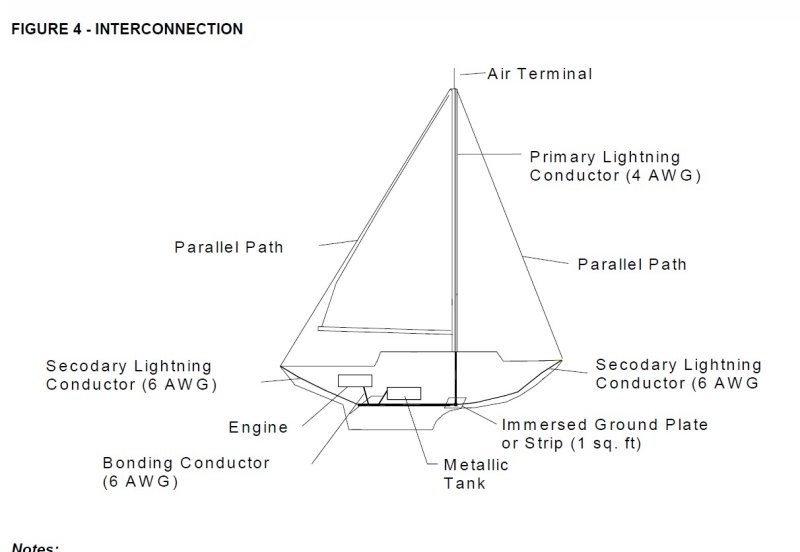
I am an ABYC member and know E-4/TE-4 fairly well and that is not how it currently suggests guiding a strike to ground. It still says strikes should come down the mast as straight as possible to a submersed keel or ground plate of at least 1 sq. foot using 4 AWG or larger type II wire. This plate must be as close to in-line with the mast as possible and a secondary plate or ground conductor can then be connected to that and to the engine or secondary items such as tanks etc.

Not saying this method is right or wrong but it is still stating what it has for many years.

This is the diagram they show for sailboats in the current ABYC E-4 / TE-4


walt

.
Jun 1, 2007
3,550
Macgregor 26S Hobie TI Ridgway Colorado
This article http://www.marinelightning.com/EXCHANGEOct2007Final.pdf
would tend to say that ABCY standards on lightning protection are under review and likely to change from what Mainesail posted.

I wonder if the ABYC standard points out that the method shown in the last post pretty much are useless in fresh water?

A quote:

The obvious organization to address these problems is ABYC, whose marine standards
form the basis for NMMA certification. In recognition of the above problems inherent in
its Lightning Protection Standard E-4, in its latest rewrite ABYC downgraded E-4 to a


Technical Report, TE-4
2. However, even when the standard E-4 existed, it was not

required for NMMA certification. During its latest revision cycle, the National Fire
Protection Association (NFPA) has taken on a comprehensive rewrite of their lightning
protection standard for watercraft based on the simple concept that the lightning
protection system on a boat should resemble that on a building. The NFPA standard is
reviewed on a four-yearly cycle by a committee of lightning protection professionals and
contains not only code language but also several informational annexes explaining the
2
underlying principles. The result in Chapter 8 of NFPA780-2008


3is a new watercraft
standard that is a major departure from the old.


walt

.
Jun 1, 2007
3,550
Macgregor 26S Hobie TI Ridgway Colorado
I would like to hear Mainesails or Bills take on the standards so don't want to derail that discussion.

But here are some interesting pictures showing what Bill is talking about. The pictures are real - I took them.

This shot is of a little "sailboat" in fresh water. The spark is created by a 10KV lab instrument with about a 10nsec rise time (used to simulate static discharge). You can see that the charge goes to the water surface and then spreads out in radial pattern at the water surface. The surface charge flow is likely still in the air just above the water surface


The shot below is the same configuration except the water is very salty (more than ocean water).


For salt water, the surface mechanism is likely the same. The charge still ionizes the air at the surface. However, surface charging of salt water is about 1000 times faster than for fresh water as well as it being maybe 1000 times more conductive so the radial patterns are much smaller.
 
Sep 20, 2006
2,953
Hunter 33 Georgian Bay, Ontario, Canada
Bill,

It still says strikes should come down the mast as straight as possible to a submersed keel or ground plate of at least 1 sq. foot using 4 AWG or larger type II wire. This plate must be as close to in-line with the mast as possible and a secondary plate or ground conductor can then be connected to that and to the engine or secondary items such as tanks etc.

Not saying this method is right or wrong but it is still stating what it has for many years.

But, lightning does not come down the mast, but goes up the mast and meets the lightning charge from the sky, if I recall the weather seminar we had in the spring...
 
Jan 27, 2008
3,092
ODay 35 Beaufort, NC
Scott,
I've heard this before also but have a difficult time with the concept. So not being an expert on lightning but having a little scientific background a few thoughts:
1. Lightning often flows between clouds and doesn't strike ground objects.
2. In the natural world energy always flows from high to low potential. This is a basic rule of science. Trying to do otherwise is the equivalent of a perpetual motion device, it is an abomination of the rules of physics.
3. If the ground is essentially free of charge (thats why we call it the ground) then it seems like the flow will go from a higher potential energy cloud to the ground.

Why don't we all just get really nice steel hulled boats and rest easy? The whole boat will then be our ground plate. A friend of mine just bought a schooner and has his steel boat for sale. Wonderful boat with great equipment.
 
Sep 20, 2006
2,953
Hunter 33 Georgian Bay, Ontario, Canada
Reread some of my notes, ( should have taken more ). Neg. charge from clouds looks for pos. charge on ground and attract each other. The "strike" is the connection of the two. The pos. charge reaches up to meet the neg. charge and kaboom, or something like that.

Other interesting note, you can tell if you or someone has become a potential target by tingling in your hair or even standing on end. Only thing you can do is get down in a crouch on the balls of your feet and tuck your head down and hope you become less of a target.
 
Sep 15, 2009
6,244
S2 9.2a Fairhope Al
Reread some of my notes

Other interesting note, you can tell if you or someone has become a potential target by tingling in your hair or even standing on end. Only thing you can do is get down in a crouch on the balls of your feet and tuck your head down and hope you become less of a target.
why not ware a plastic or rubber hat of some sort......

regards

woody
 
Jan 27, 2008
3,092
ODay 35 Beaufort, NC
Calling the ground positive and the cloud negative is just convention adopted by scientists for mathematical convenience. If you are saying that the ground (the earth itself ) is at a higher state of energy than the clouds then I have a hard time understanding that. It might be better to talk in terms of the clouds are at a much higher state of charge. Or maybe we should talk about voltages. If you could put a voltmeter between the earth and the cloud by convention you would attach the ground wire to the earth and the positive lead to the cloud and you would measure maybe a couple million volts potential difference right at the point where the lightning will propagate. If you are suggesting the voltmeter will read a negative voltage in this arrangement then lets reverse the leads. You will put the ground wire to the cloud and the positive lead to the earth. If the earth has millions of volts of electric charge in a local area then I'd be really surprised.
Calling the cloud negative is only because electrons themselves by convention are given a minus sign by the physicists.
Is my reasoning flawed???
 
Sep 25, 2008
615
Morgan 415 Out Island Rogersville, AL
The manual (1980 edition) that came with my boat (1980 Morgan 415 OI) recommends clipping one end of automotive jumper cables to the shrouds and to throw the other end of the cables overboard. I've heard of a charter boat captain that does this.

I've been holding off doing anything to my boat until I get further clarification. If I understand it correctly, I should connect a 4AWG Type II wire (or bigger) from my mast to the ground (dyna) plate on my boat (in effect grounding my mast and rigging)? And to do the same with my metal fuel and water tanks? I am on fresh water. It seems that in salt water that this would be a recipe for electrolisis in the terminals, lugs, wires, and turn buckles that keep the mast from falling on my head.
 

walt

.
Jun 1, 2007
3,550
Macgregor 26S Hobie TI Ridgway Colorado
This link described the "positive" upward header from a sailboat mast that connects up with the downwards negative bolt from the cloud

http://www.kp44.org/LightningAndSailboats.php

Quote from the link (see the area around figure 2)

As the negatively-charged stepped leader moves downwards, it induces a positive charge on the ground below. When the tip of the leader is about 30-100 yards above ground level, the induced positive charge becomes so concentrated that a new spark forms at the ground, as shown in Figure 2. This positively charged spark is the crucial process as far as the attachment to a boat is concerned. If it starts at the tip of a boat mast, then lightning strikes the mast. Unfortunately, there is no scientifically accepted technique to prevent this spark from forming.
One comment about this - what is a positive charge coming up from the mast. Normally positive charge would be associated with an ion. I believe the positive charge is still only electrons moving - it is not positively charged ions. Ie, you can have a positive charge propagation by having the electron of an atom driven in the opposite direction.

The formation of a positive streamer from the sailboat mast is also likely a water surface phenomena.
 
Jan 26, 2007
308
Norsea 27 Cleveland
Outrunning lightning doesn't seem practical. The scenario given has you out there with an approaching storm. The two leading theories, so far as I know, are to

1) shorten sail and heave to
OR
2) given the space, put out a sea anchor and run downwind

As for the lightning, I imagine each boat has more exposed locations, but any direct hit is likely to be devastating. If lightning strikes were numerous in the vicinity, perhaps a panne-panne would be in order.
 
Status
Not open for further replies.