Is this Wrong?

Aug 22, 2011
1,113
MacGregor Venture V224 Cheeseland
TopCat, consider going to a split lower backstay and using 2 wire blocks to squeeze them together //////snip ...............//////snip( percent of working load you don't want to exceed (15-20percent).
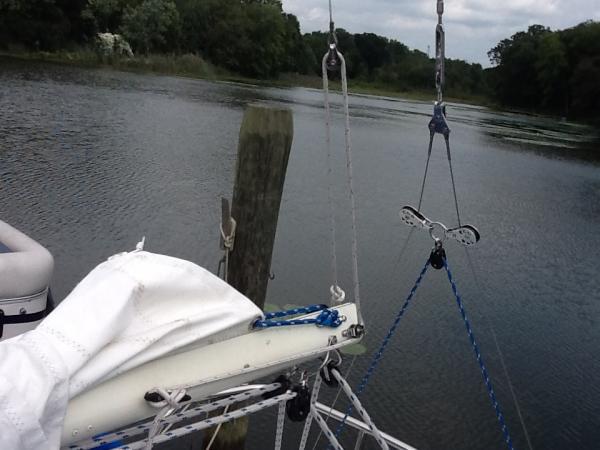
I am indeed considering it due to the comments in this thread.

But honestly I just don't understand the concern if the back stay lets go. So what? This boat and many others similar to it sail around for years with a seriously floppy backstay, in other words - it does nothing. I've seen it called "the boston strangler" on other Mac sites.

The only reason mine isn't still floppy is because I want to induce mast bend and I'm only bending the top few feet.....
 
Feb 20, 2011
8,062
Island Packet 35 Tucson, AZ/San Carlos, MX
I think Roger put that backstay there for a reason. Maybe to bend the mast, maybe to back up the shrouds, maybe both.
 
Apr 5, 2009
3,297
Catalina '88 C30 tr/bs Oak Harbor, WA
TopCat, you can get the redundancy that others are advocating with your system by shortening the length of the static line so that the moving block on the tackle is tight to the backstay block when fully released. That way, if you loose any component of the tackle system it will dead-end into the block on the backstay and maintain the minimum tension / max length as a single backstay. It will be off-center but many boats are designed that way (C42 for example) and the horizontal component is very small.
 
Jan 11, 2014
13,994
Sabre 362 113 Fair Haven, NY
This boat and many others similar to it sail around for years with a seriously floppy backstay, in other words - it does nothing
All the stays and shrouds work as a unit and balance each other. The back stay is important as the wind moves aft. The force on the mast will be forward from the pull of the jib or genoa. The back stay helps to keep the mast at the desired rake and prebend.

Downwind the there is very little pressure on the forestay, upwind there is little pressure on the backstay unless it is being adjusted to induce mast bend.

You might find these books helpful: Ivar Dedekam's book, Illustrated Sail & Rig Tuning and Brion Toss's book
The Complete Rigger's Apprentice: Tools and Techniques for Modern and Traditional Rigging, Second Edition

Toss's book is much more comprehensive than Dedekam's, but Dedekam is more practical. Toss spends time discussing the forces acting on the rig and why they are designed the way they are.