Interesting Solar Data Point

Status
Not open for further replies.
Feb 6, 1998
11,760
Canadian Sailcraft 36T Casco Bay, ME
So at 7:38am this morning we are anchored at Perry Creek on Vinalhaven Island, ME. I looked over from making coffee and noticed a net positive charge going into the battery bank. I then shut off the house loads to measure the solar performance and found + 4.3A of charge current from a 140W Kyocera panel and MPPT controller.. Not bad for 7:38 am, in Maine, an area most people assume has poor solar performance. Now, while typing, at 8:07 am it is pushing 4.5A - 4.6A...

While I have observed this before I've never thought to post it while it was happening..:)

BTW the data here is soooo slow it took me nearly 20 min to get this posted.. But hey you could not ask for a more beautiful spot to post from...:D
 

richk

.
Jan 24, 2007
495
Marlow-Hunter 37 Deep Creek off the Magothy River off ChesBay
What lies in the path between the sun and your panel may be key in this instance. (Solar and panel elevation angles are keys as well.) If the atmospheric path is particularly non-scattering and non-absorbing and solar output is constant (it isn't) then that may explain your observation.
 
Feb 6, 1998
11,760
Canadian Sailcraft 36T Casco Bay, ME
What lies in the path between the sun and your panel may be key in this instance. (Solar and panel elevation angles are keys as well.) If the atmospheric path is particularly non-scattering and non-absorbing and solar output is constant (it isn't) then that may explain your observation.
It is a fairly clear morning with minimal haze.. This is not abnormal behavior for this set up on a day like today... We also have a light West wind keeping the panel facing the East rising sun. It was/still is angled slightly towards the sun and mounted on davits.
 
Nov 6, 2006
10,216
Hunter 34 Mandeville Louisiana
I am amazed at 40-50% performance so early in the day.. Interesting .. Better to be sitting on a slow internet connection at anchor than sitting at home on a fast connection !!
 
Feb 6, 1998
11,760
Canadian Sailcraft 36T Casco Bay, ME
I am amazed at 40-50% performance so early in the day.. Interesting .. Better to be sitting on a slow internet connection at anchor than sitting at home on a fast connection !!

+100


Just made a short video at 8:58 am including GPS time, sunrise, GPS location, panel, sun height at 6.1A of net current to the bank..;)
 
Oct 2, 2006
1,517
Jboat J24 commack
I get smaller but similar results out of my 40 watt system with output very early in the day
 

walt

.
Jun 1, 2007
3,550
Macgregor 26S Hobie TI Ridgway Colorado
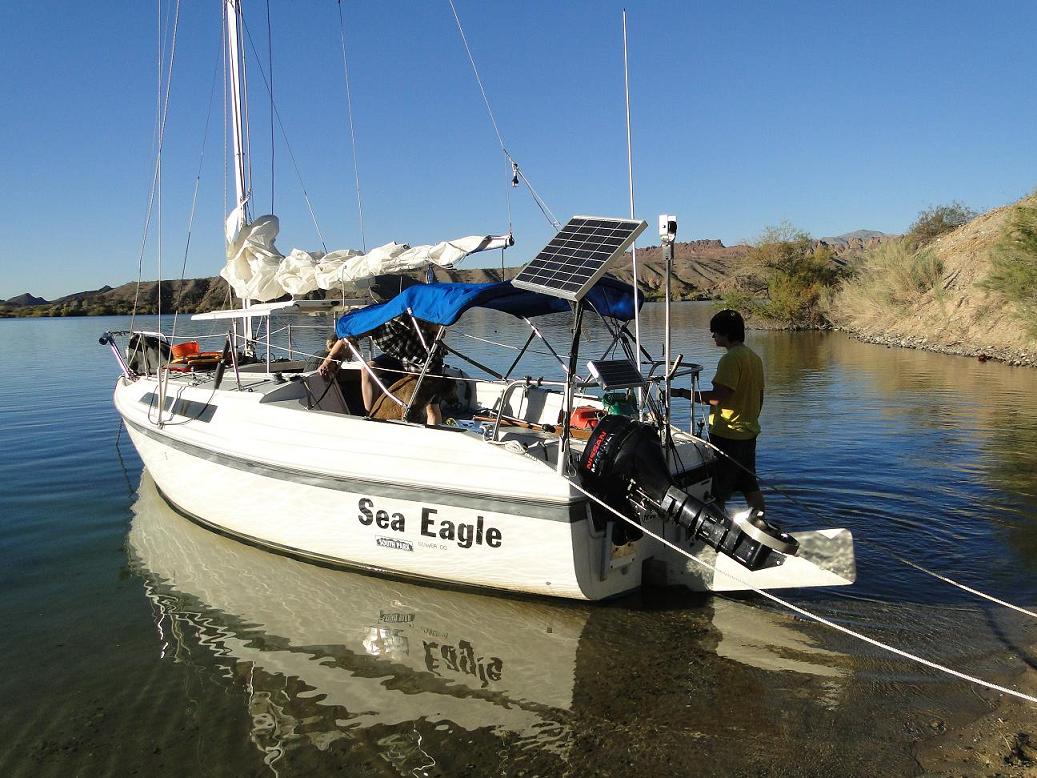
I can adjust both the azimuth and angle on this panel and even fairly early in the morning, I was measuring 70% of what the panel will give peak by pointing the panel at the sun. This was also near the end of March (in Arizona) when the sun is fairly low in the sky. My controller is a PWM type.

I think a panel sun tracking system would give significantly more power output benifit than MPPT does. Both tracking and MPPT would give even more. The cooler temps in the morning probably also contributed to what MS saw as the MPPT would work better.


njsail

.
Feb 18, 2010
216
Bavaria Ocean 40 CC Forked River
We have had a couple of Kyocera 135's and a blue sky MPPT for a few years now and I'm still surprised when I see them charging so early in the morning. I just smile and make coffee.

Walt - that's a cool setup. I like the solar on a pole. I wish I could get that close in and stand next to the boat.
 

walt

.
Jun 1, 2007
3,550
Macgregor 26S Hobie TI Ridgway Colorado
I hope I didn’t derail in the slightest Maine Sails post on fixed mount panels - hopefully we still get some video, data and pictures.

That is a small boat with fairly small power needs so I can get by with a small panel or no panel at all. So the articulating panel works fine since the panel is small (40 watts) and its easy to remove. Things have changed with that sailboat use for me over the years and I’m now and for the next few years just using that boat in the winter where the sun is low (Lake Havasu) so the large angle is handy.

On the larger boats that a lot of people on this forum have, fixed mount panels off the stern of the boat seems like the best option especially in the summer when the sun is high overhead. One thing I have wondered about "just a little" is that Florida would also be a good winter place to spend a lot of time on a sailboat. Florida is a fair amount farther South than where I’m at so maybe the angle of the sun just isn’t an issue there in the winter. I think that modern solar panels also work at fairly high angles of incidence to the sun. I also think that MPPT is often given too much credit for what you get out of a panel, you only get a maybe 7 to 15% boost depending on temp. 15% boost like you might get in the morning when its cool on very little power from the panel is still very little power.
 
Jun 28, 2005
440
Hunter H33 2004 Mumford Cove,CT & Block Island
walt;1050417[COLOR=#1c1d21 said:
I also think that MPPT is often given too much credit for what you get out of a panel, you only get a maybe 7 to 15% boost depending on temp. 15% boost like you might get in the morning when its cool on very little power from the panel is still very little power.[/COLOR]
I found the main advantage of MPPT is the ability to use Higher Voltage Panels which in larger sizes are cheaper, since they are produced in larger quantities for the housing market. I did not find any PWM controller cheaper than my Sunsaver MPPT that could handle a higher voltage panel, like mine. The other advantage of a higher voltage panel is the current from the panel to the controller, (the longer wire run) is halved for example with a 24 volt panel, from the current in the 12 volt circuit (the short wire run) the ratio is better for even higher panels. less current allows for less losses, and/or smaller dia wires which are easier to route than the fat ones, on my boat the solor run was ~27 ft, the short run 3 ft.
 

walt

.
Jun 1, 2007
3,550
Macgregor 26S Hobie TI Ridgway Colorado
Great points about the higher voltage and the lower current.

We all know the simple equations of P = V*I and V = I*R. If you re-arrange the terms a little and do some substitution, you get the power loss in the wire run is I * I *R (i.e., current squared times R).

So when you halved the current by doubling the voltage for the same power out of the panel, the power loss in the wire run dropped by four times. It adds up quickly in reduced copper needs.

Going from 12 volts to 48 volts results in 1/4 the current for the same delivered power. So the power loss in the wire run would be 1/16.
 
Status
Not open for further replies.