

Hunter 29.5 Midship Cleat
- Thread starter Driftin II
- Start date


jssailem
SBO Weather and Forecasting Forum Jim & John
- Oct 22, 2014
- 24,745
To be effective as a mid cleat used for docking and tying up to the dock with a spring line, you want to position the cleat about the center of the point of boat rotation.
This would be at the beginning of the keel. Here is a side view of your 29.5 Hunter. The Red line that I drew indicates where I would locate a mid cleat. I use the same technique on my boat, and the mid cleat works perfectly for docking safely single-handed.
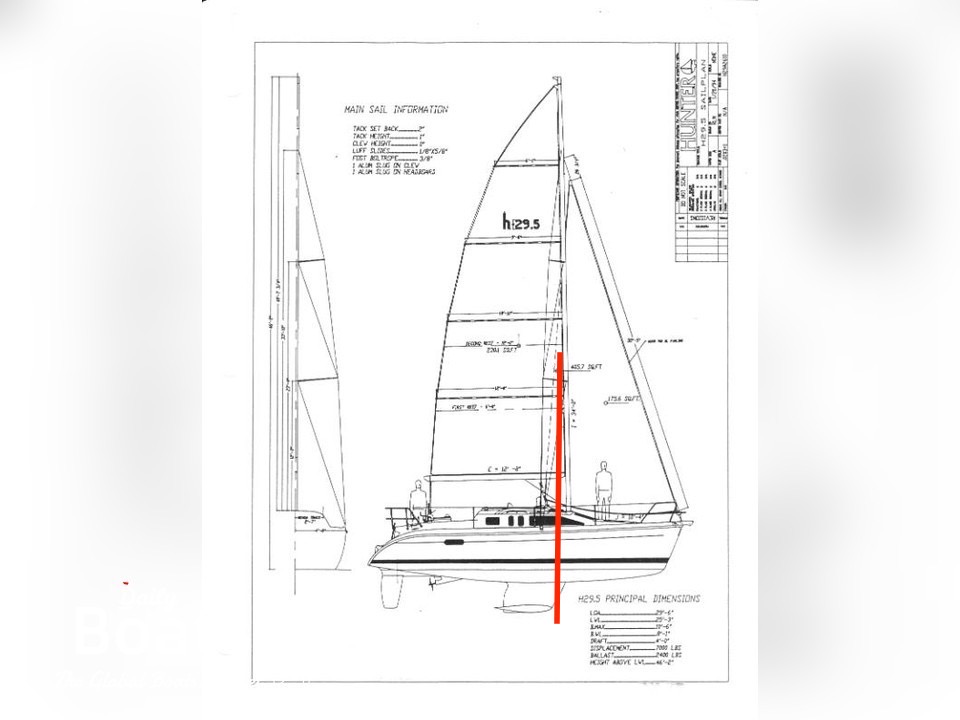
This would be at the beginning of the keel. Here is a side view of your 29.5 Hunter. The Red line that I drew indicates where I would locate a mid cleat. I use the same technique on my boat, and the mid cleat works perfectly for docking safely single-handed.


If it is for a spring line, it might be better to buy a good snatch block w/a silicon bronze snap shackle, and use it to fairlead back to a winch, or cockpit cleat. I've often used one on a chain plate, shackle, if you have one, or a shroud turnbuckle, below the threads. That way it can be rigged on either side and you have multiple points for the best fairlead.
jssailem
SBO Weather and Forecasting Forum Jim & John
- Oct 22, 2014
- 24,745
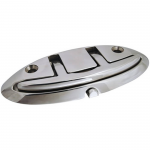
I used the base of my shroud with a soft-shackle initially, as suggested by @capta. Worked great. Eventually, I opted for a pair of Mid-deck cleats that fold down when not in use. They have been great for the past 7 seasons. If your goign to trust a deck mid-cleat, be sure that the cleat has a solid backing. You do not want to rip them out of the deck when trying to secure to the slip in a gale.


Different model boat, but here is what I did to add one to ours. https://hunter.sailboatowners.com/mods.php?task=article&mid=45&aid=7556&mn=42Asking for tips on where to add a midship cleat to my 1995 Hunter 29.5.

I can't see a cleat in post # 2 but I see a jib car track which makes me think something like this might work:

It's not
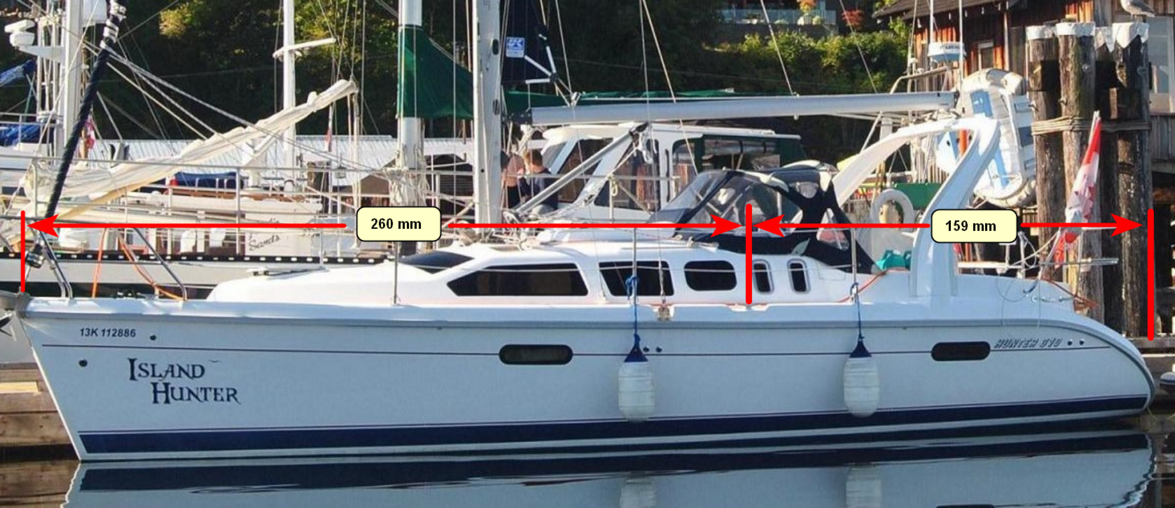
Or on a 31' boat, the mid cleat was installed by Hunter at (260/419) X 31' = 19' from he bow. This is also, thoereticaly speaking, the horizontal measurement to the centre of gravity (CG) of the boat. The vertical position of the CG does not come into play. I also find this position works perfectly for hauling the boat abeam.
If you heave on a boat abeam in calm water and want it to come directly to you without rotating, you want to pull through the CG. You are moving sideways so slowly that the influence of the keel is minor. Strong winds, different story. Strong current, different story. Design to the average conditions.
All very interesting but calculating the CG of the boat would be rather difficult to say the least. Seeing as you have the boat in hand (so to speak) there's nothing like trying to temporarily locate the position of the cleat in real life.
Close, but no cigar on that one. On this profile of my Hunter 310, the dimensions on my screen come out as shown :The Red line that I drew indicates where I would locate a mid cleat.
Or on a 31' boat, the mid cleat was installed by Hunter at (260/419) X 31' = 19' from he bow. This is also, thoereticaly speaking, the horizontal measurement to the centre of gravity (CG) of the boat. The vertical position of the CG does not come into play. I also find this position works perfectly for hauling the boat abeam.
If you heave on a boat abeam in calm water and want it to come directly to you without rotating, you want to pull through the CG. You are moving sideways so slowly that the influence of the keel is minor. Strong winds, different story. Strong current, different story. Design to the average conditions.
All very interesting but calculating the CG of the boat would be rather difficult to say the least. Seeing as you have the boat in hand (so to speak) there's nothing like trying to temporarily locate the position of the cleat in real life.
- Get a dock line about the length of your boat and tie a single knot in it about a meter from the end.
- Find the heaviest guy you know (maybe even your mother-in-law). Or, to avoid a confrontation, maybe get two people.
- Stand the boat off of the dock or finger with you on the dock.
- Have the heavy person(s) press the knot against the toe rail, roughly about midship, and stand on or near the knot to ensure the knot doesn't slip over the toe rail when the line is pulled.
- Have the person on the boat heave the line to you on the dock.
- (You) heave on the line and see how the boat approaches the dock or finger.
- Keep repositioning the line fore and aft until the boat comes in parallel to the dock regardless of how hard you pull.
Thanks for all the suggestions. My 29.5 doesn't have a jib car track on the deck, mine is located on the cabin top. (They Schaefer Mid Rail Cleats are great - I had them on our Catalina). Nor do I have a metal toe rail. So both those options are out. I hesitate to use a stanchion so I'll look closer at anchoring to the chainplate some how. Still open to any suggestions.
Yeah, a tough one. I liked the track cleat option.
I don't really like the chainplate option for several reasons. While the chainplate is a hardened location on the boat the loading cycles of a line to a dock could stress the components of the chainplate. 24/7/180 cycling is probably worse than a few hours sailing.
I still like @jsailem's suggestion of the collapsible cleat with backing plate. I don't think you need an overly beefy backing plate since loads on the cleat are mostly longitudinal and the bolts will handle that. Look at your other cleats and see what they have. I'm betting fender washers. Improve on that but no need to go crazy
I don't really like the chainplate option for several reasons. While the chainplate is a hardened location on the boat the loading cycles of a line to a dock could stress the components of the chainplate. 24/7/180 cycling is probably worse than a few hours sailing.
I still like @jsailem's suggestion of the collapsible cleat with backing plate. I don't think you need an overly beefy backing plate since loads on the cleat are mostly longitudinal and the bolts will handle that. Look at your other cleats and see what they have. I'm betting fender washers. Improve on that but no need to go crazy
Good point Lateral loading the chainplate is probably not a great idea. I was looking at collapsible cleats. Not sure exactly where I can mount them. The toe rail is part of the fiberglass molded deck, I'm not sure there's room on the toe rail for the cleat or backplate on the underside. A closer look is in order. Thanks

jssailem
SBO Weather and Forecasting Forum Jim & John
- Oct 22, 2014
- 24,745
When I first worked with using the spring line to aid in docking, I used a soft shackle to hold my dock line with a spliced loop to the main shroud. This aided me in locating the point on the boat to control the boat. I was not looking for the CG of the boat, I wanted the pivot point of the hull and keel. For my boat this is where the forward root of the keel connects to the hull. You can try using points along the rail, but I think you’ll want to locate the cleat on the deck.
The folding cleat is located when the black arrow is pointing.
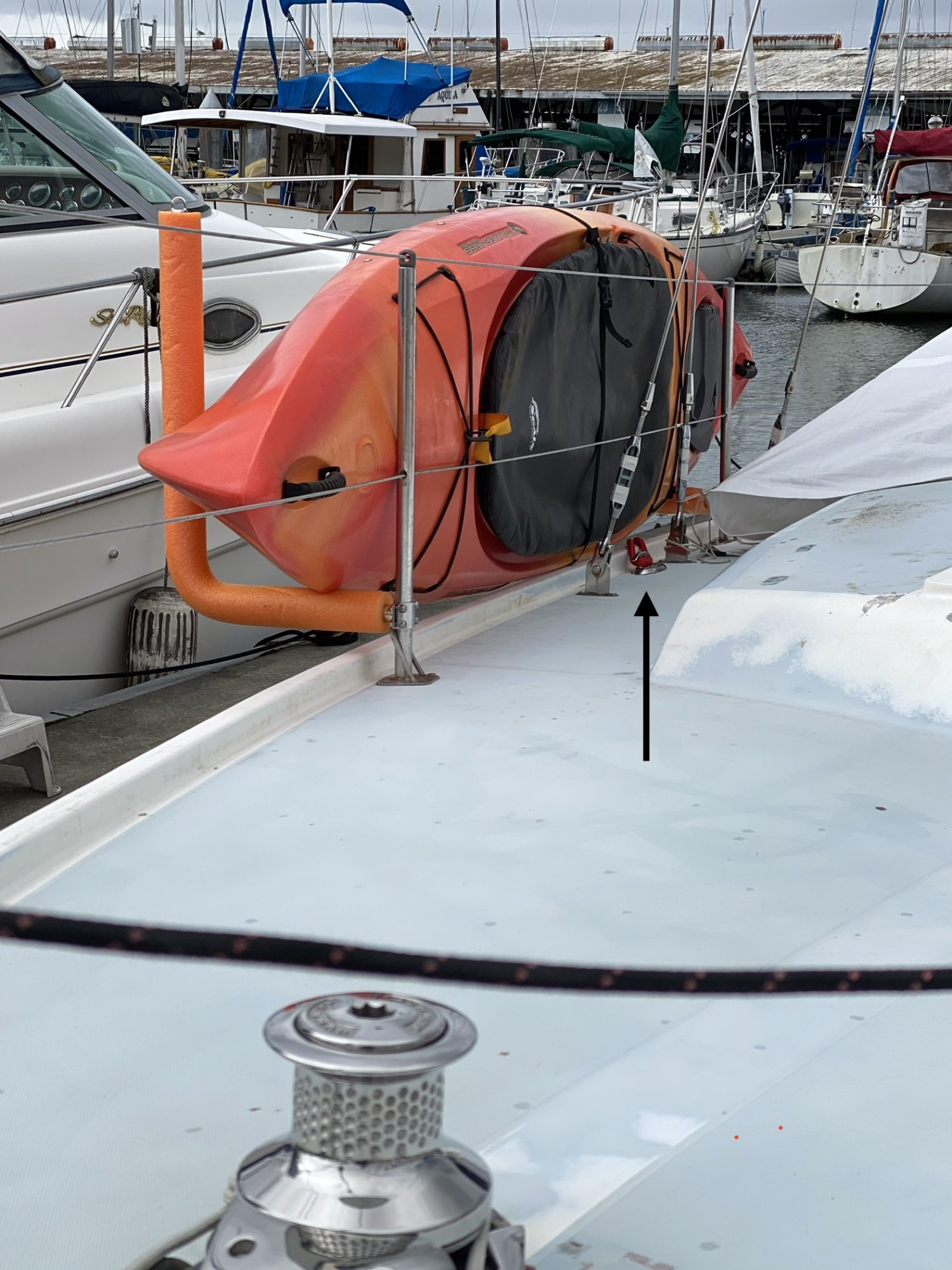
The folding cleat is located when the black arrow is pointing.