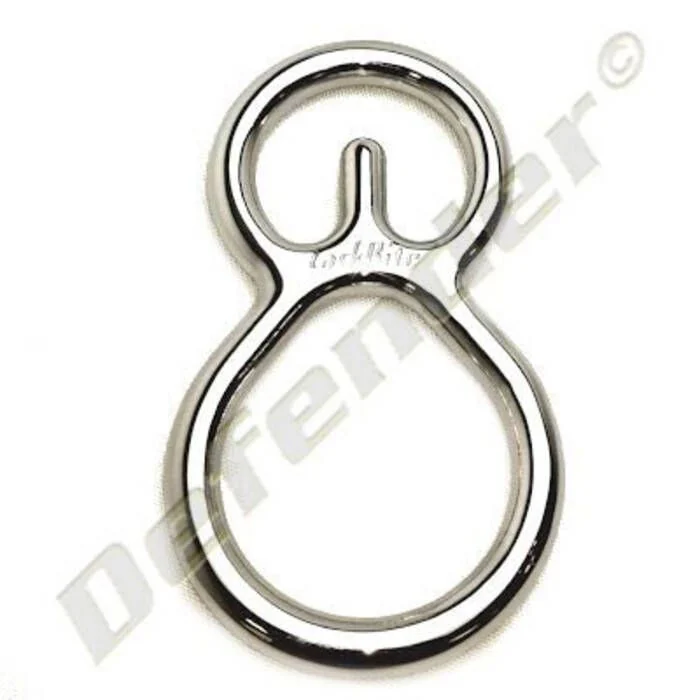
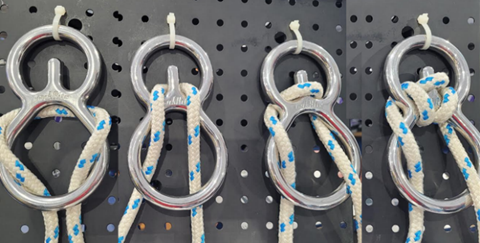
How best to use a TackRite

Sep 29, 2008
1,988
Catalina 310 #185 Quantico
I got one of these at the Annapolis Boat Show. On my Catalina 310, I have a traditional non loose footed main. It appears the best way to mount this to my boom is to put forward of the aft most bracket for my main sheet. I could either put a grommet on the boot of the sail or add one of those loopy things that is bolted into the boom. Thoughts? BTW, the sales guy sail the diagrams below are lowest resistance on the left to max resistance on the right (e.g. use as a preventer).

1795625181805.png
1795625992023.png
1795626088993.png
 

Attachments

Feb 26, 2004
23,546
Catalina 34 224 Maple Bay, BC, Canada
  • Like
Likes: capta
Sep 29, 2008
1,988
Catalina 310 #185 Quantico
Thanks Stu, Interesting read in your link. I will definitely have to take another look at how to rig it up. Ray
 
Mar 26, 2011
4,066
Corsair F-24 MK I Deale, MD
I have tested this and others. My quick advice is to either return it, or to bury it on a back shelf and mark it up to boat show sales education. I have two models on my will-never-use shelf.
Boom Brake Article

Second, this is for jibing, not tacking. An odd name.

If you do want to try it, take a deep dive into proper rigging. This is probably the best instruction sheet for this style:
Boom Brake Installation Guide

1795631128627.png


But don't expect it to actually allow smooth jibing. That is done by centering the boom by pulling in the sheet, and then releasing quickly but in control on the new jibe. There are several reasons that boom brakes don't work the way you think. I was able to fake it for a video, with careful adjustment (different for every 1-2 knots of wind change), but that's more work than just doing it right.
  • Presumably, the length of the line needs to remain constant through the jibe. That, in fact, is geometrically impossible.
  • If tight enough to control a jib, it will pull down on the boom like a vang, reducing twist more than desired. It is a sort of vang, pulling down, while restricting lateral movement.
  • The very idea of turning far enough to initiate a jibe, without pulling in the sheet, is absurd.
  • The tension must be adjusted for the exact wind force. More fiddling. Easier to pull the sheet in and center the boom.
  • More spaghetti on deck. In this case, spaghetti that doesn't help anything.
  • I have seen booms broken by boom breaks. Fatigue during a long passage.
The only possible use, IMO, is as a sort of weak preventer, intended to prevent the hardest slam. It would need to be released before jibing and then snugged down after. It would not prevent the jibe, only cushion the impact. Tightened enough to actually work as a preventer it would (a) pull the boom down too hard, preventing proper shape, and (b) potentially break the boom (has happened).

It might suit your sailing style. Probably most buyers have removed them.
 
  • Like
Likes: capta
Jan 11, 2014
14,299
Sabre 362 113 Fair Haven, NY
I can only restate what Stu and Thinwater have already emphasized, this is not a boom preventer, it will only slow down the boom as it crosses the center of the boat.

We have the Wichard version of this device and do use it. One big difference with the Wichard version is the line, it is elastic, more like a climbing rope than a low stretch marine line. This absorbs some of the shock from a jibe. We keep it on the lightest setting as our objective is to slow the boom down as it goes across in an unanticipated jibe which it does.

The boom is only one part of the equation, the line runs through a block on each side and then to a cleat in the cockpit. That block needs to be anchored to something and that something needs to be strong enough to withstand the forces developed in a jibe.
 

BrianQ

.
Jan 10, 2024
55
Hunter Legend 37.5 Havelock
As others have said, it's a bad choice as a jibe preventer.
Although I have found a use for a similar device. While at the marina I use a figure 8 descender, one intended for climbing, attached to the boom with a soft link with a line attached to the toe rail on each side to prevent the boom from swinging with the wind. With the descender attached I can leave the vang line and mainsheet lose. Don't know if that really matters but since I don't do much climbing anymore, I put an old descender to use. BTW, an anodized aluminum or stainless-steel descender can be purchased for $20 - $30 US.
 
  • Like
Likes: thinwater

capta

.
Jun 4, 2009
5,123
Pearson 530 Admiralty Bay, Bequia SVG
I couldn't for the world figure out how one could use that item for tacking, until the folks above mentioned jibing. I've very rarely used a preventer unless it is a long down wind run, as on a relatively short run one would expect to be able to steer w/o jibing for a short period.
As above, offshore, say on a TreansPac or TransAt, I've always run my preventer from the boom end outside everything to the forward chock on the side the boom is on. I often run a vang as well, to keep the boom from rising, secured to a fitting I installed on the boom directly above where the boom crosses the gene track on a dead run. That also helps flatten the sail so that it doesn't chafe on the rigging or spreaders. Pulled tight, I've never had that setup not keep the boom from swinging across the deck, but I have rarely had the wind backfill the sail, mostly on a vane gear or autopilot, swinging the boat around until the sail luffs. It can be pretty scary, but I've never sustained any damage from that unintentional maneuver. I prefer Dacron over nylon for both.
 
Mar 26, 2011
4,066
Corsair F-24 MK I Deale, MD
I can only restate what Stu and Thinwater have already emphasized, this is not a boom preventer, it will only slow down the boom as it crosses the center of the boat.

We have the Wichard version of this device and do use it. One big difference with the Wichard version is the line, it is elastic, more like a climbing rope than a low stretch marine line. This absorbs some of the shock from a jibe. We keep it on the lightest setting as our objective is to slow the boom down as it goes across in an unanticipated jibe which it does.

The boom is only one part of the equation, the line runs through a block on each side and then to a cleat in the cockpit. That block needs to be anchored to something and that something needs to be strong enough to withstand the forces developed in a jibe.
The choice of line is interesting in two ways.
  • They've been rigged with Dyneema, and something eventually breaks. The problem is that the length of the line, through the range of swing, varies. Work out the geometry. Thus, if the line is completely non-stretch, it will be slack (running free) for part of the swing) and will then catch. So some carefully calibrated amount of stretch is required.
  • Since the line tension is adjusted from one side, generally led back to the cockpit (must be, because it is frequently adjusted), that means the line on one side is at least twice as long as the other. That means one side will stretch twice as far as the other. This makes adjusting tension equally for both tacks basically impossible. Using polyester, there is still too little stretch. Using nylon, the variation from port to starboard is considerable.
If I were to use a boom brake, I would use it as a semi-preventer for when I have totally screwed up. I would jibe in the normal way (center boom), and then snug the brake down in case of an accidental jibe, to slow things down. I would not expect it to stop the jibe. I would still expect it to be ugly. But it should prevent a Chinese jibe and it should prevent breakage. It would mostly interest me if I were singlehanding a smaller boat on passages.

But I never liked them. One more complication, particularly when it's blowing. More spaghetti. My semi-method is to use the traveler, to always lock it down in the end position when reaching deep, and because I sail multihulls, never let that much sheet out (the sail will just hit the shrouds anyway). If I do jibe, the boom will not move that far because it is constrained. It won't even reach the CL and the impact is low. I can then either steer back or ease the traveler, bring the jib across, and sail on that tack for a while. Less to fool with. For a controlled jibe, I brong the sheet in, center the traveler or even slightly past, and then jibe. Easy, low impact.
 
Jan 11, 2014
14,299
Sabre 362 113 Fair Haven, NY
The choice of line is interesting in two ways.
  • They've been rigged with Dyneema, and something eventually breaks. The problem is that the length of the line, through the range of swing, varies. Work out the geometry. Thus, if the line is completely non-stretch, it will be slack (running free) for part of the swing) and will then catch. So some carefully calibrated amount of stretch is required.
  • Since the line tension is adjusted from one side, generally led back to the cockpit (must be, because it is frequently adjusted), that means the line on one side is at least twice as long as the other. That means one side will stretch twice as far as the other. This makes adjusting tension equally for both tacks basically impossible. Using polyester, there is still too little stretch. Using nylon, the variation from port to starboard is considerable.
If I were to use a boom brake, I would use it as a semi-preventer for when I have totally screwed up. I would jibe in the normal way (center boom), and then snug the brake down in case of an accidental jibe, to slow things down. I would not expect it to stop the jibe. I would still expect it to be ugly. But it should prevent a Chinese jibe and it should prevent breakage. It would mostly interest me if I were singlehanding a smaller boat on passages.

But I never liked them. One more complication, particularly when it's blowing. More spaghetti. My semi-method is to use the traveler, to always lock it down in the end position when reaching deep, and because I sail multihulls, never let that much sheet out (the sail will just hit the shrouds anyway). If I do jibe, the boom will not move that far because it is constrained. It won't even reach the CL and the impact is low. I can then either steer back or ease the traveler, bring the jib across, and sail on that tack for a while. Less to fool with. For a controlled jibe, I brong the sheet in, center the traveler or even slightly past, and then jibe. Easy, low impact.
At least for the Wichard brake the line is roughly equal on both sides of the boom because the brake hangs just in front of the vang and goes to the side deck, in our case the chainplate. Because the brake is close to the mast the swing is much smaller.

I find the brake most useful when going downwind with a following sea in under 12 knots. As the boat comes off a wave it some times will slew off course a bit towards a jibe, the brake slows the boom down enough to let me steer the boat to prevent a jibe and softens the slamming back.