Help me understand this Circuit Breaker/Switch Panel

Sep 30, 2025
173
Catalina 22 Davis Hollow - Lake Arthur
I'm new to wiring my own panels and little confused. I'm looking at this Blue Sea Systems 4321 Circuit Breaker Switch Panel and cant understand how it has breakers in it? Does each on and off rocker switch on the front, actually turn on/off 4 separate breakers each time you turn something on and off? If so don't breakers get weak and wear out when used regularly?

Take it easy on me in new to this... just trying to understand how it all works.

Thanks!!!
 
  • Like
Likes: Timm R Oday25
Oct 26, 2008
6,432
Catalina 320 Barnegat, NJ
Yes. Each switch is a separate 15 amp breaker. Some might say the breakers could wear out, but I can't imagine that you would be wearing out the breakers. I'm not sure this panel would be the best application for you without knowing what your electrical needs are. These breaker switches are pretty standard in boating applications.
 

Lazy1

.
Aug 23, 2019
194
Ericson 35-3 Erie PA
These breaker switches are commonly used as on/off switches for things like nav, steaming, anchor lights among other things. I would expect on a c22 you would have at least 6-8 different breaker circuits.
 
  • Like
Likes: Timm R Oday25
Jan 11, 2014
13,951
Sabre 362 113 Fair Haven, NY
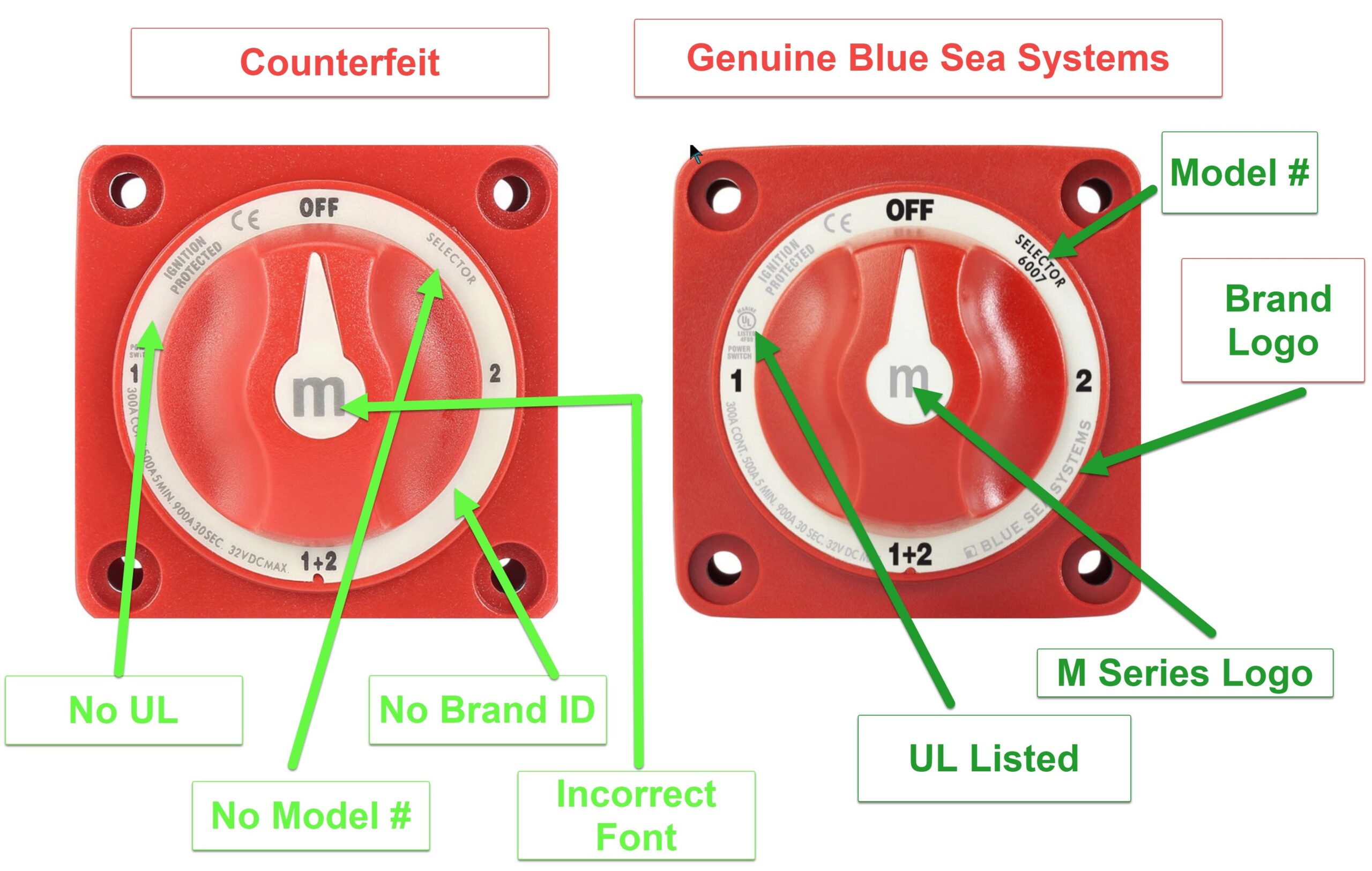
Be careful about purchasing electrical supplies from Amazon. Many of them are knock-offs of lesser quality. You'll pay a little more at Defender.com however you will be getting the genuine article.
 
  • Like
Likes: Timm R Oday25
Oct 26, 2008
6,432
Catalina 320 Barnegat, NJ
Be careful about purchasing electrical supplies from Amazon. Many of them are knock-offs of lesser quality. You'll pay a little more at Defender.com however you will be getting the genuine article.
I've never found that to be a problem with Amazon. I've never, ever unexpectedly received a knock-off product and I've always been able to verify the source for any purchase I've ever made on Amazon, and I've sourced quite a few products to take advantage of the shipping.

You can always find multiple sources (within Amazon) from whom to purchase for any listing as well (and I have learned to be a bit more discriminating). The only time I had a problem with an electronic purchase was when I bought a B&G VHF radio that was programmed with the EU channels. The supplier (definitely a questionable supplier) didn't have a clue about the products they were selling, but at least B&G rectified the problem without any difficulty.
 
Jan 11, 2014
13,951
Sabre 362 113 Fair Haven, NY
I've never found that to be a problem with Amazon. I've never, ever unexpectedly received a knock-off product and I've always been able to verify the source for any purchase I've ever made on Amazon, and I've sourced quite a few products to take advantage of the shipping.

You can always find multiple sources (within Amazon) from whom to purchase for any listing as well (and I have learned to be a bit more discriminating). The only time I had a problem with an electronic purchase was when I bought a B&G VHF radio that was programmed with the EU channels. The supplier (definitely a questionable supplier) didn't have a clue about the products they were selling, but at least B&G rectified the problem without any difficulty.
Last week I ordered some syringes for an epoxy project. The ad showed Monoject 412 images. I"ve used that brand before and liked them. The ones I received said "Monoject 412" on them in a different font and were definitely not the same as the ones I liked.

There have been reports about switches and circuit breakers being labeled as Blue Sea products which in reality are cheap knock offs.

 
  • Like
Likes: Timm R Oday25
Sep 30, 2016
429
Island Packet IP 44 Ventura, CA
There are circuit breakers and circuit breaker switches. Besides all the electrical specs you would expect on a breaker the switches are rated for considerably more on-off cycles compared to a regular breaker. Cant remember exactly, but probably an order of magnitude greater number of cycles.
 
Nov 6, 2020
552
Mariner 36 California
I've never found that to be a problem with Amazon. I've never, ever unexpectedly received a knock-off product and I've always been able to verify the source for any purchase I've ever made on Amazon, and I've sourced quite a few products to take advantage of the shipping.

You can always find multiple sources (within Amazon) from whom to purchase for any listing as well (and I have learned to be a bit more discriminating). The only time I had a problem with an electronic purchase was when I bought a B&G VHF radio that was programmed with the EU channels. The supplier (definitely a questionable supplier) didn't have a clue about the products they were selling, but at least B&G rectified the problem without any difficulty.
Mainesail has documented some and has images of knockoffs on his website. I agree i do the same and usually will only order electrical on Amazon from the manufacturers who usually sell on Amazon now, or a reputable seller.

Ha! I see Dave posted the link. Missed that.
 
Last edited:
Nov 6, 2020
552
Mariner 36 California
There are circuit breakers and circuit breaker switches. Besides all the electrical specs you would expect on a breaker the switches are rated for considerably more on-off cycles compared to a regular breaker. Cant remember exactly, but probably an order of magnitude greater number of cycles.
I believe its 10,000 cycles for the toggle switch type of breaker. Not sure about the op's panel he linked though.
 
Sep 30, 2025
173
Catalina 22 Davis Hollow - Lake Arthur
Great All good stuff to know. I understand it now.

So If all of those are 15 amp breakers... And I have a circuit with a piece of gear, say that only needs 5 amps... Would I still use the 15 amp breaker, but have to additionally wire in a 5 amp fuse somewhere in the circuit?

If so what do you recommend and where would that fuse be placed?
 
Jan 11, 2014
13,951
Sabre 362 113 Fair Haven, NY
The breakers should be sized to the wire size, not the device. So, a 15 amp breaker will be fine so long as the wire size can handle the current. You will need to get familiar with Ampacity tables and Voltage drop tables, the resources below will help you understand them.

Charlie Wing's book Boat Owners Illustrated Electric Handbook (Amazon Link) is an excellent resource. See if you can find a used copy, a new copy is kind of expensive.

This free ebook from Victron is a good resource for learning the basics about boat wiring.

 
  • Like
Likes: CrispyCringle
Oct 26, 2008
6,432
Catalina 320 Barnegat, NJ
Many devices need a fuse for protection. For instance, your chartplotter may require a 5 amp fuse. Remember, the breaker ampacity protects the wire. The fuse protects the device. Typically, the instructions and diagrams for electronic gear will require a fuse and the devise is sold with an on-line fuse holder and may also include the fuse. You would install the fuse holder on the wire between the breaker and the electronic component, typically close to the electronic device. The holder usually is made with a feature that allows you to fasten the holder to something solid so it isn't just floating around in a nest of wire.

Most boats will have multiple fuse holders, one for each piece of gear that calls for a fuse. On older boats you will find the glass fuses but more often now they would be ATC fuses, like what you see in automotive. Don't worry, not everything needs to be fused. None of my lights, fans and other stuff are fused, only the electronics that are sensitive to current spikes.
 
Last edited:
  • Like
Likes: CrispyCringle
Oct 26, 2008
6,432
Catalina 320 Barnegat, NJ
Think of it this way. Breakers protect the wires. You don't want the wiring to burst into flames in the hidden recesses of the boat due to over current. So the breaker should prevent it. If you have a multitude of devices ultimately being fed to the breaker via one wire, then you should make sure that the wire is suitably-sized for ALL the devices to be on at the same time. This commonly occurs where lights are all connected to one breaker. Lights don't produce much current so it is norma for a 15 amp breaker to be suitable for a grouping of cabin lights with small wires - say 16 awg. But multiple lights going up the mast joined with a common ground may create an over-current situation when all are on and 16 awg may be too small due to voltage drop on long runs. 10, 12, or 14 awg may be the correct wire size depending on the boat. In this case, the breaker should be sized for the safe/anticipated current when all devices are on. On small boats, it's hard to image a circumstance where any breaker greater than 15 amp is necessary, so that is why these panels are built with 15 amp breakers - they are the most common. If you need a breaker with higher ampacity, you can simply exchange it because they are interchangeable.

Sometimes, or maybe even often, a single device such as a chartplotter will be on its own breaker. However, the chartplotter needs to be protected to 5 amps. It seems silly to put the chartplotter on a 15 amp breaker when a smaller breaker is suitable. But you already have the breaker in the panel. Besides, maybe you are going to put more electronics and radios on the same breaker. You still need to protect the chartplotter. So that is why you install the 5 amp fuse next to the chartplotter. The wiring is safe and so is the chartplotter.
 
  • Helpful
Likes: jssailem
Jun 9, 2008
1,844
- -- -Bayfield
In your diagram it shows a main inline fuse from the battery positive side to the switch panel. That lead goes to the right bar (plate) and makes that whole bar positive. You can see another bar to the left of that. It is the negative bar which goes to the negative side of the battery. In each of those switches there is a small light. Those lights need both negative and positive leads to make the light work. That's all you really need to know about that. But how it works, is when the switch is in one position, it creates a connection so the light goes on and in the opposite position the light goes off because that connection is broken. In the schematic example, all the various loads (VHF radio for example), has the dotted line going from the unit to a buss bar to the right of the battery. These are the negative leads. Rather than each unit's negative wire going to the negative post on the battery, they go to that common buss bar and then only one wire goes from there to the negative battery post.
A VHF Radio (and other loads - but not all) usually have a dedicated in line fuse (or a fuse holder in the back of the unit) on the positive side. These are now shown in that diagram. But you will realize this when you open the package as they are usually included. They usually are small fuses with lower amperages to protect the unit. The breaker switches will be 15A as mentioned in the specifics. If whatever you are attaching to the switch panel requires a smaller amperage fuse (as a VHF radio would), then it is important to also put that fuse before the radio on the positive side. Fuses do not go on the negative side when it comes to 12v. If we were talking AC breakers, then they break both positive and negative sides at the panel. The two round outlets are already wired up and if you look closely, you can see where the wires go. The yellows are negative and the reds are positive. Nothing to do there. Someone mentioned to be careful buying stuff from Amazon. The product, in this situation is a Blue Seas product and Blue Seas is an excellent company that makes great quality products. It is not something Amazon made or an off brand.