Heat Exchanger zinc swells

Status
Not open for further replies.
Feb 26, 2004
23,353
Catalina 34 224 Maple Bay, BC, Canada
1) Hopefully the extra layer will reduce chance of shafe damage to the underlying hose (but adds some risk hiding possible splitting/cracking damage); and 2) If the tape wears through, the resulting black spot (the hose color) against the yellow would be readily noticeable upon inspection.

... is to mark spots on my dock lines at the cleat once every so often when the boat is centered as I like it in my slip. Then each time I return from a sail, I just adjust each line until the tape mark is just off the cleat. Outcome is perfectly centered each time with no fuss.
1. Good idea with the tape. A colleague suggested using extra hose, rather than tape, at those positions, but your idea has great merit.

2. Why not just leave your dock lines on your dock? Then you have a lot less work when you return to your own slip. It's an "automatic center-er!" Even less fuss... I know, I know, you need the dock lines when you go somewhere else. I've heard it all before: just buy some more dock lines - Xmas is always just around the corner.:):):)
 
Feb 6, 1998
11,760
Canadian Sailcraft 36T Casco Bay, ME
Maine im curious...why paint it...why not leave it all purdy copper?

Cause purdy copper won't stay purdy for very long unless of course you like the color of the statue of liberty on your engine.......;)
 
Mar 5, 2008
58
Beneteau 43 Alameda
Exchange frequency

Good thread. I'll be checking my pencil zincs with much greater frequency than in the past.

I am mystified in my case about what causes the pencil zinc in my heat exchanger to sacrifice so quickly. Just checked it yesterday (about 3 months new) and all that was left was some grey goo in the brass fitting into which the pencil zinc threads screw. The boat floats in saltwater 365 days a year. My heat exchanger is external to the engine -- mounted on a bulkhead. It has no metal connection or bonding to anything else. The bronze seawater intake strainer does not have a zinc and after many years, shows absolutely no sign of corrosion. Likewise the bronze seawater pump (mounted on a bracket attached to the engine and powered by a crankshaft belt) hasn't corroded through the years either. I don't connect my boat to shore power. The prop and shaft zincs are still in relatively sound condition after about a year. Any guess why HX zincs sacrifice so quickly? One thought I have (with no confidence of its significance) is that sea water does drain out of my HX when the engine is shut down, but before I close the seawater seacock. But water will remain pooled in the pencil zinc's fitting well ... while the upper part of the zinc will be exposed to air. Maybe this sets up a galvanic differential? Or as MaineSail has pointed out, a heat exchanger has soft metals such as solder and copper. Maybe the zinc sacrifices quicker than it does when protecting bronze and SS. Should I try bonding the HX to the engine for a while and see if that helps?

thanks in advance for opinions

regards,
rardi
Rardi, my Westerbeke HX has a big bold label on it to "Replace Monthly" next to the zinc. I thought I could stretch it to two months but it looks like I'll be on the monthly schedule. its seems strange that some have zincs that dont fit, bottom out, etc.. mine fits well, I just can't get the zinc back out..So much for standards.

Mac
 

Bob S

.
Sep 27, 2007
1,813
Beneteau 393 New Bedford, MA
Question for Mainesail

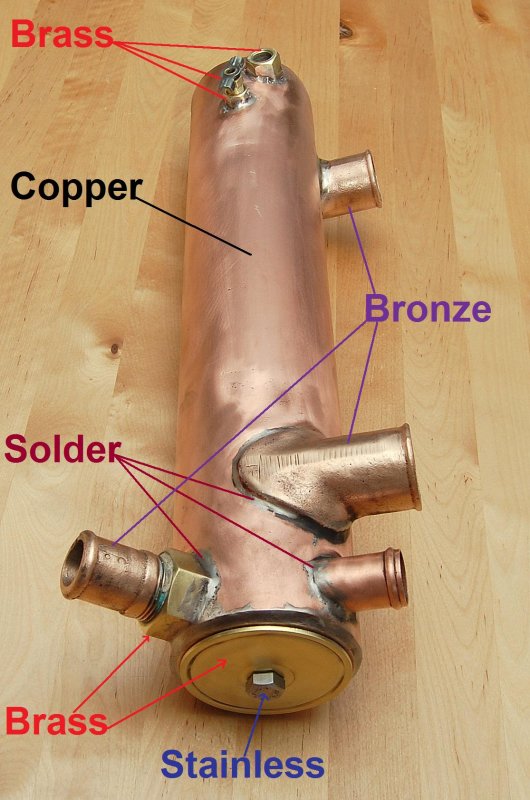
I was at the boat today changing out my fuel filters. After inspecting the HX I noticed the mounting bracket cracked and pulled away from the body. I decided to pull the whole thing off and will send it out to a radiator shop for cleaning. At first I thought the bracket was welded until I saw the unit is copper. Now I assume it's silver soldered. I started to search the archives and kept coming back to this thread. Your cleaned/polished HX looks great!:dance: Did it come back from the radiator shop like that? If not, how did you get it so clean? I wire wheeled some corrosion off but yours looks like all the other parts of your boat! :)
Do you think it would be safe to try soldering the bracket back or is this something the radiator shop should do? Silver solder requires a lot of heat and I'm afraid heating the bracket would compromise what's inside. Do you know if these are soft soldered or silver soldered?
Last question!
Would you recommend priming before painting it. I bought some engine paint from a local auto parts store.
 
Feb 6, 1998
11,760
Canadian Sailcraft 36T Casco Bay, ME
HX..

I was at the boat today changing out my fuel filters. After inspecting the HX I noticed the mounting bracket cracked and pulled away from the body. I decided to pull the whole thing off and will send it out to a radiator shop for cleaning. At first I thought the bracket was welded until I saw the unit is copper. Now I assume it's silver soldered. I started to search the archives and kept coming back to this thread. Your cleaned/polished HX looks great!:dance: Did it come back from the radiator shop like that? If not, how did you get it so clean? I wire wheeled some corrosion off but yours looks like all the other parts of your boat! :)
Do you think it would be safe to try soldering the bracket back or is this something the radiator shop should do? Silver solder requires a lot of heat and I'm afraid heating the bracket would compromise what's inside. Do you know if these are soft soldered or silver soldered?
Last question!
Would you recommend priming before painting it. I bought some engine paint from a local auto parts store.


The radiator shop just boiled it and pressure tested it with a light, but meaningless, sand blasting that removed about 10-20% of the finish. I simply took it to my bench grinder with a brass wire wheel and it was clean in about 10 minutes.

I would let the radiator shop fix it or buy a new bracket from Hansen. Some M-25 had them brazed on and others used a clamp on style. If I remember the old 2" HX's were brazed and the newer 3" style (if yu don't have this one it's a good idea) had an optional clamp on bracket. I have not owned an M-25 in a few years so perhaps one of the other guys could be more clear on the brackets.

For priming/painting I used three thin coats of a zinc chromate primer then Westerbeke factory spray paint..
 

John

.
Jun 3, 2006
803
Catalina 36mkII Alameda CA
A different idea

Good thread. I'll be checking my pencil zincs with much greater frequency than in the past.

I am mystified in my case about what causes the pencil zinc in my heat exchanger to sacrifice so quickly. Just checked it yesterday (about 3 months new) and all that was left was some grey goo in the brass fitting into which the pencil zinc threads screw. The boat floats in saltwater 365 days a year.

QUSTION:
I asked about this once before and it was rejected out of hand, but I'm still not convinced: As far as I understand, what allows the galvanic corrosion is not water, per se, but salt water. Combine this with the fact that even those who use their boats most frequently probably have it floating at their dock at least 50% or more of the time. So, wouldn't it save a lot if the hx had fresh water in it when not in use?

It seems to me there would be a fairly simple way to do this: Put a "y" at the raw water intake and a small length of hose at one of the "y" ends. Fill a bucket with fresh water, put the hose in the bucket and run the engine long enough to draw out all the water before shutting the engine down. Then you'd have fresh water sitting in the hx instead of the salt water doing its thing.
 
Feb 6, 1998
11,760
Canadian Sailcraft 36T Casco Bay, ME
Good thread. I'll be checking my pencil zincs with much greater frequency than in the past.

I am mystified in my case about what causes the pencil zinc in my heat exchanger to sacrifice so quickly. Just checked it yesterday (about 3 months new) and all that was left was some grey goo in the brass fitting into which the pencil zinc threads screw. The boat floats in saltwater 365 days a year.

QUSTION:
I asked about this once before and it was rejected out of hand, but I'm still not convinced: As far as I understand, what allows the galvanic corrosion is not water, per se, but salt water. Combine this with the fact that even those who use their boats most frequently probably have it floating at their dock at least 50% or more of the time. So, wouldn't it save a lot if the hx had fresh water in it when not in use?

It seems to me there would be a fairly simple way to do this: Put a "y" at the raw water intake and a small length of hose at one of the "y" ends. Fill a bucket with fresh water, put the hose in the bucket and run the engine long enough to draw out all the water before shutting the engine down. Then you'd have fresh water sitting in the hx instead of the salt water doing its thing.
Galvanic corrosion of dissimilar metals also occurs in fresh water all be it to a slightly lesser extent. This is why water heaters also have anode rods..

Here's why they dissolve quickly..


P.S. Westerbeke & Universal motors have a sticker right on the HX that says "Check Zinc Monthly". If you are going to check it, why not just replace it at the same time. Engines are expensive zincs are cheap..;)
 
Jan 3, 2009
821
Marine Trader 34 Where Ever I am
I regards to salt water verses fresh, in salt water you would use zinc, in fresh water you would use aluminum or magnesium.
 

RichH

.
Feb 14, 2005
4,773
Tayana 37 cutter; I20/M20 SCOWS Worton Creek, MD
......Anyone have experience on this, explaination or solutions?........
Metallic Zinc is 'oxidized' by the galvanic action which forms Zinc Oxide. Zinc Oxide has less density (less mass per cubic volume) than metallic zinc hence the apparent 'swelling'. When the mass of zinc changes to zinc oxide is 'volume' gets larger as the density become less.

The same 'swelling' or density loss is noted when iron oxidizes to (red) ferric oxide .... rust. Incidentally this is why you want your encapsulated iron keel totally watertight and the iron ballast not turn to rust ... as this will 'push apart' the encapsulating fiberglass as the density of the iron/iron oxide becomes less and the pressure against the containment fiberglass becomes extreme.
 
Status
Not open for further replies.