Each time I try to replace my exchanger zinc on my Westerbeke aux, I can't get it out as the zinc portion seems to have swelled or formed some precipitate that makes it larger than the hole. Anyone have experience on this, explaination or solutions? Its a pain to pull the exchanger apart each time to retrieve the zinc so it doesn't foul or damage the exchanger. I'm in a slip on shore power. I try to pull the zinc every two months and will have to consider moving the schedule up but would really like to understand why its getting bigger and not dissolving.

Heat Exchanger zinc swells
- Thread starter mac1840
- Start date
- Status
- Not open for further replies.

Is it a pencil zinc?
Is the zinc screwed into a brass older?
If it is, make sure the zinc is screwed into the brass collar completely and the whole assembly is screwed into the exchanger completely so it makes good contact.
I assume that not only the zinc swelled but also it is soft.
On my Catalina 30 the exchanger zinc sometimes swells and sometimes just evenly erodes but it usually takes about 9 months.
You have stray current somewhere attacking the metal.
I would also carefully watch the rest of the zincs on the boat.
Galvanic action is open to a large debate. How to stop it. Bonding, galvanic isolators, etc.
Good luck.
Is the zinc screwed into a brass older?
If it is, make sure the zinc is screwed into the brass collar completely and the whole assembly is screwed into the exchanger completely so it makes good contact.
I assume that not only the zinc swelled but also it is soft.
On my Catalina 30 the exchanger zinc sometimes swells and sometimes just evenly erodes but it usually takes about 9 months.
You have stray current somewhere attacking the metal.
I would also carefully watch the rest of the zincs on the boat.
Galvanic action is open to a large debate. How to stop it. Bonding, galvanic isolators, etc.
Good luck.

This should help
This is a post I made a while ago hopefully it will help. I address zincs at the near the bottom of the post. If you change them more often and you won't be leaving chunks in the HX...
HX's are one of those things that many boaters find mysterious but they are in fact quite simple and easy to work on, especially the cylindrical type as used on Universal and Westerbeke engines. A marine HX is very much like a cars radiator. Rather than cooling the engine antifreeze with air passing across aluminum fins, the marine HX uses raw ocean or lake water run through copper tubes. This raw water is doing, and serving, the same purpose as the air does on an auto radiator.
This is the basic anatomy of a HX. There are two sealed water loops or circuits in this tube, a fresh water side (engine antifreeze), and a raw water side (lake or ocean water):
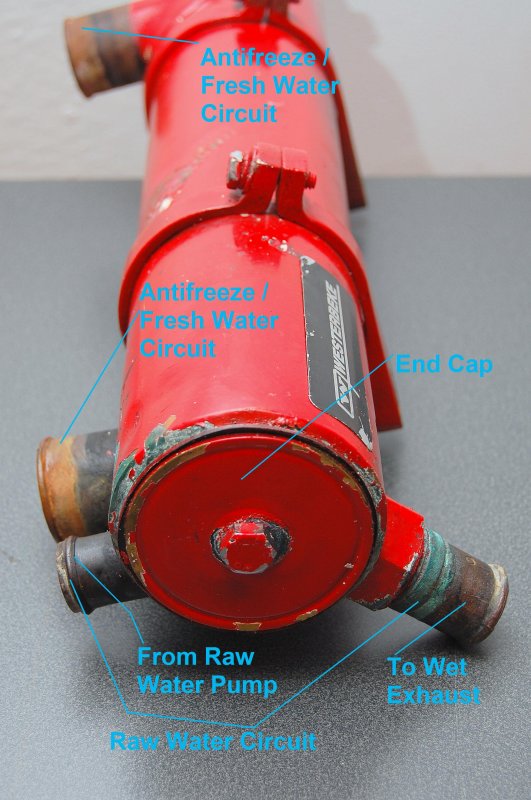
To see inside simply remove this bolt and pull the cover plate off (this can usually be done on board if you have access and a closed seacock):
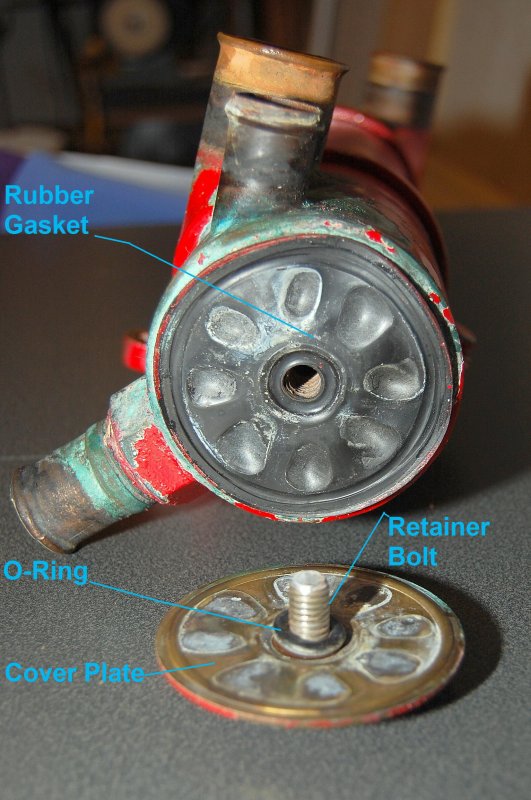
What's behind the cover plate? On this type of HX all that's there is an o-ring and rubber gasket. Be sure to have new replacements on hand before removal:
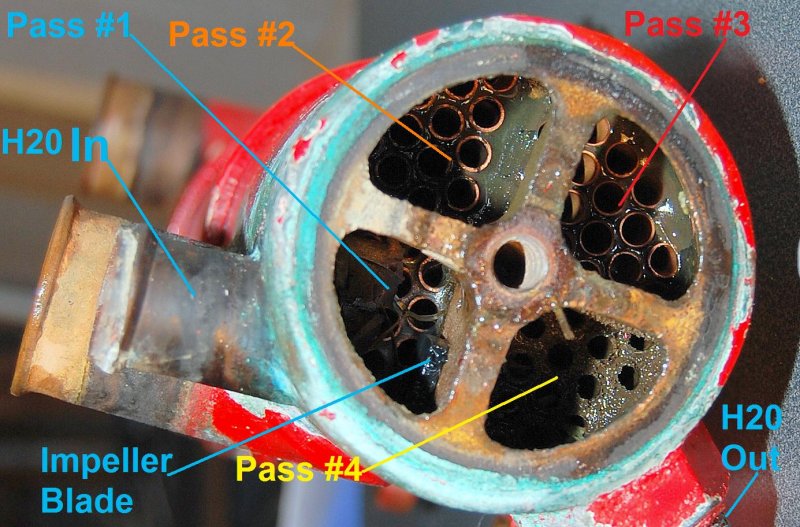
This is the most confusing part trust me! The in-coming raw water passes into quadrant #1 and makes pass #1. When it hits the end of the tube it makes a 180 degree turn and comes back for pass #2. It then hits the end of the tube again and is forced back though the HX for pass #3 where this process happens again and the raw water is finally sent out of the HX and into the wet exhaust system. In essence the raw water passes through four quadrants or quarters of the HX before leaving the HX. If you look closely you can see some eel grass and an old impeller vane. This first pass only consists of a few small diameter copper tubes so it's important to monitor temp and on an abnormal rise to use a good trouble shooting methodology and make sure it's not a blocked HX.:
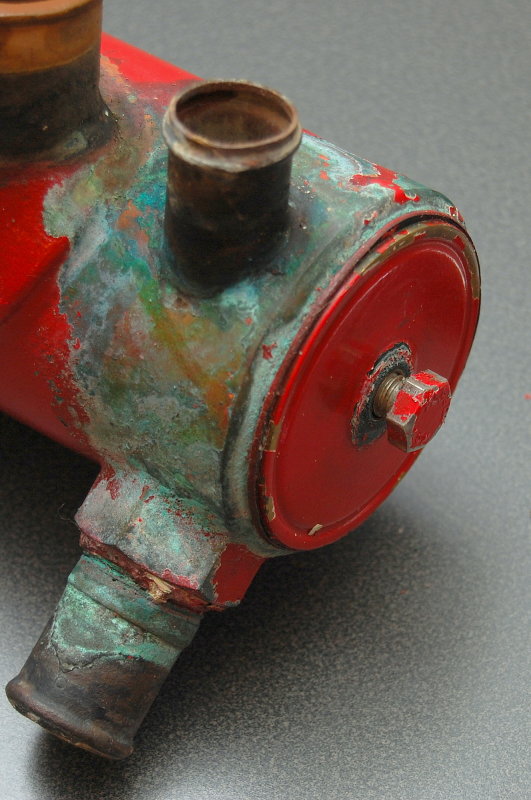
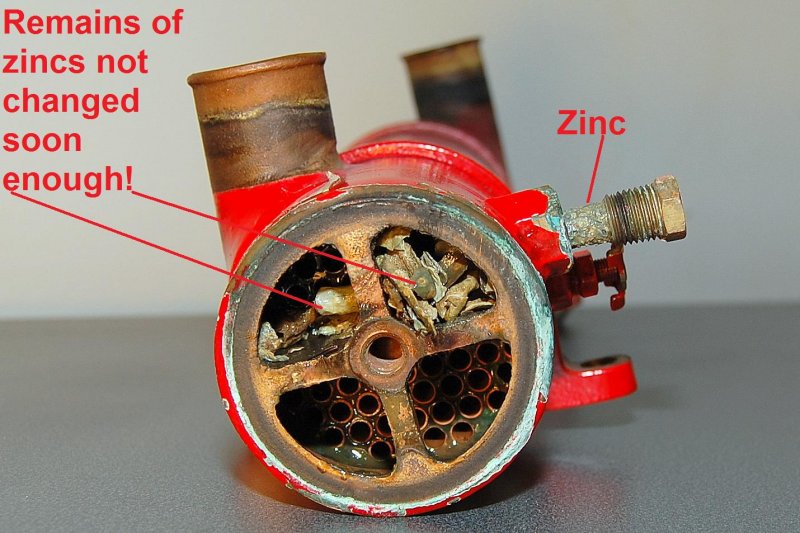
This is the end I call the trouble end and it is the one I clean most often, thought eh other end can be bad too. With Universal/Westerbeke HX's the pencil zinc is almost the same width as the threads for the head. Zincs do funny things when they sacrifice themselves one of them being that they begin to flake and appear to get bigger in diameter. If the zincs are not changed often enough a few things can happen as did here.
#1 the zinc gets thin and the water pressure snaps it off the head where it remains until you remove the cap and clean it out.
#2 The zinc deteriorates, crumbles and flakes off inside the HX which can lead to plugged tubes.
#3 The zinc gets too fat and when you un-thread it the pencil zinc snaps off the head. People often assume the zinc was totally eaten but more often than not it just broke off because it went too long before being changed.
The zinc in the photo, which came out in one piece, was about eight weeks old. I change them about once every 8 weeks. The PO spent time cruising and was in many different areas, with different water/electrolysis issues, so getting to know his zinc schedule was probably tough, hence the crud. I should have pulled the cap a long time ago but my temps were running spot on. If you don't get a full zinc out it's a good idea to pull the cap and retrieve the pieces.:
Tomorrow I drop it off at the radiator shop for a cleaning then clean it up and paint it. I learned a long time ago that paying the $20.00-$30.00 for an HX cleaning is soooooo worth it. Hell I can't even buy the Rydlyme, to DIY, for what my local radiator shop charges.
This is a post I made a while ago hopefully it will help. I address zincs at the near the bottom of the post. If you change them more often and you won't be leaving chunks in the HX...
HX's are one of those things that many boaters find mysterious but they are in fact quite simple and easy to work on, especially the cylindrical type as used on Universal and Westerbeke engines. A marine HX is very much like a cars radiator. Rather than cooling the engine antifreeze with air passing across aluminum fins, the marine HX uses raw ocean or lake water run through copper tubes. This raw water is doing, and serving, the same purpose as the air does on an auto radiator.
This is the basic anatomy of a HX. There are two sealed water loops or circuits in this tube, a fresh water side (engine antifreeze), and a raw water side (lake or ocean water):
To see inside simply remove this bolt and pull the cover plate off (this can usually be done on board if you have access and a closed seacock):
What's behind the cover plate? On this type of HX all that's there is an o-ring and rubber gasket. Be sure to have new replacements on hand before removal:
This is the most confusing part trust me! The in-coming raw water passes into quadrant #1 and makes pass #1. When it hits the end of the tube it makes a 180 degree turn and comes back for pass #2. It then hits the end of the tube again and is forced back though the HX for pass #3 where this process happens again and the raw water is finally sent out of the HX and into the wet exhaust system. In essence the raw water passes through four quadrants or quarters of the HX before leaving the HX. If you look closely you can see some eel grass and an old impeller vane. This first pass only consists of a few small diameter copper tubes so it's important to monitor temp and on an abnormal rise to use a good trouble shooting methodology and make sure it's not a blocked HX.:
This is the end I call the trouble end and it is the one I clean most often, thought eh other end can be bad too. With Universal/Westerbeke HX's the pencil zinc is almost the same width as the threads for the head. Zincs do funny things when they sacrifice themselves one of them being that they begin to flake and appear to get bigger in diameter. If the zincs are not changed often enough a few things can happen as did here.
#1 the zinc gets thin and the water pressure snaps it off the head where it remains until you remove the cap and clean it out.
#2 The zinc deteriorates, crumbles and flakes off inside the HX which can lead to plugged tubes.
#3 The zinc gets too fat and when you un-thread it the pencil zinc snaps off the head. People often assume the zinc was totally eaten but more often than not it just broke off because it went too long before being changed.
The zinc in the photo, which came out in one piece, was about eight weeks old. I change them about once every 8 weeks. The PO spent time cruising and was in many different areas, with different water/electrolysis issues, so getting to know his zinc schedule was probably tough, hence the crud. I should have pulled the cap a long time ago but my temps were running spot on. If you don't get a full zinc out it's a good idea to pull the cap and retrieve the pieces.:
Tomorrow I drop it off at the radiator shop for a cleaning then clean it up and paint it. I learned a long time ago that paying the $20.00-$30.00 for an HX cleaning is soooooo worth it. Hell I can't even buy the Rydlyme, to DIY, for what my local radiator shop charges.


I have a Westerbeke genset and I have this same problem. Not only is the zinc had to remove, but I also can't get the new one inserted. I am using the standard Westerbeke part zinc #11885 and it seems like it is just about 1/16" in diameter too big.
I've called/emailed Westerbeke with no response. I'm about ready to chuck these in my lathe and turn them down just a bit, but I really shouldn't have to do this with a genuine part.
I've called/emailed Westerbeke with no response. I'm about ready to chuck these in my lathe and turn them down just a bit, but I really shouldn't have to do this with a genuine part.

KISS
Just buy a thinner zinc. Too simple? Yup, they make 'em in varying diameters, some are as thick as cigars, some like, dare I say, pencils. If you buy the ones that just barely fit in the hole, then when, that WHEN, they expand, they're a pain to get out. They're sacrificial, so thinner ones may need to be changed a tad earlier. No big deal...
Just buy a thinner zinc. Too simple? Yup, they make 'em in varying diameters, some are as thick as cigars, some like, dare I say, pencils. If you buy the ones that just barely fit in the hole, then when, that WHEN, they expand, they're a pain to get out. They're sacrificial, so thinner ones may need to be changed a tad earlier. No big deal...
Well, Stu, the problem is that the thin zincs don't have the correct threaded head so I can't use them.
The only ones that are the correct thread are just barely too big in diameter.
The only ones that are the correct thread are just barely too big in diameter.

Rich,
Is it possible the threads in the HX are gummed up? I haven't changed my zinc yet. New to boating, so I've found this post really informative. The one in Mainsail's picture I assume is a pencil zinc and the one you use is threaded somewhat like a set screw. Could you run a hand tap in the hx to clean the threads out? Turning an od on a thread might not help you any.
Is it possible the threads in the HX are gummed up? I haven't changed my zinc yet. New to boating, so I've found this post really informative. The one in Mainsail's picture I assume is a pencil zinc and the one you use is threaded somewhat like a set screw. Could you run a hand tap in the hx to clean the threads out? Turning an od on a thread might not help you any.
Thank you
for all the information. Its always reassuring to know that your not the only one contending with an issue like this, so I really appreciate everyone's feedback and especially to MaineSail for providing pictures.
Mac.
for all the information. Its always reassuring to know that your not the only one contending with an issue like this, so I really appreciate everyone's feedback and especially to MaineSail for providing pictures.
Mac.
Rich,
Is it possible the threads in the HX are gummed up? I haven't changed my zinc yet. New to boating, so I've found this post really informative. The one in Mainsail's picture I assume is a pencil zinc and the one you use is threaded somewhat like a set screw. Could you run a hand tap in the hx to clean the threads out? Turning an od on a thread might not help you any.
Try another source?
Rich, I hear ya, but I've found that the engine chandleries, instead of WM, have a better assortment of different zinc lengths and diameters. maybe just good luck locally here, but I had the same problem and licked it.
Rich, I hear ya, but I've found that the engine chandleries, instead of WM, have a better assortment of different zinc lengths and diameters. maybe just good luck locally here, but I had the same problem and licked it.
I have the exact same setup as in MaineSail's picture. It is a pencil zinc and it threads into a tapered pipe-threaded hole. I think the hang-up is at the smallest part of the taper. Since it is a taper, I am reluctant to run a tap to open it up for fear of leaks.Rich,
Is it possible the threads in the HX are gummed up? I haven't changed my zinc yet. New to boating, so I've found this post really informative. The one in Mainsail's picture I assume is a pencil zinc and the one you use is threaded somewhat like a set screw. Could you run a hand tap in the hx to clean the threads out? Turning an od on a thread might not help you any.
If the problem was just with removal, I could understand. But I can't get a brand new zinc to insert into the hole down to the cap so I can get it threaded. The last one I installed I had to scrape the outside of the zinc with a knife to remove some material so I could get the darn thing in.
It's one thing to buy a third-party zinc and have a problem like this, but it's another issue altogether to pay twice as much for a genuine Westerbeke part and not have it fit.
Stu- I've looked in every store and measured every zinc that was close. Never found one that would fit. Wait, I did find one years ago at Boater's World, but not in the last 5-6 years.

When I have to shave a little off something small and round like that, I put it in the drill press and use a coarse file. Since I don't have a lathe.

Good thread. I'll be checking my pencil zincs with much greater frequency than in the past.
I am mystified in my case about what causes the pencil zinc in my heat exchanger to sacrifice so quickly. Just checked it yesterday (about 3 months new) and all that was left was some grey goo in the brass fitting into which the pencil zinc threads screw. The boat floats in saltwater 365 days a year. My heat exchanger is external to the engine -- mounted on a bulkhead. It has no metal connection or bonding to anything else. The bronze seawater intake strainer does not have a zinc and after many years, shows absolutely no sign of corrosion. Likewise the bronze seawater pump (mounted on a bracket attached to the engine and powered by a crankshaft belt) hasn't corroded through the years either. I don't connect my boat to shore power. The prop and shaft zincs are still in relatively sound condition after about a year. Any guess why HX zincs sacrifice so quickly? One thought I have (with no confidence of its significance) is that sea water does drain out of my HX when the engine is shut down, but before I close the seawater seacock. But water will remain pooled in the pencil zinc's fitting well ... while the upper part of the zinc will be exposed to air. Maybe this sets up a galvanic differential? Or as MaineSail has pointed out, a heat exchanger has soft metals such as solder and copper. Maybe the zinc sacrifices quicker than it does when protecting bronze and SS. Should I try bonding the HX to the engine for a while and see if that helps?
thanks in advance for opinions
regards,
rardi
I am mystified in my case about what causes the pencil zinc in my heat exchanger to sacrifice so quickly. Just checked it yesterday (about 3 months new) and all that was left was some grey goo in the brass fitting into which the pencil zinc threads screw. The boat floats in saltwater 365 days a year. My heat exchanger is external to the engine -- mounted on a bulkhead. It has no metal connection or bonding to anything else. The bronze seawater intake strainer does not have a zinc and after many years, shows absolutely no sign of corrosion. Likewise the bronze seawater pump (mounted on a bracket attached to the engine and powered by a crankshaft belt) hasn't corroded through the years either. I don't connect my boat to shore power. The prop and shaft zincs are still in relatively sound condition after about a year. Any guess why HX zincs sacrifice so quickly? One thought I have (with no confidence of its significance) is that sea water does drain out of my HX when the engine is shut down, but before I close the seawater seacock. But water will remain pooled in the pencil zinc's fitting well ... while the upper part of the zinc will be exposed to air. Maybe this sets up a galvanic differential? Or as MaineSail has pointed out, a heat exchanger has soft metals such as solder and copper. Maybe the zinc sacrifices quicker than it does when protecting bronze and SS. Should I try bonding the HX to the engine for a while and see if that helps?
thanks in advance for opinions
regards,
rardi
HX Zinc Follies
rardi - Nope, shouldn't matter at all because the zinc is there to be an anode to the galvanic corrosion between the salt water and the HX. Just change it more often. We do a 3 month scheduled turnaround on ours, sometimes it needs it more often, sometimes it'll be reinstalled since there's no change. We've "isolated" ours by placing a rubber bicycle inner tube between the HX bracket and the HX.
Rich: Try doing the same, check it more often, if it starts to go, then you can scrape the loose bits off before they completely disintegrate, or file it down as Hermit suggests.
See: http://c34.org/bbs/index.php/topic,4279.0.html and http://c34.org/bbs/index.php/topic,2593.0.html
rardi - Nope, shouldn't matter at all because the zinc is there to be an anode to the galvanic corrosion between the salt water and the HX. Just change it more often. We do a 3 month scheduled turnaround on ours, sometimes it needs it more often, sometimes it'll be reinstalled since there's no change. We've "isolated" ours by placing a rubber bicycle inner tube between the HX bracket and the HX.
Rich: Try doing the same, check it more often, if it starts to go, then you can scrape the loose bits off before they completely disintegrate, or file it down as Hermit suggests.
See: http://c34.org/bbs/index.php/topic,4279.0.html and http://c34.org/bbs/index.php/topic,2593.0.html
Re: HX Zinc Follies
Stu: Thanks for the info and the links. My HX fitting requires a 1/4" x 20 thread pencil zinc. I bought one at WM on the way home yesterday. I do have to cut off about 2/5's of the length as it is too long off the shelf. Occurred to me that I have at home a 1/4" x 20T die, so I instead of throwing away 2/5's of the zink I instead cut it in half and cut new threads on the raw end. Now two zincs for the price of one! Each might not last quite as long as max length, but almost ... and although the cost of these things doesn't break the bank (even at WM prices), every cent saved is a small victory these days. The zinc fitting on my HX is situated in plain view and very easy to reach. Its a < than 2 minute job to replace. Next time, I will take off the end cap to see if chunks of zinc remain.
rardi
Stu: Thanks for the info and the links. My HX fitting requires a 1/4" x 20 thread pencil zinc. I bought one at WM on the way home yesterday. I do have to cut off about 2/5's of the length as it is too long off the shelf. Occurred to me that I have at home a 1/4" x 20T die, so I instead of throwing away 2/5's of the zink I instead cut it in half and cut new threads on the raw end. Now two zincs for the price of one! Each might not last quite as long as max length, but almost ... and although the cost of these things doesn't break the bank (even at WM prices), every cent saved is a small victory these days. The zinc fitting on my HX is situated in plain view and very easy to reach. Its a < than 2 minute job to replace. Next time, I will take off the end cap to see if chunks of zinc remain.
rardi
Glad it helped you. Great two'fer idea!!!Next time, I will take off the end cap to see if chunks of zinc remain.
I recommend removing the HX if you're gonna do that 'cuz what I've found is that the rw inlet to the HX gets gunked up with salt falling out. So in addition to the zinc pieces, check the inlet and outlet tubes. It'll "force" you to check all of the hoses and hose clamps, too. If you have an M25 series engine, also check the elbow hose (two different sizes at either end) that comes off the fresh water pump and underneath the alternator. The back side of that hose (which you can't see) gets a lot of rubbing. Mine lasted 7 or 8 years, glad I checked it!

HX
Dissimilar metals.. This is why you need a sacrificial anode in your HX...
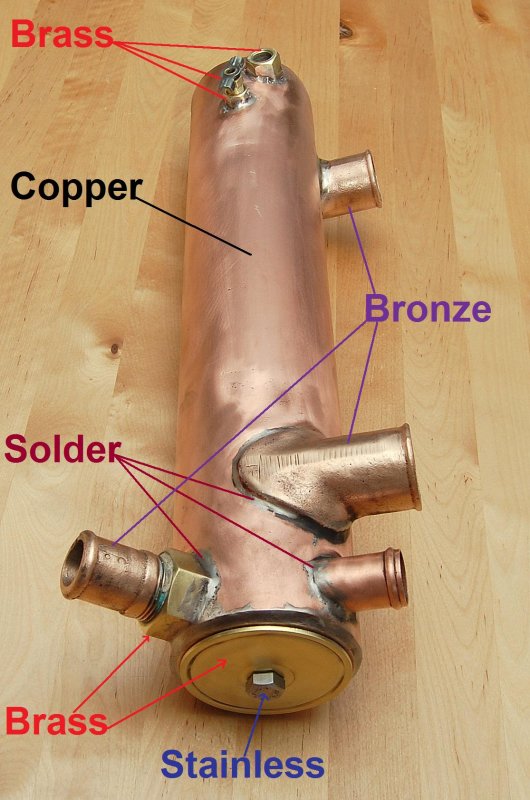
Or as MaineSail has pointed out, a heat exchanger has soft metals such as solder and copper.
Dissimilar metals.. This is why you need a sacrificial anode in your HX...
Stu:
No, I have a Yanmar 2QM20. But I also have several locations against which various hoses rub up or bend against. As with my HX, I have excellent visability all around my engine. Nonetheless, at those potentially troublesome rub points, I've wrapped the hose with a couple of layers of yellow electrical tape: 1) Hopefully the extra layer will reduce chance of shafe damage to the underlying hose (but adds some risk hiding possible splitting/cracking damage); and 2) If the tape wears through, the resulting black spot (the hose color) against the yellow would be readily noticeable upon inspection.
Another use I have for colored electrical tape is to mark spots on my dock lines at the cleat once every so often when the boat is centered as I like it in my slip. Then each time I return from a sail, I just adjust each line until the tape mark is just off the cleat. Outcome is perfectly centered each time with no fuss. A few wraps of electric tape around a dock line lasts several months.
No, I have a Yanmar 2QM20. But I also have several locations against which various hoses rub up or bend against. As with my HX, I have excellent visability all around my engine. Nonetheless, at those potentially troublesome rub points, I've wrapped the hose with a couple of layers of yellow electrical tape: 1) Hopefully the extra layer will reduce chance of shafe damage to the underlying hose (but adds some risk hiding possible splitting/cracking damage); and 2) If the tape wears through, the resulting black spot (the hose color) against the yellow would be readily noticeable upon inspection.
Another use I have for colored electrical tape is to mark spots on my dock lines at the cleat once every so often when the boat is centered as I like it in my slip. Then each time I return from a sail, I just adjust each line until the tape mark is just off the cleat. Outcome is perfectly centered each time with no fuss. A few wraps of electric tape around a dock line lasts several months.

paint?
Maine im curious...why paint it...why not leave it all purdy copper? Also, my zinc cap drips a bit...M25XP...I have it cranked down pretty well and am afraid to go further.
-steve
Maine im curious...why paint it...why not leave it all purdy copper? Also, my zinc cap drips a bit...M25XP...I have it cranked down pretty well and am afraid to go further.
-steve
Have you considered getting a new cap with your new zincs? Our local chandlery used to sell both zincs as well as zincs & caps. Now it's only the latter.Also, my zinc cap drips a bit...M25XP...I have it cranked down pretty well and am afraid to go further.-steve
Cranked down? If you read my linked posts in my reply above, you'll see that some folks find that their zincs bottom out inside the HX (see the pictures) - don't crank it down, you could be bottoming out the zinc, bending it and maybe breaking it off inside. Not too good...
Have you seen what unpainted copper does in a marine environment? that's why they paint 'em.
- Status
- Not open for further replies.