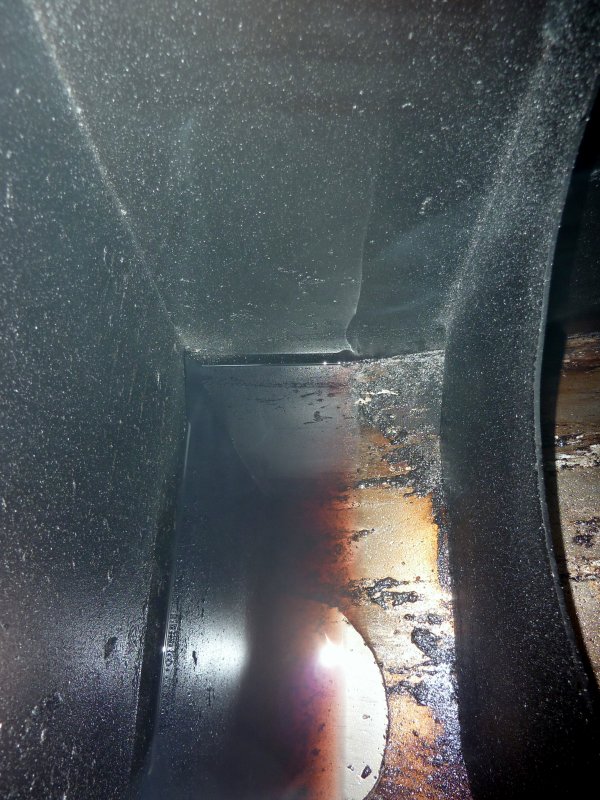
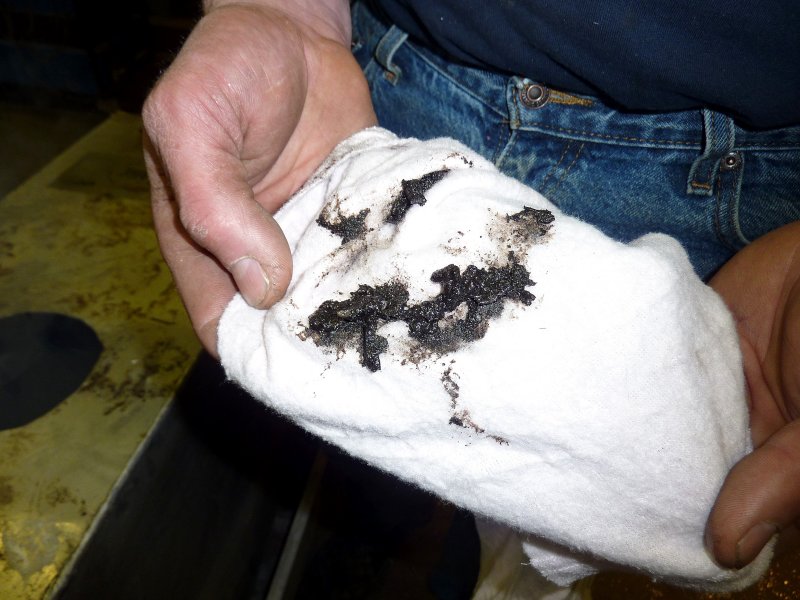
Well the new tank is finally back in the boat! Of course like anything it is never a simple swap out. I have replaced to many fuel tanks in my boat owning days and wanted to try and minimize any "issues" that may have caused past failures or at least extend the failure time.
Tank Musings:
No matter what, even if a tank is not leaking it should probably be removed and cleaned at least every 15-20 years. Actually it should be done sooner but I know how tough some tanks are to get out. Mine lasted 31 years before it developed a leak.
Previous failures have always met the standard protocol where it leaked at a weld or where in contact with the hull. This failure did not. The leak occurred in an area of the tank that was suspended in thin air and had no welds. It was however at the very bottom of the tank. I suspect that condensation on the exterior of the tank would drip to the lowest point and the water droplets would hang there until heavy enough to fall into the bilge. Either way leaks CAN happen even if the tanks is surrounded by air and does not have to always happen at a weld or hull/tank interface.
I was bound and determined to do this tank right. Initially I though Monel was the way to go but price, over 4k, and tank manufacturers talked me out of it. In the end I spoke with about 8 tank manufacturers, Parker/Racor, Seaboard Marine Filtration, Rich H, and many other experts. One thing I found interesting was the vast opinions, which made it even more confusing. In the end I wound up with a double welded, inside & out except for the top seam, 5052 aluminum tank with three sets of supply/returns. I also went back to a mechanical gauge with an electronic sensing unit.
Brass/Copper/Aluminum?:
On thing I found interesting was the conflicting advice on brass & copper fittings on tanks. Some very large manufacturers basically said they were fine while the ABYC says, and other experts say, they must be isolated from the tank by 300 series stainless or to use all aluminum. Copper is a reactive metal with fuel/aluminum and most tank manufacturers have moved away from its use but brass, which is a copper alloy is still used by some.
Working with aluminum fittings:
Having threaded stainless to aluminum before I knew I did not want to go this route. After some research I was able to track down every tank fitting in aluminum. Bud, at Luther's Welding in RI was the go to man. Luther's is who Morris Yachts uses when they need fuel tanks. His fittings are robust and well machined and his price was reasonable. Often aluminum fittings are of poor quality and they snap when threading them into the tank, not these!
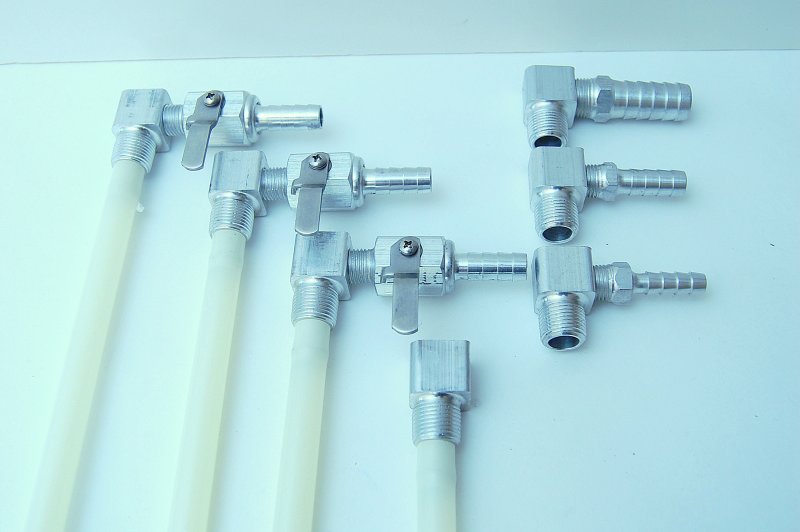
As you can see the pick up tubes are swaged onto the ferrules and are a special nylon which was easy to cut to the right length. There are four pick up tubes because one is actually a return tube for the polishing system to prevent foaming and to create circulation within the tank.
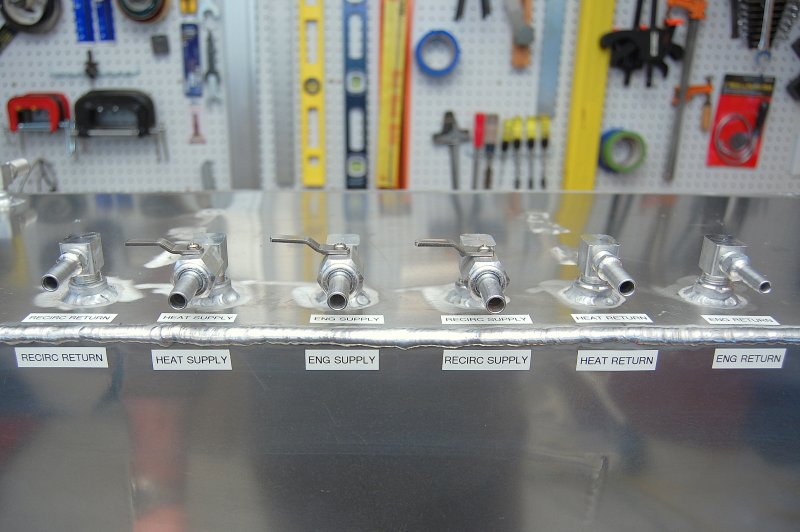
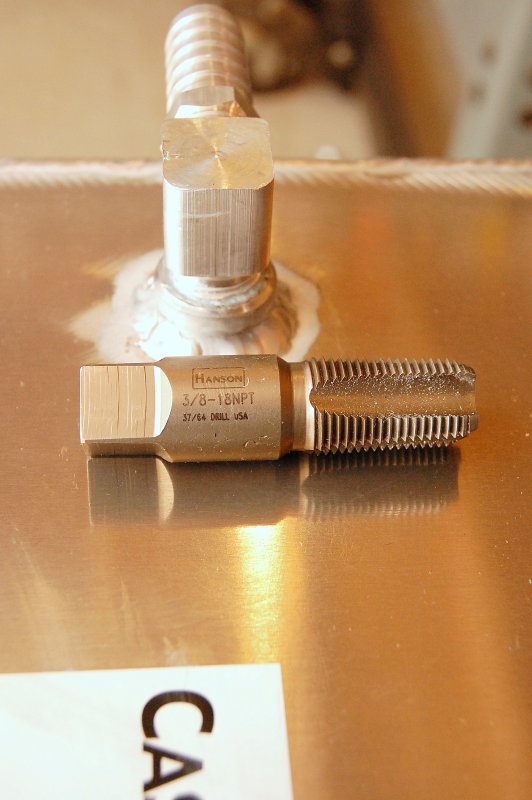
Working with aluminum can be challenging. I have before so was ready for it. Because the tank was pressure tested and stainless plugs were threaded in I knew I would have to clean up the threads before inserting the aluminum fittings. Surprisingly, or not surprisingly, I own a fair number of NPT taps for cleaning up threads. I ran my tap in/out of each 3/8" tank tapping while holding the shop vac to it to prevent any shavings from falling into the tank. A couple did fall in but I used one of the dip tubes on the end of my shop vac to suck them out by looking in one hole while moving the pick up tube to the shavings and sucking them out.
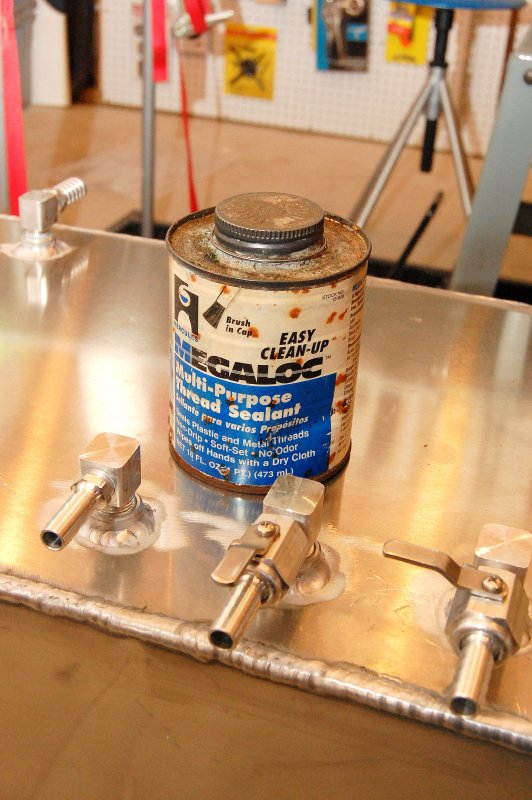
When threading aluminum you need a good slippery thread sealant, preferably rated for stainless steel, and also rated for fuel oil or diesel. I used Hercules Chemicals Megaloc for the task. I have used it for years on diesel fittings and have not yet had a leak. IMHO Hercules makes the best pipe dopes in the industry. It's important to note that very, very few people will advise the use of teflon tape on fuel fittings. I think this is probably because people use inferior tape and don't actually know how to wrap it. If wrapped incorrectly it can clog the fuel system. Still, even with a high quality three layer tape I still don't use it on fuel fittings.
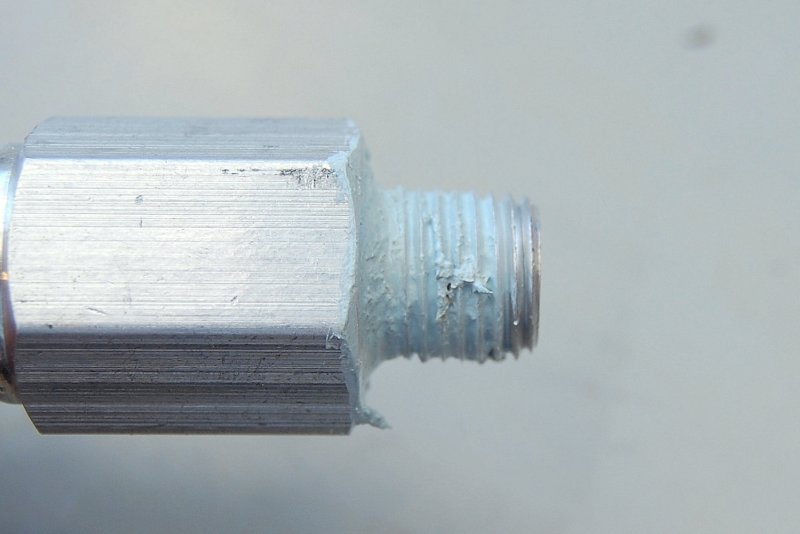
With fuel fittings it is very important to keep your dope back one or maybe two threads. I insert the fitting and thread until it begins to grab then mark that thread and start my dope one thread earlier. because they are tapered threads the first thread does not see much bite. If when threading the fitting in, it grabs, I simply back it off reapply dope and thread her back in. The first one or two threads now pick up some dope from the previous insertion and can be tightened without uneven gram. When threading aluminum to aluminum it should feel smooth the entire way. If it grabs remove it, re-apply dope and go at it again. The last thing you want to do is break a fitting. Aluminum does NOT need to be tightened as much as brass, steel, bronze or stainless because it is softer and more malleable so the threads seal easier, do not over tighten aluminum tank fittings!
Polishing System:
I gave this one a lot of research and consulted with many "experts" and manufacturers including Shelco, Parker and Seaboard. In the end it came down to a Cummins Fleetguard filter with a Seaboard Manufacturing filter head and a Racor 900MA. After consulting with both companies, I found they both had their advantages and disadvantages but my ultimate comfort was with the Racor.
The folks at Parker were knowledgeable and helpful, as were the folks at Seaboard, but the Racor still won out. Based on my system, and the fact that this is a new tank, and the capacity of the 900MA, and the GPH I will be moving, the guy at Parker advised me to polish with a 2 micron filter. He would have never advised this on an existing tank but thought the volume and starting from scratch a 2 mic would be a good place to start. If it plugs to fast I can always go to a 10 micron but he thinks with 100 hours per season +/- that a once per season filter change is all I'll need and I'll have spotless fuel. Considering I pay about $8.00 for a 900 series filter I'm not to worried, even if I have to change it every 50 hours..
Why I chose the Racor:
1- Bowl - Call me silly but I like to see my fuel
2- Customer support
3- Parts availability
4- Filter availability
5- Mounting / plumbing options
6- ABYC accepted product
7- Industry and boater accepted for any future buyers
8- Water separation - I do believe Racor has the best system for H20
Why I almost did not buy the Racor:
1- Filter capacity - I had to go to the 900 series to get the filter capacity I needed for polishing.
Simplicity:
I'm a simple guy, and like simple things, so the system is simple, on purpose. I did not want the spaghetti plate special with hoses, valves, shut offs, cut offs, diverters and the like as well as a hundred potential leak points. I wanted a simple dedicated system to do one thing, polish my fuel while my engine is running, and to do it separately from my engine filtration. By adding dedicated tank tapping for the engine, polishing system and the heating system I have achieved what I wanted.
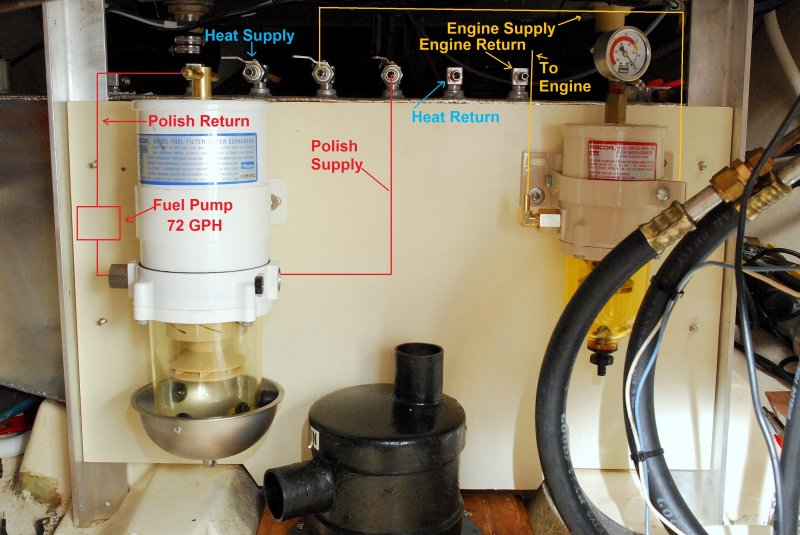
The tank pick ups are staggered, depth wise. The polishing system pics up in the V of the tank about 1/8" off the dead bottom. This is designed to catch anything and everything. The engine pick up is about 2" off the dead bottom of the V and the heater pick up is about 4" off the bottom. This is by design to give some engine reserve should we run the heater to long and suck the tank dry.

That's as far as I got today.. When I get to putting the engine back in I am fairly certain I have devised a very simple way to re-install it solo. I plan to make a "don't try this at home" style video when I do..
Unfortunately for this project I am short a bunch of photos because I keep leaving flash cards either at home or on the boat. I left four on the boat and have six here now so I should no longer have these camera issues..
Vendors
Tank:
Casco Bay Welding, LLC
Phil Daigle
Portland, ME
207-632-3449
Excellent welder and fast turnaround - 7 days
Tank Fittings:
Luther's Welding (LINK)
500 Wood Street
Bristol, RI 02809
401-253-5550
Does not take credit cards but does accept PayPal, ships fast.
Filtration:
Hamilton Marine (LINK)
Best Racor and filtration selection anywhere!
Tank Musings:
No matter what, even if a tank is not leaking it should probably be removed and cleaned at least every 15-20 years. Actually it should be done sooner but I know how tough some tanks are to get out. Mine lasted 31 years before it developed a leak.
Previous failures have always met the standard protocol where it leaked at a weld or where in contact with the hull. This failure did not. The leak occurred in an area of the tank that was suspended in thin air and had no welds. It was however at the very bottom of the tank. I suspect that condensation on the exterior of the tank would drip to the lowest point and the water droplets would hang there until heavy enough to fall into the bilge. Either way leaks CAN happen even if the tanks is surrounded by air and does not have to always happen at a weld or hull/tank interface.
I was bound and determined to do this tank right. Initially I though Monel was the way to go but price, over 4k, and tank manufacturers talked me out of it. In the end I spoke with about 8 tank manufacturers, Parker/Racor, Seaboard Marine Filtration, Rich H, and many other experts. One thing I found interesting was the vast opinions, which made it even more confusing. In the end I wound up with a double welded, inside & out except for the top seam, 5052 aluminum tank with three sets of supply/returns. I also went back to a mechanical gauge with an electronic sensing unit.
Brass/Copper/Aluminum?:
On thing I found interesting was the conflicting advice on brass & copper fittings on tanks. Some very large manufacturers basically said they were fine while the ABYC says, and other experts say, they must be isolated from the tank by 300 series stainless or to use all aluminum. Copper is a reactive metal with fuel/aluminum and most tank manufacturers have moved away from its use but brass, which is a copper alloy is still used by some.
Working with aluminum fittings:
Having threaded stainless to aluminum before I knew I did not want to go this route. After some research I was able to track down every tank fitting in aluminum. Bud, at Luther's Welding in RI was the go to man. Luther's is who Morris Yachts uses when they need fuel tanks. His fittings are robust and well machined and his price was reasonable. Often aluminum fittings are of poor quality and they snap when threading them into the tank, not these!
As you can see the pick up tubes are swaged onto the ferrules and are a special nylon which was easy to cut to the right length. There are four pick up tubes because one is actually a return tube for the polishing system to prevent foaming and to create circulation within the tank.
Working with aluminum can be challenging. I have before so was ready for it. Because the tank was pressure tested and stainless plugs were threaded in I knew I would have to clean up the threads before inserting the aluminum fittings. Surprisingly, or not surprisingly,
I own a fair number of NPT taps for cleaning up threads. I ran my tap in/out of each 3/8" tank tapping while holding the shop vac to it to prevent any shavings from falling into the tank. A couple did fall in but I used one of the dip tubes on the end of my shop vac to suck them out by looking in one hole while moving the pick up tube to the shavings and sucking them out.
When threading aluminum you need a good slippery thread sealant, preferably rated for stainless steel, and also rated for fuel oil or diesel. I used Hercules Chemicals Megaloc for the task. I have used it for years on diesel fittings and have not yet had a leak. IMHO Hercules makes the best pipe dopes in the industry. It's important to note that very, very few people will advise the use of teflon tape on fuel fittings. I think this is probably because people use inferior tape and don't actually know how to wrap it. If wrapped incorrectly it can clog the fuel system. Still, even with a high quality three layer tape I still don't use it on fuel fittings.
With fuel fittings it is very important to keep your dope back one or maybe two threads. I insert the fitting and thread until it begins to grab then mark that thread and start my dope one thread earlier. because they are tapered threads the first thread does not see much bite. If when threading the fitting in, it grabs, I simply back it off reapply dope and thread her back in. The first one or two threads now pick up some dope from the previous insertion and can be tightened without uneven gram. When threading aluminum to aluminum it should feel smooth the entire way. If it grabs remove it, re-apply dope and go at it again. The last thing you want to do is break a fitting. Aluminum does NOT need to be tightened as much as brass, steel, bronze or stainless because it is softer and more malleable so the threads seal easier, do not over tighten aluminum tank fittings!
Polishing System:
I gave this one a lot of research and consulted with many "experts" and manufacturers including Shelco, Parker and Seaboard. In the end it came down to a Cummins Fleetguard filter with a Seaboard Manufacturing filter head and a Racor 900MA. After consulting with both companies, I found they both had their advantages and disadvantages but my ultimate comfort was with the Racor.
The folks at Parker were knowledgeable and helpful, as were the folks at Seaboard, but the Racor still won out. Based on my system, and the fact that this is a new tank, and the capacity of the 900MA, and the GPH I will be moving, the guy at Parker advised me to polish with a 2 micron filter. He would have never advised this on an existing tank but thought the volume and starting from scratch a 2 mic would be a good place to start. If it plugs to fast I can always go to a 10 micron but he thinks with 100 hours per season +/- that a once per season filter change is all I'll need and I'll have spotless fuel. Considering I pay about $8.00 for a 900 series filter I'm not to worried, even if I have to change it every 50 hours..
Why I chose the Racor:
1- Bowl - Call me silly but I like to see my fuel
2- Customer support
3- Parts availability
4- Filter availability
5- Mounting / plumbing options
6- ABYC accepted product
7- Industry and boater accepted for any future buyers
8- Water separation - I do believe Racor has the best system for H20
Why I almost did not buy the Racor:
1- Filter capacity - I had to go to the 900 series to get the filter capacity I needed for polishing.
Simplicity:
I'm a simple guy, and like simple things, so the system is simple, on purpose. I did not want the spaghetti plate special with hoses, valves, shut offs, cut offs, diverters and the like as well as a hundred potential leak points. I wanted a simple dedicated system to do one thing, polish my fuel while my engine is running, and to do it separately from my engine filtration. By adding dedicated tank tapping for the engine, polishing system and the heating system I have achieved what I wanted.
The tank pick ups are staggered, depth wise. The polishing system pics up in the V of the tank about 1/8" off the dead bottom. This is designed to catch anything and everything. The engine pick up is about 2" off the dead bottom of the V and the heater pick up is about 4" off the bottom. This is by design to give some engine reserve should we run the heater to long and suck the tank dry.
That's as far as I got today.. When I get to putting the engine back in I am fairly certain I have devised a very simple way to re-install it solo. I plan to make a "don't try this at home" style video when I do..
Unfortunately for this project I am short a bunch of photos because I keep leaving flash cards either at home or on the boat. I left four on the boat and have six here now so I should no longer have these camera issues..
Vendors
Tank:
Casco Bay Welding, LLC
Phil Daigle
Portland, ME
207-632-3449
Excellent welder and fast turnaround - 7 days
Tank Fittings:
Luther's Welding (LINK)
500 Wood Street
Bristol, RI 02809
401-253-5550
Does not take credit cards but does accept PayPal, ships fast.
Filtration:
Hamilton Marine (LINK)
Best Racor and filtration selection anywhere!