Engine Charging Questions

Rick D

.
Jun 14, 2008
7,203
Hunter Legend 40.5 Shoreline Marina Long Beach CA
Ok, so I have not used our boat much last year owing to various projects. I put in some Deka AGM house batteries; four golf carts.
I have a 90 amp Balmar with a Xantrex regulator and the start battery is charged through a combiner. I am considering changing out that combiner to a smarter one that has a high voltage limit.
So my question is if I have an issue with the regulator. When charging the battery this morning (with engine) everything seemed normal but I read 14.9 volts at the start battery with the house AGMs indicating 12.8 while charging about five minutes from the start,. The house batteries indicated 12.1 when I started. I turned the start battery switch off.
So, my first issue is why the big volts indicated on the (fully charged) start battery?
Second, why did the combiner not wait until 13 volts to combine?
I have had no issue previously so it may be an issue with my understanding of things electrical. Thoughts from people smarter than I appreciated.
 

Rick D

.
Jun 14, 2008
7,203
Hunter Legend 40.5 Shoreline Marina Long Beach CA
Addendum: the regulator senses at the house bank.
 
Dec 29, 2008
806
Treworgy 65' LOA Custom Steel Pilothouse Staysail Ketch St. Croix, Virgin Islands
My guess is that the start battery is showing the output from your alternator while the engine is running. I'm not sure why the house bank is not also showing that voltage while the engine is running. Mine does the same thing, so I'll be interested in seeing the explanation.
 

SG

.
Feb 11, 2017
1,670
J/Boat J/160 Annapolis
Do the engine batteries come up in voltage?

Your regulator should bring them up to 14.4 Volts or so while charging in the "bulk" mode, then phasing down through the absorption charging phase, then "floating" at 13. whatever?
 

Rick D

.
Jun 14, 2008
7,203
Hunter Legend 40.5 Shoreline Marina Long Beach CA
Do the engine batteries come up in voltage?

Your regulator should bring them up to 14.4 Volts or so while charging in the "bulk" mode, then phasing down through the absorption charging phase, then "floating" at 13. whatever?
I only ran the engine about thirty minutes, so the house bank never got close to getting out of bulk.
 

SG

.
Feb 11, 2017
1,670
J/Boat J/160 Annapolis
But did the voltage come up to bulk charging?

If if did, then your reading may be reflective of the battery charge state (not simply the current input voltage from the alternator). Then't I'd not fixate on it. The immediate concern is that the alternator isn't putting out properly for the House Bank(s).

The regulator may be allow you to charge the Starting Battery completely independently of the House Bank.

Aren't you using the regulator to control that -- and NOT the battery combiner/issolator?
 

Rick D

.
Jun 14, 2008
7,203
Hunter Legend 40.5 Shoreline Marina Long Beach CA
The big house bank of 390 amp hours never had a chance to get to Max bulk given the discharge that I started from and the limited run time.
To fill in the blanks, I am on the back side of Catalina Island and wanted to let the solar panels take over. Late today, I will run the Honda to add more if called for to bring it up to 80-ish percent. My over riding concern is to not hurt the new AGM house bank or starting battery on the trip back which will involve some motoring.
 

SG

.
Feb 11, 2017
1,670
J/Boat J/160 Annapolis
With almost 400 AH in the house bank, in that cold Pacific water, you'll probably do nothing to your house bank.

Your starting battery might not really like 14.5 volts -- but your regulator should tool back on it. I wouldn't obsess on that.

Your 90 Amp Balmar will probably only put-out 65-70 amps in the real world in your engine compartment.

I'd check the regulator capabilities to charge the banks independently -- i.e., not only voltages, but amperage.
 
  • Like
Likes: Rick D

Rick D

.
Jun 14, 2008
7,203
Hunter Legend 40.5 Shoreline Marina Long Beach CA
So the motivation for concern is that I fried a new Optima start battery on the five hour motor over. I keep two house battery banks. One is almost four hundred amp hours. Two is a small group 24 I use at the dock under a bright-at-the-moment theory that it would do the suffering for running the frig and freezer 24/7 on dock power. It's old. Anyhow, I didn't change the selector switch to one so it had about twenty amps pushed through it with the alternator pushing amps through to keep it topped.
So my theory was that the current being pushed through also pushed the start battery to fry since it was combined. But given Main Sail's missive on Stu's post, now I wonder if that should have happened and wonder if I have a regulator problem. Looked on the manual but didn't see any test routine.
Opinions?
 

Rick D

.
Jun 14, 2008
7,203
Hunter Legend 40.5 Shoreline Marina Long Beach CA
Swell. Just fired up the engine for a while to do some trouble shooting. Now no charge at all. Repeat. Same result. Doubt it's the alternator, they don't just shut down. It worked fine yesterday. I was suspicious of the regulator and now I am more so. Will look everything over tomorrow for something obvious. Post any thoughts.
 

Gunni

.
Mar 16, 2010
5,937
Beneteau 411 Oceanis Annapolis
That Balmar alternator should be controlled by a Balmar regulator. You get more answers, less finger-pointing in a single phone call that way :) !
 
  • Like
Likes: Rick D
Feb 6, 1998
11,759
Canadian Sailcraft 36T Casco Bay, ME
So the motivation for concern is that I fried a new Optima start battery on the five hour motor over.
It would be really had to fry an Optima in 5 hours...


I keep two house battery banks. One is almost four hundred amp hours. Two is a small group 24 I use at the dock under a bright-at-the-moment theory that it would do the suffering for running the frig and freezer 24/7 on dock power. It's old. Anyhow, I didn't change the selector switch to one so it had about twenty amps pushed through it with the alternator pushing amps through to keep it topped.
Your not "pushing" amps through a battery if the system bus can develop 14.9V at XX SOC the battery will only draw what it can at that voltage and SOC... If the battery can't take more than 5A at 14.9V then that is all it will take regardless of your charge sources amperage capability.


So my theory was that the current being pushed through also pushed the start battery to fry since it was combined. But given Main Sail's missive on Stu's post, now I wonder if that should have happened and wonder if I have a regulator problem. Looked on the manual but didn't see any test routine.
Opinions?
With batteries in parallel you can't have one battery bank at 12.8V and the other at 14.9V unless you have some extreme voltage drop issues, like 2.1V of cable loss. That would even be tough to do with an isolator....

We still need to know what your charge management device is...

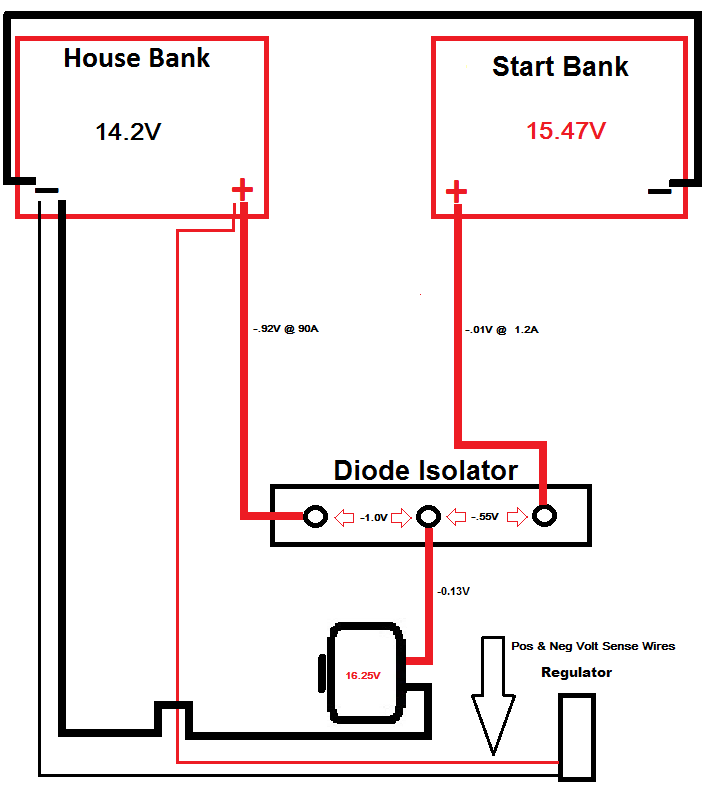
These were actual numbers from a boat taken about 5 years ago that was using a diode isolator. The installation left the isolator at the alternator end not battery end thus a LOT of voltage drop difference between the house and start banks. At near full rating diode isolators can drop over 1V to one bank and about -0.5V to -0.6V to a near fully charged start bank.....


Rick D

.
Jun 14, 2008
7,203
Hunter Legend 40.5 Shoreline Marina Long Beach CA
Ok, Balmar 90 amp alternator single pully eighteen years old, 2300 hours. Regulated by Xantrex multi stage regulator replacing a Balmar that failed ten years ago. ( They were nearly identical.) Start battery charged through a Cole Hersee (diode it appears) isolator. Two house banks controlled via a 1,2,both switch. House one is the 400 amp bank. House two is 100 amp group 24 battery. Normal practice is for me to leave the dock with full charge in the house batteries. When motoring, I leave them combined by selector on both. When on the mooring, or sailing, I have the big bank selected by the switch.
This describes the engine-driven charge layout. All has been without incident since replacing the regulator ten years ago during a cruise. The isolater was replaced a few years before that.
This trip, I left the house battery switch on the group 24 instead of combining it with the big bank.
Maine, re the Optima: it had about a third cup of acid in the battery box. Poor thing had been cooked well.
I pulled the fuse for the Xantrex regulator. It looks OK but I'll put a fresh one in tomorrow. I don't think that's it. Called Xantrex. They don't do alternator regulators any more. I'll go back to a Balmar regulator (assuming that's the point of failure).
 
May 17, 2004
6,147
Beneteau Oceanis 37 Havre de Grace
I read 14.9 volts at the start battery with the house AGMs indicating 12.8 while charging about five minutes from the start,. The house batteries indicated 12.1 when I started. I turned the start battery switch off.
Just fired up the engine for a while to do some trouble shooting. Now no charge at all.
I wonder if there's a problem with the charging circuit to the house bank, and therefore when you turned off the switch to the start bank it damaged the diodes in the alternator?
 
  • Like
Likes: Rick D

Rick D

.
Jun 14, 2008
7,203
Hunter Legend 40.5 Shoreline Marina Long Beach CA
This just gets weirder. Today, I replaced the fuse on the regulator which I'm sure was good anyway. Started and thought something had happened since I heard the engine load up after about thirty seconds, just like it should. But no amps to the house bank. So, I accessed the start battery and measured it. 17.7 volts! Thats REALLY over my head. That tells me not only is the regulator failed, the isolator has now failed as well.
Any ah has out there? I don't understand the logic here.
 
May 17, 2004
6,147
Beneteau Oceanis 37 Havre de Grace
Just to be sure - have you measured another battery with the same meter to make sure the meter is accurate? I had a cheap meter once that would read higher and higher as it's own battery got weaker.
 
  • Like
Likes: Rick D