Drill Baby Drill...

Status
Not open for further replies.
Dec 14, 2008
92
Tartan 30 Bayfield, WI
What a great resource this forum is, I am thankful for all the great info that is posted here.

My newest task is to run my mainsail halyard aft to the cockpit. I have all the hardware that I think I need, but I REALLY don't like the idea of drilling THROUGH the deck. I would consider (I think) the halyard a critical piece of equipment and the blocks and shackles involved in running it aft, critical. Would it be foolish of me to NOT drill all the way through my deck to mount the necessary hardware? (I have a Macgregor 26S) If I did not drill all the way through, would the hardware hold, how much stress is there on the halyard. I will also be running reefing lines through the same blocks.

Thanks all for the info...

Abe
 

Ross

.
Jun 15, 2004
14,693
Islander/Wayfairer 30 sail number 25 Perryville,Md.
How thick is your deck? Or how much of the screw in going to be engaged in solid material. Fiberglass is not renowned for its screw holding ability. Turning blocks should be through bolted as should cleats. Fair leads may be alright fastened just to the deck.
 
Dec 14, 2008
92
Tartan 30 Bayfield, WI
How thick is your deck? Or how much of the screw in going to be engaged in solid material. Fiberglass is not renowned for its screw holding ability. Turning blocks should be through bolted as should cleats. Fair leads may be alright fastened just to the deck.
Not positive, but it looks like the deck could be 3/4"-1" thick--and I was not sure how much screw thread was going in, I wanted to see what my fastening options were. It really is not the fact of drilling through the deck that is concerning, it is the flock of patches appearing on my headliner in the cabin, and not wanting to add to the flock if possible...(I know, I know...safety trumps beauty)
 

Ross

.
Jun 15, 2004
14,693
Islander/Wayfairer 30 sail number 25 Perryville,Md.
Any holes you drill should be well chamfered to prevent radial cracking and to provide for better sealing.
 
Jan 1, 2006
8,011
Slickcraft 26 Sailfish
A couple of thoughts: How much stress in on a halyard? Pretty much I would say. My evidence is the sound that's made when a halyard parts. It is like a guitar string breaking. Twang!!!
I would want all deck hardware to be thru bolted. Yes, turning blocks are mostly in shear force but no force is purely shear, tension or even compression.
Can you find a way to attach you turning blocks, at the base of the mast, to the mast? Screws or rivets into the mast are pretty strong. Sometimes a bail is used to which blocks are attached or sometimes there is a plate that is part of the mast tabernacle or mount. At least you wouldn't have to make holes in the deck at that critical area. How often have we heard of water intrusion into the core around the mast.
Once you've penetrated the top lamina of the deck sandwich, you've opened the door for water intrusion. Limiting the hole to not going through to the bottom layer doesn't help. In fact, I would rather the water run through the deck than be trapped in the core.
I don't think the benefits of running the halyards to the cockpit justify putting holes in the deck which threaten the long term integrity of the deck structure. In the past, before aft run running rigging was the norm, halyards were at the mast, with a winch, and cleat or stopper. You went forward to raise or lower the sail. There is less friction to raise the sail and you normally are there to lower it and flake the main anyway. At some point we were all sold about the safety of the cockpit despite the fact that most of us sail in mild to moderate conditions in which there is little or no danger of being at the mast. So we put unneccessary holes in our decks and open the door to water intrusion in order to make it more difficult to raise the sails.
I'm aware this isn't a popular opinion.
 
Sep 25, 2008
2,288
C30 Event Horizon Port Aransas
I would absolutely through bolt them. They are easier to seal and keep water out of your deck core if they go all the way through, providing you properly pot the hole and seal only the top of the fastner.
I guess you will never climb a mast on a Mac26, but other than the safety of not having turning blocks flying across the deck when they get pulled loose, I would worry about water intrusion.
I must say that when I hear someone is scared of drilling through the deck, it seems to me that the person is not very farmiliar with maintainence on their own boat. If you pot a hole, chamfer it and seal it correctly by not moving the bolt but only the nut, then there should be zero fear of water getting into the deck core. Even if I put no sealant on the fastners with potted holes, all that will happen is water runs into the cabin. That is why it is imporatant to only seal above the deck. that way when it leaks it is obvious where the water is coming from. If you haven't potted the holes and slots cut through the deck by the factory, don't worry about new holes leaking water, worry about the ones that have been there with old sealant for how ever many years the boat has been around.
 
Jan 10, 2009
590
PDQ 32 Deale, MD
At some point we were all sold about the safety of the cockpit despite the fact that most of us sail in mild to moderate conditions in which there is little or no danger of being at the mast. So we put unneccessary holes in our decks and open the door to water intrusion in order to make it more difficult to raise the sails.
I'm aware this isn't a popular opinion.
I'm with you. I prefer simplicity, and by the time I'm afraid to go on-deck, the washing is already in.
 
Oct 22, 2008
3,502
- Telstar 28 Buzzards Bay
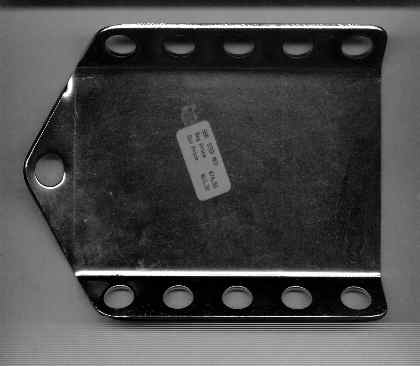
A much better way to deal with blocks for leading lines aft is to add a mast step plate for blocks to attach to. This minimizes any need for additional holes in the deck generally and instead of having loads on the cabin top, the loads become compressive loads on the mast itself...

Something like this will work for most boats with deckstepped masts.


On my boat, I added plates that bolted to my existing mast step. You can see the plates in this image:


kenn

.
Apr 18, 2009
1,271
CL Sandpiper 565 Toronto
The only items on our small boat that are NOT through-bolted are:
-the side lights (windows)
-the studs for the dodger... and one has already torn out. I'll be replacing it with a through-bolted stud.

As already mentioned, fiberglass is not so great as a receiver/holder for self-tapping screws. I ran the halyards aft to the cockpit last year, and I through-bolted the turning blocks.

(I also added slides to our mainsail's luff, and it's MUCH nicer to handle now, raising/reefing/lowering it from the cockpit)

Mostly thanks to Mainesail's great article about it, I've now gone to butyl sealant to seal deck hardware, so other than bolts appearing on the cabin roof, there's really no downside to through-bolting.

(sailingdog - that plate's a good idea. In our case, there's a solid aluminum tabernacle on the deck which was easy to mount blocks to)
 
Jan 22, 2008
880
Fed up w/ personal attacks I'm done with SBO
Shemandr, I'm with you all the way. Actually the P.O. ran the halyards to the cockpit and I put them back at the mast. In addition to the reasons you mentioned, having the halyards at the mast makes reefing infinitely easier. Imagine reefing in a blow (you should have done it earlier) single or short handed. Do you want to run back and forth between the reef lines at the forward end of the boom and the cockpit halyards or do you want to do the whole operation at one location (the mast)?
 

Joe

.
Jun 1, 2004
8,323
Catalina 27 Mission Bay, San Diego
May 20, 2004
151
C&C 26 Ghost Lake, Alberta
A Mac 26S has quite a thin deck and it's solid. But it does have a liner inside. When we install hardware on the decks we through bolt which means we have to drill through the liner to access the underside of the deck. We cover the liner holes with plastic circular plugs (about $1 each) that you can buy from any Macgregor dealer. They'll be the right colour too!
We don't do too many "S's" but when we fit out the new "M's" all the deck hardware is through bolted. Main halyard has a turning block at the mast base; a deck organizer out toward the rail and a clutch just before the winch.
sam :)
 
Oct 18, 2007
707
Macgregor 26S Lucama, NC
Atwhite2- your deck is not nearly as thick as you think. There is space between the actual deck and the inner liner. Do it right: through bolt and use the liner plugs as several have recommended. You may not like the plugs, but they are a sign the job was done right! -Paul
 
Last edited:
Dec 14, 2008
92
Tartan 30 Bayfield, WI
Thanks All,

Ok, so I will drill through the deck, I was looking for the headliner patches, however, I was unable to locate them on-line...Does anyone know of a dealer?

thanks
 
Oct 18, 2007
707
Macgregor 26S Lucama, NC
Lowe's, and probably Home Depot will have them- but you may have to paint them to match your interior. Did u check Blue Water Yachts (McGregor repair parts dealer)? -Paul
 
Status
Not open for further replies.