crazy wind Lake Dillon, CO - question re: when to lower main

Mar 1, 2012
2,182
1961 Rhodes Meridian 25 Texas coast
One question no one has asked, and it makes a HUGE difference. Is your main set with a bolt rope in a slot, or does it have slugs?

If it's a bolt rope, get it down EARLY, because when the wind gets up, that bolt rope comes out of the slot, and the sail can be uncontrollable.

Slugs will stop that. Bolt ropes are fine on racers- on a cruising boat I always install slugs or slides
 

walt

.
Jun 1, 2007
3,546
Macgregor 26S Hobie TI Ridgway Colorado
Lots of good advice on what to do with the sails.. etc. I used to sail an old Mac 26S at Elevenmile and know about the "all hell is breaking loose" conditions. I just wanted to add a couple things.

First, if you have a good and very easy to deploy anchor, it is sometimes best to just get the sails down as quick as possible and drop anchor and wait things out. Those storms come up fast but usually go away fast. The faster they come, the faster they go. Sometimes if you try and go in, you’re at the dock at the worst possible time.

Yesterday at Elevenmile we also had a pretty amazing lightning storm. I was able to enjoy it "inside", even had a bunch of windows open to get max benefit of the instantaneous lightning and thunder. However, if you’re on a sailboat.. very nervous!!!

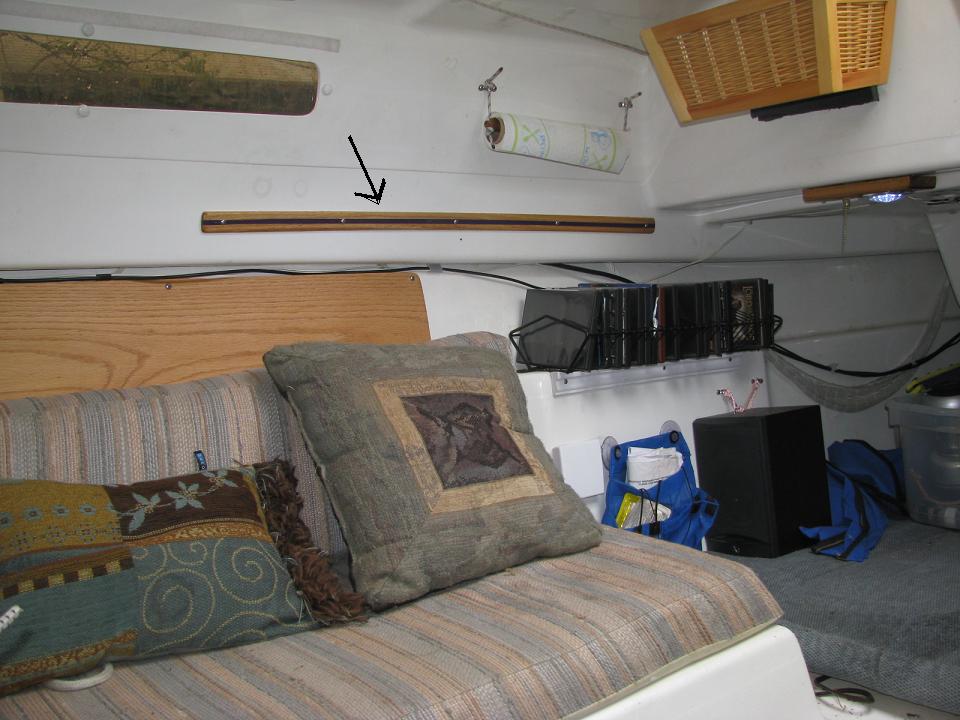
One thing I did on my old Mac 26S (which I still have) is to add a wood strip with a purple stripe on it inside the cabin (see the arrow in picture). The purpose was that if things got scary lightning wise and I had guests on board, I could tell them to go below and sit under the wood strip with the purple stripe. This stripe was in a place that was as far away from chain plates, the bottom of the mast, back stay, etc.. I.e., this was the place inside the cabin that I felt was the safest place to go in case of lightning. Way easier than trying to explain where the bottom of the mast was or even what is a chain stay..

 
Jan 22, 2008
507
Catalina 310 278 Lyndeborough NH
Re: crazy wind Lake Dillon, CO - question re: when to lower

I also have a Capri 22 – standard rig, wing keel (SRWK). I sail outside of Boston Harbor with typical 10-15 knot winds that can be higher or less.

The Capri keel is usually a wing keel especially on lakes. The fin keel is "faster" and may help a bit more in the wind, but not really much for a novice. There was also a "shoal" keel version. This keel is shallower and runs most of the length of the bottom. It has a kick-up rudder.

The mast comes in two lengths: standard rig and tall rig. The tall rig is often found on lakes and chosen by those "crazies" who have a "need for speed". Mostly it helps in light wind areas. One would reef sooner (10-15 knots vs 15-20 knots for the standard rig). That would be the biggest difference for us normal people.

The Capri does come in two other variations: with the racing package, without the racing package. The racing package has a different boom with more control lines, an adjustable back-stay, boom vang, traveller, spinnaker setup.

When my wife and I first started, we reefed before going out especially if the winds were 10 knots or more. The sails were original. Although not torn, they would "bulge" more in the wind then new sails would so we felt overpowered quickly.

Do take some time to practice reefing BEFORE you need to do it. Most Capri mainsails have slugs. This makes lowering the mainsail much easier.

I made sure I could reef quickly. The rear reef line passes through the boom (racing package). I added an external second reef line mimicking the Cunningham. The two lines are close to each other at the front of the boom so when I need to reef, I can pull the two lines together while standing in the companionway.

We replaced the sails last year. It made a dramatic difference. The original 110 jib was replaced with a 135 genoa so we have more sail area. But the new sails respond to all the control lines like we were taught in our lessons. More importantly, we don't reef anywhere near as much even in 15-20 knot winds. Part of this is experience. But part is that the sails are responding properly.

www.capri22.net is a friendly site with people who enjoy sharing their Capri 22 experience and knowledge. It has both novices and experts. You will find lots of good advice for your model.
 
Oct 26, 2008
6,370
Catalina 320 Barnegat, NJ
Re: crazy wind Lake Dillon, CO - question re: when to lower

From what I understand, you have a fairly unique situation in Colorado where the winds can become violently dangerous with very little warning. With the mountains blocking your view of approaching weather, I imagine that it will be very important to pick-up on the early signs, which I'm sure are unique to your location. That will probably come with experience.

Did your jib rip from flogging in the wind, or was it the wind strength that caused it to rip? You mentioned furling it ... I was going to suggest that you should leave a small amount of the jib out (that is if your furling system can be used for reefing) for heaving-to. You should determine if you have a furling/reefing system, or if it can only be used for furling.

When you can heave-to, you can reef your main more easily. Another technique would be to use your engine to motor-sail so that you are pinching into the wind. It will help with reefing the main. With a reefed main and a bit of jib, you can motor sail at a very high angle to the wind to stay in control without heeling too badly.

As you probably realized, turning directly into the wind is very nerve-racking and can be damaging with the sails up because of the flogging. The noise and the shuddering leads to panic far more easily than even a boat that is heeling (in my experience). When you can pinch into the wind and maintain control, things settle down to be far more manageable. Your engine is your friend in this condition and you need to help the engine out by maintaining a steady course, to keep the prop in the water. Heading directly into the wind can cause the boat to pitch too violently and then you also have the problem that you can't be sure which way the wind wants to swing your bow. You can be caught by surprise more easily when heading directly windward, so it is best to be heading off just enough to keep the wind consistently on one side.

But, obviously, you may have the danger of the shoreline to contend with, so you have to be aware of your escape route.
 
Oct 26, 2008
6,370
Catalina 320 Barnegat, NJ
Re: crazy wind Lake Dillon, CO - question re: when to lower

I also think that it is important for smaller boats like ours to have halyards leading to the cockpit. The reason is because standing on a small, rounded coach roof at the mast is no place to be when the boat is pitching in the waves. Larger boats have the luxury of working space and large surfaces for bracing at the mast. We don't have that luxury, where we are far less stable at the mast than we are in the cockpit.