Conflicting Advice....

Status
Not open for further replies.
Dec 1, 1999
2,391
Hunter 28.5 Chesapeake Bay
So what is one to do when faced with conflicting information from two boating experts? In the "Know-How" column of December 2008 edition of "Sail," Nigel Calder states that when replacing a raw water pump impeller "be sure to check the direction of rotation and then twist the impeller in that direction as you push it on the hub. This will ensure that the vanes are bent down in the correct direction." However, maintenance guru Don Casey states, in his Boat U.S. "How-To" tip sheet, that when replacing an impeller "it doesn't really matter which way you bend the vanes; they will arrange themselves on the first revolution of the pump." I have to side with Casey on this issue, at least as far as the impeller in my Yanmar 2GM20F goes. All one needs to do is take off the pump, replace the impeller any which way you like, and spin the shaft to see that Casey is correct: the vanes sort out themselves easily.
 
Sep 25, 2008
2,288
C30 Event Horizon Port Aransas
The Yanmar manual warns that if you turn it the wrong way it will damage the fins. I coat it with wheel bearing grease when I install it.
But you are right they easily flip back and forth between the two positions. I don't think it's that big of a deal myself. I just rebuilt mine a few days ago, it's still sitting in my shop waiting to be installed.
 
Feb 10, 2004
4,235
Hunter 40.5 Warwick, RI
In this case Warren, I think Calder is giving the "optimum" advice and procedure. I also agree that Casey is correct and it really doesn't matter.

Sometimes advice is stated to sound like a "must do" when it is really a best practice but not mandatory or critical.

Another example would be to fill an oil filter with oil before installation so that the engine gets oil faster on start-up opposed to leaving it empty.

Yes, I think that is also a good idea and I do it wherever possible (horizontal filters cannot do). But critical, I don't think so.

Just another opinion from a non-expert.......
 

BobM

.
Jun 10, 2004
3,269
S2 9.2A Winthrop, MA
It is probably not much of an issue with a new impeller. I have even heard that some people pull their impeller during winter storage. I can't be bothered. I put a new impeller in last spring and rotated the pump to ensure the vanes were going in the correct direction. Hermit, I must admit that I question your practice of coating it with wheel bearing grease. How do you know it is compatible with the elastomer of the impeller? It could cause premature failure of your impeller down the road.
 
Feb 6, 1998
11,759
Canadian Sailcraft 36T Casco Bay, ME
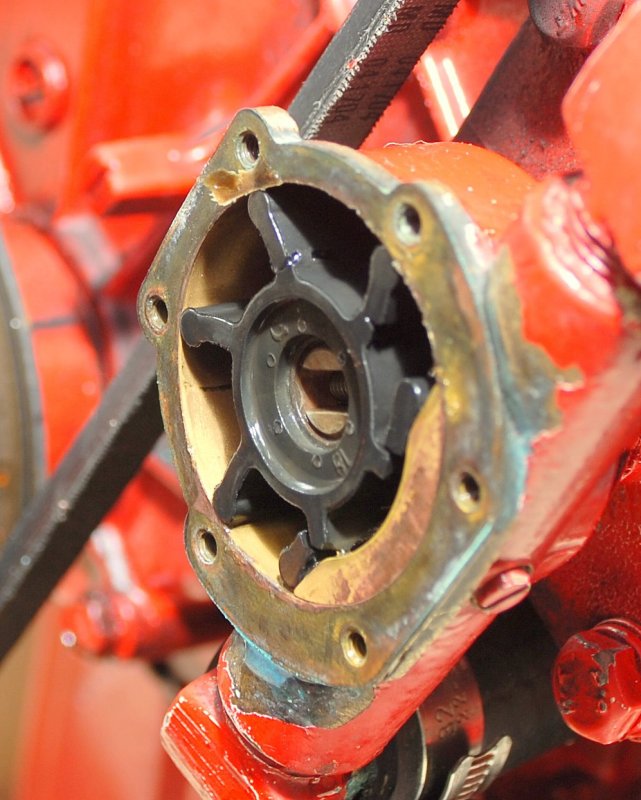
In this case Calder is merely advising to line the vanes up because in theory it will put less wear and tear on the vanes. The photo bellow proves that Casey is also right. Anyone who's ever replaced an impeller, and actually looked at the orientation of the old vanes before they removed it, will understand that it really does not matter.

On a diesel engine as it shuts down it often gives a little "kick back" on it's final revolution. This "kick back" can cause what you see in the photo. These vanes are cracked and the impeller is toast but it happens on new ones too. That photo was taken immediately after removing the cover plate for replacement and the engine put the vanes in that configuration not me..

Both are correct on this issue.. Even though I know about the "kick back" scenario I still always orient the vanes in the correct angle of attack out of habit..


Ross

.
Jun 15, 2004
14,693
Islander/Wayfairer 30 sail number 25 Perryville,Md.
Volvo recommends glycerine as a lubricant and a little dish soap also works. It rinses out soon enough.
 
Feb 6, 1998
11,759
Canadian Sailcraft 36T Casco Bay, ME
I coat it with wheel bearing grease when I install it.
Soap, Vaseline or Glycerine, which Johnson Pump supplies for all their impellers is what to use.

Here's what Johnson Pump says:

"Lubricate the shaft and the inside of the pump body and the end cover.
Use soap or vaseline (petroleum jelly) to help develop prime and prevent
damage from dry-running the pump at initial start-up. Lubricated impellers should not be stored for extended periods of time. Engine should be run after installation of a new impeller to wash out the lubrication. These recommendations also apply to
any service work on the pump and its components that require the use of lubrication inside the pump for assembly and start-up."

Wheel bearing grease will not wash out and it can damage the compound of many impellers.
 
Oct 2, 2008
3,811
Pearson/ 530 Strafford, NH
Hi Warren,
I read mv owners manuel for catalinas and the archives' threads and they follow Maine Sail, Casey, and others saying the new impeller should be lubed and compressed to slide back in place. Turning the shaft by hand slowly should allow the vanes to bend in the direction of function. The logic sound solid, but is it necessary. I look at Maine Sail's picture of a damaged impeller and would think it would be easy to go either way and get good results, (no expert either). I have an Atomic 4 gas engine which has a grease cup that has additional grease that can be squeezed into the impeller case to lube it throughout the season. A few turns on the cap squeezes that grease through a port to the gear. They suggest using the right lube so as not to eat-up the new impeller, otherwise I guess you'ld get good in changing them.
All U Get
 
Sep 25, 2008
2,288
C30 Event Horizon Port Aransas
I installed a new impeller greased inside the pump and ran the engine with the pump not being rebuilt, I motorored it to the boat house 10 hours. I can assure there was absolutely no grease when I pulled the pump to fully rebuild it.
I ran this impeller dry for a couple of minutes when I first left for that 10 hour trip, so I have to replace it again anyway. I don't trust it.
Thanks for the advice on what the pump people say though. I will follow that from now on.

Do you guys use anything to seal the gasket? I used wheel bearing grease like everything else got last time. I bought a new gasket in case that method doesn't work. I just wasn't sure about mounting it dry. I polished the face of the pump cover fortunately the last owners didn't flip it. So it just had a little corrosion from being in the rngine compartment but not wear.
 

Rick

.
Oct 5, 2004
1,098
Hunter 420 Passage San Diego
Hey Maine Sail
That pic of yours sure looks like an example of an impeller that is ready to be replaced. Do you have to wear sunglasses when you work with all that red? :)

Cheers
 
Dec 2, 1997
9,011
- - LIttle Rock
What I've learned over the years

You can never go too far wrong erring on the side of caution.

So if the cautious approach calls for making sure the vanes on an impeller are bent in the "right" direction, that's what I'd do. It takes maybe an extra 30 seconds.
 

RichH

.
Feb 14, 2005
4,773
Tayana 37 cutter; I20/M20 SCOWS Worton Creek, MD
Re: What I've learned over the years

ummmm .... caution ???!!!!!

Oh please ----- please take note that there is a cam shoe inside such a flex vane pump. At the very first contact between a vane and the cam shoe the vane will instantly re-align itself.
 

larryw

.
Jun 9, 2004
395
Beneteau OC400 Long Beach, CA
IMHO, Calder is in love with the sound of his own voice and tends to give out more info than you really need. I coat the impeller with winch grease and put a hose clamp on it to squeeze it down and get it started into the housing. One turn of the pump will arrange the vanes.
 
Status
Not open for further replies.