Closing the engine seacock while sailing?

Status
Not open for further replies.

Bob S

.
Sep 27, 2007
1,813
Beneteau 393 New Bedford, MA
The closing seacock thread has been interesting and it seems it's much safer but maybe not always convienent to close your seacocks when leaving the boat. I was out sailing today. I usually have to power for 15-20 minutes to clear a crowded mooring field. Someday I might be brave enough to sail through but until I develop better skills i don't want to risk it. I raise the main sail while still on the mooring and power out kill the engine and pull out the head sail. I don't close the engine seacock. Today we had some decent wind and I reefed the main. I was moving through the water beating through 2-4 ft seas. Does leaving the seacock open while sailing OK? I just got used to putting the engine in reverse. I can't tell you how many times I've started my engine in reverse. I really don't want to start her with the seacock closed......I made that mistake last season. :redface:
 
Jan 4, 2006
283
West Coast
Careful to the Point of Absurdity?

Yeah, I once forgot to open that valve, too, but that was in the slip and I was in a hurry. The usual overheating fun shortly ensued.

Which makes me think that if I'm under sail, and circumstances demand that I get that engine going immediately, I don't want to have to remember to jump down into the saloon, open the valve, then fly back up the companionway, and lunge for the starter button.

One, if it's an immediate danger (of whatever kind, and maybe I got myself into it) I want to have that engine running NOW;

Two, if it's an immediate danger, I might not have time to run back and forth;

Three, if it's an immediate danger, I probably shouldn't be taking my eyes off it or leaving the helm.

If the valve were closed, and it were a pressing situation, I'd feel the temptation to start the engine, try to maneuver, and shut it off before it got hot, and accept whatever damage happens to the pump vane, engine, and exhaust system.

In my book, the small risk to my yacht sailing with the valve open is more than acceptable, if it gives me the ability to be belching soot in a heartbeat.

I can't imagine any damage occurring by leaving it open.
 
Feb 26, 2004
23,353
Catalina 34 224 Maple Bay, BC, Canada
The concept is simple

Close the seacocks if you are NOT on the boat.

Your choice of what to do when you are ON the boat.

Some folks incorrectly think that if they're ON the boat and the open seacocks don't leak, then it's OK to leave 'em open when they're NOT there. That's the stupid crowd.

I agree that immediate engine starts are a safety issue. Mine is always open when I am on board the boat when not in the slip. I usually close it when we're in a guest slip, but it's open if we're anchored.

Also make sure your anti-siphon valve on the water out line right before the exhaust riser nipple connection is clean and clear.
 
Feb 26, 2004
23,353
Catalina 34 224 Maple Bay, BC, Canada
How refreshing!

can't tell you how many times I've started my engine in reverse. I really don't want to start her with the seacock closed.

Nice to know we're not alone...:doh:
 
Feb 6, 1998
11,760
Canadian Sailcraft 36T Casco Bay, ME
For $10.72

Bob,

My engine intake is open when I am on the boat but I do have three on-board high water alarms.

These high water alarms only run about $11.00 and are LOUD like a smoke detector. They are quite simple, reliable and run off a 9V battery so they can be placed anywhere.

If you have a leaking engine hose and you are on-board, even with the engine running, you'll know about it.

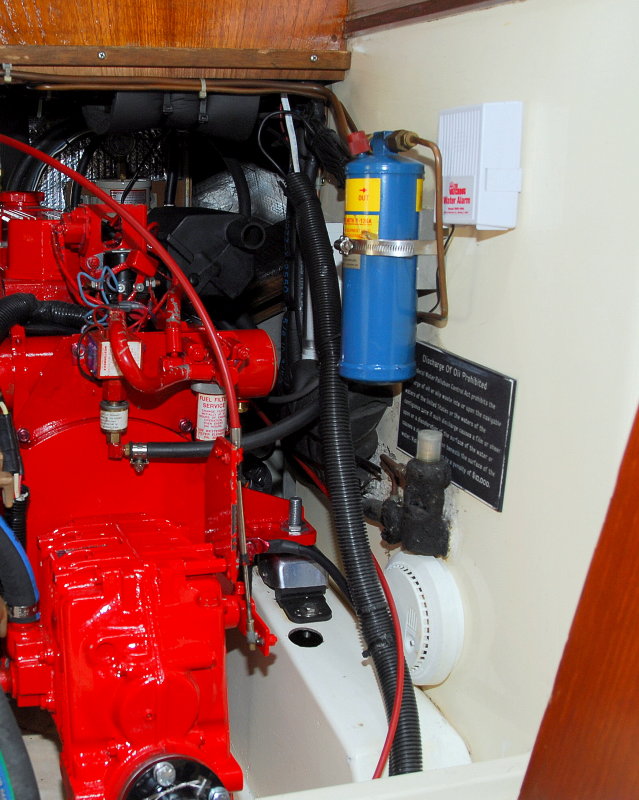
Basement Watchdog High Water Alarm (LINK)

Shown in upper right corner of photo, the little white box with red writing. The sensor sits below my gear box in the engine room sump.
 

Bob S

.
Sep 27, 2007
1,813
Beneteau 393 New Bedford, MA
Thanks, I hadn't thought about it but I do leave her open when anchored. I leave the key in the ignition too. Just in case! I'll check into the high water alarm too.
 
Jun 8, 2004
39
CS 27 - Nova Scotia (Pugwash)
Reverse lock

can't tell you how many times I've started my engine in reverse. I really don't want to start her with the seacock closed.

Nice to know we're not alone...:doh:
Is there a real justification in putting engine in reverse... I lock in forward and yes have started it in gear.
 
Feb 6, 1998
11,760
Canadian Sailcraft 36T Casco Bay, ME
Is there a real justification in putting engine in reverse... I lock in forward and yes have started it in gear.
Yes especially vs. forward. Most gear box manufacturers specifically state to not to leave it in forward and to instead leave it in neutral or locked in reverse.

Generally speaking leaving it in forward, while sailing, is a no, no with most gear boxes. You should always confirm this with your gear box manufacturer though because with some it does not matter one way or the other...
 
Dec 29, 2008
806
Treworgy 65' LOA Custom Steel Pilothouse Staysail Ketch St. Croix, Virgin Islands
No main engine seacock

We don't have a main engine seacock to open or close. Instead, we have closed system with a dry exhause through the mizzen mast. The engine cooling is circulated through an internal coolant reservoir which is in the keel, and the heat is dissipated through the hull skin. So, no seacock to worry about opening before starting. On the otherhand, it is a problem if you are cutting through the keel to remove some lead ballast, and manage to just cut into the bottom seam of both the 200 gallon main engine coolant tank, AND the 200 gallon center fuel tank. Ruins your entire weekend. Ever priced 200 gallons of antifreeze lately...

:eek:
 
Feb 26, 2004
23,353
Catalina 34 224 Maple Bay, BC, Canada
Transmission position

Is there a real justification in putting engine in reverse... I lock in forward and yes have started it in gear.
Hey, the title rhymes.:doh:

This comes up almost too often to make fun of anymore. It has become kind of a boating pox if you will that is highly unusual, in that very expensive transmissions can be ruined because the folks who buy boats don't read the instructions or go find them on the Internet.

It is not the boat size or builder, nor the engine, that determines the position when sailing. As Maine Sail said, it is the manufacturer of the transmission that determines the position.

Her's an example of how to find out what you should do with your shift lever: http://www.c34.org/wiki/index.php?title=The_Right_Transmission_Gear_for_Sailing

Read all the small print. Please.

Also search here on this board for "transmission position" and find many earlier posts on this very topic. It's almost like a CRITICAL KNOWLEDGE issue.

If you can't find out or know who made your transmission, come back here and tell us more details, like your engine type and size and year and the skippers here will most likely be able to help you specifically.

Also note that different transmissions use different fluids. My M25 uses ATF, others use engine oil. Be careful there, too.
 
Dec 29, 2008
806
Treworgy 65' LOA Custom Steel Pilothouse Staysail Ketch St. Croix, Virgin Islands
Transmission Position Disposition

Did you one better!

In my case, the previous thread about transmissions (marine gear), got me wondering, since mine will freewheel regardless of what position the gear selector is in. So, I went to the Borg Warner Velvet Drive manual and learned that in our case, it didn't matter. So, while we don't have to worry about it damaging our marine gear, nor can we lock in so it won't turn.

By the way, our engine control is my favorite part of the whole vessel. I've included a photo. If it hadn't been for this one item, we probably would have purchased a more practical boat!
 

Attachments

Jan 22, 2008
7
Beneteau 500 Cobb Island MD MD
can't tell you how many times I've started my engine in reverse. I really don't want to start her with the seacock closed.

Nice to know we're not alone...:doh:
same here as far as starting the engine in reverse (laughing) also I agree with the seacock leave it open. You will only start it once with the seacock closed so why take the chance,
 
Dec 29, 2008
806
Treworgy 65' LOA Custom Steel Pilothouse Staysail Ketch St. Croix, Virgin Islands
Re: For $10.72

Maine, if my engine, and engine room for that matter, looked that new and shiny, and you had a feather up your arse, we'd both be tickled!
 
Dec 27, 2005
500
Hunter 36 Chicago
Glad I'm not the only one who ever left an engine seacock closed. Now I hang the ignition key on the seacock whenever I close it and made a big sign "OPEN ENGINE SEACOCK" and placed it where everytime I enter the cabin I see it. It may seem like a dumb thing to some, but if it saves me a 20K engine I don't care.
 
T

tom lorenzen

keys on sea cock

place your boat keys on the seacock handls and you will never forget to turn on the seacock.


The closing seacock thread has been interesting and it seems it's much safer but maybe not always convienent to close your seacocks when leaving the boat. I was out sailing today. I usually have to power for 15-20 minutes to clear a crowded mooring field. Someday I might be brave enough to sail through but until I develop better skills i don't want to risk it. I raise the main sail while still on the mooring and power out kill the engine and pull out the head sail. I don't close the engine seacock. Today we had some decent wind and I reefed the main. I was moving through the water beating through 2-4 ft seas. Does leaving the seacock open while sailing OK? I just got used to putting the engine in reverse. I can't tell you how many times I've started my engine in reverse. I really don't want to start her with the seacock closed......I made that mistake last season. :redface:
 

BobM

.
Jun 10, 2004
3,269
S2 9.2A Winthrop, MA
A vote for open

I was sailing last friday and exited the harbor into conditions close to a small craft advisory (20+ knots of wind with three foot seas). If you want to learn how to sail you need experience right? I was solo, so I just had the main up with a single reef in. I was on a tack back into the harbor that was taking me a little to close to a channel marker :eek: for comfort. I reached down and fired up the diesel just to make sure I was going to make it. The goofy thing is that the transmission...of course...was in reverse :redface:...so it probably didn't help much! Cleared it fine though. In theory it was a positive thing that I could have used it to good effect, if necessary.

I certainly can say that I had a better sail than the poor sailboater aground (all the way aground...on its side and the keel with the mast at a 45 degree angle...luckily the bottom is gravel not rocks there) on Nixes Mate on Friday waiting for the tide. I hope all and the boat are okay!
 

Bob S

.
Sep 27, 2007
1,813
Beneteau 393 New Bedford, MA
Well i don't feel so bad, it seems many of us have started in reverse. BTW i do keep my key on the through hull when I leave the boat. Difficult to forget to open it when you retrieve the key from it. I was just wondering what the opinions where about leaving it open while on the boat.

BobM, we took about a 10 mile sail across Buzzards Bay to Quissett Harbor for a late lunch early dinner. While anchored I was listening to the Coast Guard and Sea Tow trying to rescue a 30' sailboat that grounded in Woods Hole. Heard the Pan Pan calls. Felt really bad for the owner.
 

BobM

.
Jun 10, 2004
3,269
S2 9.2A Winthrop, MA
Bob S. I felt terrible for the boat I saw too. I don't watch such things, but it seemed like a VERY low tide Friday afternoon. WYC sits in the water on pilings and it is the first time I recall seing the bottom of all of them. I was watching my chart like a hawk, which is tough to do solo in 20+ knots, and wishing I had installed my GPS at the helm already!
 
N

NC-C320

Cranking in Reverse

Your boat may be different, but for my Yanmar and the transmission attached, cranking the engine while engaged in reverse is fine. And if you need to crank it in an emergency situation and it's in reverse, what's the big deal. Once the engine is started, at idle speed, shift the engine into forward and open throttle as needed. It's a couple of seconds for the entire evolution, and during the time it's in reverse, nothing adverse is going to happen. By leaving the transmission in reverse when sailing, the prop and gearbox components do not rotate, thus reducing the wear on the gearbox items. And if sailing with any speed on when I need to start the engine, my boat won't shift out of reverse due to water pressure on prop and transmission until the engine is running, so starting in reverse is really the only way in these situations.
 

BobM

.
Jun 10, 2004
3,269
S2 9.2A Winthrop, MA
Oh it started fine in revere...just didn't do me any good, because by the time I figured it out I was already past the buoy.
 
Status
Not open for further replies.