Catalina all fractional now??

Nov 8, 2010
11,386
Beneteau First 36.7 & 260 Minneapolis MN & Bayfield WI
Its seems the Gerry and the team have decided to join the rest of the sailing world and go with fractional rigs? Hooray! Masthead rigs and huge genoas are a holdover from the CCA racing rule that favored them. While I'm not crazy about the traveler location, the new 5 series are great looking boats.

What's next on the list, sharkfin keels? Can't be long!
 
Feb 26, 2004
23,343
Catalina 34 224 Maple Bay, BC, Canada
Jack, IIRC, Gerry has called these 15/16th rigs "modified" masthead rigs. Or another word similar to "modified" trying to mean something close to: "close enough." :) If I remember the right word, I'll come back with it. It may be on CY's website and/or the brochures for any of
the new "5" series boats..
 
Nov 8, 2010
11,386
Beneteau First 36.7 & 260 Minneapolis MN & Bayfield WI
Jack, IIRC, Gerry has called these 15/16th rigs "modified" masthead rigs. Or another word similar to "modified" trying to mean something close to: "close enough." :) If I remember the right word, I'll come back with it. It may be on CY's website and/or the brochures for any of
the new "5" series boats..
Stu, good info!

15/16???? wow. The pix I was looking at make it look more like 9/10ths, which is what most modern hi-performance fract rigs are running.

To be effective even 9/10s needs a serious backstay adjuster however. You're right 15/16 offers you no leverage at all to bend/tune the mast/rig, and because of that makes it questionable to max-size the main which is part of the fractional advantage. I wonder why the notion of 15/16s, and why it looks like the 355 is much closer (at least in that rendering) to 9/10ths? I DO notice that the spreaders are inline and it has lower forward stays, so mast bending is not part of the intended program. All very interesting. Like you said 'modified masthead'!

If you find any more details behind the rig design, I'd be interested in reading about it.
 
Last edited:
May 23, 2004
3,319
I'm in the market as were . Colonial Beach
I heard that this was done because they are making bigger rigs to deal with the roller furling mains. It is supposed to get good performance. At least that was the word at the boat show last year.

I like the boats. they are sharp looking
 
May 10, 2008
392
Catalina 355 Boston
image.jpeg
Here is a shot of my 355 rig. It is technically a 15/16 rig. Although I've been told many things about why GD went with this rig, including being a design/balance issue, the biggest advantage I see is being able to fly the continuous line furler without a bale at the top. The boat can be ordered with a standard mast as well as boom furler (all still 15/16)
 
May 17, 2004
6,152
Beneteau Oceanis 37 Havre de Grace
I heard that this was done because they are making bigger rigs to deal with the roller furling mains. It is supposed to get good performance. At least that was the word at the boat show last year.
I was actually going to ask if fractional rigs were still a good choice with the increasing use of roller furling mains on cruising focused designs. Seems to me that in-mast roller furling negates the advantages of the fractional rig - you can't really use a powerful backstay adjuster (or you'd definitely have to ease it before furling), and you can't carry a large powerful main to provide the horsepower that's usually the engine of a fractional rig.

P.s. No Apple, I don't mean "fueling" every time I type "furling". Thanks for making me un-auto-correct it every time though.
 

druid

.
Apr 22, 2009
837
Ontario 32 Pender Harbour
At least they (apparently) have backstays. The 33ft Hunters and Beneteaus I looked at at the Boot Shoe last year were all backswept shrouds with no backstay at all. Great for having a party on the stern, not so good for flying a spinster (and iirc they were even fractional rigs!)

druid
 
Nov 8, 2010
11,386
Beneteau First 36.7 & 260 Minneapolis MN & Bayfield WI
At least they (apparently) have backstays. The 33ft Hunters and Beneteaus I looked at at the Boot Shoe last year were all backswept shrouds with no backstay at all. Great for having a party on the stern, not so good for flying a spinster (and iirc they were even fractional rigs!)

druid
Druid, Have a peek at the engineering of backstayless rigs. With proper sweep (usually 28 vs 22 degrees) and shroud/spar sizing, the triangulated rig is as strong or stronger that a backstayed rig. It's the standard way forward with square-top mainsails without the complexity of running backs. I've spent hours in 30+ knots of breeze with spinnaker up on several such boats. No problem at all. Dozens of boats from many manufactures offer such rigs. They don't fail.

 
Last edited:
May 23, 2004
3,319
I'm in the market as were . Colonial Beach
I like having a backstay. How do you bend the mast without a backstay with an adjuster?
 
Nov 8, 2010
11,386
Beneteau First 36.7 & 260 Minneapolis MN & Bayfield WI
I like having a backstay. How do you bend the mast without a backstay with an adjuster?
Ah. GREAT question. Someone is paying attention!

First of all there are two answers.
For boats with standard mainsails (Hunter B&R rigged) you don't get to bend the mast, and that a bad thing. You've lost a key way to shape the sail. I'm not interested (or going to talk much) about that.

But on to boats with SQUARE TOP mains. These boats cannot have fixed backstays because the sail would not clear them on a tack or gybe. So how do you bent the mast?

Answer? You don't! And that's all good!

I know that sounds strange coming from a fractional rig tuning freak, but there is something else at play. Its part of the shape of the sail. On a traditional triangle mainsail, the leech is supported sailcloth; ie it is under tension from the mainsheet. As is the rest of the sail. To get it to twist off or flatten you have to be very active with sail shape and position controls.

On a square top, all of the sailcloth outside the line drawn from the clew to the head is unsupported, and will twist off with excess pressure. That why these sails are ALWAYS full batten. The auto-twist means that as pressure comes up in the top of the sail, the sail reacts automatically and twists off. Ill see if I can find a pic taken up the leech; its an amazing thing. So you typically sail watching not the top but one telltale down while trimming, and let the sail do its thing.

Someday most sailboats will be like this. Its already happening.
 
Feb 6, 1998
11,759
Canadian Sailcraft 36T Casco Bay, ME
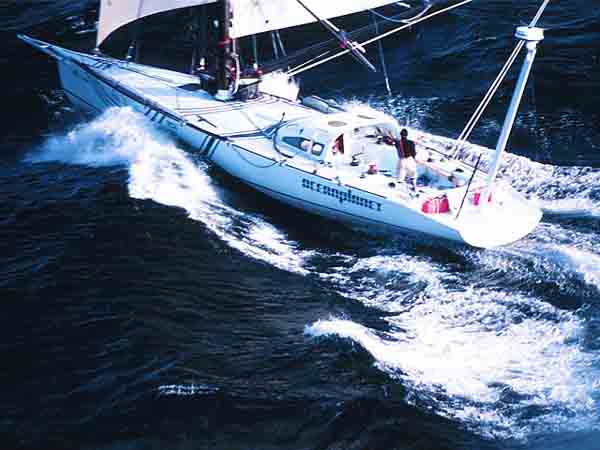
My gawd, and just to think my friend Bruce went around the world twice, in the roaring 40's, at an average speed of 11 knots with off-wind speeds in the high teens and max speeds in the 27-28 range all with an unstayed rig with no backstay. :yikes: Jeez I should have warned him he needed stays and especially a back stay... :wink:Heck he could jibe that boat down with with a mast-head chute and full main up in 30+ knots while all alone in the Roaring 40's............ Who needs stays.....:wink:

 
Nov 8, 2010
11,386
Beneteau First 36.7 & 260 Minneapolis MN & Bayfield WI
My gawd, and just to think my friend Bruce went around the world twice, in the roaring 40's, at an average speed of 11 knots with off-wind speeds in the high teens and max speeds in the 27-28 range all with an unstayed rig with no backstay..... :yikes:Heck he could jibe that boat down with with a mast-head chute and full main up in 30+ knots while all alone in the Southern Ocean......... Who needs stays.....:wink::wink:
That was an impressive lap for sure.. But Ocean Planet DID have running backs... both for forestay tension and to keep the stick up downwind. The great benefit of unstayed rigs ( and like plane wings) was to flex to leeward to relieve excess pressure. The value of stays however for forestay tension and rig support DW has to be dealt with.
 
Last edited:
Feb 6, 1998
11,759
Canadian Sailcraft 36T Casco Bay, ME
Thats an impressive lap for sure.. But Ocean Planet DID have running backs... both for forestay tension and to keep the stick up downwind.
Running back for sure but those are not a back stay in the typical sense. The stick on OP did not need the running back to stay up down wind for mast strength but it was used to tweak performance........ In fact to jibe that boat down wind he had to fully release the running backs and pull them forward. That mast was pretty amazing and even rotated under full load too.....
 
Nov 8, 2010
11,386
Beneteau First 36.7 & 260 Minneapolis MN & Bayfield WI
Running back for sure but those are not a back stay in the typical sense. The stick on OP did not need the running back to stay up down wind for mast strength but it was used to tweak performance........ In fact to jibe that boat down wind he had to fully release the running backs and pull them forward. That mast was pretty amazing and even rotated under full load too.....
Thats what I said. By 'stay up' I mean straight and powered-up. For sure the mast was designed to be very flexible and likely would not break downwind. Indeed like any boat of its type you release the runners (and get them the hell out of the way) before a gibe. But not having them on DW robs the rig of a lot of power, instead of pushing the boat downwind the push would just bend the mast.

We're both coming the same point from different sides; that good engineering can result in lots of new ways to solve old problems. Just because it does not conform to a person's notion of what's 'right' and how it's been 'done before' does not make it wrong. Far from it.
 
Last edited: