Even if I by the set I can't meet their $25 minimum order...ha! Going to have to find some other electrical stuff to order...maybe 30 feet of coax to replace my antenae wire.That looks exactly like the plug set on my circa '91 H23. If yours looks like that and you have a good deck socket, I'd consider buying just the male plug (if you can) and try it. The wires go into holes in the plug end and are fastened with small set screws.

Broke my mast foot...
- Thread starter jBlaze3000
- Start date

jBlaze3000,
Did you mention that there was some fraying of cabling ? Does that apply to your coax as well ?
If you DO buy replacement coax for your VHF, use RG-213 for the best signal transmission to the antenna. Make sure that ALL made up connections/splices (on deck and top of mast) are 'perfect' with no shorts from braid to the center conductor. Then, heat shrink or silicon grease the connections to minimize saltwater (any water) intrusion. That'll take care of some of that cash that's burning a hole in your pocket!
Light fixture replacements with LEDs is another way to release that extra cash as well !!
BTW, the type and orientation of the antenna ALSO has an impact on signal dispersal / focus...
Did you mention that there was some fraying of cabling ? Does that apply to your coax as well ?
If you DO buy replacement coax for your VHF, use RG-213 for the best signal transmission to the antenna. Make sure that ALL made up connections/splices (on deck and top of mast) are 'perfect' with no shorts from braid to the center conductor. Then, heat shrink or silicon grease the connections to minimize saltwater (any water) intrusion. That'll take care of some of that cash that's burning a hole in your pocket!
Light fixture replacements with LEDs is another way to release that extra cash as well !!
BTW, the type and orientation of the antenna ALSO has an impact on signal dispersal / focus...
For the trailerable sailboats with installed VHF anntennas, I use to run the coax thru the mast exiting a hole just a little bigger than the cable at an angle; thus, eliminating an unessecary black grommet to protect the coax sheathing as that required the cable to go thru the hole at right angles being subjected to wearing out the cover.
I used a Shakespeare PL-258LG deck plug which is a two inch long threaded that was permanently installed and well caulked into place. There is a cap that you can buy and affix to the deck to cover that plug outside to prevent it becoming wet. As for the end of the cable, I used a PL 259 which you can crimp down into the cable and seal it which worked well for a quick disconnect at the deck. I did leave extra cable in the mast for any future repairs. It worked well for me if installed and sealed correctly.
I used a Shakespeare PL-258LG deck plug which is a two inch long threaded that was permanently installed and well caulked into place. There is a cap that you can buy and affix to the deck to cover that plug outside to prevent it becoming wet. As for the end of the cable, I used a PL 259 which you can crimp down into the cable and seal it which worked well for a quick disconnect at the deck. I did leave extra cable in the mast for any future repairs. It worked well for me if installed and sealed correctly.

I would like to make a contribution to mast wiring we are now also talking about:
These may be strange for some but I went a different approach to get the mast wire –with disconnection- to the inside of the boat. On top of my mast are a VHF antenna and a combined anchor – three colors navigation light and halfway down I installed a steaming and deck light combination.
Through the mast are coming the coax cable and two three-wire cable; one for the anchor/navigation light and another for the steaming/deck light.
I did not want to put several through-deck connectors on my boat. I used one with a rubber insert, which allowed drilling of holes for cables as needed. The surrounding ring squeezed the cables nicely with the rubber to seal the through hull.
The three cables coming through a grommet and are routed into a plastic electrical wire box (Home Depot). Inside, are the electrical connectors allowing to separate the cables from the mast as needed. I cut a slot on the bottom of the box to the cable hole, so when the lid is screwed off the disconnected cable can be slide out of the box.
These may be strange for some but I went a different approach to get the mast wire –with disconnection- to the inside of the boat. On top of my mast are a VHF antenna and a combined anchor – three colors navigation light and halfway down I installed a steaming and deck light combination.
Through the mast are coming the coax cable and two three-wire cable; one for the anchor/navigation light and another for the steaming/deck light.
I did not want to put several through-deck connectors on my boat. I used one with a rubber insert, which allowed drilling of holes for cables as needed. The surrounding ring squeezed the cables nicely with the rubber to seal the through hull.
The three cables coming through a grommet and are routed into a plastic electrical wire box (Home Depot). Inside, are the electrical connectors allowing to separate the cables from the mast as needed. I cut a slot on the bottom of the box to the cable hole, so when the lid is screwed off the disconnected cable can be slide out of the box.
Attachments
-
 50.6 KB Views: 166
 -
 65.8 KB Views: 164
 -
 45.5 KB Views: 172
Yes, the cable that had the fraying ended up being the white coax (didn't know what it was for at the time). The cable for the mast lights appears to be in good condition, just missing the connector. After taking another look at the wire for the mast light, I see that that there are 3 wires coming out of it. The plug on the deck is definitely a 2 wire connection (same as the seadog part # mentioned earlier). Can I assume that one of these wires is just unused? I am going to pull the light off of the other end of the mast tonight and hopefully that will make things clearer. Here is a pic of the wire (sorry, was hard to get it focused):jBlaze3000,
Did you mention that there was some fraying of cabling ? Does that apply to your coax as well ?
If you DO buy replacement coax for your VHF, use RG-213 for the best signal transmission to the antenna. Make sure that ALL made up connections/splices (on deck and top of mast) are 'perfect' with no shorts from braid to the center conductor. Then, heat shrink or silicon grease the connections to minimize saltwater (any water) intrusion. That'll take care of some of that cash that's burning a hole in your pocket!
Light fixture replacements with LEDs is another way to release that extra cash as well !!
BTW, the type and orientation of the antenna ALSO has an impact on signal dispersal / focus...
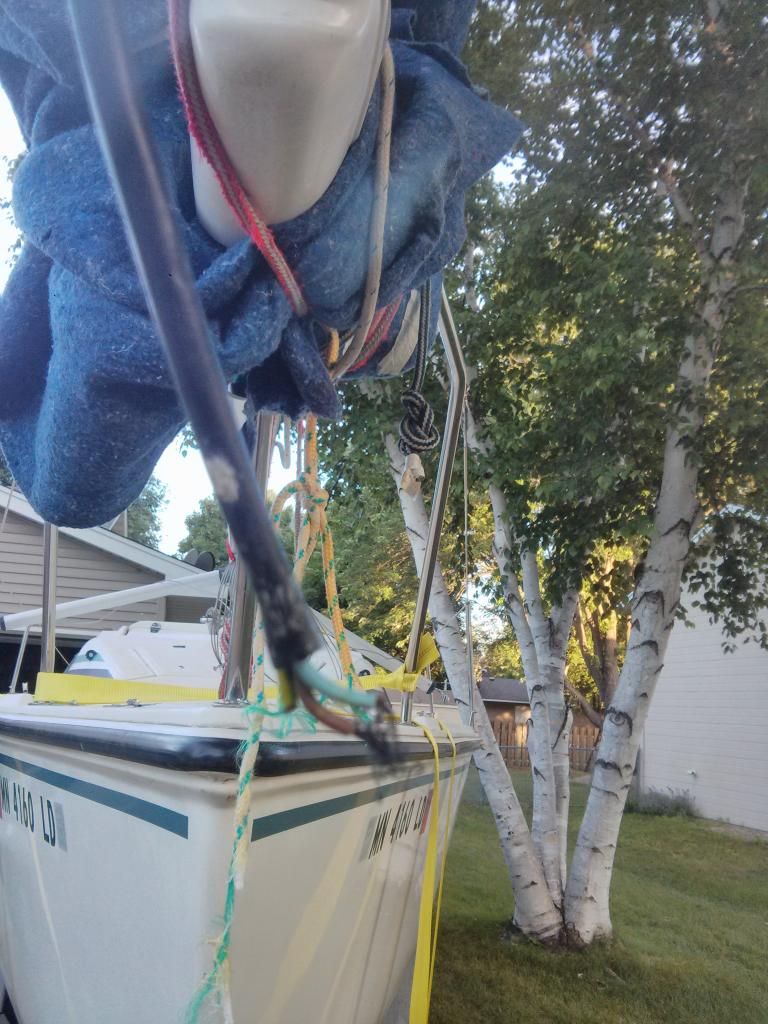
Nice setup.I would like to make a contribution to mast wiring we are now also talking about:
These may be strange for some but I went a different approach to get the mast wire –with disconnection- to the inside of the boat. On top of my mast are a VHF antenna and a combined anchor – three colors navigation light and halfway down I installed a steaming and deck light combination.
Through the mast are coming the coax cable and two three-wire cable; one for the anchor/navigation light and another for the steaming/deck light.
I did not want to put several through-deck connectors on my boat. I used one with a rubber insert, which allowed drilling of holes for cables as needed. The surrounding ring squeezed the cables nicely with the rubber to seal the through hull.
The three cables coming through a grommet and are routed into a plastic electrical wire box (Home Depot). Inside, are the electrical connectors allowing to separate the cables from the mast as needed. I cut a slot on the bottom of the box to the cable hole, so when the lid is screwed off the disconnected cable can be slide out of the box.
I see you mentioned a 3-wire cable as well. I think I am going to have bring home a 12 volt power supply from work and play with these lights a little more.