Hey everyone, first-time poster here.
I just picked up an '84 Catalina 30 Mark 1 and I’m working on getting her ready for the Bay. Since I’m both a new owner and a new sailor, I’m trying to be as thorough as possible. I really want to go over every inch of the boat before I take her out—I’d much rather find an issue at the slip than have a "learning moment" out on the water.
Welcome to the club. I have had my 88 C30 TR/BS for 27-years and am still in love.
I’m getting close to the end of my initial checklist. The main tasks left are the standard engine maintenance (oil, fuel filter, and separator), but I’m also going to inspect the steering quadrant and cables. I also need to move the oil pressure gauge from the dinette area—no idea why it was put down there—back to the instrument panel in the cockpit where it belongs.
It is probably there because there is no place on the engine panel. The original panel for the M35 did not have an oil pressure gauge. It only has a low oil pressure light and alarm busser.
I’ve attached a photo with a label "
This?" showing a component with two hoses coming out of the top. One hose goes under the sink to an anti-siphon loop, and the other end of that loop is just a cut hose laying in the engine bay. Right near it is a thru-hull with a matching piece of cut hose attached (the valve is closed). I cannot see any photo with "this" on it.
From the description, it sounds like you are talking about the hose from the heat exchanger [which is the gray cylinder with the bolted end cap in photo 2 under the wire for the oil pressure gauge] The vented loop carrys the discharge seawater from the heat exchanger to a vented loop next to the sink and then drops down to water injection port on the mixing elbow. This is the 1.5" iron pipe that connects the exhaust manifold to the water lift muffler [I think this is what you are calling the upside-down sink]. This hose is critical for cooling the exhaust before it goes into the muffler.
The previous owner had no idea what it was for and just left it. I don't think it's the raw water intake, as there’s another thru-hull right next to it that goes straight to the engine (and I’ve confirmed water is discharging from the exhaust). Still, seeing a cut hose attached to a thru-hull makes me nervous, and I’d love to know what this system originally did before I try to re-plumb it.
There is a thru hull just to port of the rear engine access panel behind the muffler. This is used to drain the galley sink.
I’ve run into a few other mystery items and some corrosion I can’t quite identify (photos attached). If anyone can tell me what I’m looking at, I’d appreciate it. Also, for the corroded parts: do these look like they just need a wire brush and some inhibitor, or should I be looking at a total replacement?
The red thingy with three heavy wires going to it is a diode battery isolator. It receives the current from the alternator and sends it to the house battery and the start battery without needing to change the battery selector switch. The small relay [four wires connected to it] which is on the port side of the exhaust manifold above the starter motor is a glow plug relay. This is a very nice upgrade that ensures that the glow plugs recieve enough current and voltage to get hot enough to start the engine. I am not seeing the corrosion you are mentioning so I do not see anything that is unusual in that regard.
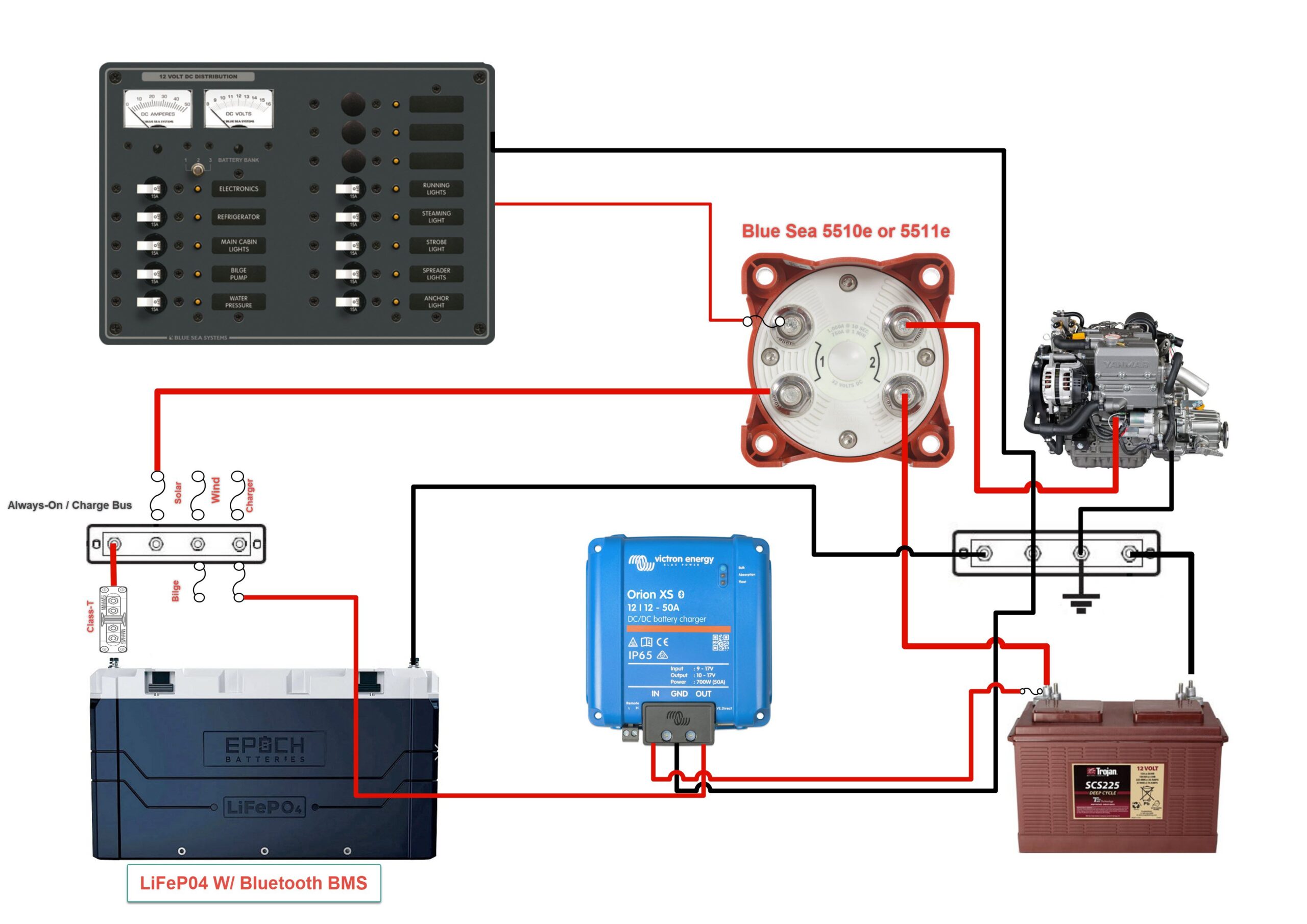
The previous owner let both AGMs sit and die completely. My jump pack got the engine started for the Inspection, but I haven't been able to bring them back to life. I’m trying to decide if I should just drop $1k on new AGMs or finally do the LiFePO4 conversion for the house bank since I already have the lithium batteries, solar panels, and a controller. My main hang-up is how to keep an AGM starter battery while running the house bank on Lithium, and the best way to handle charging both at the same time.
I have 560Ah of LFP battery for my house bank and love it so I would always sat go lithium. Seeing the battery isolator, you are probably already set up adequately for a split AGM start / LFP house. That is what I have although I upgraded the diode isolator to an ArgoFET isolator which eliminates the problem of the 0.7v drop across the diodes. LFP and AGM or FLA have very similar charging needs and as long as they are isolated for loads, can very happily be charged together.
Please ignore the "ungodly" wiring in the photos—it was like that when I got here! I’m planning a full cleanup with Blue Sea bus bars and proper crimps, but for now, I’m just focused on making her safe enough to sail. I’m saving the heavy lifting—like the full rewire and engine detailing—for the haul-out later this year. (My wife and I tried to reglaze the portlights, but the frames are just toast. At least it's not a rainforest inside anymore, but they still weep a bit.) One way to seal the old aluminum ports is to eliminate the aluminum.
Many Mk1 owners have removed the ports and cut new acrylic lenses that are glued to the outside surface of the cabin top. They end up looking more like the Mk2 fixed ports.
Anyway, sorry for the long-winded first post. I’m a little nervous getting this out there, but I’m looking forward to your responses and any constructive criticism you have for me!
View attachment 236466View attachment 236467View attachment 236468View attachment 236469View attachment 236470