Brand New Sailor and First-Time Catalina Owner... Help Needed

Feb 3, 2026
7
Catalina 1984 catalina 30 Mark 1 Sausalito
Hey everyone, first-time poster here.

I just picked up an '84 Catalina 30 Mark 1 and I’m working on getting her ready for the Bay. Since I’m both a new owner and a new sailor, I’m trying to be as thorough as possible. I really want to go over every inch of the boat before I take her out—I’d much rather find an issue at the slip than have a "learning moment" out on the water.

I’m getting close to the end of my initial checklist. The main tasks left are the standard engine maintenance (oil, fuel filter, and separator), but I’m also going to inspect the steering quadrant and cables. I also need to move the oil pressure gauge from the dinette area—no idea why it was put down there—back to the instrument panel in the cockpit where it belongs.

I’ve attached a photo with a label "This?" showing a component with two hoses coming out of the top. One hose goes under the sink to an anti-siphon loop, and the other end of that loop is just a cut hose laying in the engine bay. Right near it is a thru-hull with a matching piece of cut hose attached (the valve is closed).

The previous owner had no idea what it was for and just left it. I don't think it's the raw water intake, as there’s another thru-hull right next to it that goes straight to the engine (and I’ve confirmed water is discharging from the exhaust). Still, seeing a cut hose attached to a thru-hull makes me nervous, and I’d love to know what this system originally did before I try to re-plumb it.

I’ve run into a few other mystery items and some corrosion I can’t quite identify (photos attached). If anyone can tell me what I’m looking at, I’d appreciate it. Also, for the corroded parts: do these look like they just need a wire brush and some inhibitor, or should I be looking at a total replacement?

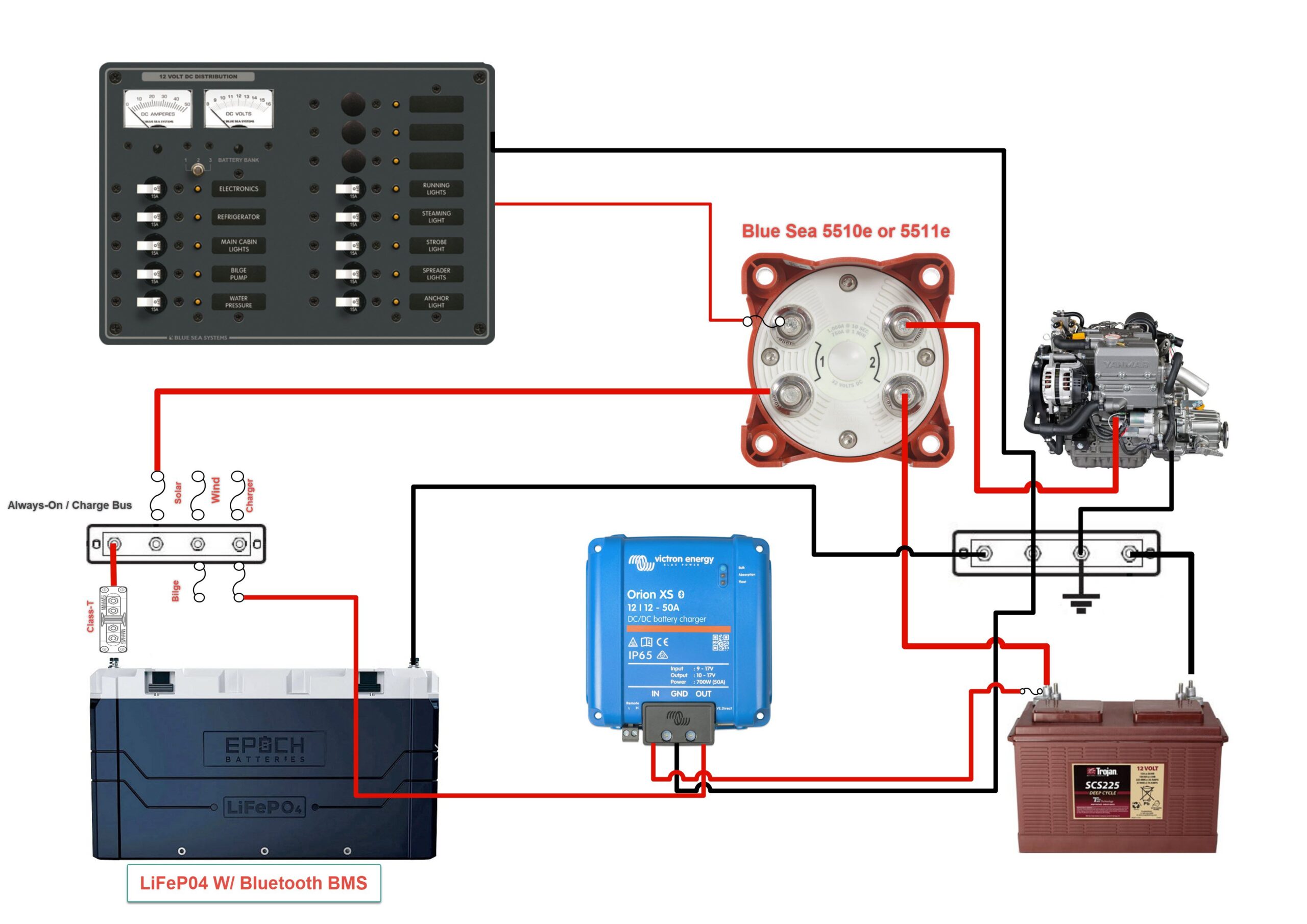
The previous owner let both AGMs sit and die completely. My jump pack got the engine started for the Inspection, but I haven't been able to bring them back to life. I’m trying to decide if I should just drop $1k on new AGMs or finally do the LiFePO4 conversion for the house bank since I already have the lithium batteries, solar panels, and a controller. My main hang-up is how to keep an AGM starter battery while running the house bank on Lithium, and the best way to handle charging both at the same time.

Please ignore the "ungodly" wiring in the photos—it was like that when I got here! I’m planning a full cleanup with Blue Sea bus bars and proper crimps, but for now, I’m just focused on making her safe enough to sail. I’m saving the heavy lifting—like the full rewire and engine detailing—for the haul-out later this year. (My wife and I tried to reglaze the portlights, but the frames are just toast. At least it's not a rainforest inside anymore, but they still weep a bit.)

Anyway, sorry for the long-winded first post. I’m a little nervous getting this out there, but I’m looking forward to your responses and any constructive criticism you have for me!


20260202_114826(0).jpg20260202_114832.jpg20260202_114846.jpgUnknown attached to alt.jpgwater pump.jpg
 

dmax

.
Jul 29, 2018
1,278
Telstar 28 Buzzards Bay
If you're referring to the second photo, the gray cylinder with two hoses coming out of the top is your heat exchanger - you''ll defintely want that hooked-up.
 
  • Like
Likes: AspiringCapt
Feb 3, 2026
7
Catalina 1984 catalina 30 Mark 1 Sausalito
If you're referring to the second photo, the gray cylinder with two hoses coming out of the top is your heat exchanger - you''ll defintely want that hooked-up.
Its the third picture It isnt the best as it only shows the corner of it. I’m going to the boat this weekend to try and figure out where the other hose goes. It’s attached to what can best be described as an upside-down icebox in the engine bay. So far, I’ve only found where one side goes, which is the anti-siphon valve, leading to a cut hose next to the thru-hull. I will see if the other end connects to the heat exchanger

What is the best way to remove an old hose from the plastic valve attached to the thru-hull without risking breaking it and having water start dumping into the boat? I’ll post more pictures this weekend when I’m back at the boat
 
Apr 25, 2024
749
Fuji 32 Bellingham
My recommendation is to stay with AGM, but only based on some assumptions. LFP installation is a bit nuanced and there isn't a lot of accurate information out there that is easy to understand. If you have a solid grasp of electrical engineering, LFP specifically, and marine mechanics and electrical, then LFP might be a good option. LFP conversion isn't particularly difficult, but there are several considerations that make it non a no-brainer.

So, the long answer is it depends on your background and willingness to learn and take a few risks.

My sense is that, being new to this, you are looking more for reliability and confidence. Even though LFP offers distinct long-term advantages, it is not the path of least resistance between you and sailing a boat you can feel confident on. Nothing wrong with AGM and you can definitely upgrade to LFP later.

My inclination for a later upgrade would be keep your starter battery as AGM and replace your house battery with LFP. But, honestly, unless you need to run a load on the house battery beyond a few LED lights, radio, etc. you can get away with just a single AGM for now, then consider adding either a LFP or AGM later for a separate house battery. If you're just going to daysail or do quick overnighters, this is perfectly reasonable - especially if you keep an emergency starter jump pack, just in case.

---

As for the hose, it isn't clear to me what you are asking. I can say this much, though. If you have a hose with an anti-siphon loop - the reason for that loop is because one end of the hose was meant to attach to a through-hull.

It would help to know what the hose is attached to, what (if anything) is attached to the through-hull, and what is above the through-hull. These things aren't clear to me, from your description and pictures. As I am understanding it, you have a hose that is attached to some part of your engine assembly, it has an anti-siphon loop, and it terminates near a through-hull. And, there is nothing attached to the through-hull. Is that much right?

As for corrosion, I don't see anything in the photos that suggests complete replacement, nor anything that screams urgency. You might have (or have had in the past) failed zincs. You'll want to check that - but you want to do that anyway, just as routine maintenance. Don't forget the one in your heat exchanger.
 
  • Like
Likes: AspiringCapt
Mar 6, 2008
1,432
Catalina 1999 C36 MKII #1787 Coyote Point Marina, CA.
The upside down container is the wet muffler where the hot exhaust is mixed with sea water then pushed out of the exhaust hose. The siphoned break is to prevent sea water from being siphoned back into the engine. Connect that back up as soon as possible. Download the manual from Sail La Vie | 1999 Catalina 36 MK II. This is for a Catalina 36 , but the setup is the same for exhaust.
 
Feb 3, 2026
7
Catalina 1984 catalina 30 Mark 1 Sausalito
The upside down container is the wet muffler where the hot exhaust is mixed with sea water then pushed out of the exhaust hose. The siphoned break is to prevent sea water from being siphoned back into the engine. Connect that back up as soon as possible. Download the manual from Sail La Vie | 1999 Catalina 36 MK II. This is for a Catalina 36 , but the setup is the same for exhaust.
Thank you so much. That's great to know. I had assumed the engine cooling was fine, as the previous owner opened one through-hull, and when we started the engine, it pumped water out the stern of the boat. I will fix this this weekend and make a note that both through-hulls need to be opened prior to running. Do you have any advice on how to get the old hose off the plastic valve attached to the through hull without risking breaking the valve? that way I can go to west marine down the road and get a new piece a hose.
 
Feb 3, 2026
7
Catalina 1984 catalina 30 Mark 1 Sausalito
My recommendation is to stay with AGM, but only based on some assumptions. LFP installation is a bit nuanced and there isn't a lot of accurate information out there that is easy to understand. If you have a solid grasp of electrical engineering, LFP specifically, and marine mechanics and electrical, then LFP might be a good option. LFP conversion isn't particularly difficult, but there are several considerations that make it non a no-brainer.

So, the long answer is it depends on your background and willingness to learn and take a few risks.

My sense is that, being new to this, you are looking more for reliability and confidence. Even though LFP offers distinct long-term advantages, it is not the path of least resistance between you and sailing a boat you can feel confident on. Nothing wrong with AGM and you can definitely upgrade to LFP later.

My inclination for a later upgrade would be keep your starter battery as AGM and replace your house battery with LFP. But, honestly, unless you need to run a load on the house battery beyond a few LED lights, radio, etc. you can get away with just a single AGM for now, then consider adding either a LFP or AGM later for a separate house battery. If you're just going to daysail or do quick overnighters, this is perfectly reasonable - especially if you keep an emergency starter jump pack, just in case.

---

As for the hose, it isn't clear to me what you are asking. I can say this much, though. If you have a hose with an anti-siphon loop - the reason for that loop is because one end of the hose was meant to attach to a through-hull.

It would help to know what the hose is attached to, what (if anything) is attached to the through-hull, and what is above the through-hull. These things aren't clear to me, from your description and pictures. As I am understanding it, you have a hose that is attached to some part of your engine assembly, it has an anti-siphon loop, and it terminates near a through-hull. And, there is nothing attached to the through-hull. Is that much right?

As for corrosion, I don't see anything in the photos that suggests complete replacement, nor anything that screams urgency. You might have (or have had in the past) failed zincs. You'll want to check that - but you want to do that anyway, just as routine maintenance. Don't forget the one in your heat exchanger.
I'm going to be going to the boat this weekend with the wife to do more work, so I will try to get better pictures. I will keep the agms for now, as I do Have a 2000 watt gen that can be used in the worst case to charge the house bank while at anchor if needed.

As far as the hose goes, I haven't found where the other end goes, but like I said in my post, one end is lying next to a closed through-hull with a piece of the same hose attached, also cut and lying there. and the other end goes to the anti-siphon valve, to what another poster said is my wet muffler, so I'm going to look at the manual and see where the other end goes to. and get that piece connected back up this weekend
 

dmax

.
Jul 29, 2018
1,278
Telstar 28 Buzzards Bay
To remove old hose: Take off any clamps, cut the hose lengthwise with a new utility knife where it is attached - if it is wire re-enforced, use diagonal pliers to cut the wire. If necessary, jam a screwdriver or something into the slit to open up the hose.
 
  • Like
Likes: AspiringCapt
Feb 3, 2026
7
Catalina 1984 catalina 30 Mark 1 Sausalito
The upside down container is the wet muffler where the hot exhaust is mixed with sea water then pushed out of the exhaust hose. The siphoned break is to prevent sea water from being siphoned back into the engine. Connect that back up as soon as possible. Download the manual from Sail La Vie | 1999 Catalina 36 MK II. This is for a Catalina 36 , but the setup is the same for exhaust.
I downloaded the manual for my Mark 1, but I’m actually even more confused now. I’m going to wait until I get to the boat to investigate further. The manual shows that the thru-hull next to the engine intake is for a galley sink saltwater intake. However, if I remember correctly, that line went to the anti-siphon valve, which doesn’t make much sense.

Cross-referencing the manual, it shows the anti-siphon valve should be attached to the engine. This makes it even more confusing because, in theory, if that valve is disconnected, water shouldn't have been coming out of the stern—it should have been dumping into the bilge from the 'cooling water discharge' side of the anti-siphon valve.

Now I’m questioning if I’m a complete idiot and just missed something, which is likely the case! If it turns out that secondary thru-hull is just for the saltwater sink, I need to figure out how to hook it back up correctly or just plug it off for good
 
Feb 3, 2026
7
Catalina 1984 catalina 30 Mark 1 Sausalito
To remove old hose: Take off any clamps, cut the hose lengthwise with a new utility knife where it is attached - if it is wire re-enforced, use diagonal pliers to cut the wire. If necessary, jam a screwdriver or something into the slit to open up the hose.
Thank you Sir, Do you have any Idea what the red thing is in my 2nd to last picture? It attaches directly to the alternator. then some Amcore wire that runs back to my electrical panel?
 
May 17, 2004
5,954
Beneteau Oceanis 37 Havre de Grace
Thank you Sir, Do you have any Idea what the red thing is in my 2nd to last picture? It attaches directly to the alternator. then some Amcore wire that runs back to my electrical panel?
The red thing itself is a heat sink for dissipating excess heat from some piece of electronics. They’re often attached to old style diode based battery isolators, but I’m not sure that’s what’s under it based on the picture. Voltage regulator like dmax said is a possibility too. If it is a splitter there are much better and more efficient ways to achieve that now. The old diode based splitters waste energy as heat (thus the need for the heat sink fins) and reduce output voltage so batteries don’t charge very well.
 
  • Like
Likes: AspiringCapt
Mar 6, 2008
1,432
Catalina 1999 C36 MKII #1787 Coyote Point Marina, CA.
AspiringCapt
There are many Catalinas in your marina. Find one of your vintage and ask the owner to show you his boat engine exhaust setup. They are all the same.
I believe your exhaust hose exits the haul below water level and there is a valve there on the hose to prevent water siphoning back into your engine as the engine is below water level. The siphon break is designed to prevent water siphoning back into your engine.
On my C36 the hose exits the hull above water but it has a siphon break anyway.
Do not run the engine without reconnecting the siphon break hose.