
Bottom Paint
- Thread starter Brenda
- Start date
- Status
- Not open for further replies.

Brenda,
assuming you mean antifouling paint I have just been doing this on Fyne Spirit. Over the years many coats have been applied and now the paint doesn't adhere properly and the surface is rough. There is some fellow up north who has invented a wet sanding machine which is good for antifouling but it is not practical for him to come down. Dry sanding is slow and the paper clogs, so scraping is how we are removing the bulk of the material, then a finish sand and epoxy primer before appliying new AF. It is a horrible, dirty job, and even with facemask, goggles and hat the stuff still gets everywhere. The shower floor looks like the bottom of a dry dock! Best method is to offer friends 8 hours sailing in exchange for two hours work. Many hands definitely make light work in this case.
Best regards,
assuming you mean antifouling paint I have just been doing this on Fyne Spirit. Over the years many coats have been applied and now the paint doesn't adhere properly and the surface is rough. There is some fellow up north who has invented a wet sanding machine which is good for antifouling but it is not practical for him to come down. Dry sanding is slow and the paper clogs, so scraping is how we are removing the bulk of the material, then a finish sand and epoxy primer before appliying new AF. It is a horrible, dirty job, and even with facemask, goggles and hat the stuff still gets everywhere. The shower floor looks like the bottom of a dry dock! Best method is to offer friends 8 hours sailing in exchange for two hours work. Many hands definitely make light work in this case.
Best regards,

Removing old epoxy bottom paint
Like Mike says Brenda this is a filthy horrible job. I did it once when I was young and fit That was over 30 years ago. Are you going to try this yourself? better to get a couple of kids and pay em to do the dirty work. One more thing! after you get it done I hope your not gonna re apply epoxy bottom paint. Use ablative paint. 3 coats first coat one color next two of a different color when the top 2 coats where down to where you can see the first coat, time to put more on. You will never have to strip the bottom again
Like Mike says Brenda this is a filthy horrible job. I did it once when I was young and fit That was over 30 years ago. Are you going to try this yourself? better to get a couple of kids and pay em to do the dirty work. One more thing! after you get it done I hope your not gonna re apply epoxy bottom paint. Use ablative paint. 3 coats first coat one color next two of a different color when the top 2 coats where down to where you can see the first coat, time to put more on. You will never have to strip the bottom again

Use stripper....... avoid sanding if you can, but it you have to, don't use disc sander - it will gouge right through the gel coat in a flash. Make sure you check boatyard restrictions on sanding. Out here you must skirt the boat and have a vacuum attached to the oscillating sander to keep residue off neighboring boats. Also, if you're sanding, cover the top of the boat to keep residue from settling on it. The stuff is difficult to hose off...

A lot of the professional yards use razor blades and windshield scraper razor blade holders. My Awlgrip guy uses razor blades to strip old Awlgrip from hulls too. They work very well, are cheap, and you can remove a lot of paint quickly.
Two yard guys scraped the majority of the paint off my 36' hull in 4 1/2 hours time. I did my own C-30 about ten years ago with razor blades and did the bulk of it alone in about eight or nine hours. I NO LONGER do my own bottom work!! Yee haa!
The scraper will only get you part way and you'll still need to sand, fair and check for moisture in the laminate before applying a barrier coat. Paint strippers will work too but have temp ranges and precautions and are not always as "easy" as they seem, especially for those of us up North. Many yards like scraping because it means lots less dust and it can actually take less time for them than using paint strippers.
This is at the one hour mark:
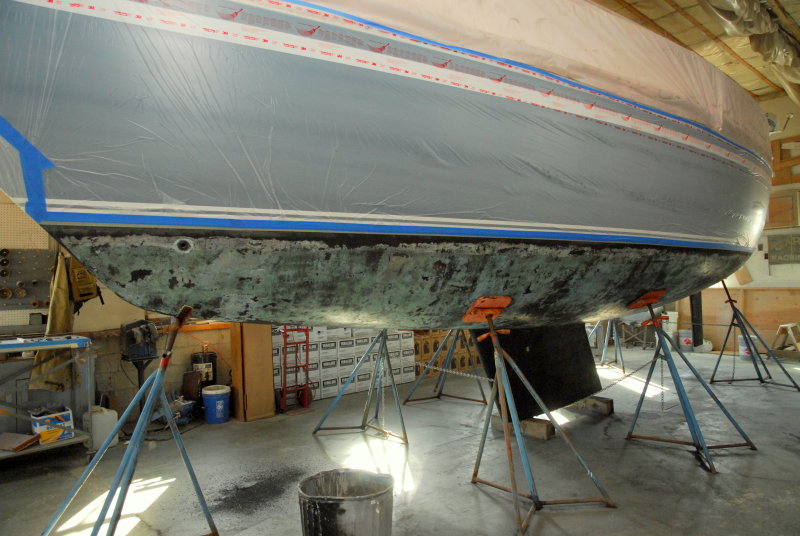
Checking hull moisture content:

I also faired and wrapped the keel joint a the same time:
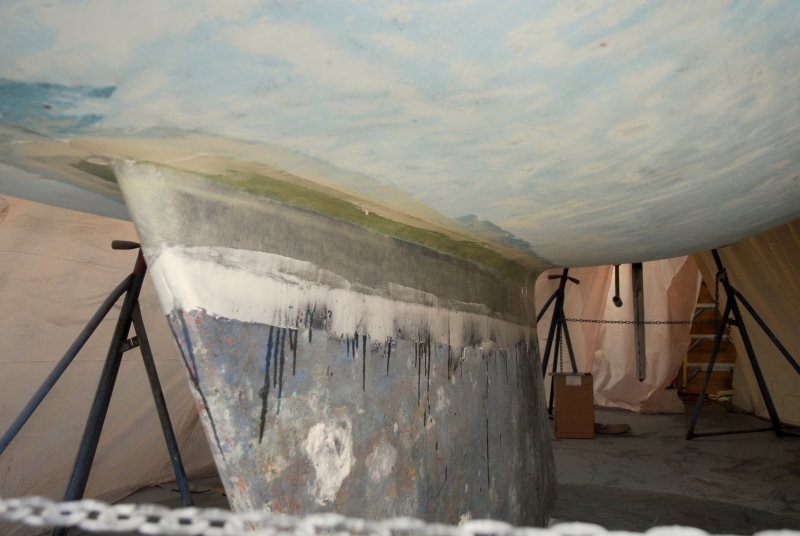
After sanding & fairing:
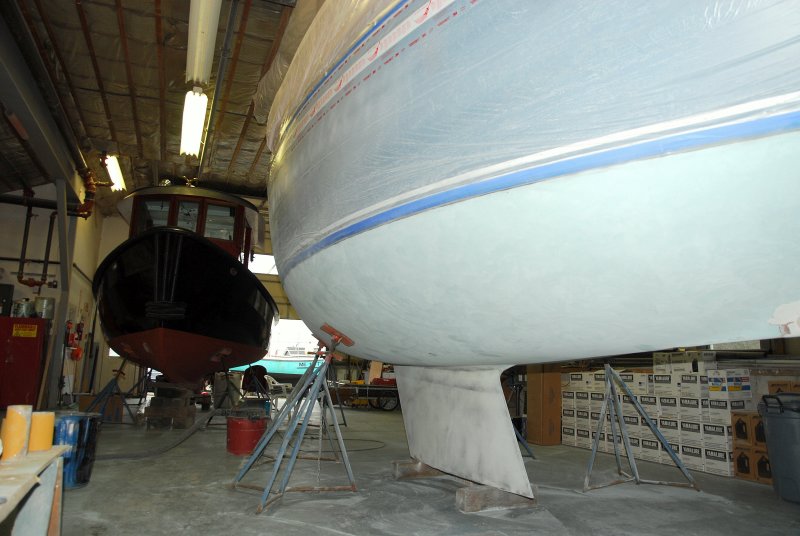
Barrier coat done:
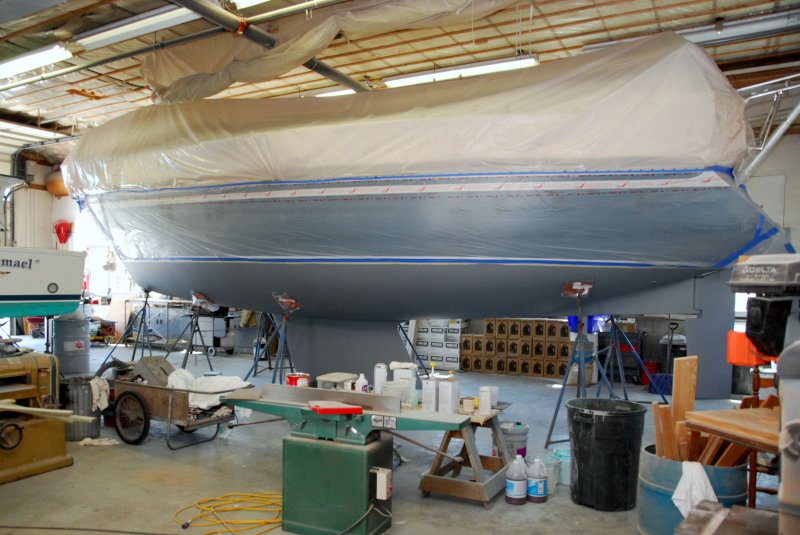
Done:
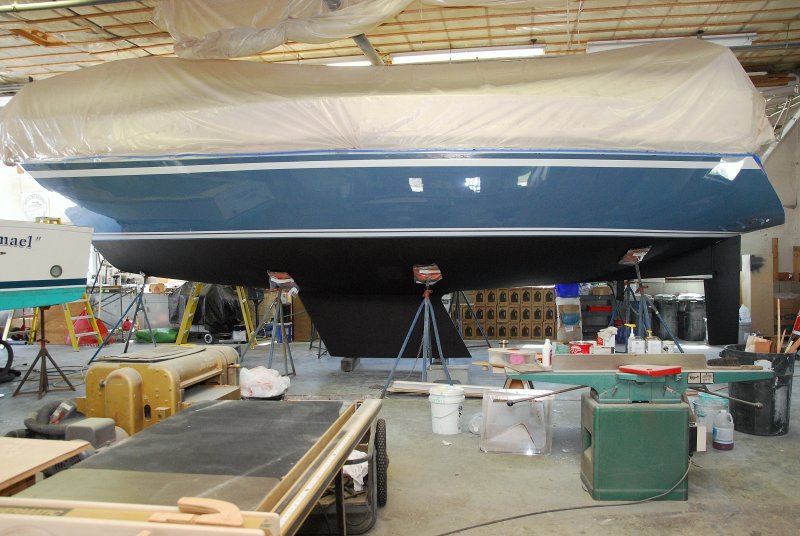
Two yard guys scraped the majority of the paint off my 36' hull in 4 1/2 hours time. I did my own C-30 about ten years ago with razor blades and did the bulk of it alone in about eight or nine hours. I NO LONGER do my own bottom work!!
Yee haa!The scraper will only get you part way and you'll still need to sand, fair and check for moisture in the laminate before applying a barrier coat. Paint strippers will work too but have temp ranges and precautions and are not always as "easy" as they seem, especially for those of us up North. Many yards like scraping because it means lots less dust and it can actually take less time for them than using paint strippers.
This is at the one hour mark:
Checking hull moisture content:
I also faired and wrapped the keel joint a the same time:
After sanding & fairing:
Barrier coat done:
Done:

I used Peel Away paint stripper. It works great with very little effort. Apply it like mayonnaise, cover it up and leave it alone for a day. Don't be cheap, lay it on thick. Remove the paper cover and using a wide mouth scrapper the paint just falls off. Wash down the hull after and give it a light sanding before you start painting.

I'd think twice about paying a couple of kids to work with toxic material.Like Mike says Brenda this is a filthy horrible job. I did it once when I was young and fit That was over 30 years ago. Are you going to try this yourself? better to get a couple of kids and pay em to do the dirty work. One more thing! after you get it done I hope your not gonna re apply epoxy bottom paint. Use ablative paint. 3 coats first coat one color next two of a different color when the top 2 coats where down to where you can see the first coat, time to put more on. You will never have to strip the bottom again

tried this
I tried both the Home Depot and Marine versions about 5 yrs ago and noted a significant difference. I spoke with the company and it was an issue of concentration of the active ingredients.As I have stated previously...I checked the MSDS's for the home depot peel away and the marine "fiberglass safe" version and they are identical.

I'd highly recommend going with a the full-face respirator, as they're a lot more comfortable and protective than the half-mask with goggles or glasses.
Mainesail, do you have a picture of the razor scraper? I am about 75% through with a tungsten scraper which is used roughly perpendicular to the surface. The outer layers of paint are quite brittle so each sweep fires a load of pieces and dust all over the place. However, it does seem that the paint beneath is of a different type and much softer. The top paint was an ablative type.
Thanks,
Thanks,

Yes. However, if you wear glasses you will need to make allowances.
But I agree - full face respirators are MUCH better. I have one that adapts to either filters or supplied air (like snubba) which allows me to work with anything in any space... within some limits. You still have to watch flammability.
Fit can be an issue for those with very slender faces.
I love ablative paints. Time it right and you can avoid build up for many years. Only spot sanding and scraping will be needed.
I have a special set of stubby glasses I use. Others use inserts for dive masks.I'd highly recommend going with a the full-face respirator, as they're a lot more comfortable and protective than the half-mask with goggles or glasses.
But I agree - full face respirators are MUCH better. I have one that adapts to either filters or supplied air (like snubba) which allows me to work with anything in any space... within some limits. You still have to watch flammability.
Fit can be an issue for those with very slender faces.
I love ablative paints. Time it right and you can avoid build up for many years. Only spot sanding and scraping will be needed.

I stripped all the ancient hard antifouling from our 19' sailboat this spring and it was a real pain, so I have much sympathy for those of you stripping larger boats.
- sanding was way too slow, hard and it fills the air with toxic blue dust. Bunny-suit and respirator definitely necessary
- our bottom paint was too hard to scrape, and scraping was more likely to cause gelcoat injury
- solvent based strippers were either ineffective, TOO effective (attacked gel-coat) or dried in 90 min and were harder to remove in any case
Long story short, I tried everything from sanding, scraping, pressure-wash, and a few different types of chemical stripper, and the absolute best technique for me was using a soy-based stripper:
- no dust, no fumes, no toxicity to the clean product, therefore no respirator or bunny-suit required while applying. Rubber gloves and an old shirt recommended for removal, but that's only because of the dissolved bottom paint
- can be left on for a day or two
- doesn't harden, removed by easy scraping with a drywall knife, or pressure-washed off. The scrapings/runoff are obviously considered toxic waste and must be dealt with properly
- it strips to the gel-coat, but doesn't harm it
Even so it still took me 2 passes to remove all the blue. Maybe I wasn't putting it on thick enough
The best-priced soy stripper I could find was Franmar Soy-Strip, and I had to track down the only Canadian importer and order it from them. I understand there are other makes of soy stripper out there as well.
- sanding was way too slow, hard and it fills the air with toxic blue dust. Bunny-suit and respirator definitely necessary
- our bottom paint was too hard to scrape, and scraping was more likely to cause gelcoat injury
- solvent based strippers were either ineffective, TOO effective (attacked gel-coat) or dried in 90 min and were harder to remove in any case
Long story short, I tried everything from sanding, scraping, pressure-wash, and a few different types of chemical stripper, and the absolute best technique for me was using a soy-based stripper:
- no dust, no fumes, no toxicity to the clean product, therefore no respirator or bunny-suit required while applying. Rubber gloves and an old shirt recommended for removal, but that's only because of the dissolved bottom paint
- can be left on for a day or two
- doesn't harden, removed by easy scraping with a drywall knife, or pressure-washed off. The scrapings/runoff are obviously considered toxic waste and must be dealt with properly
- it strips to the gel-coat, but doesn't harm it
Even so it still took me 2 passes to remove all the blue. Maybe I wasn't putting it on thick enough
The best-priced soy stripper I could find was Franmar Soy-Strip, and I had to track down the only Canadian importer and order it from them. I understand there are other makes of soy stripper out there as well.

Try again Kenn
Another victim of marketing. :naughty: The MSDS says the actual paint stripper in "Soy" strip is n-methyl pyrrolidinone. NMP isn't very toxic, but I'd still use gloves and a respirator. Most "green" or "natural" cleaning products I find have got the same chemicals doing the heavy lifting as the non "green" ones. I am glad it worked for you. The soy isn't likely doing anything except thickening the product so it adheres to the surface better.I stripped all the ancient hard antifouling from our 19' sailboat this spring and it was a real pain, so I have much sympathy for those of you stripping larger boats.
- sanding was way too slow, hard and it fills the air with toxic blue dust. Bunny-suit and respirator definitely necessary
- our bottom paint was too hard to scrape, and scraping was more likely to cause gelcoat injury
- solvent based strippers were either ineffective, TOO effective (attacked gel-coat) or dried in 90 min and were harder to remove in any case
Long story short, I tried everything from sanding, scraping, pressure-wash, and a few different types of chemical stripper, and the absolute best technique for me was using a soy-based stripper:
- no dust, no fumes, no toxicity to the clean product, therefore no respirator or bunny-suit required while applying. Rubber gloves and an old shirt recommended for removal, but that's only because of the dissolved bottom paint
- can be left on for a day or two
- doesn't harden, removed by easy scraping with a drywall knife, or pressure-washed off. The scrapings/runoff are obviously considered toxic waste and must be dealt with properly
- it strips to the gel-coat, but doesn't harm it
Even so it still took me 2 passes to remove all the blue. Maybe I wasn't putting it on thick enough
The best-priced soy stripper I could find was Franmar Soy-Strip, and I had to track down the only Canadian importer and order it from them. I understand there are other makes of soy stripper out there as well.
I stand corrected. On their website you can find the MSDS's. The actives for their various products are listed with their concentrations.As I have stated previously...I checked the MSDS's for the home depot peel away and the marine "fiberglass safe" version and they are identical.
Peel Away 1 and Marine Safety Strip II are exactly the same ingredients and ranges of concentrations.
Calcium Hydroxide 21%
Magnesium Hydroxide 16%
Sodium Hydroxide 9%
However, you are correct in that the Marine Safety Strip I ($60/gallon), is a vastly different product.
It is based on n-Methyl-2-Pyrrolidone, It may indeed work better, as Practical Sailor reported. Just be sure you are buying version I rather than version II. That should be hard to miss based on the fact that the cost is double.
Marine Strip I is more hazardous than II, due to volatile solvents (dibasic esters and NMP). I'd recommend a respirator with organic vapor cartridges and thick neoprene or butyl gloves. Disposable latex or nitrile gloves are useless and must be avoided.
Symptoms of Exposure
Acute Effects: Eyes: Vapors may cause irritation, blurred vision, cornea opacity or edema. Skin: May cause irritation.
Inhalation: Mists and vapors may cause blurred vision and irritation of the eyes, mucous membranes and upper respiratory
tract. Ingestion: May cause gastrointestinal irritation, vomiting, diarrhea, headache and abdominal pain.
Chronic Effects: Prolonged skin contact may cause dermatitis. Widespread/prolonged contact may cause absorption with
symptoms similar to ingestion.
Marine Strip II is just a strong caustic (pH is 13!), so any glove should protect you.
Symptoms of Exposure
Acute Effects: Eyes: May cause severe burns with possible permanent damage. Skin: May cause chemical burns with
reddening and pain. Inhalation: May cause eye and respiratory irritation. Ingestion: May cause burns to mouth and
gastrointestinal corrosion.
Chronic Effects: Repeated skin contact with dilute solutions or mists may cause dermatitis.
Peel Away 1 is $27/1.25 gallons at Home Depot while the marine version is $23/1.25 gallon or $109/5 gallons at Defender, so by all means buy it at that price and $109 for 5 gallons, but watch out for the impact of shipping ($10 per 1.25 gallon to my house), because a small bucket is 12 lbs. Whoops...watch out...Defender adds a $22.50 fee for hazmat shipping, but it is independent of the number of units you buy.
http://www.dumondchemicals.com/html/materialsdatasheet.htm
So, to sum it up...Peel Away 1 at Home Depot has the exact same active ingredients as Marine Strip II. Marine Strip I is a different product, but could be more hazardous to your boat as well as to your lungs, in my opinion (B.S. in chemistry, MS in Analytical Chemistry). Gloves for both. Butyl or Nitrile gloves (more expensive) for Marine Strip I are a must and I also recommend a respirator with cartridges for organic vapors. If you dont' and find yourself coughing remove to fresh air.
Hi Bob. I appreciate your cautionary note, and as you state the MSDS for Soy-strip does confirm the presence of N-Methyl Pyrrolidone. It also confirms that N-Methyl Pyrrolidone isn't that toxic, it's more of an irritant.Another victim of marketing. :naughty: The MSDS says the actual paint stripper in "Soy" strip is n-methyl pyrrolidinone. NMP isn't very toxic, but I'd still use gloves and a respirator. Most "green" or "natural" cleaning products I find have got the same chemicals doing the heavy lifting as the non "green" ones. I am glad it worked for you. The soy isn't likely doing anything except thickening the product so it adheres to the surface better.
And yes it's prudent to wear gloves during application. I did most of the time, and I should have said so. I did not wear a respirator because when brushed on and scraped off there's no fumes or vapour ( the stuff produces almost no vapour or smell compared to solvent strippers) , and also I was working outside.
Bob, have you tried a soy-based stripper? Compared to solvent-based strippers, the difference in the hazards of application and removal really is night and day - the solvent based strippers I tried (including Star 10) are all far more dangerous and toxic than a soy product when touching skin, and especially when inhaled. Orders of magnitude more toxic, mostly due to the organic solvents (acetone, methanol, toluene, etc) which are well-known toxins.
The much lower hazard in use, plus the longer working time, the quality of the stripping action, and the relative ease of removal are the reasons I'm recommending a soy-based stripper, especially for amateurs like me.
Cheers!
PS - unused Soy-strip isn't classified as hazardous waste, while solvent-based strippers are.
PPS - my posts in this thread seem like marketing testimonials. Honestly, they're not; it was my first bottom job and I tried just about everything else first.
Last edited:
- Status
- Not open for further replies.