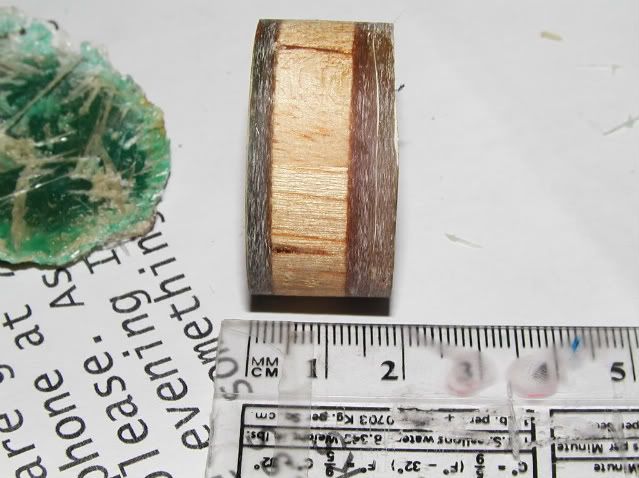
Balsa core
Early balsa core laminations were prone to failure, but as fiberglass construction improved, it was determined that successful core lamination processes should include vacuum bagging. Boats that are not vacuum bagged are more prone to delamination. As long as moisture does not permeate into the core material, then failure is rare. It is when a manufacture skips a step and fails to properly seal water coming in from the outside or when deck hardware or hull hardware is installed and not properly caulked to keep the area dry that makes for moisture problems in the lamination. It should be noted that end grain balsa is used and not long grain. There are a number of core materials, but balsa is used because it is very strong and light and more inexpensive to use than other materials, generally speaking.
Many years ago I wrote an article about Everett Pearson and his contributions to fiberglass composites and it covers the use of end grain balsa. It might be more info than you want to read, but it does give an insight to the development of fiberglass technology. I will paste it below:
Everett Pearson/TPI
Everett Pearson, president of Tillotson-Pearson (T.P.I.., Inc.), of Newport, RI, is definitely on the leading edge of fiberglass technology. Four decades of his use of innovative construction techniques and materials has earned him a reputation for leadership. His achievements literally span the evolution of fiberglass construction. He has built close to 10,000 fiberglass boats from 13 to 64 feet in length. TPI is one of the largest builders of fiberglass boats over 20 feet in the world (if not the largest).
He was first exposed to plastic resins reinforces with glass fibers (called fiberglass or FRP) in the 1950's when he was in the Navy. Intrigued, he and his cousin Clint used it to build a dinghy in their garage. They later displayed it in the 1st National Boat Show in New York City in 1957. The public interest was tremendous and encouraged them to form Pearson Yachts. In the first year they built some dinghies, a 22-foot outboard cruiser and a 14-foot sailing catamaran they called the Tiger Cat. They continued to learn as they went.
In 1958 they purchased a design from Carl Alberg of a 28-foot sloop and named it the Triton. They built a mold and produced hull #1, which they displayed in the 1959 National Boat Show. The Pearson Triton was the first family cruising sailboat made affordable by the use of FRP. Again, the demand was incredible and in 1964, after an expansion period of constructing Tritons and other designs, the cousins sold their company to Grumman. Clint moved on to other things, but Everett stayed on as general manager and the company flourished. They developed new models, set up the testing of various materials and quality control methods to assure that they had the latest in, not only FRP, but also rigging, hardware and sails for all of their boats.
During the Triton project, Everett developed the use of balsa planks sandwiched between glass and resin to stiffen the broader expanses of deck without adding weight. Cored decks became a standard on all Pearson boats.
Since the early 50's balsa was supplied by the Balsa Equator Lumber Company which was later renamed the Baltek Corp. When the problem of migrating moisture (mostly due from the boring of holes into the laminates to mount the hardware, etc.) were realized, Everett consulted with Baltek engineers and they developed the use of end-grain sheets where moisture could not migrate across the grain. It was introduced into the marketplace in 1964.
Later, in 1981, Everett personally proved that the water does not migrate across the grain in a properly laminated end-grain balsa core laminate. He took a 2' square panel, consistent with a hull section of a TPI 44-foot sailboat and sunk it in Naragansett Bay for 3 years. The grain was exposed on the four sides and four holes (2" and 4") were drilled through the middle of the plank. After 3 years they found no water penetration more than 4 mils into the core and no rot on the interior. Inside the balsa wood was clear, white and dry.
Wishing to be on his own, Pearson left Grumman in 1966 and purchased an FRP molding company in partnership with Neil Tillotson. They reorganized it into TPI, Inc. and located in Warren, RI just north of Newport. Everett then took FRP technology into a wide range of product areas, each with differing and specialized requirements. Besides marine products, they developed torpedoes, cooling towers, fan blades, tanks, plating facilities and lighting poles. In the marine area, he built a number of 58' Alden Boothbay Challengers, as well as a host of smaller boats with Baltek core in the hulls and decks.
Elsewhere, in the aircraft and aerospace field, various systems for increasing the strength of core laminations were finding their way into the boating industry. Methods such as vacuum bagging became necessary to assure a good bond across core laminations. Baltek, after an extensive R&D program introduced a new core product, called AL-600, which had a revolutionary surface treatment designed for high-tech applications of vacuum bagging and other methods of sandwich lay-up. AL-600 was the result of a chemical breakthrough in coatings technology. This coating treatment was essential in providing a superbly strengthened bond between the core and laminates. It also greatly reduced the amount of resin used which reduced costs.
On another front, an FRP distributor, Bill Seeman, was developing a low-cost, vaccum-assisted resin transfer molding process of fabricating high-performance FRP composites. He called this new process "SCRIMP" (for Seeman Composite Resin Infusion Molding Process). After a few years of the development and application of this process with prototype structures for Carderock Division of the U.S. Naval Surface Warfare Center, the Navy asked Seeman to build balsa-cored deck panels. At the time Seeman planned to use AL-600, but Baltek, with the desire to improve still further, had developed a second generation pre-coated balsa. The new AL-600/10 incorporated a new coating that was a third the cost and more compatible with current resins including ortho- and isopthalic-polyester, vinylester and epoxy systems. It proved to be more user friendly, saved both material and labor costs on all levels of sandwich construction, increased durability and consistency within the laminates and also reduced volatile organic compound (VOC) emissions in the work place. It was more tolerant to variations and longer gel times as well as changes in temperature, humidity and atmospheric pressure. It proved to be essential to the SCRIMP process. All vessel construction of Navy testing were positive and the results were publically released. It summed up "......this technology is now ready for accelerated development and application to composite boats and craft and to secondary structures of Naval combatants and other ships".
So, towards the end of 1992, the same year that Baltek AL-600/10 was introduced and extensive balsa-cored Navy testing took place, Seeman, TPI and Hardcore Composites of New Castle, DE joined and formed SCRIMP Systems, LLC. They were ready to promote and license others to use the process.
After acquiring the rights to use the SCRIMP resin infusion system the first SCRIMPed production boats Everett and TPI built were the 13.5-foot Garry Hoyt Expo Solar Sailer and then the 64-foot and 56-foot Sundeer ocean passage makers and world cruisers. All used the AL-600/10 core. But, let's back up and reveal another progression in Everett's career.
Back in 1977, designer Rod Johnstone and his brother Bob, approached Everett Pearson with a request to build the J/24. The prototype had already been built in Rod's garage. The idea was for TPI to build it and the Johnstones would market it. The deal was signed, but only after Everett's influence to use Baltek end-grained core instead of the originally planned foam core. From that point on, history was in the making and it was a turning point for both parties. The J/24 became the world's second largest one-design keel boat class, second on the to the International Star Class boat, which were first built in the early 1900's. Rod Johnstone continued to design popular keel boat designs from 22 feet to 44 feet. All were cored hulls and decks with hand-laid Baltek balsa and it has become a solid relationship between TPI and J/Boats. THIS IS NO LONGER TRUE. TPI NO LONGER BUILDS J/BOATS , FYI.
The development of Johnstone's unique designs combined with Everett's high-tech production materials and methods are astounding. J/Boats have made a shift from their previous emphasis of racing thoroughbreds to fast, user-friendly cruising boats that can be sailed with a short-handed crew. The J/Boat designs have repeatedly won Cruising World's Boat of the Year overall winner and Fortune Magazine recently named the TPI-built J/Boats (and the 44 to 54-foot Alden Yachts) among the 100 best American-made products citing their technology, design, reliability and value.
Other boats, not already mentioned, that TPI has built, were the offshore Rampage Sport-Fishing boats, Freedom Yachts, the 37 and 42-foot Jeanneau Lagoon catamarans, as well as the Carl Schumacher-designed Alerion-Express. In addition, TPI built a fleet of 44-foot sail training vessels for the U.S. Naval Academy.
Besides boat building, to name a few, TPI, since the 70's, has designed and built 27 to 56-foot windmill blades for generating electricity, Delta Air Line passenger shuttles, and SwimEx tubs for medical patient rehabilitation and for other applications, such as professional football player's training rooms.
Currently, TPI is working on several new ventures around the world. Besides making fixtures such as fiberglass landscape trees for Disney, TPI is currently testing a new ride designed to attain speeds to 65 mph, where passengers think they are traveling 140 mph. Each unit was Detroit-tested over 50,000 miles. The metal components and welds attached to the fiberglass body failed where the fiberglass withstood fatigue loading and remained solid.
General Motors have been developing an electric test automobile and TPI builds the car body. At 30 mph the cars were smashed into walls. The bodies momentarily collapsed and then bounced back to their original shape staying intact. Everett Pearson is very impressed with GM technology and claims that you will hear much about electric cars in the near future. They are in the process of developing cars that will travel 370 miles at highway speeds between charges. The future might bring hook-up sights at gas stations where yo drive in to get a charge instead of a fuel fill, or have a battery exchange program - and off you go!
For some time now, TPI has produced marine pilings and utility poles up to 75' long. They have tested the FRP pilings with repeated poundings when driven into the marina bottom and they are holding up very well and are expected to outlast conventional materials. Both New York City and the State of California will be using these pilings in new upcoming marina developments.
TPI also has been the largest user of carbon fiber outside of the aeronautics industry.
Everett Pearson continues to do a tremendous amount of R&D to improve the production of SCRIMP boats. TPI has a laboratory used for testing their laminates against other methods of FRP construction and for testing materials. They tank-test various resins and gelcoats by exposing them to different solutions at varying temperatures up to 140 degrees from 350 to 500 hours to determine the best resistance to blister/osmosis abnormalities. It has been determined that one manufacturer of gelcoats outperforms the others and their use of that and vinylester resins enable TPI to offer remarkable blister-prevention warranties on their hulls. They even shoot various calibers of firearms into their Baltek-cored and SCRIMPed laminates to determine whether or not a boat's water integrity would be impaired should it be fired upon. They have determined that bullets do not pass through.
Everett Pearson and TPI are technologically advanced and definitely are riding at the fore-front of boat building technology. They now have become the standard in the eyes of the Environmental Protection Agency because the resin infusion process of putting resins under vacuum solves the VOC problem. The SCRIMP process is very consistent, the results are superior and it complies with the laws of the land. And, according to Everett, the business of composites is in it's infancy.
Author: Bill Hooper