Another solar discussion

Status
Not open for further replies.

DannyS

.
May 27, 2004
933
Beneteau 393 Bayfield, Wi
I know this topic has had much discussion here and I've been reading quite a bit in past threads. Sometimes searching for information makes my head spin.
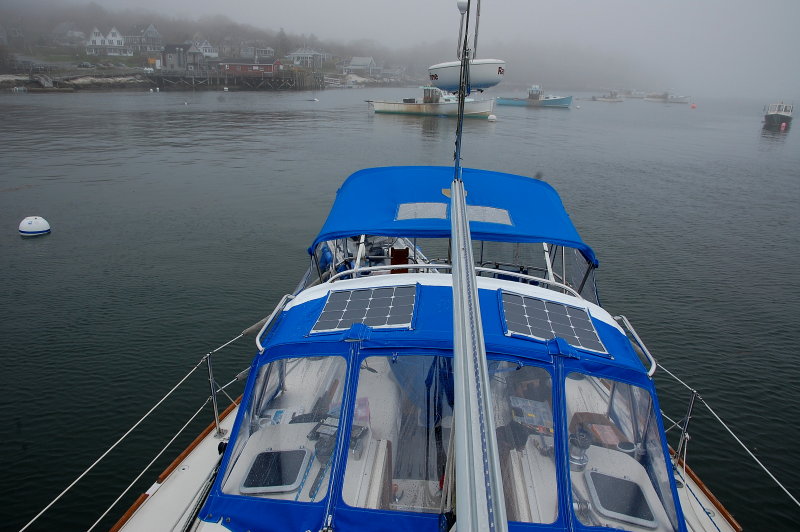
I'm seriously looking in to adding solar to our boat. We spend much of our summer on the boat, with quite a number of nights away from shore power. We're planning a two week cruise up the Canadian North Shore of Lake Superior this summer so I'd like to feel beter about our power consumption. I'm looking at two 65 to 80 watt panels on the bimini.
Would I be better off having two smaller panels or one large panel (something in the 140 watt range)?
Also, without having an electrical budget figured out, how does this size solar system sound for a 35 foot boat with moderate electrical needs. We have an Dometic chest type refrigerator/freezer which is perhaps the largest energy user on board. We also have radar/chartplotter, mostly LED lighting in the cabin, VHF radio, stereo, etc. Nothing out of the ordinary.
Any insight would be appreciated.
 
Nov 6, 2009
353
Hunter 37 FL
I know this topic has had much discussion here and I've been reading quite a bit in past threads. Sometimes searching for information makes my head spin.
I'm seriously looking in to adding solar to our boat. We spend much of our summer on the boat, with quite a number of nights away from shore power. We're planning a two week cruise up the Canadian North Shore of Lake Superior this summer so I'd like to feel beter about our power consumption. I'm looking at two 65 to 80 watt panels on the bimini.
Would I be better off having two smaller panels or one large panel (something in the 140 watt range)?
Also, without having an electrical budget figured out, how does this size solar system sound for a 35 foot boat with moderate electrical needs. We have an Dometic chest type refrigerator/freezer which is perhaps the largest energy user on board. We also have radar/chartplotter, mostly LED lighting in the cabin, VHF radio, stereo, etc. Nothing out of the ordinary.
Any insight would be appreciated.
We are in the process of installing solar panels. We spent a few weeks earlier this year at Marathon FL in the mooring field and it was interesting to see that most of the boats had solar, wind generators or both. This article is helpful in determing solar need. http://www.boatus.com/boattech/articles/solar-panels.asp
 
Apr 12, 2009
101
Hunter 1996 hunter 40.5 Green Cove Springs FL
I know this topic has had much discussion here and I've been reading quite a bit in past threads. Sometimes searching for information makes my head spin.
I'm seriously looking in to adding solar to our boat. We spend much of our summer on the boat, with quite a number of nights away from shore power. We're planning a two week cruise up the Canadian North Shore of Lake Superior this summer so I'd like to feel beter about our power consumption. I'm looking at two 65 to 80 watt panels on the bimini.
Would I be better off having two smaller panels or one large panel (something in the 140 watt range)?
Also, without having an electrical budget figured out, how does this size solar system sound for a 35 foot boat with moderate electrical needs. We have an Dometic chest type refrigerator/freezer which is perhaps the largest energy user on board. We also have radar/chartplotter, mostly LED lighting in the cabin, VHF radio, stereo, etc. Nothing out of the ordinary.
Any insight would be appreciated.
I installed 2 one thirty fives from Kyocera and a 200 W Airbreeze on my 40.5 for the Bahamas. The panels do all the heavy lifting-the w/g puts out maybe 5 amps on a good day. just mount 'em where they will be free of shadows. It did my fridge and separate freezer all winter
 
Jan 22, 2008
8,050
Beneteau 323 Annapolis MD
I have 2 x 40. I was getting 5 amps charge after several days of hardly any sunshine. If you are dependent on solar to back up your charging, you'd want two panels. I can switch from series/parallel, and can drop one of them out of the mix if need be. I've not used my shorepower in my home slip for 3 years now.
 
Oct 25, 2011
576
Island Packet IP31 Lake St. Louis, Montreal
I added a 135 watt Kyocera panel with a Moningstar controller to our boat last year. We spend 3 weeks each summer cruising the boat and rarley plug in.

We have an older Adler Barbour refrigerator and non led (for the moment) cabin lighting so our energy needs are probably similar.

Having the panel made us completely self sufficient. I was pleased with the amount of charging I got even on overcast days. Our house bank is 2 group 27 batteries.

As for one big panel vs. two smaller ones, for me the main driver would be the mounting location and whetehr you have the room for the large panel or not. I put ours on a temporary setup (until we install davits) on the transom making sure that there is enough room underneath to usethe boarding ladder without bumping your hear. Also, this location is quite good to keep the shadws of the panel.


I hope this helps a bit.

Matt
 
Feb 6, 1998
11,760
Canadian Sailcraft 36T Casco Bay, ME
I know this topic has had much discussion here and I've been reading quite a bit in past threads. Sometimes searching for information makes my head spin.
I'm seriously looking in to adding solar to our boat. We spend much of our summer on the boat, with quite a number of nights away from shore power. We're planning a two week cruise up the Canadian North Shore of Lake Superior this summer so I'd like to feel beter about our power consumption. I'm looking at two 65 to 80 watt panels on the bimini.
Would I be better off having two smaller panels or one large panel (something in the 140 watt range)?
Also, without having an electrical budget figured out, how does this size solar system sound for a 35 foot boat with moderate electrical needs. We have an Dometic chest type refrigerator/freezer which is perhaps the largest energy user on board. We also have radar/chartplotter, mostly LED lighting in the cabin, VHF radio, stereo, etc. Nothing out of the ordinary.
Any insight would be appreciated.

Feel free to read these they are written from my experience as a marine solar installer and use "real world" numbers that I have seen & measured:

Installing A Small Marine Solar System

Installing A Solbian Ultralight Solar Panel
 

kenn

.
Apr 18, 2009
1,271
CL Sandpiper 565 Toronto
Hi MS,

Your solar articles are very informative. Thanks for making and sharing them online.

One question: in the section "Do I Need A Controller ?" (11 Aug 2012) you mention that a current of just over half an amp would seriously overcharge the 2x Group 27 batteries. It's been my understanding that standard flooded-cell batteries can tolerate slight overcharging at low current as long as the cells are checked and topped up periodically. Do you agree with that, and if so, what would be the maximum value of "acceptable" current at full charge, to preserve the batteries?

We have an inexpensive 5W panel that i just leave sitting in the cockpit, no controller, and so far it's been pretty effective at topping up our single group24 battery. Full current from that thing is under 350 mA, and more typically under 200 mA, so I haven't been concerned about overcharging... but maybe I should be.
 
Feb 6, 1998
11,760
Canadian Sailcraft 36T Casco Bay, ME
Hi MS,

Your solar articles are very informative. Thanks for making and sharing them online.

One question: in the section "Do I Need A Controller ?" (11 Aug 2012) you mention that a current of just over half an amp would seriously overcharge the 2x Group 27 batteries. It's been my understanding that standard flooded-cell batteries can tolerate slight overcharging at low current as long as the cells are checked and topped up periodically. Do you agree with that, and if so, what would be the maximum value of "acceptable" current at full charge, to preserve the batteries?

We have an inexpensive 5W panel that i just leave sitting in the cockpit, no controller, and so far it's been pretty effective at topping up our single group24 battery. Full current from that thing is under 350 mA, and more typically under 200 mA, so I haven't been concerned about overcharging... but maybe I should be.
If the panel can push your batteries to 14.8V + then you will need to do something about it.

Keep in mind this will not happen for a long while with a 5W panel and with warm summer temps you also have self discharge to worry about. Chronic over charging results in positive grid erosion.

My warnings are more about batteries left long term with unregulated panels not batteries in use regularly with small panels.

Current and voltage go hand in hand, you can't have one without the other.. The batteries will take what they take in current at a given voltage. The higher the voltage the more current they will take. Ideally, once full, they should be at 13.8V or lower.

All you need to do is measure the open circuit voltage after a week or so to make sure your batts are not approaching 14.6+V.
 

DannyS

.
May 27, 2004
933
Beneteau 393 Bayfield, Wi
Thanks for all the input everyone. I'm looking at either a single Kyocera 140w panel or two 65w skinny panels ("skinny" meaning only 13.5 inches wide x 58" long) with the Genasun MPPT GV-10 controller. I think I can fit either one on the bimini but I'll need to do some measurin' and figurin' for the framework. I like the skinny panels for the option to mount them on the lifelines if I decide that is a better option down the road, although I kindof doubt I'd do that. I also like the idea of keeping within the parameters of the Genasun GV-10 controller.
 
Mar 20, 2012
3,983
Cal 34-III, MacGregor 25 Salem, Oregon
Thanks for all the input everyone. I'm looking at either a single Kyocera 140w panel or two 65w skinny panels ("skinny" meaning only 13.5 inches wide x 58" long) with the Genasun MPPT GV-10 controller. I think I can fit either one on the bimini but I'll need to do some measurin' and figurin' for the framework. I like the skinny panels for the option to mount them on the lifelines if I decide that is a better option down the road, although I kindof doubt I'd do that. I also like the idea of keeping within the parameters of the Genasun GV-10 controller.
I am definitly not an expert as I am still learning about all the solar stuff, but I installed solar on my boat and found it to be the greatest thing... second only to the boat being dry when it rains...

I also fought with the idea between installing two smaller panels or one larger panel....
with 2 smaller panels, you have redundency if one should fail.... one wont supply much power, but you may be able to limp thru until you get both of them working again....
but as dependable as they are these days, its not common to have one fail....

with one single large panel, there is no redundency. but if you decide you need more power or the redundency, its nice to be able to have the panels the same size.
i only had one general area on my boat to install the panel, but if I add another one it will be easy to turn the one I have lengthwise, and add another one beside it without any re-engineering of the mounting or placement of the panels... if I would have went with the 2 smaller panels, it would take more work to get more panels placed properly, that is if 4 of them would even fit.
you have a larger boat so it may not be an issue to you.... and with the refridgerator consumption, I would think (2) 120 to 140 panels would give you enough power to keep you going for a few years without worry.
but it all depends on how much you use the boat, the refridgerator and the motor...
 
Feb 6, 1998
11,760
Canadian Sailcraft 36T Casco Bay, ME
Thanks for all the input everyone. I'm looking at either a single Kyocera 140w panel or two 65w skinny panels ("skinny" meaning only 13.5 inches wide x 58" long) with the Genasun MPPT GV-10 controller. I think I can fit either one on the bimini but I'll need to do some measurin' and figurin' for the framework. I like the skinny panels for the option to mount them on the lifelines if I decide that is a better option down the road, although I kindof doubt I'd do that. I also like the idea of keeping within the parameters of the Genasun GV-10 controller.
You may also want to consider a Solbian ultralight panel. By the time you are done with a Kyocera 140 & frame you'll be adding an additional 40 +/- pounds atop a frame that was never intended for much more than a couple of pounds of fabric. If you do go with a rigid panel you'll want to be sure..

* The feet for the bimini are through bolted not screwed as many are.
* The bimini is "strapless" and supported by stainless struts.
* You employ some cross bracing to the rear push pit to prevent sway
* That the frame is heavy walled SS tubing not thin wall
 
Jun 17, 2007
402
MacGregor Mac26S Victoria Tx
One other plus for two panels is the shading effect. A shadow will greatly decrease panel output. Having two separate panels lessens that issue somewhat.

I am definitely not an expert as I am still learning about all the solar stuff, but I installed solar on my boat and found it to be the greatest thing... second only to the boat being dry when it rains...

I also fought with the idea between installing two smaller panels or one larger panel....
with 2 smaller panels, you have redundency if one should fail.... one wont supply much power, but you may be able to limp thru until you get both of them working again....
but as dependable as they are these days, its not common to have one fail....

with one single large panel, there is no redundency. but if you decide you need more power or the redundency, its nice to be able to have the panels the same size.
i only had one general area on my boat to install the panel, but if I add another one it will be easy to turn the one I have lengthwise, and add another one beside it without any re-engineering of the mounting or placement of the panels... if I would have went with the 2 smaller panels, it would take more work to get more panels placed properly, that is if 4 of them would even fit.
you have a larger boat so it may not be an issue to you.... and with the refridgerator consumption, I would think (2) 120 to 140 panels would give you enough power to keep you going for a few years without worry.
but it all depends on how much you use the boat, the refridgerator and the motor...
 
Feb 6, 1998
11,760
Canadian Sailcraft 36T Casco Bay, ME
One other plus for two panels is the shading effect. A shadow will greatly decrease panel output. Having two separate panels lessens that issue somewhat.

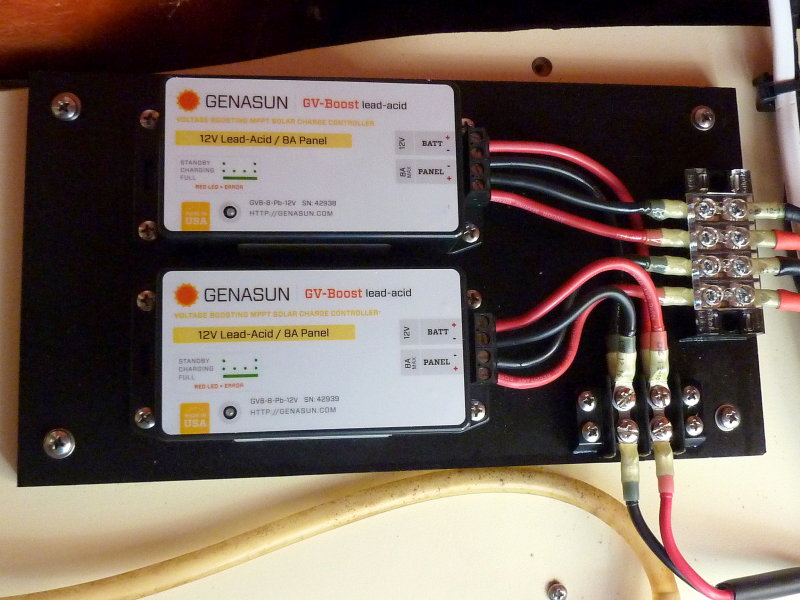
Depends how they are wired. Series can kill both panels, parallel can work but if using an MPPT it makes the power point tracking more difficult and less efficient. If using two panels the most efficient approach is for each panel to have its own controller, especially if shade is going to be an issue.

I really dislike mounting on dodgers but if doing so each panel gets its own controller..


DannyS

.
May 27, 2004
933
Beneteau 393 Bayfield, Wi
I never even thought about having one controller per panel. Main Sail, when you say PPT more difficult and less efficient, can you explain what you mean by that? I'm leaning toward the two 65 watt panels and the Genasun GV10 but if I go with two controllers, would the GV 5 models match with that panel rating? It seems as though I'd be on the top end for that controller, but it's within their parameters.
Any thoughts?
 
Feb 6, 1998
11,760
Canadian Sailcraft 36T Casco Bay, ME
I never even thought about having one controller per panel. Main Sail, when you say PPT more difficult and less efficient, can you explain what you mean by that? I'm leaning toward the two 65 watt panels and the Genasun GV10 but if I go with two controllers, would the GV 5 models match with that panel rating? It seems as though I'd be on the top end for that controller, but it's within their parameters.
Any thoughts?
Without getting to technical an MPPT controller basically searches for the most optimum performance (Vmp) from the panel to operate at. It can then send the most possible current to the bank by optimizing the panel performance and using every bit of it that it can.

With one panel unshaded you will be harvesting max panel efficiency if it has its own controller. Conversely even the shaded or partially shaded panel will be able to produce at its shaded max efficiency with its controller. If you wire them in parallel you'll still do better than with a PWM controller but still not as well as with two controllers. If the panels won't have shade issues, like on a bimini or davits then one controller can work well.

If they are on deck (bad location) or a dodger (also a poor choice) they will do better performance wise if each panel has its own controller. When installing panels in less than optimal locations like a dodger or deck two controllers really shine. Where the panels will see similar light then less performance gains will be seen.. Hope that made sense....
 

DannyS

.
May 27, 2004
933
Beneteau 393 Bayfield, Wi
Another question about mounting the panels as it regards to running wires...For those of you that have bimini mounted panels, did you run the wires down through the bimini frame and into the boat via a waterproof fitting? Or did you zip tie them to the frame externally? I'm not so concerned with the waterproof fitting, I've done those before. What size wire is typically associated with the panels? I'm not to keen on the idea of external wires down the frame.
 
Dec 19, 2006
5,832
Hunter 36 Punta Gorda
Hunter Mounting

For you Hunter owners with thhe stainless arch can use the arch as a mounting point for the normal solar panels and less cost building a a big frame and also run the wire cables into the arch tubing making a nice looking install and even water tight.
I did this all on my 2007 H-36 and got some of the idea from the new electric H-36 which has solar panels on top the Bimini and here in Florida I have the Bimini on all the time for added Sun protection and a great location for the panels to get good Sun and alot less shading.
Nick
 

Attachments

Status
Not open for further replies.