Alternators and horsepower

Feb 26, 2004
23,139
Catalina 34 224 Maple Bay, BC, Canada
thanks HB.....i am still wondering if he converted the hatchie alt to external or did he just hook up the balmar without changing the alt to external regulator
Woody,

Why would he ever do that?

Stu
 
Sep 15, 2009
6,244
S2 9.2a Fairhope Al
Woody,

Why would he ever do that?

Stu
i dont know that he did.... but the way his post read he didn't say he did change the alt and if he didn't i would like to know how that can work that way because it would be something new for me to digest ...i know its been said many times to convert the alt to external output and the question just popped in my mind that maybe he didn't and i would like to have know how if he didn't it worked that way
 
May 24, 2004
7,202
CC 30 South Florida
Gentlemen I am amassed at all the technical jargon that today permeates an alternator discussion. Don't get me wrong, I understand the science and can see the enhanced results that can be obtained by an upgrade. What I do not get is that recreational sailors with needs beyond the scope of an alternator upgrade have bought into the idea that they need the largest they can fit. Maybe it has to do with the I-Phone concept that people will dish out all kinds of money just to have the latest model. I consider myself an average recreational sailor with many day sail outings during the year, a few weekends and perhaps two long coastal trips with perhaps to include a crossing to the Bahamas. I look at this technology and really have been looking to see how I could use a 100A+ alternator but have failed to have a reason as my needs have been adequately met by the OEM 55A which feeds a split bank setup. It could very well be that my batteries could be failing to charge beyond 80% SOC but since I do not have a battery monitor I could be oblivious to it. What I know is that I get 3+ years of battery life from the wet cell group 27's and for their cost I consider that very reasonable. Ill be fair I do try to spend at least every third night at a marina to plug into shorepower and take a long hot shower. I have been called antiquated in my approach but I do not need the latest I-Phone if the one I got still can be used to make calls.
 
Jan 4, 2006
7,441
Hunter 310 West Vancouver, B.C.
i dont know that he did.... but the way his post read he didn't say he did change the alt and if he didn't i would like to know how that can work that way because it would be something new for me to digest ...i know its been said many times to convert the alt to external output and the question just popped in my mind that maybe he didn't and i would like to have know how if he didn't it worked that way
Woody,

I think you've got it right.

My first trip was to an automotive electrical shop as I was not comfortable in changing the Hatachi 55A alternator to external regulation without a wiring diagram. I had given the shop quite a bit of business in the past so he did it for something like $25.00.

I next wired the Balmar ARS-5 to the Hitachi alternator and had great fun in setting up the program for it.

The results as seen on the Link 10 battery monitor were:

- the bulk charge voltage was now 14.7V due to the Balmar regulator whereas before, it was continuously 14.2V with internal regulation.

- the amperage to the battery was now about 35A in bulk charge whereas before, the amperage was about 10A and dribbled down to about 4-5A after several hours of motoring.

- I now got to 100% SOC whereas before it was only around 80%. I realize this requires continuous updating as to the battery's current AH rating but this is only for comparison.

What made the big improvement was the greater driving force (voltage) into the battery.

Unless one has a battery bank whose acceptance is considerably greater than the output of the alternator, a larger alternator will not pump one additional amp into the battery if it still has an internal regulator set for 14.2V.

Maybe that's why people who install larger alternators don't see a drop in available propulsion power, the bigger alternator STILL isn't doing anything.

The other thing to remember is that Mr. Yanmar doesn't give a rat's a$$ about our house batteries. He's only concerned about recharging his starting battery so he's ready to go the next time.
 
Jan 4, 2006
7,441
Hunter 310 West Vancouver, B.C.
And Just What Would You Propose ......................

Gentlemen I am amassed at all the technical jargon that today permeates an alternator discussion.
..................... we do with all our spare time if it weren't for all the technical jiggery-pokery with which we manage surround ourselves :confused:.

And don't mention any spare money we may have laying around :eek:.
 
Sep 15, 2009
6,244
S2 9.2a Fairhope Al
thanks for the replys to my question HB and Ralph...now it is transparent...

ps ..Benny you are correct in your thoughts this stuff can get out of hand and out of pocket as well ....there is a lot of options on dressing up the bride so to speak....the thing is...the comfort of having topped off batteries at the end of a day's cruise when one is staying on the hook and not in the slip is a nice feeling...especially as reckless i can be with power sometimes....but its also nice to have an oil lamp on board just incase.....uh another boat buck :D
 
Feb 6, 1998
11,723
Canadian Sailcraft 36T Casco Bay, ME
Just a few thoughts.

#1 Unless you run the motor for 10+ hours you are not getting your batteries back to 100% SOC with an alternator, regardless of the regulator. This is a battery monitor problem not a charging problem. Even the best AGM batteries still take in excess of 7 hours to get to 100% SOC due to declining charge acceptance...

#2 In bulk charging, which is called CC or constant-current, the alternator will put out what ever it can minus any heat losses. When hot (190F or better) a good quality high output small case alternator will put out about 10-25% less than its cold rating. An auto unit, such as the Hitachi, may put out 25 -40% less than its rating, when hot. This has nothing to do with teh regulator just that as the alt heats up it can only put out so much. The alt may still be being "full fielded" by the regulator but it can only supply so much current at XXX temp...

#3 Until the battery terminal voltage attains the limiting voltage, which is the constant-voltage or CV phase of charging, also called absorption voltage (or incorrectly referred to as bulk voltage) your alternator will be in bulk/constant current providing everything it can.

#4 Once the battery terminals have attained the limiting voltage, or the alternator thinks it has, (see voltage drop article; here) the current must decline. From 50% SOC it should take at least an hour + on a well sized charging system to bring the battery terminals to the limiting voltage.

#5 If your batteries are at 50% SOC and you fire up the alt and it very quickly enters absorption or CV mode (terminals come up to limit voltage too quickly eg: 14.4V - 14.7V) your batteries are simply toast or you have a serious voltage sensing issue.

#6 Sailors often opt for a high output system so they don't need to listen to the motor as much, thus getting as much energy back into the batteries in the shortest time possible.

#7 Battery charging is often way over complicated but it is very easy to understand as there are only two parts CC & CV:

CC/Constant-Current/BULK = In this first stage of charging the charge source is producing all the current it can with no limits imposed by the battery. There is no such thing as a "bulk voltage" unless you are using the term to denote a "transition voltage" from bulk to absorption. Sadly the correct term should be absorption voltage NOT bulk voltage... When manufacturers refer to a "bulk voltage" this is marketing terminology NOT actual terminology as related to charging. Constant-current can not be a voltage.....;)

CV/Constant-Voltage/Absorption = Once the battery comes up to the target "voltage limit" the regulator, controller etc. begins to limit the voltage to the voltage set point. Once voltage is held steady current has to decline. At this point we have entered the CV stage of charging. All this stage does is LIMIT VOLTAGE... It is really that simple. Absorption, float and equalize are all CV/constant-voltage.

Charge sources do two things:

Sprint/Full Bore & Limit Voltage

That's about it.......;)
 
Jan 4, 2006
7,441
Hunter 310 West Vancouver, B.C.
#2 In bulk charging, which is called CC or constant-current, the alternator will put out what ever it can minus any heat losses. When hot (190F or better) a good quality high output small case alternator will put out about 10-25% less than its cold rating. An auto unit, such as the Hitachi, may put out 25 -40% less than its rating, when hot.
Maine,

Thanks for your thoughts here. However, I can only say that is NOT what I've seen on my Link 10 battery monitor.

No theory here, just observations:

- With internal regulation, after a short time the voltage rose to 14.2V and not a 0.1V more and stayed there. With the Balmar ARS-5 doing the thinking, the voltage rose to 14.7V after a short time for the bulk charge. It later dropped to absorption voltage and float voltage, the time depending on the SOC when this all started.

- With internal regulation, the amperage started out at 10-15A and backed off until, after several hours, it was down to 4-5A. With the Balmar, the amperage started out in the range of 35A and slowly dropped down. I never did catch what the amperage was before dropping down to absorption but I never saw it below 10A.

I realize heat is an amperage limiter and set the Balmar to start backing off at 180 deg. F. but this was still miles ahead (actually AH's ahead) of where I was with internal regulation.

Back when I still had internal regulation, I removed the Nike shoe box which surrounds the engine to allow for more cooling air and still found that the alternator quickly backed off in amps.

I agree that it takes hours to get those last few hours AH's into the battery but we get little to no winds in the summer up north and it's a long way between anchorages so we often see 95 - 100% SOC.
 

Attachments

Feb 6, 1998
11,723
Canadian Sailcraft 36T Casco Bay, ME
Maine,

Thanks for your thoughts here. However, I can only say that is NOT what I've seen on my Link 10 battery monitor.

No theory here, just observations:

- With internal regulation, after a short time the voltage rose to 14.2V and not a 0.1V more and stayed there. With the Balmar ARS-5 doing the thinking, the voltage rose to 14.7V after a short time for the bulk charge. It later dropped to absorption voltage and float voltage, the time depending on the SOC when this all started.

- With internal regulation, the amperage started out at 10-15A and backed off until, after several hours, it was down to 4-5A. With the Balmar, the amperage started out in the range of 35A and slowly dropped down. I never did catch what the amperage was before dropping down to absorption but I never saw it below 10A.

I was referring to two alts a high performance and a stock one both driven with external regulation not one with a Balmar and one with the internal Hitachi regulator...

I realize heat is an amperage limiter and set the Balmar to start backing off at 180 deg. F. but this was still miles ahead (actually AH's ahead) of where I was with internal regulation.
180F is a pretty low temp limit for an alt. The engine room can often exceed 130F giving very little range for heat extraction/cooling. Normally with a stock alt I will allow them to run up to 200-215F, controlled via belt manager, then set the temp limit at 220-225F..

Back when I still had internal regulation, I removed the Nike shoe box which surrounds the engine to allow for more cooling air and still found that the alternator quickly backed off in amps.
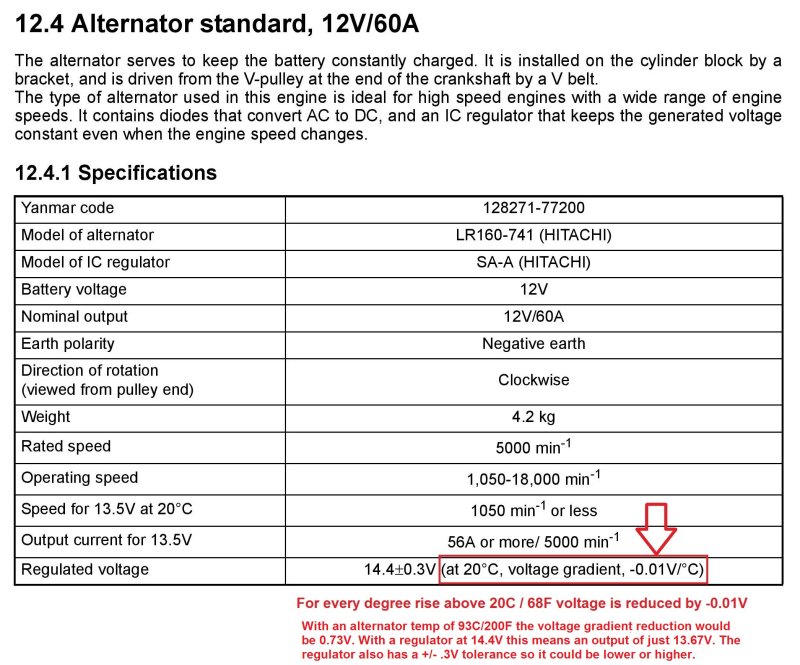
The alt will still get hot even without the shoe box.... The temp gradient for Hitachi's to begin dropping voltage begins at just 68F... By dropping the regulation voltage limit you also drop the current that can flow into the battery thus effectively cooling the alternator. It is a really, really poor way of protecting an alternator but on a car battery it works just fine and the Hitachi was first a typical car alternator...

I agree that it takes hours to get those last few hours AH's into the battery but we get little to no winds in the summer up north and it's a long way between anchorages so we often see 95 - 100% SOC.
Certainly with 10+ hour motor runs getting back to full is easily possible but it is impossible with 1-3 hour engine runs no matter how big the alt is unless you had LiFepO4 of a similar Lithium chemistry....

The Balmar regulators handle the alt differently, in terms of protecting it. The Balmar reduces the field while the Yanmar / Hitachi reduces the regulation voltage based on alternator temp.

Raising the regulation voltage, and keeping it there, means faster charging too. If you reduced the regulation voltage in the Balmar, instead of controlling the field wire & keeping voltage steady, you would see the same performance effect with the Balmar that you do with the Hitachi's.

If you removed the voltage gradient in the Hitachi alts dumb regulator, and set both regulators to the same voltage limit, the battery would charge at the same speed. I have done this exact A/B with a Motorola alt that did not have a temp gradient just a dumb regulator with bulk and absorption. It got fry eggs hot but both regulators, set to the same regulation voltage, performed the same.

The reason the Hitachi charges soooo slow, and you see reductions in current so much, is because the dumb regulator in them is actually dumber than dumb..... If you want to protect an alternator, to make it through the warranty period, this works okay. If you actually need to charge batteries, used in deep cycling applications, the Hitachi's with internal regulation are really quite pathetic. The regulator in them is only about one thing, protecting the alternator from melt downs. It is not about charging performance nor does it car about your batteries. Slap it in a car and you're good to go. Put it in a boat with deeply cycled banks and they really perform horribly....

 
Jan 30, 2012
1,150
Nor'Sea 27 "Kiwanda" Portland/ Anacortes
Maine

Assuming a 'proper' setting up - will a Victron battery monitor accurately keep track of battery state of charge no matter whether I have an alternator regulated smart or regulated stupid x2?

If so - then at least one would know where one stands?

Charles
 
Feb 6, 1998
11,723
Canadian Sailcraft 36T Casco Bay, ME
Maine

Assuming a 'proper' setting up - will a Victron battery monitor accurately keep track of battery state of charge no matter whether I have an alternator regulated smart or regulated stupid x2?

Charles
The monitor only counts amps in/out and applies a charge efficiency factor, Peukert and a temp factor if equipped. An Ah counter only remains accurate if you program it to..

This is a long detailed read, may require two passes, but really should be a must read for anyone who owns an Ah counter....

Programming A Battery Monitor
 
Jan 30, 2012
1,150
Nor'Sea 27 "Kiwanda" Portland/ Anacortes
Thank you again for that lead.

I have so far suffered between that explanation and this thread - and my brain is just now recovering from its convalescence.

I will keep at it.

Charles
 
Mar 11, 2015
357
Hunter 33.5 Tacoma, WA
DEFAULTS are factory settings that are made to be modified to suit your setup.
There are two things to consider. In my case, I have a Xantrex charger/inverter, and an external Xantrex alternator regulator. After reading this thread, it makes sense that each of these must be set to the same voltage levels.

It would make no sense to have your alternator maxing out your charge while in port your AC charger is more conservative. More stuff to check. Still, I'd rather have a more conservative setting on the alternator due to the heat stress it is under. I'd rather have a functioning alternator.