AC Circuit Confusion!

Oct 26, 2008
6,370
Catalina 320 Barnegat, NJ
I'm hopeful about my electrical upgrades this winter but getting confused about the various components I need to buy. I abandoned my original thought to keep the original AC panel that has the main breaker and 3 outputs. My AC power needs are relatively simple and I don't anticipate very much expansion.
Background info: Shore power appears to be 15 amp service as the boxes are like the kind of outdoor outlet box on my deck. It definitely is not a 30 amp outlet box. My alternator is Hitachi 80 Amp Model LR180-03C. I'll have a new ProNautic charger. I'll have a water heater on AC power. I have at least 3 AC outlets (not including the new outlet for water heater). I have no air conditioning or refrigeration and have no plans to install.
So my questions are:
1) ABYC appears to require an Equipment Leakage Circuit Interrupter (ELCI) for safety purposes. Does this replace the need for an Isolation Transformer (IT)?
2) MainSail posted at one time that a galvanic isolator is a bandaid compared to IT and every AC system should have an IT instead of the GI. Doesn't the ELCI serve the purpose or is it necessary to install both? The $$ begin to add quickly!
3) Hopefully, ELCI eliminates the need for IT, but then I would potentially need a galvanic isolator, right?
4) See choice of panels below. Which would be recommended? Can an ELCI breaker be substituted for the 30A double pole main breaker in the metered panel? Or do I have to get the panel that is made for the ELCI breaker? It appears that the smaller model has 2 blanks for branch breakers, right or wrong?
5) What size charger considering the shore power amps? I am considering 40A, 30A, or 20A with preference for price at 20A, obviously. But, also thinking about 40A based on 133% of potential upgrade to 30 amp shore power service.

https://www.bluesea.com/products/1193/ELCI_Main_30A_Double_Pole_+_4_Positions_Horizontal
http://shop.sailboatowners.com/prod.php?10633/360+Panel+System+120+Volt+AC+Main+Panel
https://www.bluesea.com/products/1502/ELCI_Main_30A_Double_Pole_Panel
All comments welcome! I want to be reasonably economical but I also don't want to omit essential components for a modern, comprehensive system that is suitable for limited cruising needs.
 
Last edited:
Jun 6, 2006
6,990
currently boatless wishing Harrington Harbor North, MD
First off AC amps and DC charger amps are not comparable except to say that one 120 volt amp of AC = 120/12= 10 amps of 12 volt DC. So your 40 amp 12 volt charger equates to 40*12/120= 4 amps of 120 volt AC. Bottom line is your water heater is a much bigger user of AC amps than the charger.
GFCI and ELCI are similar types of devices GFCI is for people protection and ELCI is for equipment protection. After some reading it appears that GFCI actually provides "more" (aka less current to trip) protection so and ELCI allows the equipment to continue to operate but not shock you. If you are plugging all your equipment into AC outlets I'm thinking that one GFCI protecting all four outlets would be sufficient.
Iso transformers solve a lot of problems for boat AC systems but they are really heavy and expensive. The TOTALLY isolate shore from boat using magnetism to bring power into the boat. No ground wire to attach you to all the other boats in the water!!!! I don't think IT and ELCI address the same problem. IT is corrosion prevention and ELCI is safety. Galvanic Isolators are just 2 diodes running in opposite directions on the ground wire between the boat and shore. the diodes have a 2ish volt turn on voltage so if the ground wire is energized in an emergency they pass the voltage (less the 2 volts turn on) safely to ground. If you have corrosion voltage on the ground wire the 2 volt turn on voltage is above those corrosion voltages so you are effectively isolated from the shore power ground wire in that case. They are less expensive and smaller than ITs
Picking a charger is dependent on how fast you want to / have to recharge the bank, the bank size, and what bells and whistles you want. If you need to (worst case) plug into shore power at 1800 with 50% discharged batteris and need them to be fully charged at 0600 the next morning (aka staying at a slip for the night) then you need a much bigger charger than if you come back with discharged batteries on Sunday night and have till Friday afternoon to get them charged.

lead acid batteries go from 50% to 85% SOC pretty quickly (bulk charging) and then start to develop internal resistance (acceptance charging) to about 95%. After that the internal resistance is so high that you would need to raise the voltage so high (to keep the amps up) you start to boil the water out of the batteries. So you keep it at 14.4ish and live with the trickle charge rate. What this means is the max charge rate of the charger is only valid when moving from 50% to 85% charge. After that the batteries control the charge rate with bigger banks being able to accept more amps. I'm of the opinion that a battery bank normally found in a sailboat is not going to be large enough to accept absorption charging at full rated capacity of the charger for more than a few minutes. Bottom line is if you have the worst case usage..... buy more batteries not a bigger charger. You will not get their SOC as high but will store more energy in the time allowed. If you have a weekend sailer usage then a 5 amp charger is probably good enough and easier on your batteries. Size the charger for the worst case of course.
I would also note that zinc is cheap and can give you a pretty good indicator of a ground wire problem.
 
Jan 19, 2010
12,754
Hobie 16 & Rhodes 22 Skeeter Charleston
Hi Scott T-bird

I don't know what you are thinking regarding the connectors but I'd go with a 30 Amp plug on the boat even though your shore power is 15 A...and then use an adapter to bring it down to the 15 Amp style plug for the power cord. When you go cruising, the vast majority of marinas will have 30 A power. I purchased various plugs at Lowes and made two sets of adapters that I keep on my boat. I have a 30A to 15 A and a 30 A to a regular house plug. I've had to use both in the past.

Regarding a GI.... I might be wrong about this but I don't think they are very common on boats that use an O.B. I'm not familiar with the Starwind 27 so I don't know if this applies to you... but....if you are plugged into shore power and have your outboard up and out of the water, then there aren't any underwater metal bits for the GI to protect.
 
Jan 11, 2014
13,427
Sabre 362 113 Fair Haven, NY
Scott, what's the current draw for the water heater? I'd guess that it is above 10 amps which is pretty close to the maximum current a 15 amp circuit can provide. Plug in a battery charger and start charging a few phones or a laptop and you'll be tripping breakers. High current draws will also contribute to overheating the shore power cord.

30 amp service is pretty standard in marinas, with some larger slips providing 50 amp service, go with 30 amp service. Since this is a new install, go with the Smartplug, a much better solution than the standard 30 amp shore power setup.
 
Oct 26, 2008
6,370
Catalina 320 Barnegat, NJ
Thanks for replies, but they don't really answer my questions so far! :frown: I should have added, my house battery bank will never be more than about 200 ah. The water heater element is 750 watts, so by my calculation, the current draw should not exceed 10 amps. I installed a new GFCI outlet for the WH power cord.
I know that 15 amp service is limiting and I have an adapter for the 30 amp cord. Smart plug is in my plans. I also plan to be able to use 30 amp service at other locations.
rg, I have Yanmar 2ym15 newly installed, with heat exchanger, which will also heat the water; thus, the 80 amp alternator.
Bill, your answers pretty much read like some of the technical explanations that I have read, but also don't really answer my questions that are based on practical applications. I do appreciate your comment that smaller (5 amp charger) is better for weekend use. Besides, everything I read indicates the IT is also safety related (to prevent electric shock drowning), not just corrosion protection. I did leave unsaid, that my outlets will also have GFCI protection (one for the branch).
I think that I only need 2 branch circuits, one for the water heater and the other for all other outlets (currently, I have 3 separate branches, 1 for each outlet - original installation :confused:). To date, I have never used the AC circuits because at first I didn't have shore power, and now that I do, I don't trust the boat installation. I forgot to add that the only other AC electric component that I contemplate adding would be an electric stove top for use with shore power, so a separate branch for that installation, I assume.
So my questions are really based on what all you folks have installed or would have installed.
1) Is it true that ABYC requires ELCI at the AC panel (within 10' of shore power plug)? If so, why would an IT also be required? How many of you have ELCI? How many Have IT? How many have both and if so, why? Will a GI round out the need for corrosion protection, assuming that I install ELCI?
2) Assuming that I install a safe AC circuit in the boat, I would plan on charging during the week. I'd guess that I would be perfectly fine with a 20 amp charger for 200 ah battery bank. Would I be wrong about that? How should I correlate the charger size to battery bank size? (I've seen a variety of rule's of thumb).
3) I was also asking for opinions on the various AC panels that are available, and if ELCI can be installed in the ones that don't specifically call it out.
My desire is KISS, but I want to make sure I have all necessary safety components and rational equipment sizes for my limited needs.
 
Last edited:
Jan 19, 2010
12,754
Hobie 16 & Rhodes 22 Skeeter Charleston
I found it...

E-11 AC and DC ELECTRICAL SYSTEMS ON BOATS Based on ABYC's assessment of the existing technology, and the problems associated with achieving the goals of this standard, ABYC recommends compliance with this standard for all systems and associated equipment manufactured and/or installed after July 31, 2009.

11.4.10 Equipment Leakage Circuit Interrupter (ELCI) - A residual current device which detects equipment ground fault leakage current and disconnects all ungrounded (110 V & 240V) and grounded (110 V neutral) current carrying conductors from the supply source at a preset trip threshold.

The full PDF is attached.
 

Attachments

Oct 24, 2010
2,405
Hunter 30 Everett, WA
The IT is the best way to go but cost, weight, and size are the impediments. I've not had a boat with one installed (have a GI.)
My boats use GFCI. I may be wrong, but I think an ELCI would be redundant.

Ken
 
Oct 26, 2008
6,370
Catalina 320 Barnegat, NJ
I found it...

E-11 AC and DC ELECTRICAL SYSTEMS ON BOATS Based on ABYC's assessment of the existing technology, and the problems associated with achieving the goals of this standard, ABYC recommends compliance with this standard for all systems and associated equipment manufactured and/or installed after July 31, 2009.

11.4.10 Equipment Leakage Circuit Interrupter (ELCI) - A residual current device which detects equipment ground fault leakage current and disconnects all ungrounded (110 V & 240V) and grounded (110 V neutral) current carrying conductors from the supply source at a preset trip threshold.

The full PDF is attached.
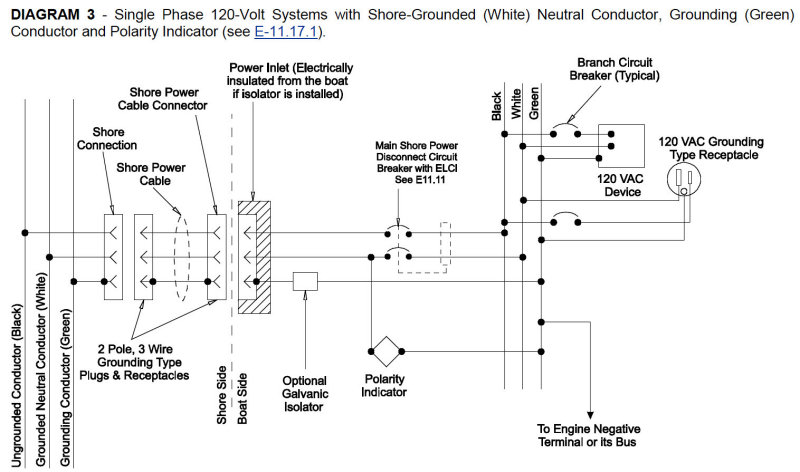
So it would seem, based on Diagram 6, that every boat with AC circuits should have a main shore power panel with ELCI and an isolation transformer? Really? Where is the AC branch panel in the diagram? The diagram doesn't appear to coincide with the panel products that include a main breaker and an assortment of branch breakers within the same panel. I can't help but feel that this diagram is for more complex systems?
Like Ken, I'm still wondering about the redundancy. Are the safety features (prevention of ESD) of ELCI and IT redundant or is it necessary to include both in my system? It seems that most boatowners (smaller boats) have neither. This is leading to my confusion.
 

jssailem

SBO Weather and Forecasting Forum Jim & John
Oct 22, 2014
23,786
CAL 35 Cruiser #21 moored EVERETT WA
Interesting topic. Can someone address the IT magnetic issue in relationship to Compass or Autopilot. As I understand part of the IT's cost and weight is associated with the magnet used to manage the power interruption. Does this create an issue for these magnetic field sensitive equipment we use on small boats?
 
Jan 11, 2014
13,427
Sabre 362 113 Fair Haven, NY
Interesting topic. Can someone address the IT magnetic issue in relationship to Compass or Autopilot. As I understand part of the IT's cost and weight is associated with the magnet used to manage the power interruption. Does this create an issue for these magnetic field sensitive equipment we use on small boats?
This is not an issue, except perhaps for a little residual magnetism. The magnetic fields are developed when AC power is applied to the transformer. AC current will produce an alternating magnetic field which will induce AC current in another coil. Thus, once you leave the dock and shore power there is no magnetic field to worry about. Here's one website that explains the functioning. Electrical Transformer - Basic construction, working and types | electricaleasy.com

The advantage to an Isolation Transformer over a Galvanic Isolator is that there is no physical wired connection between the boat's AC system and the shore power system, save for the short path from the shore power connection to the transformer. Whereas with a GI, the hot and neutral wires are physically connected to shore power and the ground wire (green) connection is blocked by a pair of diodes. The diodes will block low levels of DC current but not higher levels of AC current that might occur in the case of a short.

Both the IT and the GI help prevent galvanic action between metal fittings on neighboring boats. The IT however is both more expensive and considerably heavier. In some applications such as a metal boat, the IT is the best way to go for most of the rest of us a good quality fail safe GI is more than adequate at ⅓ the cost and 1/10 the weight.
 
  • Like
Likes: jssailem
Oct 26, 2008
6,370
Catalina 320 Barnegat, NJ
Both the IT and the GI help prevent galvanic action between metal fittings on neighboring boats. The IT however is both more expensive and considerably heavier. In some applications such as a metal boat, the IT is the best way to go for most of the rest of us a good quality fail safe GI is more than adequate at ⅓ the cost and 1/10 the weight.
The IT is the best way to go for what? Protection against galvanic corrosion? What else?

The attachment below is what has me looking into the ELCI.
https://www.bluesea.com/resources/1381
Granted, it is from Blue Seas, who sells this stuff, but they are saying that it is required in ABYC under Section E 11.11.1. The link that rgranger posted appears to skip over this section (instead, going past it to E 11.11.1.1.)
MaineSail posted in a thread that ALL AC circuits SHOULD have IT (he stated that GI is just a "bandaid"). Presumably, his justification for requiring IT is for safety (Electric Shock Drowning prevention) in addition to galvanic corrosion.
I want the boat to be SAFE. I have only a passing concern for galvanic corrosion. Does this mean that I should install ELCI and IT, or are they redundant. If the two devices are redundant, then which one should I purchase?
 
Last edited:
Jan 11, 2014
13,427
Sabre 362 113 Fair Haven, NY
The IT is the best way to go for what? Protection against galvanic corrosion? What else?
The short answer is that an IT gives you an AC system that is completely isolated from the shore system. If you have a metal hull this is important, fiberglass, not as much. See: Transformer or galvanic isolator, which is better? and this SmartGauge Electronics - Isolation Transformers or Galvanic Isolator? ½

An ELCI and an GI or IT serve different purposes. A GI or IT serve to block stray DC current that caused galvanic corrosion between your boat and other boats and shore side metal objects that are connected by the ground wire.

ELCI protects against AC current energizing devices that are plugged in to the AC circuit, such as the water heater jacket, the metal frame on the batter charger, the cabinet on the microwave etc. It works in much the same way as a Ground Fault Circuit Interrupter. If metal on the boat becomes energized through a ground fault, the water around the boat becomes energized with 120v AC which is deadly. What might be a path for the metal to be energized? A ground fault in the battery charger might put AC into the charging circuit allowing AC to follow through the DC negative wire to the engine and then to water through the prop and shaft.

An ELCI provides whole boat protection, the GFCI provides circuit protection. There are differences in how much current leakage it takes for each to trip, but I can't recall off hand what the values are.
 
Feb 6, 1998
11,722
Canadian Sailcraft 36T Casco Bay, ME
1) ABYC appears to require an Equipment Leakage Circuit Interrupter (ELCI) for safety purposes. Does this replace the need for an Isolation Transformer (IT)?
Yes an ELCI (30mA leakage trip point) is an ABYC requirement to meet the minimum safety standards. It is a very good idea to do anywiring, especially AC wiring to meet the current safety standards.

An isolation transformer or galvanic isolator are not "required" but are very good to have in order to minimize corrosion issues..

2) MainSail posted at one time that a galvanic isolator is a bandaid compared to IT and every AC system should have an IT instead of the GI. Doesn't the ELCI serve the purpose or is it necessary to install both? The $$ begin to add quickly!
An isolation transformer or galvanic isolator are designed to deal with corrosion and the ELCI is for human safety. An isolation transformer (IT) 100% isolates your boat from shore power essentially creating a new "source of power" on-board your vessel. It is the only true way to remain isolated from your boat neighbors while on dock power. They are however heavy and expensive.

A galvanic isolator is a device that blocks "galvanic level" corrosion. It blocks the current levels created by immersing dissimilar metals in an electrolyte but not much more. The problem is that a GI only blocks galvanic levels not stray DC or stray AC current levels that exceed the capabilities of the diodes.

If you choose a GI it should be of the fail safe type. Because the GI is inserted into the AC green/earthing/grounding wire an unsafe failure would leave you with no safety ground. A fail safe GI or a monitoring system is also an ABYC requirement if the vessel is fitted with a GI. No requirement to fit one, but if it is, it then needs to meet the minimum safety standards.


3) Hopefully, ELCI eliminates the need for IT, but then I would potentially need a galvanic isolator, right?
There is no requirement for an IT or a GI but if plugging into a marina you would be very wise to at least have a GI. For human safety the ABYC, Canadian standards (Transport Canada) require the AC green to be bonded to the ships DC ground regardless of whether or not you have an ELCI. This creates a potential for corrosion thus you then add a GI or IT. The ISO/RCD European standards also require AC ground and DC ground bonding though they do grant an exception if you have an RCD fitted. There is no such exemption in North America..


4) See choice of panels below. Which would be recommended? Can an ELCI breaker be substituted for the 30A double pole main breaker in the metered panel?
Depending upon the AC panel a 30A toggle double pole ELCI can be retro fitted (about $140.00) but the panel must conform to industry standard toggle breaker spacing and you lose a spot (takes three slots). Not all boat builder panels conform to this spacing. Sometimes it is easier to retrofit an ELCI near the 30A inlet.


Or do I have to get the panel that is made for the ELCI breaker? It appears that the smaller model has 2 blanks for branch breakers, right or wrong?
Sky is the limit really. You can buy a new panel, retro fit an ELCI in its own box before the existing 30A double pole or retrofit one in your existing panel if it will fit. It is never a bad idea to also protect the circuits that you can with GFCI (5mA leakage trip point) outlets.

5) What size charger considering the shore power amps? I am considering 40A, 30A, or 20A with preference for price at 20A, obviously. But, also thinking about 40A based on 133% of potential upgrade to 30 amp shore power service.
Ideally you want a charger that can deliver at least 10% of bank capacity even with dock side loads running. This article will give you a lot more information: Installing a Marine Battery Charger

The real focus on a charger should be that you actually get a smart one or at least quasi smart.. This means temp compensation and fully adjustable voltage profiles to match your batteries at a bare minimum. Avoid any charger that does not have temp compensation. Also avoid chargers that use "dip switches" with the three basic "AGM, GEL, FLOODED" settings to choose from. You also want to avoid "egg-timer" chargers that use a simple timer based algorithm for the absorption cycle.

I want the boat to be SAFE. I have only a passing concern for galvanic corrosion.
Why? If you are plugging into a marina stray and galvanic current damage can cause thousands in damages. I have said it before, I would not plug into a marina without an IT. Many do without IT's but I get to see the reasons behind why I say this on a daily basis. Lucky for us our boat is never plugged into a marina and never will be......

Charlie Wing's Book is an excellent choice if choosing to do your own AC wiring.

Please remember AC wiring mistakes can kill people!!

This is an example of a bare minimum AC installation..

 
Jan 30, 2012
1,150
Nor'Sea 27 "Kiwanda" Portland/ Anacortes
The ECLI 30mA trip threshold is 4- 5 times the current necessary to do in a human being - so use a GFCI at every circuit possible. For me that means every circuit on the boat. No device on my boat causes nuisance trips.

If you use an isolation transformer and if it is within 10 feet of the shore power inlet receptacle then (I think) an ECLI is not necessary.

So is a simple 1 circuit 100% GFCI protected AC installation (no IT) the indubitable equivalent of an ECLI protected system?


Charles
 
Last edited:
Oct 26, 2008
6,370
Catalina 320 Barnegat, NJ
Thanks for the thorough replies! I eventually came to the conclusion to use this panel for ELCI.
https://www.bluesea.com/products/1193/ELCI_Main_30A_Double_Pole_+_4_Positions_Horizontal
I am creating cabinet space to upgrade to a larger DC panel with the rockers, so the work just needs to expand for the new AC panel. The space is already planned. I didn't really mean to imply that I wasn't concerned about galvanic corrosion, but I believe that I will use a GI and I appreciate the comments (I am very concerned about the safety of this installation because I tend to go in the water around my boat!). My AC wiring is stranded and it is far more accessible than the DC wiring, luckily, so I can change it at any time without much inconvenience. I haven't decided about changing it out for the existing outlets, but the rest of the AC wiring is new, and new wiring will be installed from the smart plug to the panel, since that wiring is a little more difficult to get to.
This is the article that led me to believe that the IT is also necessary for safety considerations, as well as preventing GC.
http://www.boatus.com/seaworthy/magazine/2015/july/isolation-transformers.asp
The price of this model shown is not the shocker that many seem to consider debilitating. It can be had for less than $800 here (considerably less at Defender). The size shouldn't be an issue, either.
http://shop.sailboatowners.com/prod.php?1328
 
Last edited:
Oct 26, 2008
6,370
Catalina 320 Barnegat, NJ
If you choose a GI it should be of the fail safe type. Because the GI is inserted into the AC green/earthing/grounding wire an unsafe failure would leave you with no safety ground. A fail safe GI or a monitoring system is also an ABYC requirement if the vessel is fitted with a GI. No requirement to fit one, but if it is, it then needs to meet the minimum safety standards.


Thanks for this great point. I do recall reading this in the many articles that I reviewed. It is definitely worth emphasizing.
 
Feb 6, 1998
11,722
Canadian Sailcraft 36T Casco Bay, ME
The ECLI 30mA trip threshold is 4- 5 times the current necessary to do in a human being - so use a GFCI at every circuit possible. For me that means every circuit on the boat. No device on my boat causes nuisance trips.

If you use an isolation transformer and if it is within 10 feet of the shore power inlet receptacle then (I think) an ECLI is not necessary.

So is a simple 1 circuit 100% GFCI protected AC installation (no IT) the indubitable equivalent of an ECLI protected system?


Charles
On a small simple boat where individual devices can be protected by a GFCI this can work but the safety standards need to cover all human safety situations and there are many on-board devices that simply can't be serviced by outlet style GFCI's. GFCI's are already required for certain locations anyway such as galley, head, machinery spaces and weather-deck locations.

As for the differences in trip duration and current threshold the 30mA / 100mS of the ELCI was chosen to balance human safety while minimizing nuisance-trips in order to increase the adoption of the ELCI technology.

While nuisance trips may not be common on some boats n=some or n=1 in your case, GFCI nuisance trips are common on many, many vessels due to the "additive leakage effect" as I tend to call it. A 5mA trip level for the main breaker is simply too sensitive for an entire vessel but usually okay for a single branch circuit..

Even the NEC requires 100mA trips main runs and and 30mA trips on dock fingers/branches in order to minimize nuisance trips. The roll out of marina/shore side RCD/ELCI's has been absolutely horrific because far too many boats are not wired properly thus causing nuisance trips. The NEC's roll out of marina side ELCI's are another topic all together..

We need to remember that many, many of the devices we use aboard are each allowed a certain level of "leakage" including our reverse polarity indicator. Devices such as power tools, battery chargers, cordless drill chargers, wall-warts, inverters, computers, motors, fans, refrigeration, microwaves and AC/heat compressors can all lead to additive nuisance trips at such a low 5mA level. What I mean by additive is that each device connected to the load side of the GFCI is allowed some leakage under UL. Add all these devices up and you can hit 5mA pretty easily especially on a boat with multiple outlets protected by a single GFCI.

All one has to do is monitor they piles of posts about boaters using 30A to 15A adapters and plugging into 15A GFCI protected outlets on shore pedestals. Nuisance tripping galore..

Unfortunately even the ABYC roll out of ELCI's has been fraught with issues because far too many boats are improperly wired (on-board neutral to ground bonding for example or improperly installed generators or inverters etc..). The mere installation of an ELCI on a boat with a complex AC wiring system really exposes the issues. At a recent training event it was estimated that close to 60% of the vessels out there have improperly wired AC/White/Neutral to AC/Green/Grounding bonds on-board. That stat is actually pretty close to what I see out there.. Scary stuff!!
 
Jan 30, 2012
1,150
Nor'Sea 27 "Kiwanda" Portland/ Anacortes
I don't have the latest ABYC E11 standards. So is there an IT excpetion to the ECLI rule?

Charles

Edit - Scott's question hinted at this I think.
 

walt

.
Jun 1, 2007
3,546
Macgregor 26S Hobie TI Ridgway Colorado
One thing to also be careful of. One of the purposes of ELCI is liability - example electric shock drowning. Since you are installing the ELCI on your boat and there may not be an ELCI circuit in the dock source, you have to keep in mind that leakage faults that happen before the ELCI circuit will not trip it. For example, say you bring in the AC onto the boat and it goes directly to an ELCI circuit. However, in that short run before the ELCI run, you also have a DC power run that is very close to the AC. If there was a fault in that line before the ELCI (like a 12 volt wire got hot and melted insulation and connected to the hot AC wire), the ELCI would not trip even through a dangerous condition was created.

That AC power run that comes into the ELCI should have no other wires near it..
 
Feb 6, 1998
11,722
Canadian Sailcraft 36T Casco Bay, ME
Thanks for the thorough replies! I eventually came to the conclusion to use this panel for ELCI.
https://www.bluesea.com/products/1193/ELCI_Main_30A_Double_Pole_+_4_Positions_Horizontal
I am creating cabinet space to upgrade to a larger DC panel with the rockers, so the work just needs to expand for the new AC panel. The space is already planned. I didn't really mean to imply that I wasn't concerned about galvanic corrosion, but I believe that I will use a GI and I appreciate the comments (I am very concerned about the safety of this installation because I tend to go in the water around my boat!). My AC wiring is stranded and it is far more accessible than the DC wiring, luckily, so I can change it at any time without much inconvenience. I haven't decided about changing it out for the existing outlets, but the rest of the AC wiring is new, and new wiring will be installed from the smart plug to the panel, since that wiring is a little more difficult to get to.
This is the article that led me to believe that the IT is also necessary for safety considerations, as well as preventing GC.
http://www.boatus.com/seaworthy/magazine/2015/july/isolation-transformers.asp
The price of this model shown is not the shocker that many seem to consider debilitating. It can be had for less than $800 here (considerably less at Defender). The size shouldn't be an issue, either.
http://shop.sailboatowners.com/prod.php?1328
Scott,

I will never try to talk you out of an IT. (wink) if it is within 10' wire feet of the AC inlet no need or requirement for an ELCI.

There is a less costly ELCI solution from Blue Sea and that is the 8081 panel. I often tend to prefer the toggle style breaker because they are available everywhere and are pretty inexpensive. It is quite rare that I can walk into one of my suppliers and pick up a rocker or flat style breaker off the shelf. Toggle breakers are everywhere..