
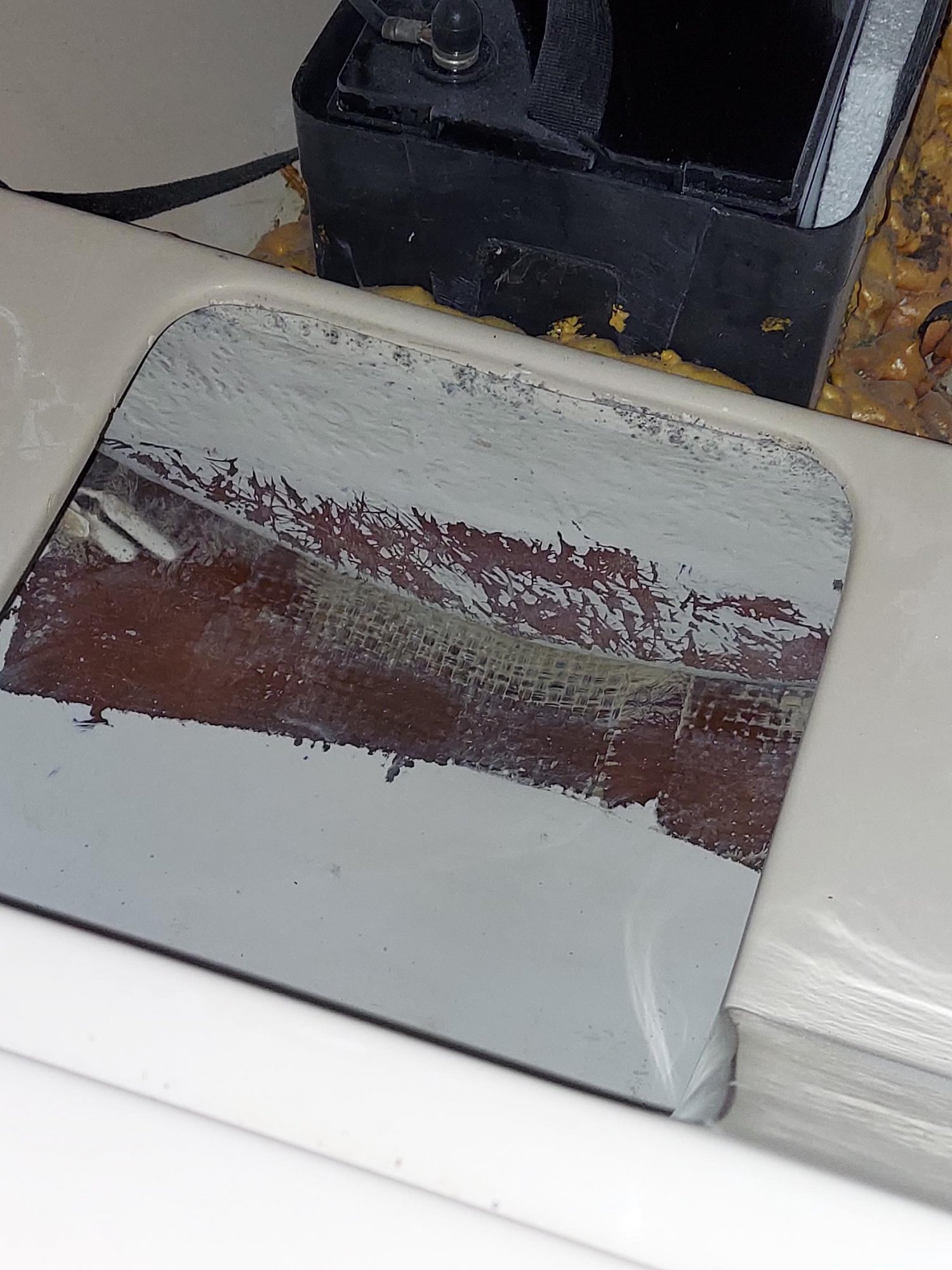
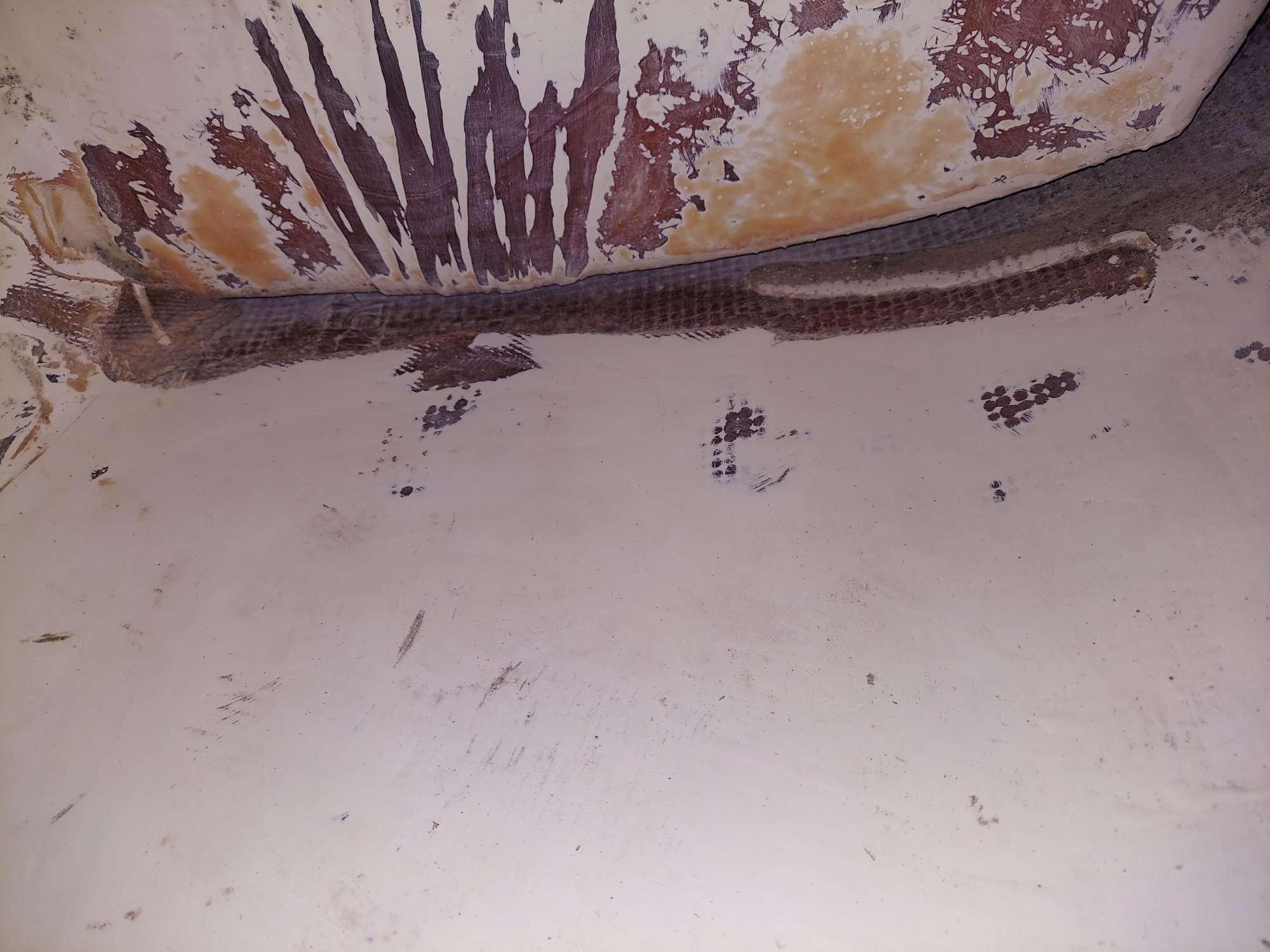
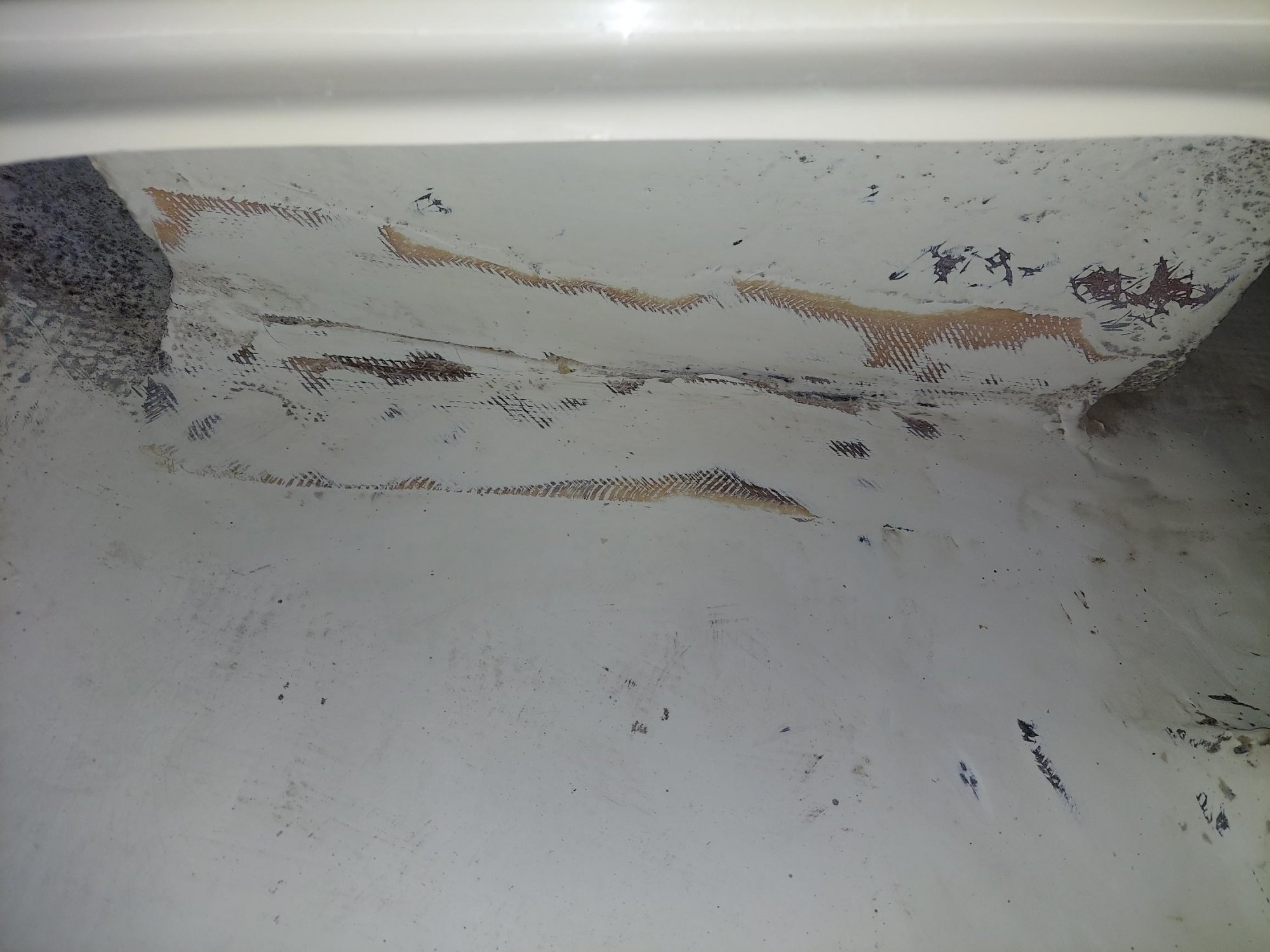
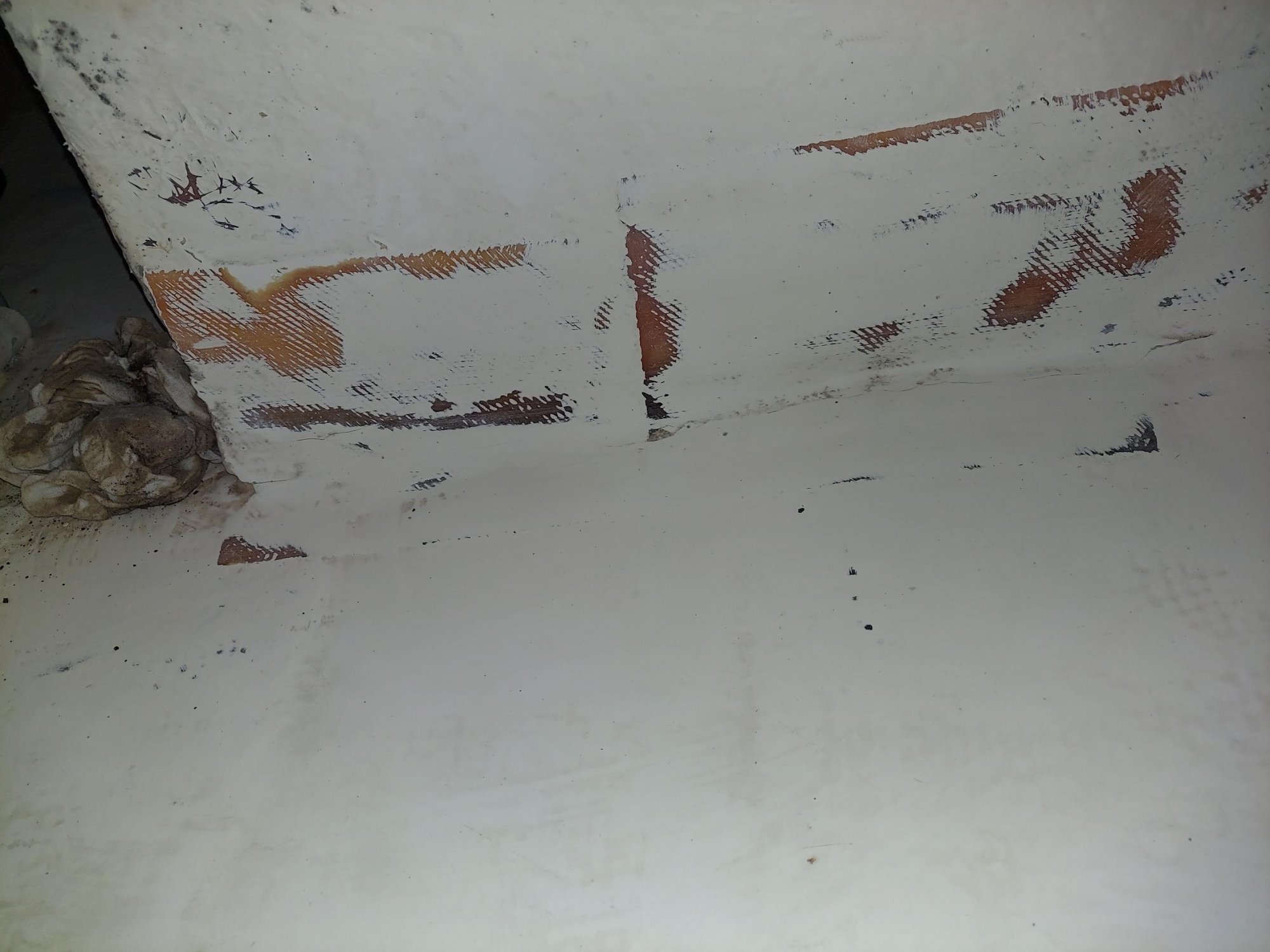
My new to me 1989 Catalina 22 has some cracked tabbing between the interior shell and the hull. Most of the tabbing still seems attached to the hull and shell pretty well. So my plan is to lay new fiberglass tabbing over the old. I plan to use one or probably 2 layers of 17 oz. 1708 cloth with epoxy resin. Hopefully all of this sounds good so far. My question is in regards to preparation. The accessible areas between the hull and shell (under the hatches) have a white coating of some sort that covers the tabbing and the exposed hull. Do I need to grind through this white coating down to the amber colored material and fiberglass cloth that is underneath the white coating? Or can I lay the new tabbing on top of the white layer? The first picture with the battery in it is where I was able to completely rip off the tabbing in one piece. If I want the new tabbing to extend onto the white area do I need to grind it down so that it looks like the amber colored area? Any help will be greatly appreciated!! This is all new to me.

1989 Catalina 22 hull tabbing repair help
- Thread starter Chipmunk88
- Start date

The white area could be paint or gelcoat. If it's gelcoat there was wax added to the final coat to promote curing. The wax must be removed before you grind it and apply fiberglass/epoxy over it. Whether the white area is paint or gelcoat you should grind the surface to promote good adhesion.
Yeah, you should remove all of the white (paint or gel coat) and any loose material. Then clean with acetone - twice.
I am not sure what this tabbing does, structurally, based on your description and photos. But, 1-2 layers seems unnecessarily frugal. Just as easy to do 3-4.
Some considerations:
Tabbing doesn't usually fail on the tabbing material itself. It fails when the tab separates from the surrounding structure. Or, it fails because of large voids (air pockets) in the tab layups. If the tabs themselves are cracked, you might want to investigate why this happened, and it might be an indicator that you want more than 1-2 layers.
17 oz fabric is quite heavy. The challenge is that it is hard to wet out cloth in tabbing applications and also get excess resin out, since you working in such awkward way. The heavier cloth just makes this harder. It is also less cooperative at making sharp bends.
You can make your life MUCH easier by using something like 6oz fiberglass tape and just use more layers. This also lets you stagger your edges better for a nice tapered transition. And, if you use peel ply to get a clean surface, that will also help. The peel ply will help squeeze out extra epoxy and gives you a nice clean finish.
I am not sure what this tabbing does, structurally, based on your description and photos. But, 1-2 layers seems unnecessarily frugal. Just as easy to do 3-4.
Some considerations:
Tabbing doesn't usually fail on the tabbing material itself. It fails when the tab separates from the surrounding structure. Or, it fails because of large voids (air pockets) in the tab layups. If the tabs themselves are cracked, you might want to investigate why this happened, and it might be an indicator that you want more than 1-2 layers.
17 oz fabric is quite heavy. The challenge is that it is hard to wet out cloth in tabbing applications and also get excess resin out, since you working in such awkward way. The heavier cloth just makes this harder. It is also less cooperative at making sharp bends.
You can make your life MUCH easier by using something like 6oz fiberglass tape and just use more layers. This also lets you stagger your edges better for a nice tapered transition. And, if you use peel ply to get a clean surface, that will also help. The peel ply will help squeeze out extra epoxy and gives you a nice clean finish.

It seems as though the tabbing is only 1 maybe 2 layers of fiberglass. I believe its purpose is to stiffen the hull, in order to maintain its shape. If it is gelcoat and there is a layer of wax can I just grind through it without first removing the wax? I have already done some grinding and sanding and may have already removed a wax layer?
Jamestown distributors carries 8.7 ounce 90 degree fiberglass tape, is this compatible with epoxy resin?
You can call and ask them, tech support there is pretty good. The only glass fabric that is usually not compatible with epoxy is chopped strand mat. The glue that holds it together does not dissolve in epoxy, which makes it difficult to saturate the cloth and requires more resin to saturate it than polyester resin. The styrene in polyester resin will dissolve the glue.Jamestown distributors carries 8.7 ounce 90 degree fiberglass tape, is this compatible with epoxy resin?
It will probably be cheaper to purchase a yard or two of the cloth you want and cut it in strips.
The tape (and just about any fiberglass fabric) is almost certainly compatible with epoxy, for reasons Dave explained.
One thing to avoid is having the bulky fibers running perpendicular to the joint because this makes the cloth not want to stay bent into a nice corner. It will tend to straighten out and fight you. So, you want your strips to have their fibers running diagonal to the joint to make this easier. I have seen the argument that the fibers should be perpendicular for maximum strength, but this ignores the fact that joints are subject to shearing forces.
It will definitely be cheaper to buy cloth and cut it into strips, but this is a messy job. Cloth cut into strips produces lots of stringy edges that want to unravel and, at best, they are a mess to deal with when you are doing your layups. But, more seriously, they tend to produce very sharp needles that stick out of your layup and increase your finishing effort. Peel ply helps with this but the fewer raw fiber ends the better.
That said, with tape, it is slightly more challenging to get a good taper since the edge of the tape sort of ends abruptly rather than naturally feathering. If you stagger your layers and use peel ply, this will be a minor issue, but it is an issue.
If this was me, I'd use 6-ish oz diagonal bi-directional tape - maybe 3-4 inches wide (depending on the location). And, I would do 3 layers - the first centered on the joint, the second offset about 1/2" one way, and the third offset about 1/2" the other way. If I was concerned about strength, I would do a 4th layer centered on the joint. Peel ply and call it a day.
Also, if you're not experienced with fiberglass, one of the best things you can do is have an assistant whose job is simply to not get resin on their hands and hand you stuff.
One thing to avoid is having the bulky fibers running perpendicular to the joint because this makes the cloth not want to stay bent into a nice corner. It will tend to straighten out and fight you. So, you want your strips to have their fibers running diagonal to the joint to make this easier. I have seen the argument that the fibers should be perpendicular for maximum strength, but this ignores the fact that joints are subject to shearing forces.
It will definitely be cheaper to buy cloth and cut it into strips, but this is a messy job. Cloth cut into strips produces lots of stringy edges that want to unravel and, at best, they are a mess to deal with when you are doing your layups. But, more seriously, they tend to produce very sharp needles that stick out of your layup and increase your finishing effort. Peel ply helps with this but the fewer raw fiber ends the better.
That said, with tape, it is slightly more challenging to get a good taper since the edge of the tape sort of ends abruptly rather than naturally feathering. If you stagger your layers and use peel ply, this will be a minor issue, but it is an issue.
If this was me, I'd use 6-ish oz diagonal bi-directional tape - maybe 3-4 inches wide (depending on the location). And, I would do 3 layers - the first centered on the joint, the second offset about 1/2" one way, and the third offset about 1/2" the other way. If I was concerned about strength, I would do a 4th layer centered on the joint. Peel ply and call it a day.
Also, if you're not experienced with fiberglass, one of the best things you can do is have an assistant whose job is simply to not get resin on their hands and hand you stuff.
Well I already have the 1708, and the existing tabs don't make a hard bend in the corners they form a curve. Maybe a 1-2 inch radius. Do you think that 17 oz. 1708 can confirm to that?

I’ve put some filled epoxy in the sharp bends and the tape over that. This was done on a stitch and glue pram I built. It was very strong as evidenced by my getting it between my 356 and a dock pole. The pram bent nearly in half but all the “Glued” joints held and it had years more service. I used the West System filleting filler. Not sure about that spelling!
You can make a filleting tool out of wood, plastic or metal that makes the job easier. Just form the end to the radius you desire. No need to make a material (Tape) do what it doesn’t want to do. Off Center Harbor web site has an excellent video on this. Unfortunately I let my membership lapse and I can’t reference it for you.
You can make a filleting tool out of wood, plastic or metal that makes the job easier. Just form the end to the radius you desire. No need to make a material (Tape) do what it doesn’t want to do. Off Center Harbor web site has an excellent video on this. Unfortunately I let my membership lapse and I can’t reference it for you.
The vertical and horizontal sections don't actually meet. There is about a 1 inch gap between them. So there isn't much to press the fillet? material against. I don't know if that would affect the results at all. I guess it couldn't hurt. I'll consider it.
Well then, getting tape or other material to make a right angle is moot. Just place the tape to have enough overlap on the horizontal and vertical panels with a reasonable bend radius. Then tape as described in Foswick's post #8. I'd still add the fillet filler to the last layer.
Buy the good scissors. To get good clean cuts in tape or cloth it is worth the money.
Buy the good scissors. To get good clean cuts in tape or cloth it is worth the money.

jssailem
SBO Weather and Forecasting Forum Jim & John
- Oct 22, 2014
- 24,817
Biaxial Tape would be a good choice.
From the Jamestown product description:
Fiberglass Biaxial Cloth Tape - 6 inches WideFiberglass 6 inch Biaxial Tape is E-glass Biaxial (+/-45) Cloth tape with 3/4 oz mat backing. Tape is held together by light stitching. Flat non-crimped fibers yield reduced print-thru and higher stiffness than woven fabrics. Biaxial tape is ideal for repairs, tabbing, and reinforcing.
From the Jamestown product description:
Fiberglass Biaxial Cloth Tape - 6 inches WideFiberglass 6 inch Biaxial Tape is E-glass Biaxial (+/-45) Cloth tape with 3/4 oz mat backing. Tape is held together by light stitching. Flat non-crimped fibers yield reduced print-thru and higher stiffness than woven fabrics. Biaxial tape is ideal for repairs, tabbing, and reinforcing.
The white material doesn't seem to like paint, if I had to guess I would say its gelcoat. I'm in the process of getting down to the hull and shell
(what a mess, I don't see how I could ever get rid of all the dust), alot of the tabbing is not well adhered and only seems to be one layer thick. I think that the custom trailer is the culprit. For one, the front of the bunks were much higher than the rear. The whole boat was tilted back with the bow up. The bow was almost a foot from the bow bumper thing. The previous owner said "it likes to ride like that". I assume the weight on the bunks is undesirable too but who knows (its a wing keel not a swing). I can imagine without the bow supported, the whole boat rocking fore and aft going down the road going over potholes and whatnot. All that energy transfers into the boat and seems like these tabs are the weakest link. But this is my first boat so what do I know. What do you all think?
(what a mess, I don't see how I could ever get rid of all the dust), alot of the tabbing is not well adhered and only seems to be one layer thick. I think that the custom trailer is the culprit. For one, the front of the bunks were much higher than the rear. The whole boat was tilted back with the bow up. The bow was almost a foot from the bow bumper thing. The previous owner said "it likes to ride like that". I assume the weight on the bunks is undesirable too but who knows (its a wing keel not a swing). I can imagine without the bow supported, the whole boat rocking fore and aft going down the road going over potholes and whatnot. All that energy transfers into the boat and seems like these tabs are the weakest link. But this is my first boat so what do I know. What do you all think?

While you've received a lot of good input on tape and such I'm a bit confused about your photos. I owned a C22, 1981, #10496. Please help me understand where on the boat those vertical "walls" are located, because I just can't get oriented to where on the boat they are.
I've copied your photos as part of this post rather than having to scroll back to the top.
I've copied your photos as part of this post rather than having to scroll back to the top.
My new to me 1989 Catalina 22 has some cracked tabbing between the interior shell and the hull. Most of the tabbing still seems attached to the hull and shell pretty well.
>>>>>>>>>>>>>>>>>>>>>>>>>>>>>>>>>>
>>>>>>>>>>>>>>>>>>>>>>>>>>>>>>>>>>
View attachment 236767View attachment 236768View attachment 236769View attachment 236770
I have been reading about surface prep and cleaning and whatnot, but I still have one big question. I have removed what I believe is the gelcoat and have completely removed the old tabbing and I am now down to the fiberglass hull and "shell". I believe I read somewhere that the hulls were made with polyester resin. Do I need to grind through the outermost resin down to actual fiberglass cloth? or can I just sand the outermost "layer" of resin and attach my tabbing directly to that?
Is dewaxer necessary? Will acetone suffice? Is a thickening agent necessary for the resin or can I just use straight epoxy resin? Will the tabbing stay in place on the vertical sections?
jssailem
SBO Weather and Forecasting Forum Jim & John
- Oct 22, 2014
- 24,817
NO.
Resign (vinylester or polyester) impregnates the fiberglass. So using 80 grit just rough up the material no need to sand through the resin, and begin the process. Epoxy resin will work with either.
You have a 90º corner so a filler is warranted.
There is a product called KittyHair. It is a bit of chopped up fiberglass fibers used with epoxy to create a fillet for the 90º corner. Put it down in the corner then the cloth has a better transition.
Check out Andy at BoatToday.com. He has a great video to install tabbing.
Resign (vinylester or polyester) impregnates the fiberglass. So using 80 grit just rough up the material no need to sand through the resin, and begin the process. Epoxy resin will work with either.
You have a 90º corner so a filler is warranted.
There is a product called KittyHair. It is a bit of chopped up fiberglass fibers used with epoxy to create a fillet for the 90º corner. Put it down in the corner then the cloth has a better transition.
Check out Andy at BoatToday.com. He has a great video to install tabbing.
