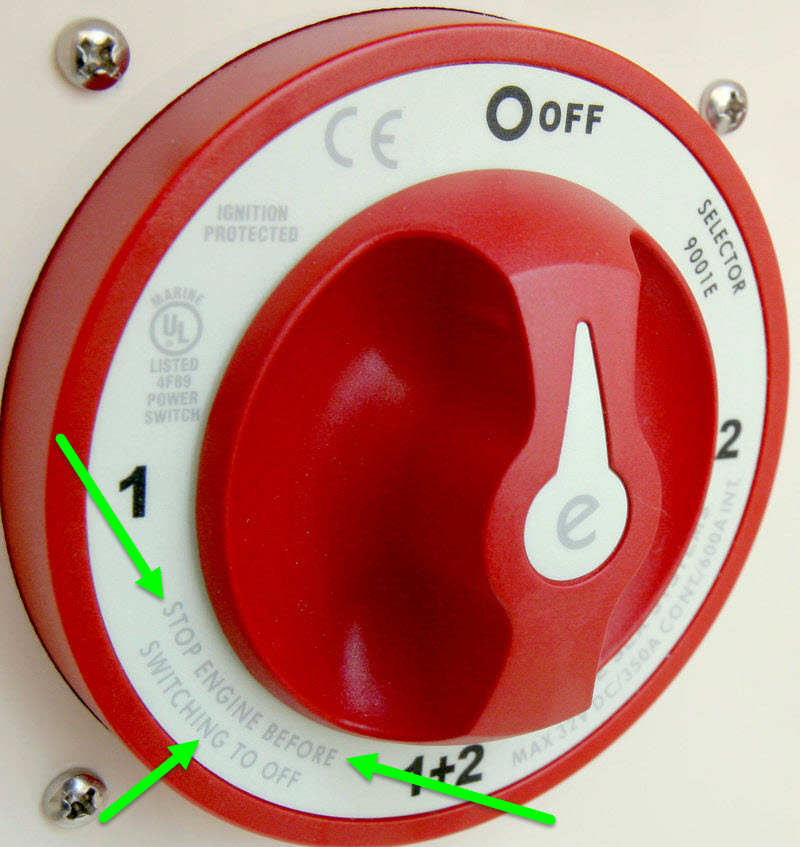
Are you still baffled as to how the 1 - 1+2 - 2 battery switch works?

jssailem

SBO Weather and Forecasting Forum Jim & John
Oct 22, 2014
24,649
CAL 35 Cruiser #21 moored EVERETT WA
There are several viewpoints, with sound reasoning, about the Battery switch that has been in use since the 60s to control the battery/batteries onboard your sailboat. For a new boat owner, it appears pretty straightforward. Like my electrical panel at home, I turn the switch and electricity flows from the power station to the lights - heat - refrigeration, etc. All the conveniences of the modern living space.

I recently reviewed the Practical Sailor YouTube video on the subject. In about 12 minutes, the video gives a good overview description of the issues about this switch and it’s utilization. I think it will help owners new to the boating world begin to understand the background and uses of the battery switch.

 
Jan 19, 2010
12,968
Hobie 16 & Rhodes 22 Skeeter Charleston
I liked his suggestion to toss out the 1-2-all switch and get an on-off switch for each bank and then devise a way to start the engine with the house bank in an emergency.
 
  • Like
Likes: Ward H
Jan 11, 2014
14,069
Sabre 362 113 Fair Haven, NY
For a deeper dive into the 1-2-Both switch, read Rod's article on it.


I liked his suggestion to toss out the 1-2-all switch and get an on-off switch for each bank and then devise a way to start the engine with the house bank in an emergency.
There is a really simple solution that is well known. Install a Blue Sea Dual Circuit Plus switch with an ACR between the 2 battery banks. The switch is a double pole switch which allows you to control 2 isolated banks with one switch. The Plus series has an emergency parallel position that will allow either battery to start the engine and run all the house loads (if all the loads are on one bus). The ACR keeps the start battery charged.

This is not a new design, I've had it on my boat for over a decade.
 
May 29, 2018
678
Canel 25 foot Shiogama, japan
RE: I liked his suggestion to toss out the 1-2-all switch and get an on-off switch for each bank and then devise a way to start the engine with the house bank in an emergency.

That is what I have done.
The result is two completely independent systems.
I have battery jumper leads for emergency starting (and to help others out!)
Gary
1786020987045.png
 
Last edited:
Apr 10, 2025
8
Hunter 326 Northport
Since were talking about that video, there is 1 part that is confusing to me. He mentions that if the start battery is low or weak you can put switch to all to get more power to start the engine. He also said that the weaker battery can drain the stronger one. Would you ever want to use all to start the engine? or why not just use the other bank only to start it?
 
Jan 19, 2010
1,380
Catalina 34 Casco Bay
WE have: a chart plotter, auto helm, refrigeration, pressure water, radios and a windlass that all could be demanding on the batteries. Obviously the windlass is a part time use and only when the engine is running. To support these, there is a starting battery and a house bank of 3. I have a 1,2,BOTH/OFF switch for the starting battery and a separate 1,2,,BOTH/OFF for the house. With each switch the number 1 position sends power to the appropriate place. No engine charging goes back through the switches. Instead, the alternator sends power to an isolator. This keeps the separation complete. Should the starting battery fail, its switch could be set to #2 and the house bank switch also moved to #2. This would allow the house bank to start the engine. Regardless of the switch positions, the charge is going back into each bank. And just to make things interesting... the solar panels each feed to a battery switches that are only 1,2 OFF. Position 1 is solar and 2 is shore that feeds from a Xantrex charger.
 
Jan 11, 2014
14,069
Sabre 362 113 Fair Haven, NY
Since were talking about that video, there is 1 part that is confusing to me. He mentions that if the start battery is low or weak you can put switch to all to get more power to start the engine. He also said that the weaker battery can drain the stronger one. Would you ever want to use all to start the engine? or why not just use the other bank only to start it?
Yes you can do that and yes you can end up with 2 depleted batteries. The purpose of starting the engine from the Both position is to charge both batteries at once. From my perspective, recognizing that this is possible and not warning against not doing this is irresponsible.

Whether it is reasonable to parallel the batteries to start the engine really depends on the electrical system and why the start battery is depleted. In the both position the alternator output will be sent to both batteries, with the majority of the output going to the more discharged battery because the resistance is lower. It gets a bit more complicated because the healthier battery will discharge into the less healthy battery until the voltages are equal, leaving the boat with 2 depleted batteries.

OEM alternators are designed primarily to quickly recharge the start battery and to maintain it in a fully charged state. That they can provide some additional power to run the boat's systems is a bonus. They are not up to the task of charging a deeply discharged battery efficiently because of lead acid battery chemistry and the alternator reducing its output to avoid damaging the alternator. A single LA battery at 50% SOC will take 5 or more hours to reach 100% using the engine alternator along.

This article does a deeper dive into the OEM (Automotive) Alternators and batteries.

 
  • Like
Likes: niceshoes6
Feb 26, 2004
23,399
Catalina 34 224 Maple Bay, BC, Canada
I think he glossed over the most important part of the entire non-issue, but chose to blame the switch, not the users.

Maine Sail has covered this in great detail: make it a USE switch and NOT a CHARGING switch.

Here's a number of reasons why and how:

OEM 1-2-B Switch Wiring History http://c34.org/bbs/index.php/topic,4949.msg30101.html#msg30101

1-2-B Considerations (New 2020 - Rod finally got around to diagramming what I had done in the above link in 2009 :) )
1/2/BOTH Switch Considerations

Basic Battery Wiring Diagrams This is a very good basic primer for boat system wiring: http://c34.org/bbs/index.php/topic,6604.0.html

This is another very good basic primer for boat system wiring: The 1-2-B Switch by Maine Sail (brings together a lot of what this subject is all about)
http://forums.catalina.sailboatowners.com/showthread.php?t=137615

This is a newer primer for boat system wiring design with a thorough diagram: Building a Good Foundation (October 2016)
Building a DC Electrical Foundation
 
Apr 8, 2010
2,243
Ericson Yachts Olson 34 28400 Portland OR
A well regarded surveyor told me that too many boat owners overlook the primary reason for a master switch: to be able to remove power from all boat circuits in case of smoke & fire. They gloss over the word "master" .
Unlike even a major leak in the hull that may give the crew 10 or 20 minutes to escape, a fire will overwhelm the boat in seconds, i.e. often under a minute - and suffer burns and smoke inhalation while exiting.
Best to have no circuits directly connected to the battery or severely limit them. (Even fuses at the terminals may not be accessible in an emergency.)
 
May 17, 2004
6,173
Beneteau Oceanis 37 Havre de Grace
Since were talking about that video, there is 1 part that is confusing to me. He mentions that if the start battery is low or weak you can put switch to all to get more power to start the engine. He also said that the weaker battery can drain the stronger one. Would you ever want to use all to start the engine? or why not just use the other bank only to start it?
When I was a kid we’d often put my grandfather’s powerboat on Both to start it when cold. But that was a big V8 engine, with wiring and a starter that were probably in pretty questionable shape. These challenges probably shouldn’t apply to more modern sailboats with much smaller engines.

Off-topic, but he did also once have a problem where a corner of the boat got caught under a dock on an incoming tide. Unknown to him it held the boat down enough that water backed up the exhaust and into the cylinders. When he got back to the boat at low tide and tried to start it the engine was hydro-locked, but he just thought he had a dead battery. He put the switch on Both but still couldn’t start it.so he grabbed a couple more batteries and put them in the circuit too. That was enough energy to turn the starter, but in the process it destroyed the engine.
 
May 24, 2004
7,226
CC 30 South Florida
The alternator will appreciate a battery switch that "Makes Before Breaks" You may have the need or want to change the battery in use while motoring and that short disconnect where the load disappears may cause to fry the diodes in the alternator. The MBB battery switch is designed to close the connection to the other battery or both before it disconnects from the one in use. There is always a load maintained on the alternator. Although most manufacturers have upgraded their design there are still some switches out there that perhaps are not intended for charging systems but that are being sold and used in boats.
 
  • Like
Likes: MFD
May 24, 2004
7,226
CC 30 South Florida
When I was a kid we’d often put my grandfather’s powerboat on Both to start it when cold. But that was a big V8 engine, with wiring and a starter that were probably in pretty questionable shape. These challenges probably shouldn’t apply to more modern sailboats with much smaller engines.

Off-topic, but he did also once have a problem where a corner of the boat got caught under a dock on an incoming tide. Unknown to him it held the boat down enough that water backed up the exhaust and into the cylinders. When he got back to the boat at low tide and tried to start it the engine was hydro-locked, but he just thought he had a dead battery. He put the switch on Both but still couldn’t start it.so he grabbed a couple more batteries and put them in the circuit too. That was enough energy to turn the starter, but in the process it destroyed the engine.
Since were talking about that video, there is 1 part that is confusing to me. He mentions that if the start battery is low or weak you can put switch to all to get more power to start the engine. He also said that the weaker battery can drain the stronger one. Would you ever want to use all to start the engine? or why not just use the other bank only to start it?
The battery switch also provides redundancy, which is to maintain a source of power in reserve for an emergency situation. Start Batteries and House batteries usually have different structures, the Start is designed to provide a burst of power over a short duration, while the House Battery(s) are deep cycle and are designed to provide power over a long duration. A charged Deep Cycle Battery has no problem starting the small auxiliary diesel engines in sailboats so many sailors forego installing Starter batteries for a second Deep Cycle. The idea is to have two equal batteries of approximately the same age so that they can pair well when combined (BOTH). Since the engine can be started by either battery there you have your redundancy. There is just a little concern about always using the same one as batteries have a limited number of charging cycles and the other needs to be exercised from time to time. The way many sailors use them is to alternate using Battery #1 and Battery #2 in subsequent outings. They will be used to start the engine and run the boat's 12V electronics and Appliances while the other is held on reserve. The engine alternator will charge the selected battery when motoring. Both batteries will receive charge when connected to both. Also understand that when connecting a partially discharged battery to a fully charged one the power will flow from the full battery to the empty until both reach equilibrium. A bad battery will suck the power out of a good one without retaining any useful charge. which is the main reason to keep them isolated until an emergency. Hope this helps. There are many other considerations about battery Bank size and recharging methods. Alway consider your personal needs when sizing your batteries. Deep Cycle Batteries are rated for Capacity(stored power) in Amp/Hours (Ah). If you need more capacity you may need a larger battery or you could increase your opportunities to recharge. Adding solar panels or a generator would be a way of doing that. We size our battery banks for 80% of our sailing. On those instances when we want to go on extended cruises we bring aboard one or two extra batteries and our trusted Honda 2000 gas powered generator. There is a lot of info out there about batteries, maintenance, charge sources and electrical systems so there is a steep learning curve but worthwhile.
 
Apr 5, 2009
3,311
Catalina '88 C30 tr/bs Oak Harbor, WA
WE have: a chart plotter, auto helm, refrigeration, pressure water, radios and a windlass that all could be demanding on the batteries. Obviously the windlass is a part time use and only when the engine is running. To support these, there is a starting battery and a house bank of 3. I have a 1,2,BOTH/OFF switch for the starting battery and a separate 1,2,,BOTH/OFF for the house. With each switch the number 1 position sends power to the appropriate place. No engine charging goes back through the switches. Instead, the alternator sends power to an isolator. This keeps the separation complete. Should the starting battery fail, its switch could be set to #2 and the house bank switch also moved to #2. This would allow the house bank to start the engine. Regardless of the switch positions, the charge is going back into each bank. And just to make things interesting... the solar panels each feed to a battery switches that are only 1,2 OFF. Position 1 is solar and 2 is shore that feeds from a Xantrex charger.
It sounds like I have the same setup as you with two 12BO switch with position 1 for start and house. If your system has a heavy wire that connects the #2 terminal on both switches like mine is, then you have a misconception on how to get emergency power from the house to the starter. To start the engine from the house battery only and have it not connected to the start battery you do the following. Turn the start switch to position #2. Turn the house switch to both. This way, the power comes out of the battery and into terminal #1, it is then sent out position #2 because of the both setting. Then the power goes into start switch #2 and to the starter.
If you turn both switches to #2 position, neither battery is connected to anything because they are both connected to terminal #1.