Sobering Post...

Status
Not open for further replies.
Feb 6, 1998
11,760
Canadian Sailcraft 36T Casco Bay, ME
I found this on this on the Catalina 28 owners site;


"Hi All

On Labor day while motoring in after a nice sail I glanced over
at my temp gauge as I do quite often and saw that it was completely off the
scale with no high temp alarm sounding. I was close to a public dock and swung
around and tied up, shut down the engine and went below to investigate. There
was wispy smoke in the cabin. Taking the engine cover off I was shocked to find
that my entire wiring harness was melted and smoking.
I was able to get towed to
a local boatyard where I have been undergoing repairs for the past month. Damage included the entire harness back to and including the instrument panel in the cockpit, starter damage, oil pressure switch and a few other items. All repairs
had to be brought up to current ABYC standards which meant glow plug solenoid,
associated breakers, rebuilding the starter and updated wiring and new
instrument panel. The cause was determined to be a chafed wire that shorted out
on the engine. I was told that if it was wired under current standards this fire would not have happened due to engine breakers tripping.
Total cost of repairs was $5233.61. Thankfully my insurance covered about $4000.00. Under my policy most of the parts were depreciated and had almost no value. Basically they paid for labor. Please check your wiring and make sure it is well protected so this doesn't happen to you. At least I'll get a couple more weeks of sailing before haul out."


I know I harp on over current protection a lot but this is yet one more case of a boat that almost burned to the waterline..Please be safe and FUSE, FUSE, FUSE!!!!!!
 
Jan 30, 2012
1,154
Nor'Sea 27 "Kiwanda" Portland/ Anacortes
Dare I add two points:
(1) the install time is under 10 minutes and
(2) the cost is under $50.
If anyone needs to know these fuse values - just ask right here.
 
Sep 25, 2008
7,695
Alden 50 Sarasota, Florida
This seem to imply that the standards do not require fuses.

"All repairs
had to be brought up to current ABYC standards which meant glow plug solenoid,
associated breakers, rebuilding the starter and updated wiring and new
instrument panel.
The cause was determined to be a chafed wire that shorted out
on the engine. I was told that if it was wired under current standards this fire would not have happened due to engine breakers tripping
.
"

I assume the person who wrote this meant the work was not up to the standards or had not been done???
 
Feb 6, 1998
11,760
Canadian Sailcraft 36T Casco Bay, ME
This seem to imply that the standards do not require fuses.

"All repairs
had to be brought up to current ABYC standards which meant glow plug solenoid,
associated breakers, rebuilding the starter and updated wiring and new
instrument panel.
The cause was determined to be a chafed wire that shorted out
on the engine. I was told that if it was wired under current standards this fire would not have happened due to engine breakers tripping
.
"

I assume the person who wrote this meant the work was not up to the standards or had not been done???

What he was saying is that prior to the fire the boat was not wired to current safety standards and after the fire they insisted it be brought up to current standards.
 
Feb 6, 1998
11,760
Canadian Sailcraft 36T Casco Bay, ME
Dare I add two points:
(1) the install time is under 10 minutes and
(2) the cost is under $50.
If anyone needs to know these fuse values - just ask right here.
And what is the cost of losing half a sailing season on top of eating $1300.00 and having a tick on your insurance policy........ But of course we all know boats don't vibrate....right....;)
 

Rick D

.
Jun 14, 2008
7,204
Hunter Legend 40.5 Shoreline Marina Long Beach CA
One More Point

...as someone who trained insurance adjusters, (but four decades ago) taking depreciation (betterment) on anything but the starter is ludicrous. Just how is this owner being 'bettered' by new wiring, gauges, switches, etc? It's beyond me. I can certainly see it with respect to the starter since it is a wear item. :snooty:
 
Jan 30, 2012
1,154
Nor'Sea 27 "Kiwanda" Portland/ Anacortes
No human being is safe when insurance adjusters approach the boat.

Edit: What this means is avoid these adjusters altogether - all you need to do is install the fuses Maine identifies. It is just too cheap/simple.

C. Erwin JD
 
Feb 6, 1998
11,760
Canadian Sailcraft 36T Casco Bay, ME
It seems there are two issues at play here.

1- Lack of a proper installation when it comes to over current protection and sloppy wiring practices.

2- Choosing the least expensive policy can come back to bite you.:doh:

We did not choose a cheap policy and pay for "replacement". When hit by lightning NOTHING was depreciated by our insurance company.
 
Dec 11, 2008
1,338
catalina C27 stillwater
Maine, don't forget to point out that under current ABYC/NMMA guidelines, the builder is not required to fuse the starting/cranking circuit... Ironically this is one of, if not the largest, cables in an engine compartment, and therefore most capable of starting a big fire quickly. One cannot say that a new boat built today is fire-proof in the event of a short, due to this fact.

It would be a good bit of information for the sailors who read here to know what ampacity a typical master fuse might be for protecting the entire harness and in particular the cranking circuit.

I know fusing can be spec'd basically two ways, one based on cable size and thermal capacity of the insulation, and the other based on branch circuit load. How would you suggest a reader here go about determining the proper fusiing, both for the primary harness protection fuse at the battery and for individual branch circuits?
 
Jun 15, 2012
717
BAVARIA C57 Greenport, NY
I thought the starting circuit is not fused due to the high current demand of the starter. Is there a way to protect this circuit?
 
Sep 25, 2008
7,695
Alden 50 Sarasota, Florida
I thought the starting circuit is not fused due to the high current demand of the starter. Is there a way to protect this circuit?
There are a number of ways to protect that circuit with high current fuses, both in-line and post-type units depending on your needs and the finesse with which you want to wire it. Lots of info via a google search of marine starting circuit fuses.
 
Feb 6, 1998
11,760
Canadian Sailcraft 36T Casco Bay, ME
Maine, don't forget to point out that under current ABYC/NMMA guidelines, the builder is not required to fuse the starting/cranking circuit... Ironically this is one of, if not the largest, cables in an engine compartment, and therefore most capable of starting a big fire quickly. One cannot say that a new boat built today is fire-proof in the event of a short, due to this fact.

It would be a good bit of information for the sailors who read here to know what ampacity a typical master fuse might be for protecting the entire harness and in particular the cranking circuit.

I know fusing can be spec'd basically two ways, one based on cable size and thermal capacity of the insulation, and the other based on branch circuit load. How would you suggest a reader here go about determining the proper fusiing, both for the primary harness protection fuse at the battery and for individual branch circuits?
This is an "exeception" for starting circuits. It does not however mean that they should not be fused. Problem is builders are cheap and will only do the bare minimum to ensure your safety. before taking delivery of our 2005 Catalina, in 2005, I fused the starting battery.

I have argued for a long time that this exemption wording should be tightened up, folks like Ed Sherman agree on this, especially where a 1/2/BOTH switch is used and either bank can be "house" or "start", but it has gotten nowhere even with Ed pushing. With Li technology expect to see that "exception" change...

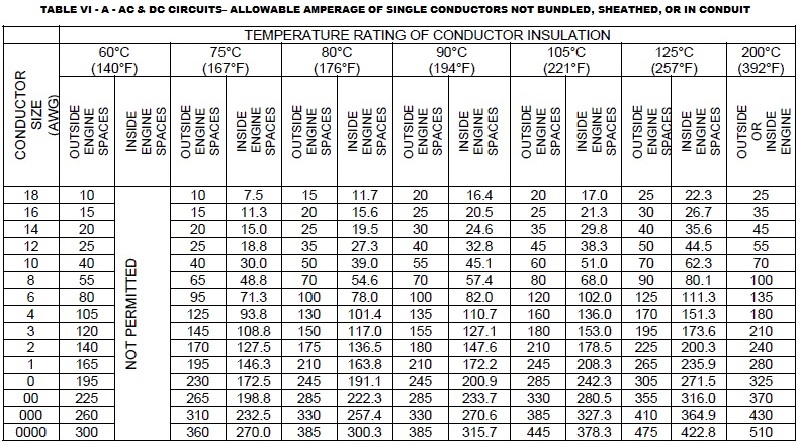
As for fuse sizing use E-11 Table VI and size it to the max ampacity of the wire. You are also allowed to go to 150% of the ampacity chart for OCP and that can sometimes be necessary. on small aux engines this 150% should only come into play if the starter wires are undersized.

If wires are bundled you'd need to go to the other ampacity charts in E-11.

 
Status
Not open for further replies.