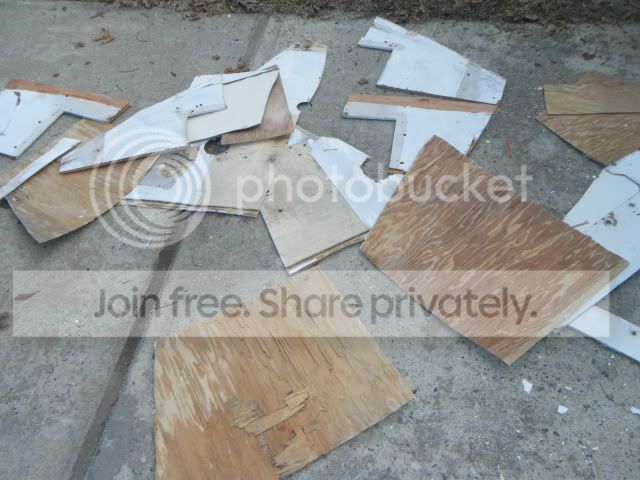
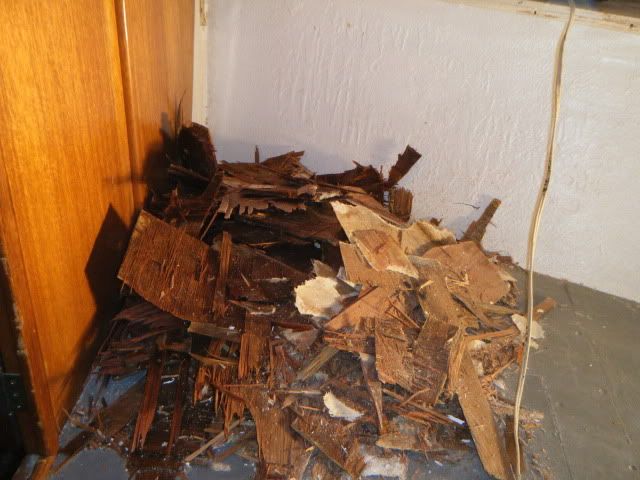
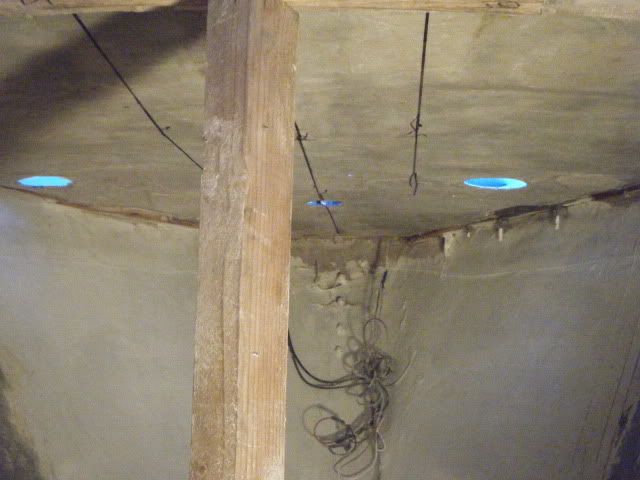
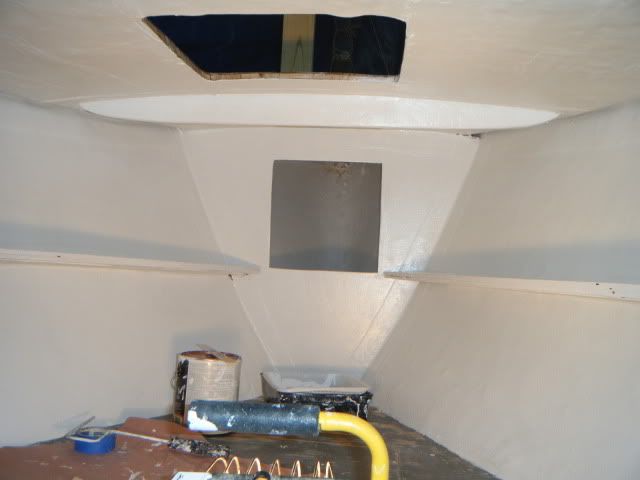
We try a new to us technique for dealing with soft decks.

Status
Not open for further replies.
Apr 3, 2007
48
-O'Day 32' CC Rock Hall MD
CPES

From what I have read, the CPES is thin enough to saturate and encapsulate the rotted core fibers. I've done some deck repairs by removing the top skin, replacing the rotted core with epoxy-saturated 1/4" marine ply, then returning the upper skin with more wet epoxy to bond the upper and lower skins. It was a messy, fussy job. I have another small soft spot on deck, and have been considering trying CPES (West Marine also carries a similar product, but they didn't know they carried a product like this until, after asking about it and being told that they did not, then I found it on their shelves). The idea is that the epoxy would harden and be strong but with voids in it similar to lava. Friends have drilled holes through the top skin, much as described above, then chasing the water by squirting acetone in through the holes until it showed up at the outer holes, then letting it sit for maybe a week, which allowed the acetone to evaporate. MAS Epoxies makes a less toxic acetone that I'm sure is compatible with at least their epoxy, if not the others. They don't make a REALLY thin resin like CPES, but their thin epoxy used for wetout of glass cloth and chopped fiber might work.
 
May 5, 2006
1,140
Knutson K-35 Yawl Bellingham
Sounds like a good solution to a bad problem.. I am constantly amazed by the power of epoxy... i don't know why more things aren't made out of the stuff..
Epoxy has a couple of fatal flaws. It gets brittle over a multitude of flex cycles and it degrades badly when exposed to UV light.
 
Jan 22, 2008
280
Hunter 25_73-83 NORTH POINT MARINA/WINTHROP HA IL
I just spoke with Randy at System 3 Technical support at 232-333-8118 and he said that neither their epoxies nor any others will bond to a wet, saturated, degraded core. Since there seems to be much confusion and misinformation concerning this area, I felt someone who represents Systems Three for technical information would have sufficient experience and expertise regarding this subject. The only way to repair a badly degraded core is to replace it. Good luck and good sailing, Ron
 
Oct 2, 2006
1,517
Jboat J24 commack
The attempt to do this is as old a modern boats in that it was sure being tried with GIT-ROT on plywood cored motor transoms in the 70s
 
May 5, 2006
1,140
Knutson K-35 Yawl Bellingham
Re: We try a new to us technique for dealing with soft decks

Maybe but it was new to us, hence the post...
 
Sep 28, 2008
922
Canadian Sailcraft CS27 Victoria B.C.
Charlie

The jury is still out unless the deck is cut open to see how it worked - or didn't work.

I doubt the epoxy stuck to much core. But as has been proven in the past by many it really makes a proper repair in the future difficult when the top and bottom skins are bonded to each other in places with mushy core in the middle.
 

NYSail

.
Jan 6, 2006
3,184
Beneteau 423 Mt. Sinai, NY
Re: We try a new to us technique for dealing with soft decks

and when the remaining core completely degrades, you will have voids and flexing. I would have removed the wet core at the least. I had a significant problem when I bought my boat and basiclly cut the entire skin off, removed all core and recored with Nidacore. Done.
 
May 5, 2006
1,140
Knutson K-35 Yawl Bellingham
Re: We try a new to us technique for dealing with soft decks

There was NO money, absolutely NONE left in this boat...
 
Sep 28, 2008
922
Canadian Sailcraft CS27 Victoria B.C.
Charlie

I understand that and you took a shortcut. But recommending the shortcut, which isn't a proper fix, doesn't really help anyone much. Both here and on Sailnet there are several posters that have suggested that they might try this - after all a professional in the marine business, an expert did it.

Yes, a proper recore takes time and money. Injecting epoxy will stick well enough to the skins to make a proper repair very hard in the future but not really either remove the moisture or the soggy rotten core it surrounds but doesn't stick to. With thinner skins and a freeze/thaw cycle or two that proper recore may come sooner rather than later.
 

Ross

.
Jun 15, 2004
14,693
Islander/Wayfairer 30 sail number 25 Perryville,Md.
Re: We try a new to us technique for dealing with soft decks

I wish all of the "experts" here had the experience of rebuilding just one boat from a bare hull. Sometimes you really do run out of money and you must make do. I probably have as much experience as most here when it involves recoring decks and hulls. We all know how good it should be but very few of us know how bad it can be and still be good enough. How many have peeled a deck and replaced the core and then the deck?
 
Oct 2, 2006
1,517
Jboat J24 commack


I fully understand why and what Charlie did as Seafever was a long and large series of comprises and decisions to end up with a safe and usable boat with the allowed time and money

And if i did not have plywood core i might even give it a try on the cabintop section of boat i have left for another day as it was good enough for the next decade or so
 
Dec 2, 2003
1,637
Hunter 376 Warsash, England --
Hey Bill!

What a profound statement :-
"Men with experiences are never at the mercy of men with theories."


I have one too. To describe a free thinker we say
"He is unfettered by education."
Rgds,
 

Bob J.

.
Apr 14, 2009
775
Sabre 28 NH
Re: We try a new to us technique for dealing with soft decks

Playing devil's advocate here:

If the core has been allowed to properly dry out then why not inject epoxy in lieu of ripping off the skin? Most of the core that is degraded becomes kinda like what you'd mix with epoxy to give it consistency for patching/fairing.

Any thoughts on this because this is the course of action I was planning on for the areas on our boat that are soft.

Bob
 
May 5, 2006
1,140
Knutson K-35 Yawl Bellingham
Re: We try a new to us technique for dealing with soft decks

Okay, here's the result of a direct experiment on balsa core that was pulled out of this boat. I did not give it time to dry and soaked it in CPES. The very next day, the balsa was hard as a rock and stood up to compression very well. That leads me to believe this "incorrect" process is better than nothing at all. Would I had rather pull the core and do it right? Yes, could I do it this time? Nope, no way.
 
Sep 28, 2008
922
Canadian Sailcraft CS27 Victoria B.C.
Bob

If the core if very wet it will not dry without cutting the skin off. A few holes will not work.

Charlie

Yes, it is probably better than nothing. But it is a quick fix, not a proper solution. I would avoid buying a boat that has had such quick fixes as most should. And I would not suggest it to others.
 

MSter

.
Apr 12, 2010
131
Sabre 38' MK II Oriental, NC
Re: We try a new to us technique for dealing with soft decks

I for one am glad that Charlie shared this trick with us. Each of us have our own set of skills and also the ability to understand when and where to use something like this. It was clear from the onset that this was a stop gap type fix. It is often stated that boats are full of compromises. This is something that some may be able to use to buy some time.
MSter
 

Bob J.

.
Apr 14, 2009
775
Sabre 28 NH
Re: We try a new to us technique for dealing with soft decks

Mitiempo,

That's why I said allowed to "properly dry out"

I've drilled holes 4" apart in the areas that need attention, the boat has been tented
since May & I wasn't planning on completing the repairs until next spring.

All the deck hardware has been removed & everything was drying out real good until I taped up the holes & took the tarp down for the "hurricane" :)

Nothing says knock me off the jack stands in a good gust like a tarp around a boat.....

Bob
 
Sep 28, 2008
922
Canadian Sailcraft CS27 Victoria B.C.
Bob

The problem is that drilling holes will only really allow the core to dry out immediately around the holes if the core was installed properly during the layup. End grain balsa doesn't transfer moisture easily horizontally in a deck because of the vertical grain - no other wood in the same configuration would either. The end grain will be mostly sealed by the resin. The water in most decks didn't arrive yesterday - it took years to migrate through the core, eventually leaving rot in its path. when this stage is reached and the deck is soft, meaning there is a fair amount of water present, it will not lend itself to easy removal. A series of holes may work in a locally damp core but I think if you drill a series of holes in a wet deck and let it sit for months under cover you will find if you cut it open that a lot of moisture is still present.
 

Ross

.
Jun 15, 2004
14,693
Islander/Wayfairer 30 sail number 25 Perryville,Md.
Bob

The problem is that drilling holes will only really allow the core to dry out immediately around the holes if the core was installed properly during the layup. End grain balsa doesn't transfer moisture easily horizontally in a deck because of the vertical grain - no other wood in the same configuration would either. The end grain will be mostly sealed by the resin. The water in most decks didn't arrive yesterday - it took years to migrate through the core, eventually leaving rot in its path. when this stage is reached and the deck is soft, meaning there is a fair amount of water present, it will not lend itself to easy removal. A series of holes may work in a locally damp core but I think if you drill a series of holes in a wet deck and let it sit for months under cover you will find if you cut it open that a lot of moisture is still present.
In the building trades we ask ,"is there any chance that it will ever get wet?" If there is we use either durable wood or pressure trearted wood. The people that build boats figure that the wood cores will last longer than the 5 years or 50,000 miles warrenty so they don't care. Those that do care build boats with Airex or Corecell in the cored components and they sell their work for 100,000 to 250,000 more than the mass market boats that we see. You can turn a 45 foot hunter into a 45 foot Morse if you are willing to spend the extra dollars for the structrual improvements
 
Sep 28, 2008
922
Canadian Sailcraft CS27 Victoria B.C.
Ross

I don't think there is anything wrong with end grain balsa core if it is properly done and maintained. Any core can have moisture intrusion and delaminate, it just won't rot like balsa eventually will. Properly means that there should not be any balsa bordering hatch cutouts or any other holes in the surface including all fastenings. In these areas the balsa should be removed and replaced with thickened epoxy or these areas should be solid layup during construction. Balsa has the best compression/weight ratio of any non-exotic core material. Also deck fittings are not there for life - hardware should be re-bedded through the life of a boat and not ignored.

Most of the boats with wet deck problems have been through multiple owners and maintenance has been ignored at times.
 
Status
Not open for further replies.