Heating system design ideas

Status
Not open for further replies.
Nov 22, 2008
3,562
Endeavour 32 Portland, Maine
I have completely re-thought my cabin heater installation. The final design has been quite a project due to the tight clearances and conflicting requirements. I think it's going to be the cat's pajamas though. I have some heat recovery from the flue, a huge increase in radiated area, avoided total refinishing of a bulkhead, provided heat for the head, and will have have 4.6 gallons of hot water continuing to radiate heat into the cabin after the fire is put out at night.

Full description here:

http://www.rogerlongboats.com/10Winter.htm
 
Sep 15, 2009
6,244
S2 9.2a Fairhope Al
rodger ....

i do like the heater system that you propose for you boat......down south there seem to be a lot of marine air units with reverse cycleing ...and was wondering if they are on the same consept and a heat pump in the home systems.....if so i really am not to fond of thoses as they seem to depend on a back up heat strip and that says to me that they are not that great ......

regards

woody
 

Ross

.
Jun 15, 2004
14,693
Islander/Wayfairer 30 sail number 25 Perryville,Md.
Roger, you will have about 37 pounds of water in the tank at about 125 Degrees F and a cooling rate of about 24 btu's per hour per degree F. You will probably get good heat for about 2-3 hours. The system looks good and nicely inovative.

Specific heat of water is one btu per pound per degree F.
 
Feb 26, 2004
23,356
Catalina 34 224 Maple Bay, BC, Canada
rodger ....

......down south there seem to be a lot of marine air units with reverse cycleing ...and was wondering if they are on the same concept and a heat pump in the home systems.....if so i really am not to fond of those as they seem to depend on a back up heat strip and that says to me that they are not that great ......
woody

There is a reason for that. As Ross has mentioned many times on this topic, the issue is heat transfer.

Reverse cycle heat pumps work very well for the cooling "side" because they're cooling from 95 degrees outside temperature to 75 inside, a 20 degree difference.

On the heating "side", twenty degrees difference makes them good for down to 55 degrees. Once it gets colder they simply can't keep up, and that's why they add additional electric heating coils to them.

Think of those heat pumps just like a window air conditioning unit that simply gets turned around from summertime to wintertime.

That's why, it's NOT that they're bad, it's just that they are good for some conditions and not all colder outside conditions below 55 F.

That's a simple explanation without much "engineer-speak" involved.
 
Nov 22, 2008
3,562
Endeavour 32 Portland, Maine
You will probably get good heat for about 2-3 hours. The system looks good and nicely inovative.
Thanks. Care to give me an estimate of how long it will take to heat up the 5 gallons of water in my main hot water tank? It's 13 feet aft of the heater and on the other side of the boat so I'll have some long hose runs and it's not clear yet how easy it will be to insulate them. There will be a valve to throttle the flow for optimum heat pick up and transfer.
 
Sep 15, 2009
6,244
S2 9.2a Fairhope Al
woody

There is a reason for that. As Ross has mentioned many times on this topic, the issue is heat transfer.

Reverse cycle heat pumps work very well for the cooling "side" because they're cooling from 95 degrees outside temperature to 75 inside, a 20 degree difference.

On the heating "side", twenty degrees difference makes them good for down to 55 degrees. Once it gets colder they simply can't keep up, and that's why they add additional electric heating coils to them.

Think of those heat pumps just like a window air conditioning unit that simply gets turned around from summertime to wintertime.

That's why, it's NOT that they're bad, it's just that they are good for some conditions and not all colder outside conditions below 55 F.

That's a simple explanation without much "engineer-speak" involved.
thanks for the answer..... Stu.....thats about what i expected it to be .....i may have stated it with bisas but ment no harm to the type of system...just that being touthed by the sellers as the best thing sence sliced bread made me wonder why the heat strip ......i personally dont think that even in ga we are far enough south to use a heat pump only ....i remember back in 1962 when it got so cold in NAWORLINLS and they didnt have much heat in the homes everyone was walking around in blankets and heavy clothing lol ....again thanks

regards

woody
 

Ross

.
Jun 15, 2004
14,693
Islander/Wayfairer 30 sail number 25 Perryville,Md.
Five gallons is about forty pounds. assume a cold temperature of 45 degrees and a hot water tank temp of 130 degrees you will probably need about 150 degrees from the coil to allow for loss. With 2000 btu's flowing over the coil and an efficiency of 40 percent you may get a net 800 btu's of heated water or about one gallon per hour. More turns in the coil can help catch more of the heat. The heat loss from an uninsulated tank will limit the maximum water temperature you can get. I am presuming that your heating coil is in the flue.
 
Nov 22, 2008
3,562
Endeavour 32 Portland, Maine
about one gallon per hour.
That's in line with my expectations. I was only counting on hot water from the main tank during long rainy days at anchor when the heater was running all day. That's when I'm most likely to want a shower anyway. The coil is only a single turn in the heater but it's right in the firebox just above the maximum flame level. Dickenson says the coil will heat a 10-15 gallon tank but doesn't say how long.

I can't run the heater under sail but will probably be able to run it under power.
 

Ross

.
Jun 15, 2004
14,693
Islander/Wayfairer 30 sail number 25 Perryville,Md.
Under those conditions(coil in fire box) you will probably get better results. The barest minumum of insulation will make a large difference in heat loss. Like a sock on a glass of icewater or the foam coffee cup. One sixteenth of an inch of insulation and you can hold boiling water in you hand.
 
Dec 2, 2003
1,637
Hunter 376 Warsash, England --
Much admired your proposals and the detail you have gone to.
Are you abandoning the engine as a source of hot water when you are not operating the furnace in the summer?
Also it would be a simple matter to fit an in line pump to pressurize the shower and heads basin.
Might not be a good idea to return the new hot tank overflow - spillage, expansion etc - to the main (drinking water?) tank. Legionnaires disease etc!
 
Nov 22, 2008
3,562
Endeavour 32 Portland, Maine
Are you abandoning the engine as a source of hot water when you are not operating the furnace in the summer?
Yes. It never worked on my boat. The engine is raw water cooled and the Yanmar 2QM20 is a very cool running engine. Even 8 hours of running never made the water even luke warm. Converting to fresh water cooling is on my "someday" list but primary heat came first.

Also it would be a simple matter to fit an in line pump to pressurize the shower and heads basin.
Yes, could do that (and might at some point) but water capacity is pretty limited on a 32 foot boat and I don't need any further temptation to use it. If I can just wash my face in warm and hands in water before I got to bed and take a sea sponge shower without having to carry water from the galley, I'll be happy.

Might not be a good idea to return the new hot tank overflow - spillage, expansion etc - to the main (drinking water?) tank. Legionnaires disease etc!
True. I should have pointed out that I have a separate potable water tank and the tank in this system is used for wash water only or things like making pasta where it gets boiled. The bulkhead tank will have a sight glass and I'll keep it far enough below the overflow to provide expansion.

How do you like my cabin table? (Thread below) Not optimum for a coastal boat but I think it will be great offshore and in rough water.
 
Feb 6, 1998
11,760
Canadian Sailcraft 36T Casco Bay, ME
Roger,

Be very careful not to create any thermal loops or heat traps. Gravity flow is easy to mess up. I don't know what the published head of the internal coil on the heater is but this and any dips in the hot water supply could stop your gravity dead in its tracks. Your drawing is 1D so it's tough for me to tell how all this will play out in the boat. IMHO gravity on a boat could be quite tough to pipe. Also gravity piping works best with larger diameter piping. 1

Even a drop like this is an effective heat trap stopping gravity flow..
 
Nov 22, 2008
3,562
Endeavour 32 Portland, Maine
Gravity flow is easy to mess up.
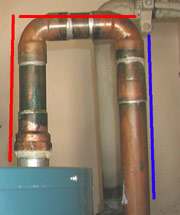
That's what has driven this whole design. The coil is 5/8" tubing and 1/2" copper is about all I can fit for the runs and obtain a valve for that will fit in the space. I've therefore kept the runs as short as possible. All the piping you see is all in one plane except for the connections to the back of the heater which will be within and inch or two of that. I've indicated the centerlines red and blue for hot and cold.


Ross

.
Jun 15, 2004
14,693
Islander/Wayfairer 30 sail number 25 Perryville,Md.
Roger place a plastic tube over the hot water return to insulate it from the cold water at the bottom of the tank. A piece of pvc pipe will serve
 
Dec 2, 2003
1,637
Hunter 376 Warsash, England --
Heater & Table Questions

Heater - can you still have heat to the cabin after water is hot enough? I visualize the water boiling unless the fuel supply to the heater is thermostatically controlled and this would be a dangerous temperature for both tank/radiator and heads basin supply. Is there some way of keeping the heater running for the radiant and convected heat to the cabin or will you need to close it down? Restricting the thermo-siphon flow will only result in the coil boiling and the control would need to be automatic.

How do you like my cabin table? Not optimum for a coastal boat but I think it will be great offshore and in rough water.
Table - system looks fine but am concerned that 1" dia vertical will not resist person falling against it athwartships. Also might be flexible making table feel insecure. Likewise 7/8" horizontal rail.
At a guess 1 1/2" tubing might be needed for rigidity. (Stress calc needed!)
Do you plan additional support for both leaves at fwd end. Someone applying body weight here could 'wring' it. Perhaps the support column would be better placed in the middle of table which would allow a more rigid setup. Or a second vertical below table top at fwd end?

Either way it will become a useful hand hold.
 
Nov 22, 2008
3,562
Endeavour 32 Portland, Maine
Heater - can you still have heat to the cabin after water is hot enough? I visualize the water boiling ..
Ross above figures 2 - 3 hours of heat after the fire is turned off which seems about right. The boiling issue was a factor in choosing a large surface area, uninsulated tank. I don't expect to run this system unattended or overnight. If the tank does get too hot, or just up to a comfortable hot water level, and I still want primary heat, I'll start dumping heat in to my main hot water tank. It will take a few hours for that to come up to temperature. I don't intend to run this system unattended. If I hear steam bubbles, I'll start the circulation pump. I plan to mount a thermometer on the tank.

The primary purpose of the bulkhead tank is actually to cool the stove water coil and keep it on "standby" without having to have a circulation pump running whenever the heater is on and not waste the heat as a tank hidden away in a locker would do.


concerned that 1" dia vertical will not resist person falling against it athwartships.
It might not. Falling forces are hard to predict but a falling person will bend a lifeline stanchion. Easy to replace S.S. tubing. Hard to arrange chopper evacuation.

The full height stanchions of the same material I have now feel pretty stiff although the are supported about 1/3 of the way up. The S.S. handrail material is pretty stiff. I'll re-assess when I get a piece of the stock in my hands. Table leaves will be supported on the removable stanchions I have currently. They will go under about the middle of the leaves which is a bit of a pain from the leg standpoint but is quick and easy and gives good support. They have nice heavy, sharp, rectangular flanges at the table end and are just the right heft and length for repelling boarders so I want to find a use for them to justify keeping them on board:)

The table design and hinges have been revised since you may have seen it so that the leaves can be raised 30 degrees and to be more compact. This gives the option of support from overhead chains so that it can be angled for a long tack. It would be a simple matter to make this a swinging table but they usually don't work out very well in small boats.
 
Sep 25, 2008
615
Morgan 415 Out Island Rogersville, AL
woody

There is a reason for that. As Ross has mentioned many times on this topic, the issue is heat transfer.

Reverse cycle heat pumps work very well for the cooling "side" because they're cooling from 95 degrees outside temperature to 75 inside, a 20 degree difference.

On the heating "side", twenty degrees difference makes them good for down to 55 degrees. Once it gets colder they simply can't keep up, and that's why they add additional electric heating coils to them.

Think of those heat pumps just like a window air conditioning unit that simply gets turned around from summertime to wintertime.

That's why, it's NOT that they're bad, it's just that they are good for some conditions and not all colder outside conditions below 55 F.

That's a simple explanation without much "engineer-speak" involved.
55 degrees? My 9,000BTU heat pump keeps my aft cabin at a constant 72 even when it is in the single digits outside. It won't quit working until the water temperature gets to about 35 degrees (the manual says 40 degrees). My heat pump doesn't have heat strips. A marine heat pump doesn't fizzle out like land based heat pumps. It will put out plenty of heat until the coil freezes the water and prevents it from circulating. I live on my boat year round. For those of us who are tied to a slip most of the time, a heat pump makes dam good sense.
 

Ross

.
Jun 15, 2004
14,693
Islander/Wayfairer 30 sail number 25 Perryville,Md.
Roger, I believe that the losses of heat from the tank above the stove will reach equilibrium at around 150 degrees. That is too hot for washing but not so hot as to cause instantaneous injury. The large surface area of the tank will spill a lot of heat. You have a volume to surface area ratio of about 3 pints per square foot. A sauce pan in my kitchen that holds 2 quarts is about 6 inches dia and 5 inches tall. That works out to a little less than a square foot.
 
Nov 22, 2008
3,562
Endeavour 32 Portland, Maine
Roger, I believe that the losses of heat from the tank above the stove will reach equilibrium at around 150 degrees.
That's damn near perfect. I'll be gravity drawing water from the bottom of the tank so it should be a bit cooler. With a thermometer on the outside of the tank, it will be just a matter of watching for the right temperature. If the tank is at 150 degrees, it will probably be time to turn off the Dickenson and conserve diesel anyway.

One thing I'll have to be careful about is turning on both hot and cold water in the head at the same time when gravity drawing. The cold water will still be under system pressure so may back into the system due to restriction at the combined spigot. I could put a check valve in the hot water line but the flow will be pretty slow due to the low head gravity supply and I'm not sure I'll want to restrict it. Easy to experiment with though.

Telling guests not to turn on both hot and cold water at the same time shouldn't be any more difficult than introducing them to the mysteries of the head.
 

Ross

.
Jun 15, 2004
14,693
Islander/Wayfairer 30 sail number 25 Perryville,Md.
Roger consider the flow rate from a bag in box wine. A 12 inch head pushes a lot of water.
 
Status
Not open for further replies.