Help to install Shore power ?

Status
Not open for further replies.

MrBee

.
Dec 30, 2008
425
Irwin 34 Citation Middle River, Md.
Good morning all, I know ALL the info is on this site some place but putting it all together from different post might mess me up.
My wife and I just bought a New to us boat. It is a 1975. It has never had Shore power installed so we will be starting from scratch. Don't think other info is needed but just in case... Boat has Yanmar 2gm20f and regular Panel from the factory with a few Batteries. I know I need the Shore cord, then receptical to plug it into boat but after that I'm not sure what we need. I think "I will install 30amp service.
Thanks for any assistance.

Ps., Ross, will be leaving CT. with boat on Saturday, should be in Marina by Saturday the 16th.

Brian
 
Oct 22, 2008
3,502
- Telstar 28 Buzzards Bay
Basically, you will need the following:

A Shore power cord, probably 30 amp:


photo courtesy of SBO's online store, click to see product there

A shore power inlet fitting

photo courtesy of SBO's online store, click to see product there.

triplex 12 or 10 AWG marine-grade tinned wire with sheath. A good source for this is either GenuineDealz.com or SailorSolutions.com Both of these sources are going to be far less expensive than buying Ancor's wire almost anywhere.

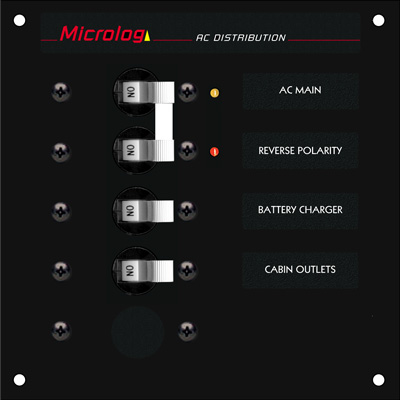
A shore power breaker panel with a ganged double breaker for the main AC shore power connection. The reason for the double breaker is to interrupt both the hot and neutral lines. If you have only a single breaker, and the shore power system has reversed polarity, you'll still have hot wiring on the boat with a single breaker. For a small boat like yours, you might be okay with a panel like this one:


Photo courtesy of Sailor Solutions.com. Click photo to see product there.

You'll also want to have at least one GFCI outlet for each circuit you have installed.

Be aware that the hot wire in the marine-grade triplex AC wiring is black in color, and can easily be confused for a DC ground wire if you don't have them clearly marked and run in separate locations. This is why I recommend that you use YELLOW wire for the 12VDC ground connections whenever possible.
 

Ross

.
Jun 15, 2004
14,693
Islander/Wayfairer 30 sail number 25 Perryville,Md.
Brian, Don't be in a hurry to install that for docking in Owen's. We don't have AC on the 400 pier.
We plan to sail with the tide on May 12 and return May 22. Want to avoid the holiday madness. I can leave you a line on one of the dock cleats if you would like. We back into the slips here. Pray for an east or south wind when you are docking, it makes life much easier.
 
Feb 26, 2004
23,353
Catalina 34 224 Maple Bay, BC, Canada
Consider: Maybe don't break the neutral [revised]

1. A shore power breaker panel with a ganged double breaker for the main AC shore power connection. The reason for the double breaker is to interrupt both the hot and neutral lines.

2. Be aware that the hot wire in the marine-grade triplex AC wiring is black in color, and can easily be confused for a DC ground wire if you don't have them clearly marked and run in separate locations. This is why I recommend that you use YELLOW wire for the 12VDC ground connections whenever possible.
1. Revised Consider to not break the neutral. See this long discussion about this subject, here: http://forums.catalina.sailboatowners.com/showthread.php?p=621739 Wire it properly. I used to think that breaking the neutral was the reason for two gang switches, too....[deleted certainty]

2. To avoid this very issue, which is properly noted by Dawg, I recommend you purchase your AC wiring in a sheath. They make it in 3 wires, black, white and green, bundled in a white protective cover. It reduces any possible confusion and makes pulling the AC wires easier. Most older boats have black DC grounds. I've started to use yellow for grounds because that's the newer code, but I doubt if anyone would rewire their boats because of that. Label everything: each end of the wire and the wire itself. Draw wiring diagrams before and after you've done your work. Scan the wiring diagrams so you have one at home and one on the boat.
 
Last edited:
Oct 22, 2008
3,502
- Telstar 28 Buzzards Bay
Stu—

I'm going to have to disagree with you on this point. IIRC, the current ABYC standards require the AC shorepower setup have both the hot and neutral wires on breakers that are ganged together mechanically.
1. Don't break the neutral. See this long discussion about this subject, here: http://forums.catalina.sailboatowners.com/showthread.php?p=621739 Wire it properly. I used to think that breaking the neutral was the reason for two gang switches, too. It simply is NOT!
The wire source I recommend has the triplex wire in a flat sheath...also, having the system documented as clearly as possible is a good idea.
2. To avoid this very issue, which is properly noted by Dawg, I recommend you purchase your AC wiring in a sheath. They make it in 3 wires, black, white and green, bundled in a white protective cover. It reduces any possible confusion and makes pulling the AC wires easier. Most older boats have black DC grounds. I've started to use yellow for grounds because that's the newer code, but I doubt if anyone would rewire their boats because of that. Label everything: each end of the wire and the wire itself. Draw wiring diagrams before and after you've done your work. Scan the wiring diagrams so you have one at home and one on the boat.
 

Ross

.
Jun 15, 2004
14,693
Islander/Wayfairer 30 sail number 25 Perryville,Md.
As strange as it may seem I can't add anything to this and believe that it is the code I followed.
 
Jan 22, 2008
8,050
Beneteau 323 Annapolis MD
Stu, do we need to start into this 'AC neutral circuit breaker' again? We hashed this on Blitz's post on April 27. I went back to read the Catalina web site you quote here, and it is the same erroneous one you post the 27th. I'm not seeing the Catailna site as being an authority on this subject if that is where you get your mis-information from. Go back to Calder's book, find the section on AC circuits and you will find neutral interrupt circuit breaker on every diagram. That also goes for the Blue Sea Systems Marine Electrical Products catalog, the Marinco guide to shore power, The West catalog, P276, The Boatowner's Illustrated Electrical Handbook, page 167 to 180 "Approved Shore-Power Circuit", and probably every source that has been publish recently.

These sources tell me you are wrong- AGAIN. I'd be glad to hear of any published source you can offer as validationg your OPINION. This is exactly why I say- and as you previously chastized me for- on this forum there is often wrong information given out as being factual, when there are source books to prove otherwise. I wish you'd do some reseach other than your Catalina web site and stop giving out wrong information.... I see that since I started this reply Sailingdog and Ross have chimed in on this thread. Perhaps they would look at that Catalina source you offer and see if they think it is too much outdated/in error/opinion/non-facts and might just as well be deleted. Perhaps if you want to ignore the written word maybe you'll listen to their learned advice. Nothing personal, just trying to get the facts to those who may not know better.
 
Last edited:
Oct 22, 2008
3,502
- Telstar 28 Buzzards Bay
I'd also point out that what may work for a house's AC electrical system, may not be feasible or wise on a boat, which has a very different ground connection and very different use requirements. The reason the ABYC requires that the hot and neutral lines be on breakers is so that when the main shorepower breaker (which is actually two 30 amp breakers ganged together mechanically) is thrown, there is NO CHANCE of the circuits being live.

As I said previously, if there were only a single breaker, and the shore power system had a reverse polarity fault, you'd have 110 VAC live inside the boat, where it would not be expected, and electrocution would be a very serious risk. To do this, the neutral line has to have a breaker in it. There is NO WAY AROUND THIS.
 

Ross

.
Jun 15, 2004
14,693
Islander/Wayfairer 30 sail number 25 Perryville,Md.
In domestic wiring Neutral is always tied to ground via a copper plated rod driven into the earth. GFCI's separate neutral and ground and provide dedicated conductors for each. In the event that there is an imbalance between the current carried in the hot and the neutral the circuit will be interrupted. The usual path for the imbalance to go to ground is the person holding the tool or appliance. Breaking hot and neutral is equivilant to unplugging the power cord.
 

MrBee

.
Dec 30, 2008
425
Irwin 34 Citation Middle River, Md.
Thank you Sail Dog, a list such as you posted is just what I needed to get me started in the correct direction.

I'm not in a hurry to install the shore power, as Ross said, we don't have it on the dock I will be at. But we will probably have it in 2010, and i'll want it anyway, in case we stay at a marina in our travels, and can plug in.
Gives me plenty of time to find good prices on the components I need.

Brian

Ross, when you see "Big Sis" across from you, you'll know we made it down.
 
Oct 22, 2008
3,502
- Telstar 28 Buzzards Bay
Glad to help. I'd recommend you use adhesive lined heat-shrink terminals for the installation. Sailorsolutions.com has the proper crimp tool for those types of terminals at a reasonable price. The reason I recommend Berkshire wire over Ancor, is it is more flexible and IMHO better wire, and much more reasonably priced. They're also based here in Massachusetts, so, by buying from them, you're supporting my state. :)

Thank you Sail Dog, a list such as you posted is just what I needed to get me started in the correct direction.

I'm not in a hurry to install the shore power, as Ross said, we don't have it on the dock I will be at. But we will probably have it in 2010, and i'll want it anyway, in case we stay at a marina in our travels, and can plug in.
Gives me plenty of time to find good prices on the components I need.

Brian

Ross, when you see "Big Sis" across from you, you'll know we made it down.
 

Ross

.
Jun 15, 2004
14,693
Islander/Wayfairer 30 sail number 25 Perryville,Md.
Brian, Just some local knowledge for you. When you clear the Amtrak bridge DON'T head straight for the marina. Turn and run parallel to the bridge until you are past the speed limit buoys. Your DF will go from about 20 feet to between 9 and 12 feet and then quickly drop to about 50-60 feet. The breakwater for the 400 pier is the broken down one. The 200 and 300 piers have new break waters. The 400 is in ruins and the one for the lost 500 pier is mostly just a memory. Don't cut the turn at Fishing Battery short, there are stone groins projecting out from the island for the service boats' dock.
 

Benny

.
Sep 27, 2008
1,149
Hunter 320 Tampa, FL
What ever happened to good old common sense and practices. I never gave it a thought wether a boat had a single or double breaker or if reverse polarity was present. Early on I learned never not to stick my fingers in outlets and to unplug the supply cable from the boat whenever doing some work on the wiring. Disconnecting at the supply pedestal just does not cut it as a well meaning passer by could think he is doing you a favor and hook you back up. Have we gotten so hooked on convenience that everything has to be automatic and foolproof. The best safety item is between our ears.
 

MrBee

.
Dec 30, 2008
425
Irwin 34 Citation Middle River, Md.
Thanks Ross,
i do know about not taking the Direct cut from Bridge to Dock. I have sailed outa Owens' a few times with the friend that is helping me bring the boat down. He has a boat on the 300 pier. We were down the other week to have a look around and see were our slip is. We have to get a key yet because they were out of them when we stopped in the office.
Bee
 

MrBee

.
Dec 30, 2008
425
Irwin 34 Citation Middle River, Md.
Thanks nimbus, I can learn a lot from that link.

Bee
 

Ross

.
Jun 15, 2004
14,693
Islander/Wayfairer 30 sail number 25 Perryville,Md.
Brian when we can get together you will be able to look at my set-up and apply what you have learned and what you see to the work on you boat.
 
Status
Not open for further replies.