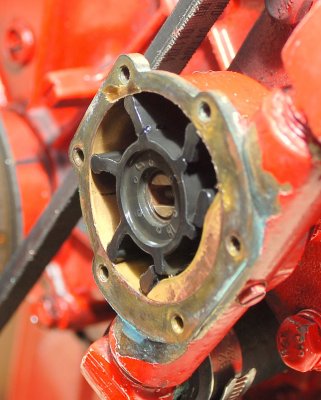
Changing impeller

Status
Not open for further replies.
Oct 27, 2008
38
Hunter 34 Bahamas
Thank you so much for this forum...
Trying to find my way around new (to me) Hunter 34 (1985).
To change the impeller, will I have to drain coolant first?
Can't seem to find any details on 3 GM F
Thanks,
Mike
 
Sep 25, 2008
7,693
Alden 50 Sarasota, Florida
There's lots of stuff on the internet, among them:

Opening the Pump
Replacing a water pump impeller is usually easier than describing the procedure. Start by closing the intake seacock. Next spread an old towel beneath the pump to catch any small parts you drop or dislodge unexpectedly. On some engine installations, it can be easier to remove the pump entirely than to replace the impeller in place. This is an option to keep in mind if access to the face plate of your raw water pump is difficult.


With the seacock closed, remove the machine screws that hold the pump's cover plate in place. If these show signs of corrosion, plan to replace them now. Don't wait until one loses its slot or sheds its head.
If the cover is stuck to the pump body, pry it free, taking care not to distort it. The cover will be sealed with an O-ring or a paper gasket. The O-ring can be reused if it is still supple; a paper gasket normally must be replaced. Scoring on the inside of the cover plate reduces the pump's efficiency, so replace a scored plate. (Some pumps also have wear plates in the back of the pump chamber.)
Out with the Old
Removing the cover plate exposes the impeller. If it has a rubber plug in the center, pry that out of the shaft and set it aside. Now look at how the impeller is attached to the shaft. Most just slide over splines, a keyway, or flats on the shaft, but impellers are occasionally pinned to the shaft with a through-bolt or set screw. In this latter instance, remove the bolt or release the screw.

You may be able to get a grip on opposing vanes with thumb and forefinger and work the impeller out of the pump chamber. Otherwise pry it out with a pair of screwdrivers. It should come out without too much coaxing. Another method is to grip the hub between vanes with channel-lock pliers. Don't grip the vanes; pliers will tear the vanes and nix use of the old impeller as a spare.
Sometimes vanes have already torn off. If the impeller is missing vanes, be sure you can account for all the pieces. If they aren't in the pump body, they are probably in the outlet hose or the inlet side of the heat exchanger. Loose vanes are often the cause of unexplained and sometimes intermittent overheating. They are a particularly serious problem in a raw-water-cooled engine because they can get into the engines cooling passages, resulting in serious engine damage. Take the time to find and remove missing vanes.
Check at the base of each vane by bending it vigorously; if any show cracks, don't keep this impeller as a spare.
While the impeller is out, check the shaft for wobble. If it seems loose to you, you may need to dismantle the entire pump and replace the bearings and the seals. For the specifics of doing that, you should consult the service manual for your engine.
In with the New
Check the new impeller against the old one to make sure you have the right one. Grease the vanes and the wall of the pump chamber with petroleum jelly to provide lubrication for the few seconds the pump will run dry before priming. The grease also improves the seal of the vanes, helping the pump to prime more quickly.
If the shaft is keyed, make sure the key is in place, then slide the impeller onto the shaft. Fold the vanes to get the impeller inside the pump chamber. If you have difficulty here, tie the vanes folded until you get the impeller partially into the chamber. It doesn't really matter which way you bend the vanes; they will arrange themselves on the first revolution of the pump.
Push the impeller all the way home. Reinstall the through bolt, set screw, and/or the hub plug if your pump has any of these. Position the cover gasket or O-ring. If the gasket is paper, paint it with a flexible gasket sealant-both sides.
Screw the cover in place. Open the seacock. Start the engine and watch the exhaust to make sure the pump primes properly, then check the pump for leaks.
 

Ross

.
Jun 15, 2004
14,693
Islander/Wayfairer 30 sail number 25 Perryville,Md.
Mike, No! first assemble your tools and new impellor. Remove the cover and gasket, with a pair of pliers pull out the old impeller, wet the new one and push it into place making certain it is seated. Turn the engine once with the hand crank, install the new gasket and the cover plate. You are done.
 

Ross

.
Jun 15, 2004
14,693
Islander/Wayfairer 30 sail number 25 Perryville,Md.
Wow... that was quick! Thanks so much.
Mike
Mike, I must tell you that I have a Volvo engine and the water pump is right up front and very accessable. Other engines may not be.
 
Feb 6, 1998
11,759
Canadian Sailcraft 36T Casco Bay, ME
This may help too

This may help too:

Changing a Raw Water Impeller (LINK)


This is on a Westerbeke but the basics are all the same. With some Yanmar engines it's easier to actually remove the pump because it's backwards than to attempt it while the pump is in place.
 
Dec 2, 1999
15,184
Hunter Vision-36 Rio Vista, CA.
Mike:

Unfortunately Yanmar screwed up and mouthed the raw water pump backwards. There are two bolts that mount the pump to the block. One bolt allows the pump/pulley to pivot and the other allows you to tension the belt.

The only thing you need to worry about is turning off the raw water.

Don's illistration is fairly accurate. So just-do-it

You can also replace the cover plate with a "Speed Seal" which makes changing the impeller swap much easier next time.
 

Shell

.
Sep 26, 2007
138
Catalina 30 standard JC/NYC
Do not scratch the inside walls of the impeller housing with any tools.
If you do it can create premature wear of the new impeller.
Good luck.

SH
 
Feb 6, 1998
11,759
Canadian Sailcraft 36T Casco Bay, ME
Do not scratch the inside walls of the impeller housing with any tools.
If you do it can create premature wear of the new impeller.
Good luck.

SH
I agree you need to be very, very careful using the screw driver method outlined above. If an impeller comes apart from pulling it out with a set of pliers you probably did not want to use it again anyway..

My needle nose vise grips have worked quite well for over 20 years jest be careful and don't force it. Every now and then I needed two sets of needle nose pliers to pull exactly straight out but usually not.
 
Oct 27, 2008
38
Hunter 34 Bahamas
Thanks

Thank you to all.
I am so used to out board kickers on my sailboats but this is the first diesel and I must say it has been a little intimidating! Simple things like changing the coolant in a car become more confusing with "air traps" and "burping" etc.!

But you guys and this forum have given me a lot of confidence and I am now
looking forward to tackeling this impeller. Mind you, I have not had a problem with overheating, and the water flow out the exhast seems to be ok but I,m presuming this engine has not been looked at for a couple of years!
Thanks again,
Mike
 
Oct 22, 2008
3,502
- Telstar 28 Buzzards Bay
One question—if you're winterizing your boat and going to lay it up for the winter, why would you want to change the impeller now, instead of in the spring?? Changing it now means that it will be sitting all winter long, which gives the blades more of a chance to take a set. If you're not winterizing the boat, then that's a different story, but for the people who are, I'd highly recommend changing the impeller in the spring... not now.
 
Nov 6, 2006
10,216
Hunter 34 Mandeville Louisiana
YEAH! Steve Dion is correct.. Don and Main Sail’s pictures are great but your pump faces opposite. Turn off the raw water thru hull valve, take the hoses off the pump, remove the two bolts holding the water pump to the block and take it out. Takes longer to write about it than it does to do it. Put some cardboard or newspaper on the table and sit and take the impeller out and put the new one in. I find it easier to work on that way instead of having to stand on your head in the engine box, as is the norm. When you put the new impeller in, the pump rotates counter-clockwise when viewed from the impeller side; make sure you have the vanes bent in the correct direction. Reinstall, being careful to tension the pump drive belt carefully. It is a bit tricky because the belt is so short. Couple of things ya might want to jot down in your notes .. The pump ball bearings are 6202Z (available at machine parts stores) and the water seal is TC 13287. You will need both those numbers to completely rebuild the pump in the future.
 

Attachments

Last edited:
Oct 22, 2008
3,502
- Telstar 28 Buzzards Bay
What Maine Sail neglects to mention is that he's got plenty of practice doing that up in Maine... :) The sailing season there is three days long... :) and two of those will be in fog...
Perhaps we could start an "ice boat" conversion company!! Remove keel, add some skis....:D:D
 
G

Gene / ESCAPADE II

Further re impeller replacement

Regarding some of the smaller Universal/Westerbeke Diesels
1. The impeller may be held on with a small "D-ring" which is most easily removed with an appropriate pin pliers.
2. Don't let the shaft pull out. It might then require that you remove the entire pump to reinstall the shaft properly.
3. Check with source of the impeller regarding lubricants. Grease/Vaseline might degrade some "rubber" type materials.
 
Dec 1, 1999
2,391
Hunter 28.5 Chesapeake Bay
Lots of good info here on impeller changes. Also, see the Don Casey Reference Library on the Boat US website. The only caution I would add is that I would be very careful using two screwdrivers to pry out an old impeller. It is very easy to gouge the relatively soft water pump rim which must mate tightly with the water pump cover. I think you would be better off trying to pull out the old impeller with a needle nose, or similar pliers by grasping it by the base of a vane and wiggling it out. If you do use two screwdrivers, put a protective ring of masking or similar tape around the shaft of the screwdrivers where they will contact the edge of the pump housing as you lever out the old impeller. If you nick or gouge the pump housing, you are probably going to be buying a new water pump....
 
Status
Not open for further replies.