Winterizing - Hot Water Tank Question

Status
Not open for further replies.

PKFK

.
Jul 12, 2004
206
Hunter 36 Ottawa
I am having a strange issue winteriizing my hot water tank (a Kuang 6 gallon on a Ticon-30). (I previously just used a LOT of antifreeze to fill the tank, but want to stop that and blow out the tank and install a bypass).

Access to the tank is poor, so I installed air blow-out fittings to the hot and cold water lines in the bilge (easy access to the lines). I set my air compressor to about 40 PSI so to not damage anything.

The thought was that if I pressurize the HOT water line from the tank (which goes to the upper portion of the tank), and open a COLD water tap in the boat, then the air pressure in the top of the tank will drain it under pressure (the COLD line goes to the bottom of the tank).

This does not seem to work though - all I do is pressurize the lines and no water comes out the tap.....

If I pressurize thru the COLD water line, I end up blowing air and some water thru the Hot water taps, but can definitely hear the air bubbling up thru the water that is still in the tank (makes sense - the water level in the tank would be slightly below the hot outlet - so not more water will come out - I just blow bubbles in the tank).

Can anyone think of why this would not be working ? Would there be a check-valve on the tank preventing incoming pressure on the hot water outlet ? (the outliet line just seems to have a pressure relief valve on it, but Ican't see how that would prevent me from blowing out the tank).

Paul
 
Jun 2, 2004
5,802
Hunter 37-cutter, '79 41 23' 30"N 82 33' 20"W--------Huron, OH
Yep, check valve.

Not sure about your tank but many do have a check valve. I just drain mine by attaching a hose that runs to the bilge and opening the safety valve to let in air. A little water lying in the tank will not hurt anything.
 
Sep 25, 2008
7,693
Alden 50 Sarasota, Florida
It's easier and just as effective to simply drain the water as Ed described. He knows!
You really gain nothing by blowing out the tank.

My suggestion is do the by-pass, drain the tank and run antifreeze through the lines.
 

PKFK

.
Jul 12, 2004
206
Hunter 36 Ottawa
Re: Yep, check valve.

OK that makes sense. The top hose (hot water) goes in thru a fitting that has an extra hose coming out of the side of it, so I think that is the pressure relief valve. Now if I can just figure out how to open it.......(I am not at the boat but don't recall seeing any lever on it to open it up).

My home hot water tanks always had an obvious lever to flick that opened the safety pressure valve on the hot water line....but I don't recall seeing one of those on the boat water heater.....

Any other tips on what to look for to get that safety valve open ?

(BTW the tank does not have a drain on it like my home tank - that would be too simple !!)

Thanks

Paul
 
Jan 2, 2008
547
Hunter 33 (Cherubini design Forked River, Barnegat Bay, NJ
Clearng the Air

You are on the right track, but you have caused your roblem by limiting the volume of air going through. Your air is passing over the water left on the bottom of the pipe or coil or whatever you want to call it. Your thinking was essentialy good, but need to understand that if the end of the line is open you will not build up any real pressure inside the line. Open all hot water faucets, crank up the compressors pressure setting and open the valve that lets the air flow through the tank. You do have a valve and not just an open hose, right?

Where I work we pump large quantities of Scotch and Rum through 2" and 3" inside diameter hoses. Once a tank is empty an air hose is connected to the hose and blows the remaining 10 or 20 gallons into the recieving tank. That includes working against a head of better than 15 feet. The hoses at pumps and filters are clear and we can see exactly what is happening when the air comes on. Our compressors are big enough so we can supply the air volume required to move the liquid.
 
Feb 6, 1998
11,759
Canadian Sailcraft 36T Casco Bay, ME
Photos???

Some photos might help us identify what's going on.

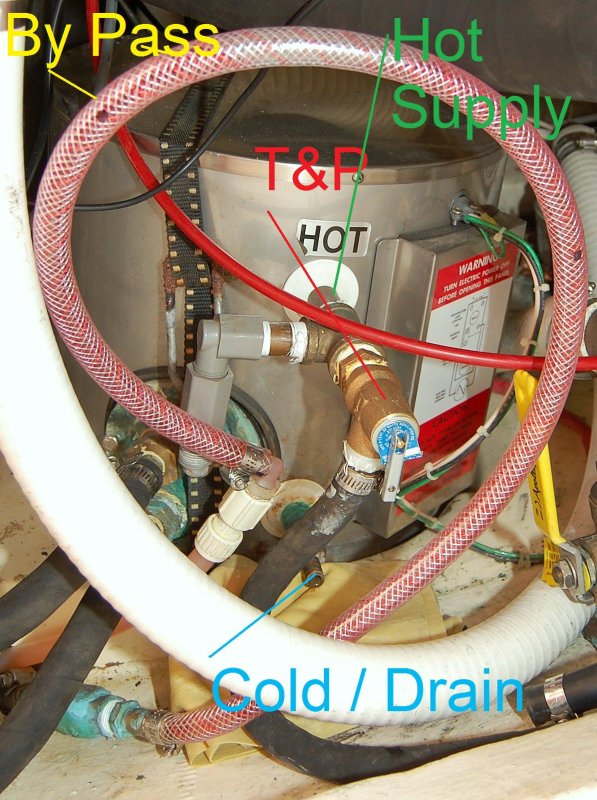
Most all relief valves, that I know of, have a flip lever. They will also be screwed directly into the tank because they have a long sensor for "T" or temperature. Water heater relief valves are called T&P valves by the trade or temp and pressure. They are also referred to as a TPR valve depending upon where you are in the country.. They will release under both temperature and pressure..


Please ignore the shoddy plumbing on my water heater. It's on the "LIST"!!


PKFK

.
Jul 12, 2004
206
Hunter 36 Ottawa
Thanks for the photo Maine Sail.

The valve you show looks exactly like the one in my *house* - however I don't recall seeing the silver "release lever" on the boat heater - and hence my problem. For my home heater, I just flick the silver lever up, and presto - the valve is open.

My boat set-up otherwise is the same as your photo - except that since access to the tank is very poor, I plumbed in "T" adaptors to the hot and cold lines to the tank in the bilge and installed these blowout plugs:

http://www.jcwhitney.com/CAMCO-RV-BLOWOUT-PLUGS/GP_2015536_N_111+10207+600018514_10107.jcw

My thought was to pressurize the "hot" line to the tank and drive the water out of the cold line below it by opening a cold faucet. I use an air chuck to connect the compressor to the installed blow-out valves.
(I am trying to avoid dumping 6 gallons of water from the tank into the boat since it will run down behind the batteries, transmission, and end up pooling in the sump below the engine.)

Air into the "cold" line works fine - I just open up a Hot water faucet and no problem....the lines blow clean and lots of airflow.

When I put the compressor on the "hot" line, and open up a cold faucet.....nothing happens, other than if I slowly turn the pressure up, I can hear some leakage starting at the connections to the galley sink - so therefore the pressure is not getting past the T&P valve on the hot water heater.....as someone suggested it must be blocking the pressure I am trying to get into the tank.

I will go to the boat on the weekend and see if I can figure out how to get this valve open on the hot line from the heater.
 
Feb 6, 1998
11,759
Canadian Sailcraft 36T Casco Bay, ME
Easiest way..

(I am trying to avoid dumping 6 gallons of water from the tank into the boat since it will run down behind the batteries, transmission, and end up pooling in the sump below the engine.)
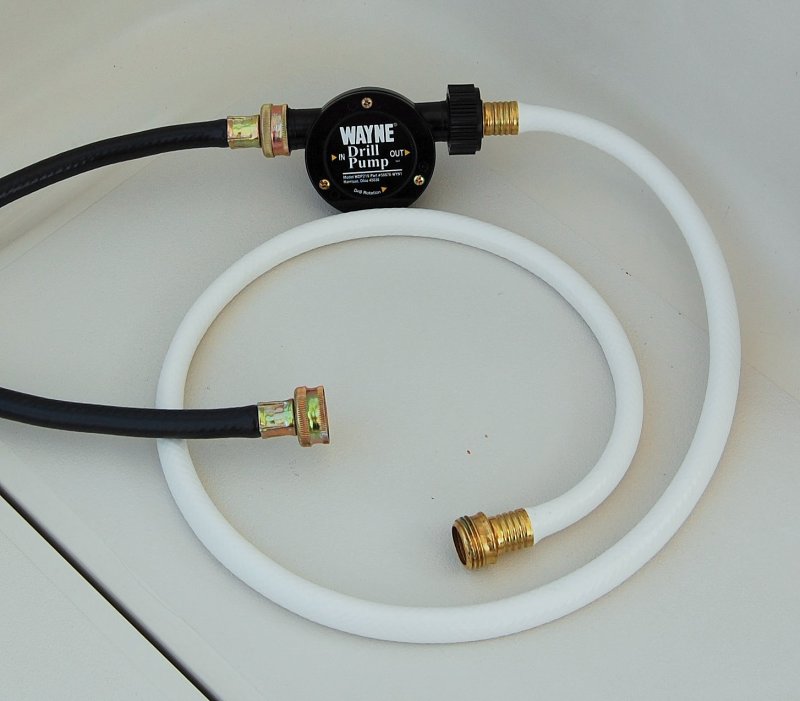
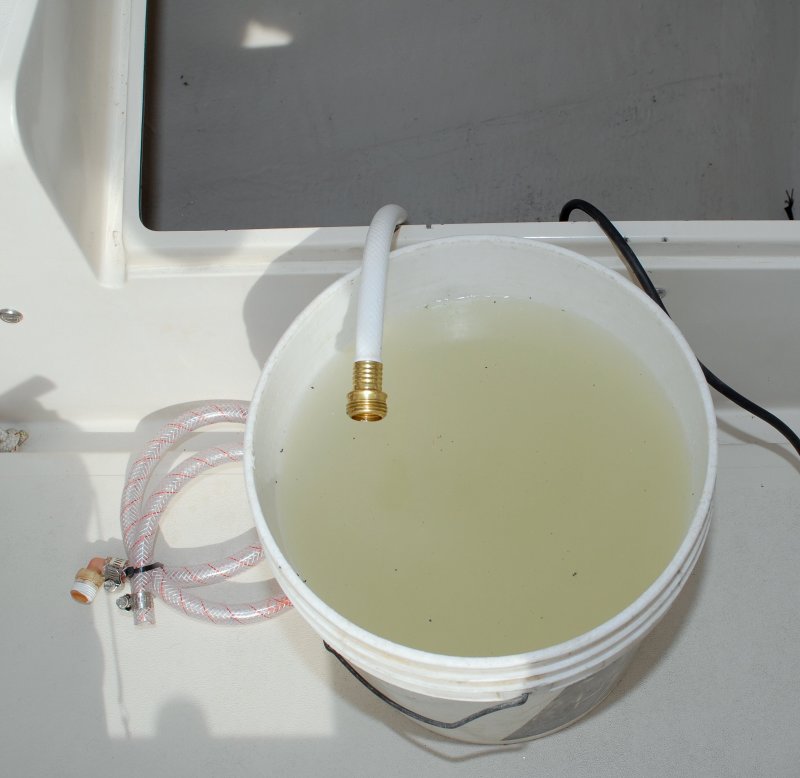
Easiest way is a drill pump!

Out of the water heater...


And into a bucket..

Place a synthetic chamois, I like the brand "The Absorber" under the cold tap and catch what drips out.. (see photo in previous post and you'll see the chamois!)
 

PKFK

.
Jul 12, 2004
206
Hunter 36 Ottawa
Re: Easiest way..

That is an excellent suggestion !!!

Thank-you very much for taking the time to reply and post the helpful pictures !

Paul
 
Jun 1, 2005
772
Pearson 303 Robinhood, ME
Re: Photos???

Gee... I guess I should keep Main Sail away from my water heater... or that would be on his list too! He is a regular McIver.
 

PKFK

.
Jul 12, 2004
206
Hunter 36 Ottawa
Well I finally got the darn tank empty. This is really bizarre....I figured out what was going on.

The COLD water supply at the bottom of the tank has a ONE-WAY valve in it. You can put water in the tank, but getting it out is a problem !!

Taking the hose off accomplishes nothing - even when I put air pressure on the hot water outllet at the top of the tank.

Look at the photo of the cold line input: (hope the picture works - this is my first try at using Picasa and linking a picture)


What I did was remove the nut at the top of the fitting - and then with pressure, the water would flow out of the tank thru the opening where the nut was - with air pressure added to the hot water line, it emptied with considerable "fountain-like" behaviour !! However with no air pressure, the water would barely trickle out this hole - even with the taps opened up to prevent an air lock.

So - mystery solved - you need to remove this nut to get the water out of the tank due to the one-way valve.

However - this results in all the water going to the bilge - instead of me just opening a tap and having it go down the drain.

Has anyone ever seen such a setup before ?? Why in the heck would the tank have this one-way valve ? It seems to really make it a pain to drain the tank !
 
Dec 2, 1997
9,011
- - LIttle Rock
Impossible to drain a water tank via faucets...

'Cuz the cold water inlet is at the bottom and the hot water discharge is at the top. So you'd have to turn it upside down to drain it out the discharge that goes to the faucets.

Most water heater tanks have a petcock at the bottom to drain 'em.
 

PKFK

.
Jul 12, 2004
206
Hunter 36 Ottawa
This tank is a Kuang (from what I can see of the label) tank - never heard of them before.

I know you were kidding about turning the tank upside down (I'll just un-install it and get right on that !!) - however, the setup seems to not make any sense for a boat that was built in Canada - where tanks freeze !

There is no petcock to drain the tank - if there was, I sure would have saved a lot of grief and used it....

Previous owners had always just filled it with antifreeze, but that was getting expensive. However with no drain petcock, and a one-way valve on the bottom of the tank, draining it - which should be simple - became a pain (remove the nut on the input, and then use air pressure on the hot line to blow the water out, then pump that mess out of the bilge). I couldn't even use Maine Sail's drill pump idea without first concocting some adapter system to fit it into the threads from the nut I removed, rather than just connecting it to the cold-water line :-( .

Anyhow - I have a way to drain the tank and it worked - but I still don't get why it needs to be such a silly set-up. Has anyone heard of a Kuang hot water tank ? (without a drain ;-) ).

Paul
 

Tim R.

.
May 27, 2004
3,626
Caliber 40 Long Range Cruiser Portland, Maine
The real question is why do you need this valve. I had one on my previous HW heater but when I replaced my heater, I removed the valve. It worked flawlessly all season and was a snap to drain. My bilge(rain comes down the keel stepped mast) is a little bit more humid than Maine Sails so I just let the tank drain directly into the bilge. It will get dried when I haul for the season.
 
May 18, 2004
385
Catalina 320 perry lake
I know my tank has check valves on the intake and outgoing water lines. I usually drain mine using the drain spicket. In the past, I let the water run to the bilge but this year I used a wet/dry shop vac to suck up the water as it came out of the spicket. worked great.
 
Feb 6, 1998
11,759
Canadian Sailcraft 36T Casco Bay, ME
The reason for that check valve is to prevent gravity cycling of the hot water. With small tank you can chew up some stored water temp without a check valve. Here's another option.

1) Remove the check valve and fit a brass tee in its place threaded directly onto the nipple already there. If the check valve takes the nipple out with it when you back it out either remove the nipple and re-use it or buy a new one.

2) Into one of the outlets of the new tee thread in a 1/4 turn boiler drain/pet cock/drain valve be sure to use pipe dope or teflon tape or both together.

3) Thread a hose barb into the other outlet of the tee that has the same diameter barb as your water supply hose and connect your hose.

Now you have a tank drain. Simple & done...
 

PKFK

.
Jul 12, 2004
206
Hunter 36 Ottawa
Thanks Tim, Bill, and Maine Sail - all great suggestions !

I will first try to remove the existing valve on the cold (and throw it into the harbor - forcefully !). My only concern will be putting too much torque on the fitting and damaging the tank (look @ the picture I put up a few posts earlier - the fitting might be frozen so I will be somewhat cautious - I dont want to have to replace the tank !).

If that does not work, then the shop-vac idea will definitely do the trick - great idea !!

Thanks again folks for all the very helpful suggestions. I am new to this forum - but it seems to be an excellent resource. I also checked out some of Maine Sail's "how-to" articles - complete with photos - and I have to say they are excellent.

Paul
 
Status
Not open for further replies.