Will this mehtod of blister repair last?

Status
Not open for further replies.
Sep 25, 2008
2,288
C30 Event Horizon Port Aransas
shaft/marina

I went to the boat today. I focused on the topsides and wisely sent my wife to buy a prop shaft. She got it for $70 and the guy straightened it for free, I still have to have the taper and slots machined, maybe 50 to 75 more (I know the guys at a machine shop in town). I think it is aquamet 17. I hope that holds up in the salt.
Maine sail, I wet sanded with 1000, compuonded(3M) with a wool pad, and body shop polishing compounded(no silicates, paintable) with a foam pad. The only parts that are looking glossy at an angle are some repair sections and the transom which has been regel coated at some time. The rest of the boat looks ok. I didn't wash it thouroughly yet after the polish/foam pad yet, but I can't see it being ready to wax. I have meguires #9 left to do. Should it be glossy at this point? Is a foam pad what I should be using for the finess it type stuff?
I also scoped out the Corpus Christi municiple marina. It is right next to downtown, that concerns me a bit, but they did have secure looking gates to each dock. I guess I need to go during the day and talk to someone about security.
 
Mar 5, 2008
58
Beneteau 43 Alameda
Hermit,

The advice on drying out is well stated by most of the posts and is important for the new resins to bond to the old and as stated you can't feel wetness. Mositure follows the fiberglass strands, which is why they call it "wicking". The chopped mat you mentioned may not have been mat at all but a technique called a chopper gun that literally chops up fiberglass and mixes resin with it at the gun and is blown onto the mold. This is overlaid on the woven fabric typically. The mix at the gun was critical to how well the hull was laid up, which might explain why you only have blisters on one side. Regarding the resins, epoxy bonds to either polyester or vinylester. Polyester poorly bonds to epoxy or vinylester. Vinylester is the best material to use but also can be the most difficult to work with. Hopefully you won't see the bottom for years to come but if you should ever have to do this again, there are curing steps (aside from drying it out) that are required between layers if you start to do this again. One thick repair isn't as sound as layers that are cured properly, not fully, before the next layer is installed.

All these resin types are permeable, the rate of permeability is the only difference. As to why the older boats don't get blisters, the resins and solvents used then were different and performed better. During the "oil crisis" the quality of polyester resin was not "consistent" which led to higher permeability rates in the resin ie, more blisters.

Unless your planning on heavy offshore sailing, I wouldn't worry about any of this, just have some fun.
 
Feb 6, 1998
11,759
Canadian Sailcraft 36T Casco Bay, ME
I went to the boat today. I focused on the topsides and wisely sent my wife to buy a prop shaft. She got it for $70 and the guy straightened it for free, I still have to have the taper and slots machined, maybe 50 to 75 more (I know the guys at a machine shop in town). I think it is aquamet 17. I hope that holds up in the salt.
Maine sail, I wet sanded with 1000, compuonded(3M) with a wool pad, and body shop polishing compounded(no silicates, paintable) with a foam pad. The only parts that are looking glossy at an angle are some repair sections and the transom which has been regel coated at some time. The rest of the boat looks ok. I didn't wash it thouroughly yet after the polish/foam pad yet, but I can't see it being ready to wax. I have meguires #9 left to do. Should it be glossy at this point? Is a foam pad what I should be using for the finess it type stuff?
I also scoped out the Corpus Christi municiple marina. It is right next to downtown, that concerns me a bit, but they did have secure looking gates to each dock. I guess I need to go during the day and talk to someone about security.
Hermit,

You started at P1000? What were the pads and compound you used? What was the buffer? If it's not shiny yet don't bother with #9 as it must be quite shiny before going to a glaze step which is essentially what #9 is.


This should be the basic steps.

#1 Acid clean the hull to remove tannin or rust stains (On & Off Gel or FSR)

#2 Wet sand but ONLY if absolutely necessary P600 and up.

#3 Compound Phase - Heavy duty rubbing compound containing NO silicone and an aggressive wool compound grade pad like this one. Compounding Grade Pad #05711 (LINK) I recommend 3M Super Duty Compound because it's readily available.

#4 Polishing Phase - Finesse It II with a foam or light polishing grade wool pad like this Foam Polishing Grade Pad #05725 (LINK). Finesse It II is not a compound and not something to follow up a 600 grit with. the hull must be quite shiny before using Finesse It II. It is a swirl grade remover polish..

#5 Wax Phase - After years and years of detailing boats I have found no wax for gelcoat that lasts longer or goes on and off easier. It may be out there but I have yet to try it. I've tried easily 50+ products over the years. Some are not even worth the paper the receipt is printed out on!

Apply with a 4" foam hand application pad or a terry cloth hand application pad and wipe off by hand with microfiber rags. If you want you can also apply a wax with your clean bare fingers. This is how concourse quality show cars are waxed, by bare hand... The secret is to mist the area you are applying wax to with water before rubbing the wax into the hull.

Just remember that expensive machine buffing & polishing pads should only be used with body shop safe compounds and polishes. Waxes and sealants, especially cheap ones with high concentrations of silicone, will permanently destroy expensive wool pads and it will never wash out. Carnuba's & polymer sealants also destroy wool pads. Never ever use compounds or polishes containing silicone and only use products rated as "body shop safe" or that say "contains no silicone" for the compounding or polishing phase..

Most all waxes will contain some amounts of silicone. The best and longest lasting ones contain the least amount of silicone. Collinite #885 for example has less than 2% silicone while some of it's competitors have as much as 30%+.
 
Sep 25, 2008
2,288
C30 Event Horizon Port Aransas
steps

Maine,
I am only doing the topsides right now. This is what I have done so far.
1. MaryKate on/off gel.
2. Then I did the bottom job.
3. Wetsand with 1000 grit. After I wet sanded and washed it down there was no more chalk coming off.
4. 3M compounding with a wool pad. I only compounded for maybe a minute over each 2'X2' area. It was not shiny at this point. Should it be shiny at this point.
5. I used a body shop no silicone polishing compound. With a foam pad.

The polisher I used was a variable speed from 200-3200, soft start, 7" polisher sander.
I asked the guys in the yard that polish topsides for a living. But they use a compound/wax method. So their advice was irrelevent.
The transom was actually a little shiny, but I think the gel coat is newer than the rest of the boat. I initially thought the transome was painted, but it was chalky like the rest of the boat.
 
Feb 6, 1998
11,759
Canadian Sailcraft 36T Casco Bay, ME
Maine,
I am only doing the topsides right now. This is what I have done so far.
1. MaryKate on/off gel.
2. Then I did the bottom job.
3. Wetsand with 1000 grit. After I wet sanded and washed it down there was no more chalk coming off.
4. 3M compounding with a wool pad. I only compounded for maybe a minute over each 2'X2' area. It was not shiny at this point. Should it be shiny at this point.
5. I used a body shop no silicone polishing compound. With a foam pad.

The polisher I used was a variable speed from 200-3200, soft start, 7" polisher sander.
I asked the guys in the yard that polish topsides for a living. But they use a compound/wax method. So their advice was irrelevent.
The transom was actually a little shiny, but I think the gel coat is newer than the rest of the boat. I initially thought the transome was painted, but it was chalky like the rest of the boat.
Answer to #3 yes! It should not be dull. If it was badly oxidized you may need to go back to 600 then P1000 then compound. I would think that with 3M Superduty and no chalk it should bring up a 2X2 area in about a minute or two..

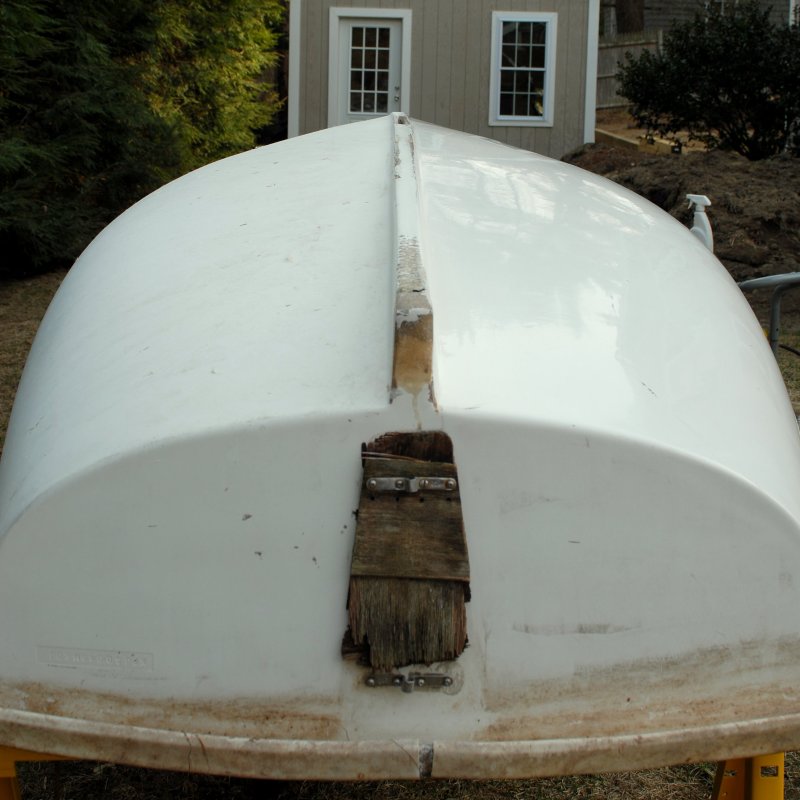
On this dinghy I went from P600 straight to Presta Ultra Cut Compound and a 3M wool buffing pad. In this photo there was no polish phase & no wax just P600 and Presta Ultra Cut Compound. It should be at least this shiny before polishing..

I only did the right / port side of the hull to show a before and after..

Yeah most boat yards do it the cheap and dirty way and it looks like crap 6 weeks later. It is not thier fault though as no boat owner is willing to pay a yard 2k+ to recondition the gel coat.

 
Sep 25, 2008
2,288
C30 Event Horizon Port Aransas
3M

It wasn't #m superduty. I was another 3M that said it was to take out 1200 sandpaper scratches. The bottle is at the boat not with me, so I can't say exactly what brand it was. I will go back and try 3Msperduty compound, if that doesn't make it shiny, I will go back and rewetsand starting at 600
 
Status
Not open for further replies.