Lithium and Start Battery Load Management

Oct 26, 2010
2,213
Hunter 40.5 Beaufort, SC
After reading Rod's Lithium 101 I'm searching to plan out what loads to put on the on the FLA Start Battery and what loads to put on the 314 AH Wattcycle Lithium House Battery. Thanks @Maine Sail for the link for the purchase and the article and the basic wiring diagram, which is the starting point.

Rod's primer discusses load management with emphasis on "in rush current" and its effect on damaging the BMS on the Lithium Battery.

I have three loads that could generate in-rush current that I need to manage properly.

Maxwell 800 Anchor Windlass - currently wired to the Start Battery and I'll leave it that way
Lewmar 48 Electric Cabin Top main haylard winch
5KW NextGen Generator

Any suggestions on pro's and con's of where to put the Haylard winch and the Generator starter? Not sure what the in-rush current is on the cabin top winch or the generator. starter?
 
Jun 14, 2010
2,466
Robertson & Caine 2017 Leopard 40 CT
The generator starter should have its own lead acid start battery, or share the propulsion engine start battery. The halyard winch can probably use the house battery, but you need to verify the battery BMS specs vs the winch max load specs.
 

BarryL

.
May 21, 2004
1,114
Jeanneau Sun Odyssey 409 Mt. Sinai, NY
Hello,

I believe the Lewmar winch includes a 100A breaker. So as long as your lithium battery can supply 100A I think you are good to use the lithium battery to power the winch.

Barry
 
  • Helpful
Likes: jssailem

jssailem

SBO Weather and Forecasting Forum Jim & John
Oct 22, 2014
24,455
CAL 35 Cruiser #21 moored EVERETT WA
:plus: Regarding the FLA starter battery being used for both your auxiliary engine and the generator. It is difficult to imagine a time when I would want to use the start battery for both the generator and the engine at the same time. The positive aspect is that both engines would be charging the start battery while in use.

As @BarryL shares, the powered winch and wires are protected by the fuse. As long as the BMS can handle the winch demand, it seems like a practical setup. The WattCycle website lists their 314 AHr batteries as having a 200A to 300A BMS. Note that the duration of use will be relatively short. While the amperage demand may be high, I estimate the amount of battery drawdown will not seriously consume the stored power based on short-duration usage.
 
Jun 14, 2010
2,466
Robertson & Caine 2017 Leopard 40 CT
Why wouldn't the generator feed the house bank?
It can, and it probably is already set up to do that - either with a battery isolator or a battery combiner or with a DC-DC converter. The latter is generally preferred when bridging a charge to a Lithium battery from a LA battery.
 
  • Helpful
Likes: jssailem
Oct 26, 2010
2,213
Hunter 40.5 Beaufort, SC
The generator and the solar MPPT are both set up to charge the House Bank.

Remember, the purspose of this thread to to determine what "in-rush" currents need to be kept off the Lithium battery, not what the charging sources output will be hooked go. The Generator will set up to charge the House Bank as well as the Solar MPPT. There will be a DC to DC converter so the Lithium Battery doesn't fry the Alternator.

So: Back to the question. What should the 5KW Generator and the Lewmar Electric Main Haylard winch be connected to for starting to avoid frying the Lithium BMS.

I don't see any downside with powering the Maxwell 800 Anchor Windlass and the Lewmar Electric haylard winch from the start battery because I will almost alway have the engine running when I am retrieving the anchor and when hoisting the main.

The real question is the Generator starting power source.

Your persepctives on this are appreciated.
 

BrianQ

.
Jan 10, 2024
44
Hunter Legend 37.5 Havelock
These are the pertinent BMS specs for the Wattcycle 314Ah 12v battery from their web site. Both limits are generally limited to 10 second spikes.

Over-current Discharge Protection210A±10A
Over-current Charge Protection210A±10A
 
Last edited:
Feb 26, 2004
23,308
Catalina 34 224 Maple Bay, BC, Canada
5KW NextGen Generator
The real question is the Generator starting power source.
And our real question to you remains: what is the generator starting load?

Also, try another way to look at it: Maine Sail has shown us all what the actual load to start our inboard diesels in the range of 21-44 hp is ~ 150A for tiny amounts of time. Your generator is most likely lots less than this..
 
Oct 26, 2010
2,213
Hunter 40.5 Beaufort, SC
For further discussion, lets confine our consideration to "in-rush" current. Take a look at @Maine Sail article. I have bolded a few key statements.
from Rod's article.

The questions isn't whether the Litium battery has enough "capacity" to handle the load or will be depleted by the load but rather will the "in-rush" current from the motors in the equipment (Anchor Windlass, Lewmar Halyard winch, 5KW generator starter damage the BMS and thus cause premature failure. Now, it is not likely or even feasable that I'll be trying to start/use all of these individual components at the exact same time and I realize that.

Seems to be some misunderstanding of my initial question. Quoting from @Maine Sail (hope you don't mind Rod) In-rush current for large DC motors can be very high and can result in early BMS failures. It is the In-Rush current that is the killer to the Lithium batteries. @Stu Jackson
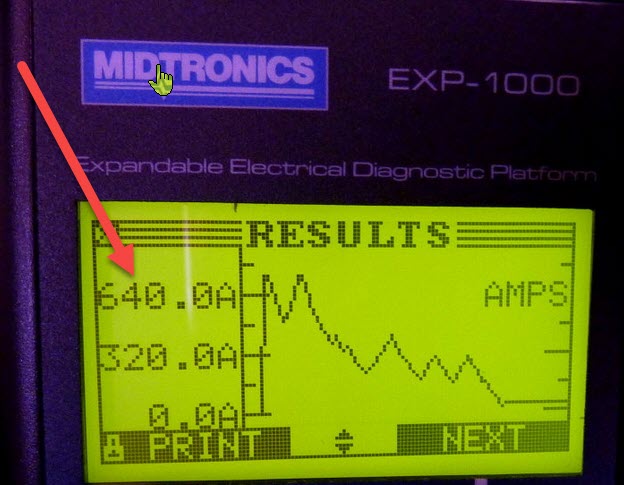
you list the starting current for a 21-44 HP diesel to be 150A for a tiny amount of time. That is not the "in-rush" current though and Main Sail shows the "in-rush" current for a 40 HP Westerbek diesel to be 640A!

The following exerpts are from Rod's primer on Drop-In Lithium batteries and considerations in their proper care and use.
______________________________________________________________________________________________________________________________________________---
From:
Drop-In LiFePo4- Be an Educated Consumer

DC Motor In-rush

The reason most drop in batteries cannot be used for starting is the in-rush current. The in-rush of large DC motors looks like a dead short to the FET’s. Imagine sitting there and intentionally shorting your battery multiple times each day…..That is what starting your motor, running a windlass, electric winch or Bow thruster looks like to the FET’s. There are LFP batteries that can be used for starting but they are very expensive at this point in time.

Starting a 40HP Westerkeke takes=640A!!!!
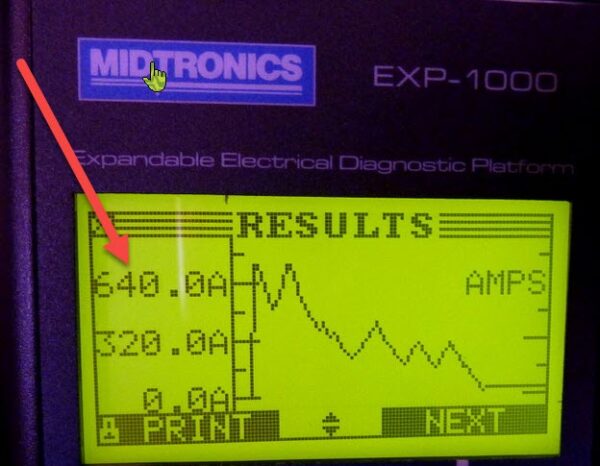


Know your loads before you buy!

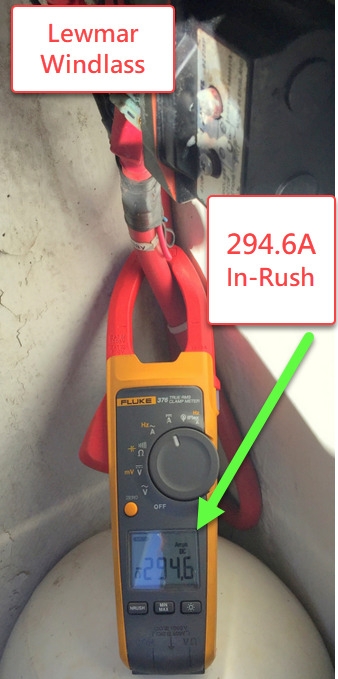
The critical load data you need to know is the in-rush current for all DC Motors .This includes a windlass, electric winches or a bow thruster. You also want know your inverters Pre-charge in-rush. Unfortunately most DC Clamp meters cannot properly capture DC in-rush current. We own three DC clamp meters that claim to do in-rush but all except the Fluke meters fail miserably. The image below is one of our Fluke 376 meters capturing the in-rush current for a Lewmar V2 Windlass. This customer ruined his FET BMS (seen in an image above in this article) by using his “direct from China” drop-in battery to power his windlass. Warranty? Ha-ha now that’s funny….
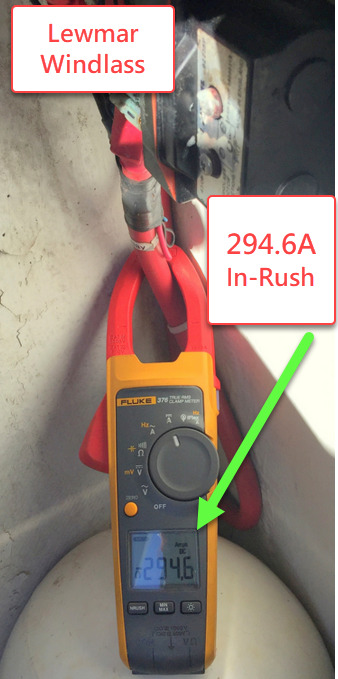


The image above is a prime example of how drop-in battery bank went wrong for this customer. he wanted to lighten the load in the bow of his sailboat so he installed a single drop-in battery to power his windlass.What he failed to understand was the BMS’s current handling rating . In just a few short weeks he destroyed his drop-in battery with his windlass when he failed to account for what the peak in-rush current handling of the BMS., Warranty? Not covered!

______________________________________________________________________________________________________________________________________________

I've pretty much convinced myself that I need to wire the starter for the 5KW Generator to the Start Battery. I could get a separate start battery for the generator. The Anchor Windlass is already wired to the Start Battery. It would also be prudent to wire the Main Haylard winch to the Start Battery too. None will be operated at the exact same time nor would I likely be starting the Yanmar at the exact same time I'd be operating any of these other motors.

Any suggestions and/or comments/perspectives are appreciated. Hopefully @Maine Sail will weigh in soon.
 
Last edited:
May 17, 2004
6,112
Beneteau Oceanis 37 Havre de Grace
I've pretty much convinced myself that I need to wire the starter for the 5KW Generator to the Start Battery. I could get a separate start battery for the generator. The Anchor Windlass is already wired to the Start Battery. It would also be prudent to wire the Main Haylard winch to the Start Battery too. None will be operated at the exact same time nor would I likely be starting the Yanmar at the exact same time I'd be operating any of these other motors.
That sounds reasonable to me. None of those things really need the capacity and deep discharge capability that lithium provides, and if you’re going to have at least one lead battery anyway running those things off it seems like a good way to use the best aspects of each chemistry.
 
Oct 26, 2010
2,213
Hunter 40.5 Beaufort, SC
Why wouldn't the generator feed the house bank?
The generator will powering the AC Panel, which has a ProNautic Charger that will be programmed for a Lithium profile so the generator will be charging the House Bank. It is the in-rush current for starting the the NextGen 5KW that I'm concerned about
 

jssailem

SBO Weather and Forecasting Forum Jim & John
Oct 22, 2014
24,455
CAL 35 Cruiser #21 moored EVERETT WA
It is the in-rush current for starting the the NextGen 5KW that I'm concerned about
The generator in-rush current is from the battery source. What is the reason you would want to use the LiFePO4 battery for that purpose. If the lead acid battery can start the auxiliary engine without concern for in-rush current, why can’t the FLA BATTERY be used to start the generator?

How you direct the charge power to replenish batteries is not associated with the source of power to startup the generator.
 
Oct 26, 2010
2,213
Hunter 40.5 Beaufort, SC
@jssailem I agree. My post #11 came to that conclusion. My answer to Stu was related to the confusion that was occuring about where the charge sources are directed. All charge sources EXCEPT the Alternator are directed to the House Bank. The Alternator charges the Start Battery and a DC-DC Charger is used to charge the House Bank as shown by Rod (Main Sail).
 
Jan 11, 2014
13,951
Sabre 362 113 Fair Haven, NY
To clear some of the confusion, generators typically have a small alternator, the sole purpose of which is to charge the generator's start battery. This is in addition to the generator part which produces AC. The AC is then fed to a charger or inverter/charger to charge the house battery.

The specs for a LFP battery should have a continuous discharge current rating and a Peak or Surge max discharge rating usually listed in max amps for a specified time. So long as the in-rush current is less than the Peak rating it is safe to use that battery for starting an engine, windlass or winch. Note if the battery bank has multiple batteries in parallel, the Peak rating for the total bank is cumulative, i.e., if there are 3 batteries with a Peak discaharge rating of 350 a for 3 seconds, the bank's capacity is 1050a for 3 seconds.

A major reason for having a generator is to have an onboard charging source for the house bank. As such it should have its own dedicated start battery. The diesels that run the generator is pretty small, a Group 24 FLA or smaller battery would be sufficient. The other onboard source for battery charging is the auxiliary diesel, which should have its own start battery. This provide 2 independent and redundant sources of power to recharge the house battery. Solar, is of course a third source.
 
  • Like
Likes: Stu Jackson

jssailem

SBO Weather and Forecasting Forum Jim & John
Oct 22, 2014
24,455
CAL 35 Cruiser #21 moored EVERETT WA
I like it straight forward structure.
Which of the WattCycle 314 batteries did you select? The one with the BMS rated at 300A should be able to handle your electric winch. I thought the winch was your achilles heel in the planning.