under 2ft draft - options for far off shore trailer-able boat?

Aug 23, 2023
35
Paceship PY23 Gulfport, FL (Tampa)
I'm loving the Paceship PY23 which has a 20" draft with the steel stub keel and centerboard. I've had it for 20 years and though haven't been looking, haven't really seen anything else so stable in strong conditions - and maybe I'm missing something so asking y'all.

Are the other other low-draft trailer-ables that one would feel confident in strong conditions 100 miles off shore?

Being able to deal with strong conditions is very important, additionally -
self-launchable
sleeps 4
spinnaker capable

I'm looking at getting a replacement PY23 with a strong deck because my balsa-core deck has several soft spots and getting another hull may be easier than re-coring.

Thanks in advance for your thoughts.

(before cleaning after sitting under a FL tree for 2 years).
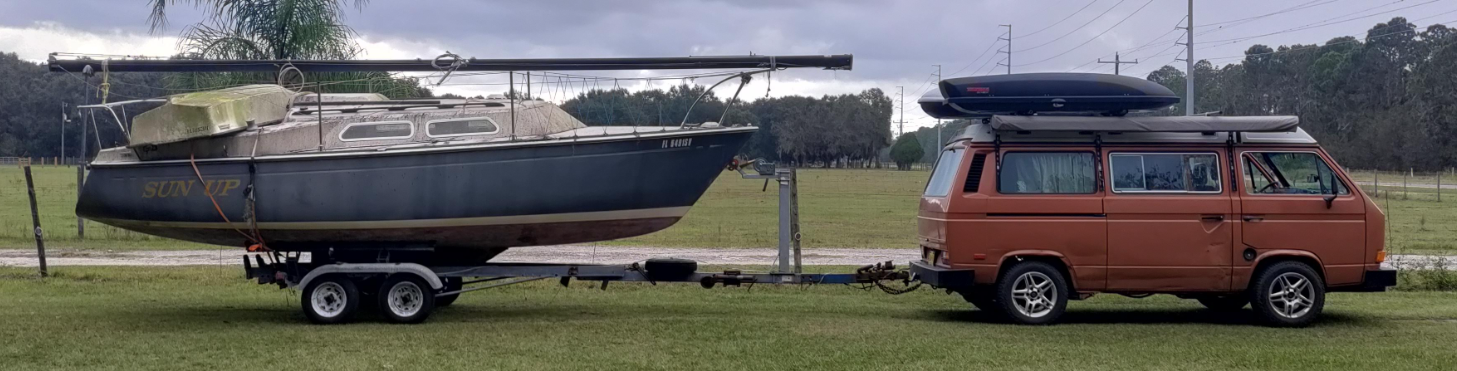

IMG_20220328_083017.jpg
IMG_20201231_170813283.jpg
 

Attachments

  • Like
Likes: Will Gilmore

jssailem

SBO Weather and Forecasting Forum Jim & John
Oct 22, 2014
23,769
CAL 35 Cruiser #21 moored EVERETT WA
:plus: A great story of fierce waters, a well founded boat and the skills of sailors with knowledge of the sea.
Thanks.
 
Apr 25, 2024
705
Fuji 32 Bellingham
I would argue there is no such thing as an off-shore capable boat of any size ... or ... all boats are off-shore capable. The issue is matching the boat to the experience and needs of the skipper and crew - and a range of conditions. The question is more one of how much of a safety margin under what range of conditions does the individual find acceptable.

A friend won some single-handed race from CA to HI in a San Juan 24. Not a boat I would off-shore cruise in, but it suited his situation nicely. Had conditions been treachorous, he could not have raced, whereas some other boats might have been able to. Likewise, had he been less capable himself, the boat would have been inadequate. The boat was matched to the skipper and conditions.

If you are a less capable sailor, you need wider safety margins. If you cannot be as selective about your sailing conditions, you need wider safety margins. If you are more isolated from assistance, you need wider safety margins. And so on.
 
Jan 19, 2010
12,754
Hobie 16 & Rhodes 22 Skeeter Charleston
To answer the OP’s question, Sailboatdata.com has a lot of good information regarding the abilities of different sailboats.

Seems the most relevant data point for your question would be a boats “s” number
IMG_7192.jpeg


And here are some stats for your boat

IMG_7193.jpeg


To answer your question, you can compare different boats on the sailboat data website
 
  • Helpful
Likes: Will Gilmore
Aug 23, 2023
35
Paceship PY23 Gulfport, FL (Tampa)
To answer the OP’s question, Sailboatdata.com has a lot of good information regarding the abilities of different sailboats.

Seems the most relevant data point for your question would be a boats “s” numberView attachment 235637


And here are some stats for your boat

View attachment 235638

To answer your question, you can compare different boats on the sailboat data website
Can you please elaborate on CSF vs S#? In your post you use the terms interchangeable as do definitions from google search. However, the image you provided has a CSF of 2.37 and a S3 of 3.89 so those terms/numbers can't be interchangeable.
 

jssailem

SBO Weather and Forecasting Forum Jim & John
Oct 22, 2014
23,769
CAL 35 Cruiser #21 moored EVERETT WA
You are correct, the terms are not interchangeable. They look at different boat characteristics.

The CSF rating looks at the boat's hull design. It compares the beam and displacement numbers of the boat to provide a Capsize ratio. How vulnerable is the hull design to capsizing in open water during dangerous sea conditions?

The S# is used to compare the sailing performance of similar boats of comparable size.

py-23-paceship
 
Mar 20, 2015
3,298
C&C 30 Mk1 Winnipeg
FWIW, I notice that the PY 23 was one of the boats in the MORC Midget Offshore Racing Club class.
But I assume that was the fixed keel version.
 
Last edited:
Aug 23, 2023
35
Paceship PY23 Gulfport, FL (Tampa)
FWIW, I notice that the PY 23 was one of the boats in the MORC Midget Offshore Racing Club class.
But I assume that was the fixed keel version.
seems to be so
The later fixed fin keel version has a draft of 3.75 ft (1.14 m) and is often referred to as the PY 23K or PY 23 FK. This fixed keel version was designed for Midget Ocean Racing Club (MORC) competition
 
Oct 19, 2017
8,027
O'Day Mariner 19 Littleton, NH
Check out the Hake Seaward line of trailerable sailboats. My Mariner 19 CB was MORC rated. Keep in mind, a vessel that one might enter in an offshore competition, is not going to expose its crew to the same level of dangers as those of a single vessel crossing bluewater alone.

Much of it has to do with the comfort level of the sailor. For example, I would gladly sail my 19 foot Mariner the 90 nm to Bimini where I knew the passage was well within a comfortable weather window and there would likely be plenty of other vessels that could be contacted by radio for the entire passage, but I wouldn't be so quick to set off from San Francisco to Hawaii, where I would be at sea long past any reasonable expectation of accurate weather predictions and there would likely be no maritime traffic most of the trip.

-Will
 

capta

.
Jun 4, 2009
5,006
Pearson 530 Admiralty Bay, Bequia SVG
You might want to check out these boats, and compare yours to theirs

A "transatlantic mini sailboat race" most commonly refers to the Mini Transat, a solo, two-leg ocean race for 21-foot sailboats (6.56.5 meters) that happens every two years. The race typically starts in France, stops in the Canary Islands, and finishes in the Caribbean (Guadeloupe). There are other similar events like the Globe 5.80 Transat, which is a shorter solo transatlantic race, or the Mini Globe Race, an around-the-world race for 5.8-meter boats.
 
  • Helpful
Likes: Will Gilmore

PaulK

.
Dec 1, 2009
1,444
Sabre 402 Southport, CT
You might want to check out these boats, and compare yours to theirs

A "transatlantic mini sailboat race" most commonly refers to the Mini Transat, a solo, two-leg ocean race for 21-foot sailboats (6.56.5 meters) that happens every two years. The race typically starts in France, stops in the Canary Islands, and finishes in the Caribbean (Guadeloupe). There are other similar events like the Globe 5.80 Transat, which is a shorter solo transatlantic race, or the Mini Globe Race, an around-the-world race for 5.8-meter boats.
Most of the Mini Transat boats are keelboats (they're required to be self-righting) with about 5' or more drafts despite only being 21 feet long. Many of them have canting keels. Newer designs are foilers. They would not be very easy to trailer.
 
Last edited:
  • Like
Likes: capta
Aug 23, 2023
35
Paceship PY23 Gulfport, FL (Tampa)
This is creating a good list of boats to consider. So far the Seawards are looking promising, even the 32 footer has a 1'-9" draft!, though I fear I'll miss the agility of the PY23
 

capta

.
Jun 4, 2009
5,006
Pearson 530 Admiralty Bay, Bequia SVG
Most of the Mini Transat boats are keelboats (they're required to be self-righting) with about 5' or more drafts despite only being 21 feet long. Many of them have canting keels. Newer designs are foilers. They would not be very easy to trailer.
Personally, I've never, even in my wildest dreams, considered crossing any serious body of water in a boat smaller than a Tahiti Ketch, by John Hanna, so I know nothing about those boats, hence the link. I was really jealous when Frenchman Jean-Yves Rozé got to race Vendredi 13, a massive, 128-foot (39 meters) three-masted schooner built specifically for single-handed ocean racing in the 1972 Observer Single-handed Trans-Atlantic Race (OSTAR) from Plymouth to Newport. I figure I would have been able to sleep in a new bunk, with crisp, clean sheets, every night of the trip, never mind a hot shower whenever I wanted. It was a North Atlantic race, after all.
 
  • Wow
Likes: jssailem

capta

.
Jun 4, 2009
5,006
Pearson 530 Admiralty Bay, Bequia SVG
Not a minimalist sailor, Are ye.
:biggrin::beer:
I spent 5.5 years cruising the South Seas on a 1909 Wm. Hand 65' gaffer, on which the only electric light was at the chart table. She was a gold plater, not a winch to be seen, and miles of halyards. Double topping lifts and a dozen baggywrinkles strewn about aloft.
Some regular double gimbaled cabin lights, plus a bright kerosene mantle lamp. Every night at anchor, I lit a white kerosene all around light and took it aloft on its own halyard. At sea under sail, I lit the port, stb, stern, & two kerosene lights in the binnacle. Under power I had a white light I could raise to comply with the regs. They all came down at sunrise, as running out of fuel was bad for them. Lots of maintenance, but I learned wick care and had to clean the glass only every fortnight or so. Good times, but I was young, had a good woman, had enough money to cruise an old wooden boat and living a life that was on the very tail of its existence.
 
  • Wow
Likes: jssailem