Battery Woes update...
When you last saw this title, we had our 4xL16, bank 740AH, batteries which
weren't performing to our satisfaction.
Several pros chimed in and either posted in one of the places I posed our
issue, or wrote to me directly.
Symptoms, they agreed, pointed to chronic undercharging. Likely the cause
was promoted by either and/or both being misled, perhaps, by our Tri-Metric
2022 monitor, as the batteries aged, or merely our not letting them charge
fully enough before shutting off our Honda 2000. (Recall that we have 370w
solar, KISS wind generator, 1500w/70A inverter charger and 40A shore
charger, plus a 70A alternator when we motor - which in our charging scheme,
is nearly never.)
Cure, the pros (and industry literature I got keyed to or sent) suggested,
might be repetitive cycles of deep (50%) discharge, followed by full
charging and then 3 hours of equalization.
We moved onto a dock to be able to take advantage of the adequate power to
run both our 70A inverter/charger, and our 40A shore charger. We also
followed one's suggestion of getting a 200W bulb, and running all AC devices
possible (to the max 1500W) and everything we could turn on to achieve a
quicker draw--down. So, oddly for us, of course, instead of trying to
minimize use, we were maximizing it, turning off our shore power at night.
Having every light in the boat on, every fan, and our freezer set to a place
it could not achieve (run at high speed all the time), all charge-able items
connected to AC and the lamp and a fan running on the inverter and the
battery box, at night was a bit disorienting.
We then reversed the procedure, turning on the shore power (for the
chargers), running our freezer set point up to its minimum use and turning
off every other load, in order to charge as quickly as possible.
We allowed for an all-day charge cycle, with whatever assistance was
available from wind and solar, and then equalized after dark before turning
off the shore power and starting our drain.
All along (from start through this point), bank (12V battery) 2 was always
hotter than bank 1 (in parallel to bank 1), and it got pretty warm along the
way, which I think caused the heat probe to throttle back the amps, but kept
the voltage up during some of the equalization cycles. For several days, it
looked promising, as the consumed AH went deeper each time, before it got
low enough to kick out the inverter or the freezer. However, the deepest we
could get it was 40% discharged before it got low enough (11.3 or so; we
were asleep so I never actually saw that happen).
So, we let it rest for a couple of days on shore charge, making it fully
charged, and equalized occasionally. Yesterday I equalized 3 separate
times, and then we read the specific gravities. All were markedly improved
from where we started, and, unlike the first time, when bank 1 was at
ambient, but bank 2 at elevated temperatures, this time both banks were
elevated in temperatures. We adjusted with our temperature-compensated
hydrometer, but didn't top up bank 2, which had used rather more water than
we had found in our initial equalizations. I assume this would have led to
slightly higher SGs than was warranted had I topped them off, and equalized
again.
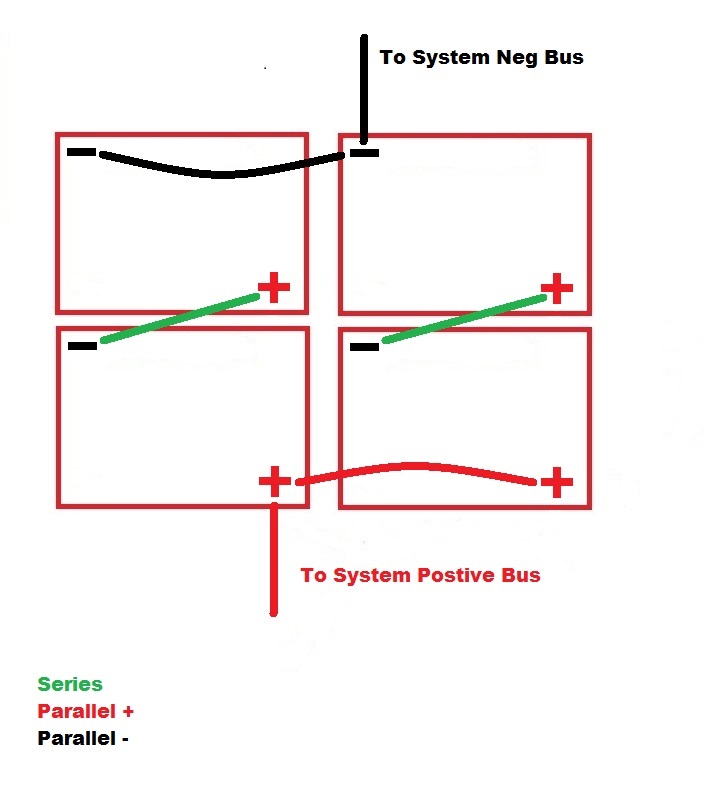
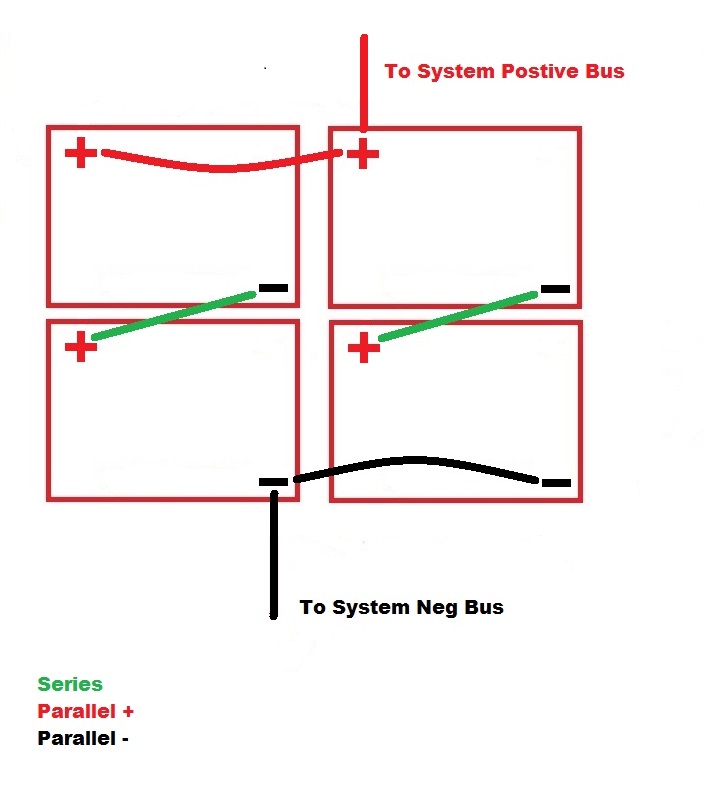
So, bank 1 is batteries b1&b4 and bank 2 is b2&b3. Temperature adjusted SGs
were, in order (1-12, moving clockwise from the first cell, all
one-dot -1.xxx - values): 263, 258, 263 (b1), 334, 319, 319 (b2), 319, 319,
319 (b3), 258, 258, 258 (b4)
So, with one exception, all cells were essentially the same per battery, and
within margins to be 'not bad' cells. However, Bank 2 (b3&4) was still
undercharged, despite being hotter (19 temp adjust vs 8 on bank 1). Hm.
So, I decided to swap b3 and b4, changing one each, to see if that changed
matters. These weigh 125# each, so I knew it would be a wrestling match.
After unhooking, and taping off, the necessary leads to allow those two to
be lifted out of the box, I started. Hm. Not only is it heavy, but it
seems to not want to come more than a few inches up. Muck around with the
lifting straps we'd made, but since these were able to fit into the box with
their original handles still attached, used those. Made sure the straps
were clear, and tried again to use the straps.
Same deal. Hm. Strong light down the sections between the batteries.
Oops. The interior short side (between b3 and b4) of b4 was seriously
bulged. If one cell is bulged, even though the specific gravities were the
same in all but one (263 vs 258) of the cells in bank 1, the whole system is
dead. That bank 1 was not even fully charged just confirms it. However, I
speculate, as it's well into the charge range, that bank 2 (5 cells 319, one
334) is just fine. If someone wants them for more than whatever the core
charge would be, I'm happy to have you get them in Vero Beach City Marina.
We'd have to coordinate with my new batteries, in order that I still
function aboard, of course.
So, now starts the challenge of finding some solution which won't be any
worse than I know it will have to be, most likely well over a boat buck.
Scuttlebutt at one of our cruisers' Monday Night Burger Night (the source of
all my Mr. Manatee tee shirts I earn for me, the admiral, and her kin) had
someone here renting a car and driving to Miami, the savings were so
significant; that's a possibility, I suppose, but having an able-bodied
assistant in getting these out, and the new ones in, might be necessary; a
delivery would have the appropriate personal strength and equipment to make
the transfers more routine.
What I'm going to be looking for will be L16 (floor sweeper, e.g.)
batteries, preferably high capacity (over 400AH), vertical lugs taking
bolts.
Various pros have expressed that my charge sources - aside from more solar
being always a good thing - are fine, but that I need to reset my monitor to
new or zeroed values every time I equalize, and spend a great deal more time
in my float-off charging. The best solution for US will be to nearly double
our solar capacity with two 345w panels, exchanging for our 3 (370w, 11
years old and not nearly as efficient as the new ones would be), as we have
the available real estate in roughly the same size as our current solar
array, and our MPPT charger can handle those effective amps. So, I need to
move that up on the priority li$t; if we had all that solar (usually), not
only would we not be as deeply depleted, but our float-out would have ample
power every day, not waiting for our Honda to drive us deaf.
So:
Do you want a pair of 30-month old L16s, cheap?
And...
Recommendations for the least expensive solution to 4 more batteries in Vero
Beach FL?
Thanks, all, for reading this far and for all the assistance which has been
previously rendered.
Skip
Morgan 461 #2
SV Flying Pig
When you last saw this title, we had our 4xL16, bank 740AH, batteries which
weren't performing to our satisfaction.
Several pros chimed in and either posted in one of the places I posed our
issue, or wrote to me directly.
Symptoms, they agreed, pointed to chronic undercharging. Likely the cause
was promoted by either and/or both being misled, perhaps, by our Tri-Metric
2022 monitor, as the batteries aged, or merely our not letting them charge
fully enough before shutting off our Honda 2000. (Recall that we have 370w
solar, KISS wind generator, 1500w/70A inverter charger and 40A shore
charger, plus a 70A alternator when we motor - which in our charging scheme,
is nearly never.)
Cure, the pros (and industry literature I got keyed to or sent) suggested,
might be repetitive cycles of deep (50%) discharge, followed by full
charging and then 3 hours of equalization.
We moved onto a dock to be able to take advantage of the adequate power to
run both our 70A inverter/charger, and our 40A shore charger. We also
followed one's suggestion of getting a 200W bulb, and running all AC devices
possible (to the max 1500W) and everything we could turn on to achieve a
quicker draw--down. So, oddly for us, of course, instead of trying to
minimize use, we were maximizing it, turning off our shore power at night.
Having every light in the boat on, every fan, and our freezer set to a place
it could not achieve (run at high speed all the time), all charge-able items
connected to AC and the lamp and a fan running on the inverter and the
battery box, at night was a bit disorienting.
We then reversed the procedure, turning on the shore power (for the
chargers), running our freezer set point up to its minimum use and turning
off every other load, in order to charge as quickly as possible.
We allowed for an all-day charge cycle, with whatever assistance was
available from wind and solar, and then equalized after dark before turning
off the shore power and starting our drain.
All along (from start through this point), bank (12V battery) 2 was always
hotter than bank 1 (in parallel to bank 1), and it got pretty warm along the
way, which I think caused the heat probe to throttle back the amps, but kept
the voltage up during some of the equalization cycles. For several days, it
looked promising, as the consumed AH went deeper each time, before it got
low enough to kick out the inverter or the freezer. However, the deepest we
could get it was 40% discharged before it got low enough (11.3 or so; we
were asleep so I never actually saw that happen).
So, we let it rest for a couple of days on shore charge, making it fully
charged, and equalized occasionally. Yesterday I equalized 3 separate
times, and then we read the specific gravities. All were markedly improved
from where we started, and, unlike the first time, when bank 1 was at
ambient, but bank 2 at elevated temperatures, this time both banks were
elevated in temperatures. We adjusted with our temperature-compensated
hydrometer, but didn't top up bank 2, which had used rather more water than
we had found in our initial equalizations. I assume this would have led to
slightly higher SGs than was warranted had I topped them off, and equalized
again.
So, bank 1 is batteries b1&b4 and bank 2 is b2&b3. Temperature adjusted SGs
were, in order (1-12, moving clockwise from the first cell, all
one-dot -1.xxx - values): 263, 258, 263 (b1), 334, 319, 319 (b2), 319, 319,
319 (b3), 258, 258, 258 (b4)
So, with one exception, all cells were essentially the same per battery, and
within margins to be 'not bad' cells. However, Bank 2 (b3&4) was still
undercharged, despite being hotter (19 temp adjust vs 8 on bank 1). Hm.
So, I decided to swap b3 and b4, changing one each, to see if that changed
matters. These weigh 125# each, so I knew it would be a wrestling match.
After unhooking, and taping off, the necessary leads to allow those two to
be lifted out of the box, I started. Hm. Not only is it heavy, but it
seems to not want to come more than a few inches up. Muck around with the
lifting straps we'd made, but since these were able to fit into the box with
their original handles still attached, used those. Made sure the straps
were clear, and tried again to use the straps.
Same deal. Hm. Strong light down the sections between the batteries.
Oops. The interior short side (between b3 and b4) of b4 was seriously
bulged. If one cell is bulged, even though the specific gravities were the
same in all but one (263 vs 258) of the cells in bank 1, the whole system is
dead. That bank 1 was not even fully charged just confirms it. However, I
speculate, as it's well into the charge range, that bank 2 (5 cells 319, one
334) is just fine. If someone wants them for more than whatever the core
charge would be, I'm happy to have you get them in Vero Beach City Marina.
We'd have to coordinate with my new batteries, in order that I still
function aboard, of course.
So, now starts the challenge of finding some solution which won't be any
worse than I know it will have to be, most likely well over a boat buck.
Scuttlebutt at one of our cruisers' Monday Night Burger Night (the source of
all my Mr. Manatee tee shirts I earn for me, the admiral, and her kin) had
someone here renting a car and driving to Miami, the savings were so
significant; that's a possibility, I suppose, but having an able-bodied
assistant in getting these out, and the new ones in, might be necessary; a
delivery would have the appropriate personal strength and equipment to make
the transfers more routine.
What I'm going to be looking for will be L16 (floor sweeper, e.g.)
batteries, preferably high capacity (over 400AH), vertical lugs taking
bolts.
Various pros have expressed that my charge sources - aside from more solar
being always a good thing - are fine, but that I need to reset my monitor to
new or zeroed values every time I equalize, and spend a great deal more time
in my float-off charging. The best solution for US will be to nearly double
our solar capacity with two 345w panels, exchanging for our 3 (370w, 11
years old and not nearly as efficient as the new ones would be), as we have
the available real estate in roughly the same size as our current solar
array, and our MPPT charger can handle those effective amps. So, I need to
move that up on the priority li$t; if we had all that solar (usually), not
only would we not be as deeply depleted, but our float-out would have ample
power every day, not waiting for our Honda to drive us deaf.
So:
Do you want a pair of 30-month old L16s, cheap?
And...
Recommendations for the least expensive solution to 4 more batteries in Vero
Beach FL?
Thanks, all, for reading this far and for all the assistance which has been
previously rendered.
Skip
Morgan 461 #2
SV Flying Pig