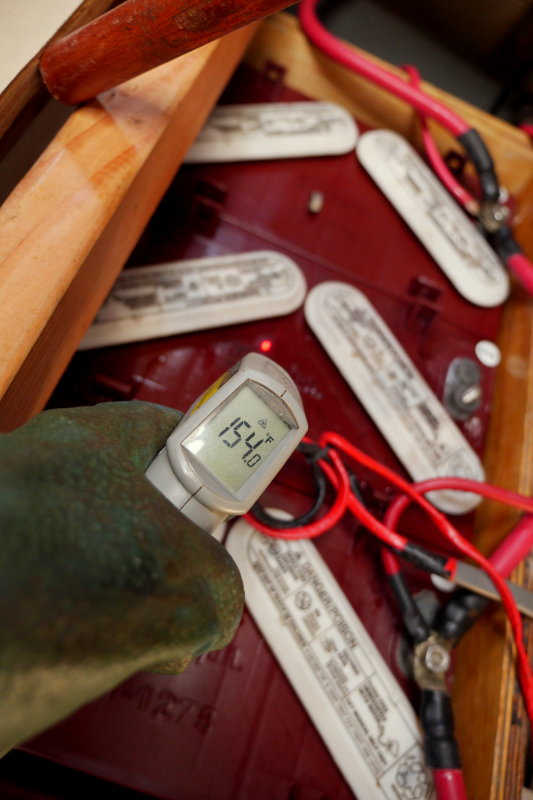
I just had the opportunity to test this on an AGM battery. Lots of dock-talk suggests that a battery not used, such as in a reserve battery application, will die and lose capacity. This can be true if the self discharge rate is enough, the storage temps are also high and you let the battery self discharge to a dangerous level. Flooded batteries self discharge faster than AGM or GEL and warmer temperatures do accelerate this process on all lead acid batteries. Flooded batteries will also suffer from stratification if the electrolyte does not get to gassing voltages often enough, but on a sailboat that gets used the electrolyte is continually moving.
The Battery:
In March of 2015 I had one of a customers May 2014 date code Deka G-31 AGM batteries in my shop for capacity testing and to see if it could be have any capacity regained from an overly deep discharge event....
He brought it to me because his Rule bilge switch stuck in the on position (go figure never heard of that before ) and the bank was discharged to an approx 10.2V rebound/resting voltage, once the load was removed. He caught it quickly but the capacity testing still put the approx 1 year old AGM battery at 75.91Ah of capacity out of a 105Ah rating. It had lost approx 28% of its rated capacity and only had about 15-18 actual cycles on it. The failed Rule switch murdered the bank (don't even get me going on these switches)...
After the testing had concluded I recharged the battery at a 30A rate and and held a 14.6V absorption voltage until 0.1A of current was flowing into the battery. I then set it aside for him to pick up.
Long and short he simply decided to purchase new batteries and the Deka sat in the corner. Two days ago I noticed it and decided to see how if faired after well over a year sitting uncharged through an entire summers worth of heat and a winters worth of cold.. The resting open circuit voltage, when I got it on the bench, was 12.48V, not full but not dead either. I recharged to 100% SOC using the identical protocol as above 30A to 14.6V then absorption was held until 0.1A was flowing into the battery..
I then ran another capacity test at the same battery temp as the previous one, 75F. This time the battery delivered 75.23Ah which is a mere a 0.68Ah difference. This difference is well within the range of error for any 20 hour capacity test, on a battery this size. Despite a rather low resting end point voltage, from sitting so long untouched and uncharged, it really had a minimal to zero net effect on the batteries actual Ah capacity.
For those using AGM batteries as reserve batteries, only rarely topped up, it seems that as long as you keep them charged, resting voltage over 12.7V, better than I did on this one, that you should have no problems for a good long time letting it sit there ready for emergency use.
Ah Testing vs. Impedance Testing:
How does this compare to an impedance tester? Both the Midtronics and Argus analyzers put the CCA at right around 879CCA. This is 79CCA better than the brand new rating of 800CCA. The actual usable capacity at the 20 hour rate however is coming in at just 71.6% of the Ah capacity rating. Once again this shows why impedance testers can be entirely misleading and incorrect guidance for Ah capacity. The impedance testers show a battery in better than new condition yet an actual 20 hour test, done accordance with BCI testing standards, shows it at 71.6% of new. The only reliable & accurate method of testing Ah capacity is a physical discharge capacity test. Once again the impedance testers fail to deliver reliable accuracy.
March 2015 = 75.91Ah > Sit for 14 months > June 2016 = 75.23Ah
This battery sat 100% untouched and uncharged for approx 14 months...
The next steps for this battery will be a battery desulfator as I have a good history and baseline to draw from and to track any improvements. This will just add to my growing desulfator data...
The Battery:
In March of 2015 I had one of a customers May 2014 date code Deka G-31 AGM batteries in my shop for capacity testing and to see if it could be have any capacity regained from an overly deep discharge event....
He brought it to me because his Rule bilge switch stuck in the on position (go figure never heard of that before
) and the bank was discharged to an approx 10.2V rebound/resting voltage, once the load was removed. He caught it quickly but the capacity testing still put the approx 1 year old AGM battery at 75.91Ah of capacity out of a 105Ah rating. It had lost approx 28% of its rated capacity and only had about 15-18 actual cycles on it. The failed Rule switch murdered the bank (don't even get me going on these switches)...After the testing had concluded I recharged the battery at a 30A rate and and held a 14.6V absorption voltage until 0.1A of current was flowing into the battery. I then set it aside for him to pick up.
Long and short he simply decided to purchase new batteries and the Deka sat in the corner. Two days ago I noticed it and decided to see how if faired after well over a year sitting uncharged through an entire summers worth of heat and a winters worth of cold.. The resting open circuit voltage, when I got it on the bench, was 12.48V, not full but not dead either. I recharged to 100% SOC using the identical protocol as above 30A to 14.6V then absorption was held until 0.1A was flowing into the battery..
I then ran another capacity test at the same battery temp as the previous one, 75F. This time the battery delivered 75.23Ah which is a mere a 0.68Ah difference. This difference is well within the range of error for any 20 hour capacity test, on a battery this size. Despite a rather low resting end point voltage, from sitting so long untouched and uncharged, it really had a minimal to zero net effect on the batteries actual Ah capacity.
For those using AGM batteries as reserve batteries, only rarely topped up, it seems that as long as you keep them charged, resting voltage over 12.7V, better than I did on this one, that you should have no problems for a good long time letting it sit there ready for emergency use.
Ah Testing vs. Impedance Testing:
How does this compare to an impedance tester? Both the Midtronics and Argus analyzers put the CCA at right around 879CCA. This is 79CCA better than the brand new rating of 800CCA. The actual usable capacity at the 20 hour rate however is coming in at just 71.6% of the Ah capacity rating. Once again this shows why impedance testers can be entirely misleading and incorrect guidance for Ah capacity. The impedance testers show a battery in better than new condition yet an actual 20 hour test, done accordance with BCI testing standards, shows it at 71.6% of new. The only reliable & accurate method of testing Ah capacity is a physical discharge capacity test. Once again the impedance testers fail to deliver reliable accuracy.
March 2015 = 75.91Ah > Sit for 14 months > June 2016 = 75.23Ah
This battery sat 100% untouched and uncharged for approx 14 months...
The next steps for this battery will be a battery desulfator as I have a good history and baseline to draw from and to track any improvements. This will just add to my growing desulfator data...