200W solar vs 2000W generator?

Jun 5, 2014
209
Capital Yacths Newport MKIII 30 Punta Gorda, Fl
I am trying to decide which is the best investment for us? We keep our boat in the canal behind our house. Therefore, we have access to 110v for the battery chargers regularly. We do allot of 1 and 2 day sailing so far. I have read that when we do a 3 week cruise that our batteries will never return to 100% SOC when we motor. And that is not good to run the engines at idle very long.

Therefore, would it be best to invest in one of the Honda 2000w portable generators or a 200-250W solar system. From what I have read the solar is great but still will not bring my batteries up to 100% SOC. We have 3 house batteries, 1 engine battery and 1 trolling motor battery for our dinghy. As a newbie who has not cruised for more than 1-2 days at a time, I am trying to figure out the best/most efficient way to keep our batteries charged.

Sorry, I should had mentioned that we do not have AC nor a heater. Mainly; bilge pump, lights (LED anchor light), instruments, VHF, refrigerator, 12V TV, hot water heat (which will also heat with engine water).

Thanks
 

Gunni

.
Mar 16, 2010
5,937
Beneteau 411 Oceanis Annapolis
Consider a high-output alternator, or the solar AFTER you have done an energy budget. The house battery will also need to be sized.
 
Sep 25, 2008
7,689
Alden 50 Sarasota, Florida
Opinions vary but it really depends on your use, I.e., if you want to run the A/C away from shore power, elec appliances like microwave, coffee maker, hot water heater, ice maker, etc... All are conveniences some go without and others consider comforts they desire. If you don't 'need' a generator for those purposes, solar and wind are great.
 
Oct 25, 2011
576
Island Packet IP31 Lake St. Louis, Montreal
We run off a Kyocera 140W solar panel on our annual 3 week vacation and are completely self sufficient. The panel does charge on cloudy days though at a reduced rate based on how heavy the cloud cover is. We have 2 group 27 house batteries and 1 starting battery. For us, it's a great system. It's quiet, non intrusive and just sits there and does its thing.

I general I would say Solar is your solution. The one thing I wonder about is the trolling motor battery for your dinghy. If you use the dinghy during the day then you may have to wait to use the dingy again until the panel has charged up the battery sometime the following day. Not sure if this limitation is something you want to live with.

Cheers

Matt
 
Nov 26, 2008
1,970
Endeavour 42 Cruisin
You shouldnt need to worry about getting to 100% soc on a 3 week trip. You will be able to top up when you get back.
The worry is dropping below 50% soc.

You need to analyze a few things to make a better determination.

What is your estimated daily amp/hr use?
What is your alternator output and how much do you motor?

With those you should be able to figure your supplimental needs.

You will be cruising in summer with longer days and sunny skies. I suspect solar will be good with a little bit of engine run time if necessary and you'll get hot water from the engine time.
 
May 24, 2004
7,213
CC 30 South Florida
For us it was an easy decision; a generator could provide something that solar panels could not deliver and that is the ability to run the air conditioner away from shorepower. All the others pros and cons are arguable and may depend on individual needs, likes or dislikes.
 
Jan 22, 2008
8,050
Beneteau 323 Annapolis MD
Since you have an electric outboard, for a generator you'd have to find a place to stow it PLUS a gas can. I have a B32-3, and 80 watts of solar has been sufficient with limited motoring to/from slip and/or anchorage. More watss would be better, but doing a weekender every-other week, it has been sufficient for 2 size 31s. The solar runs till the sun goes down, and again at sunup- about 40 amps a night of drain. But, yeah, it can be less on a cloudy day, but will still give you a bit of output. It's nice having solar at the slip and not be plugges in to shore power.
 
Nov 18, 2010
2,441
Catalina 310 Hingham, MA
And that is not good to run the engines at idle very long.
This is one of those false notions that many boaters believe to be true.

Here is a discussion on this topic I started 2 years ago.

From our local guru, Maine Sail at that discussion:

Jesse,

I am assuming your engine is already broken in? This removes that from the equation. Second if run at a normal 70% - 80% load often, and idling in-between to charge batteries, I've simply not seen bore glazing be a real or quantifiable issue, at least in my customer base.

Can it technically happen? Absolutely. I think we tend to miss that when charging, the engines are loaded pretty well, at that specific HP, so we are not just "idling with no load". While the load may be small and the engine may not warm up to operating temp in cooler waters if you then go our and run her hard after this you should be fine four thousands of hours. We are already at "thousands of hours" so know this to be true for our engine based on our real world results. I have zero issue running our engine at idle when needed and when it does not disturb or impact others.

Do I believe bore glazing can happen? Sure, but I see engines die far more often from lack of use or other maintenance issues rather than the cruiser who idles to charge and runs her hard when not charging..

It is also advised by almost all diesel generator manufacturer that they be "loaded" to approx 70-80% when run, and in the real world, that also rarely happens.

I have one customer with 6k hours on an old 8kW diesel Westerbeke generator. It has an old 50A Heart Interface battery charger that is the primary use for the gen set. They occasionally load it for hot water or the microwave but usually the 8kW generator runs powering a small 50A battery charger. Even with every load on their boat drawing constantly it can't even come close to the 8kW or even 6.4kW which would be the 80% recommended by the manufacturer. They have been lucky to load this gen at 30% and yet it has 6k hours on it and still runs just fine.

There are also the thousands of owners out there who run Sea Frost engine driven refrigeration, as our boat has, who do not have issues with bore glazing.

About three years ago myself and a Beta dealer here in Maine had a long discussion with Stanley of Beta Marine, at the Maine boat builders show, specifically about bore glazing.

Stanley's take was this is a "non-issue" for Beta engines. He insisted they have not seen a single case of bore glazing in a Beta / Kubota block. Not a single one (as of three years ago). This is the US distributor of Beta engines and a guy who has been working with diesel engines his entire life. He is one of the more honest guys in the business and if we had to replace our Westerbeke tomorrow the guy who would get the engine sale....

He also admitted they have lots of customers who idle to charge. I suspect a lot of this is a CYA from the manufacturers point of view and with some engines there is more truth than on others..

The Universal M-25 is the same block Beta uses...... He did say that on some older Volvo's, some Yanmar's and some Vetus/Westerbeke/Mitsubishi blocks that this can be worse. That said we have a Westerbeke/Mitsubishi that has zero bore glazing and more than half its life spent idling. You simply don't get to 3600 hours on a 2002 engine, even when cruising full time as the PO's did, without idling the engine. They had no gen set and only had an 80W panel and a 50A stock alternator. The trick is after idling the PO's, and us always, run it hard.

I think the worry over this is a tad overblown if you otherwise care for and use the engine properly...

So can it happen? Yes, in certain cases I think it can. Does it happen regularly? Not that I have seen or heard of and almost all my customers, being on moorings, idle to charge....
Now to your original question....

Normally I would say solar. I have been in anchorages with people running generators non-stop and hate it. But you won't be in an anchorage but at a dock on a canal. So that is a little different.

However, I am still inclined to say solar. The amps from those small generators are limited and it could take a long time running the generator to get you up to 100% depending on a lot of details we don't know. The solar would likely get you charged while you aren't using the boat. Do you want to give up weekend boat time to sit and watch a generator run?

Good luck and fair winds,

Jesse
 
Nov 18, 2010
2,441
Catalina 310 Hingham, MA
I should have added some discussion on solar.

As others have pointed out you will need to do a power consumption budget. I attached a copy of mine so you can get the idea. Once you have that, read this entire article from Maine Sail: Installing a Small Marine Solar System. Lots of discussion on the how to aspects of sizing and installing solar.

Here are some posts from my blog on solar:

Trying to Make Sense of Solar Options

Planning Our Solar Array

Chinese Knock Off Solar Panels

Good luck and fair winds,

Jesse
 

Attachments

Jun 5, 2014
209
Capital Yacths Newport MKIII 30 Punta Gorda, Fl
I should have added some discussion on solar.

As others have pointed out you will need to do a power consumption budget. I attached a copy of mine so you can get the idea. Once you have that, read this entire article from Maine Sail: Installing a Small Marine Solar System. Lots of discussion on the how to aspects of sizing and installing solar.

Here are some posts from my blog on solar:

Trying to Make Sense of Solar Options

Planning Our Solar Array

Chinese Knock Off Solar Panels

Good luck and fair winds,

Jesse
Thanks for the links. Very interesting. Yes I have read Maine Sail's article on Installing Small Marine Solar System. I have decided that if we do decide on solar than it is defiantly a MPPT controller. I am also leaning towards the Renogy flex panels like in these articles. If we got the non flexible panels than I would have to buy extra SS tubing to reinforce our Bimini. I calculated the cost would end up being about the same in the end. I am thinking 2-100W flex panels will be plenty.

Thanks for everyone information.
 
Jan 22, 2008
551
NorSea 27 Az., Doing the To-Do list
Thanks for the links. Very interesting. Yes I have read Maine Sail's article on Installing Small Marine Solar System. I have decided that if we do decide on solar than it is defiantly a MPPT controller. I am also leaning towards the Renogy flex panels like in these articles. If we got the non flexible panels than I would have to buy extra SS tubing to reinforce our Bimini. I calculated the cost would end up being about the same in the end. I am thinking 2-100W flex panels will be plenty.

Thanks for everyone information.
Sounds like a good plan to me. I have two of them, from Amazon.com. I had to return one as it was not a good match with the other.

One thing to keep in mind. With the semi flexible, you do NOT need to mount them permanently. We have 1 @ 85 Watt that is mounted on our aft rail, we "fly" other panels as needed, when at anchor.

Just a thought.

Greg

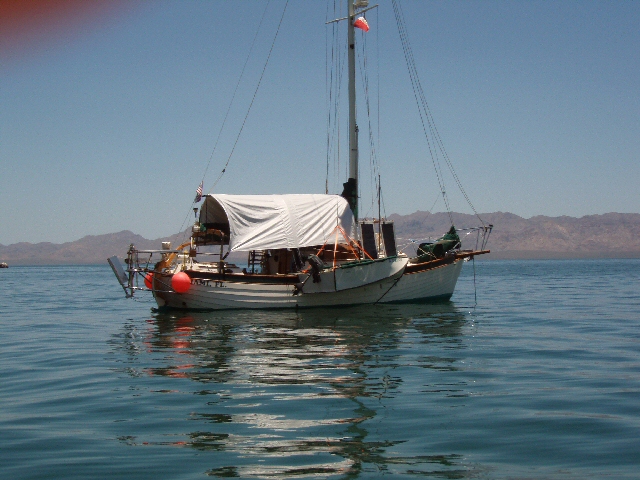
You can see the panels, in the down position, on our boat in the Sea of Cortez. We can also fly them on the shade cloth Jill made for the fore deck.
 
Jun 5, 2014
209
Capital Yacths Newport MKIII 30 Punta Gorda, Fl
This might be a dumb question, but i am guessing that people just hook solar panel leads up to the house bank and not to house and engine batteries? Reason I ask is I know the engine battery should not need it, but I have a separate battery for the trolling motor on the dinghy and was wondering if it could hooked up to charge the 3 house bank batteries and the 1 trolling motor battery?

Thanks
 
Nov 18, 2010
2,441
Catalina 310 Hingham, MA
This might be a dumb question, but i am guessing that people just hook solar panel leads up to the house bank and not to house and engine batteries? Reason I ask is I know the engine battery should not need it, but I have a separate battery for the trolling motor on the dinghy and was wondering if it could hooked up to charge the 3 house bank batteries and the 1 trolling motor battery? Thanks
The solar panels should be connected to a charge controller then the batteries.

Look up ACR for how to charge multiple banks. For the trolling motor battery you could install a selector switch to switch between the starter battery and an extra set of leads for the trolling battery.
 
May 24, 2004
7,213
CC 30 South Florida
It's nice having solar at the slip and not be plugges in to shore power.
Irrespective of whether a solar panel or generator is favored; I fail to see what would be nice about having shorepower and not plugging into it.
 
Jan 22, 2008
551
NorSea 27 Az., Doing the To-Do list
Irrespective of whether a solar panel or generator is favored; I fail to see what would be nice about having shorepower and not plugging into it.
It might be better to not use shore power "IF" the shore power on the dock has ANY problems. At times a leak to earth on the shore power side might cause a problem that is not seen on the boat. It might not show itself for short times of charging, but could cause problems if left connected for long periods of time.

*** MIGHT *** :confused:

Greg
 

WayneH

.
Jan 22, 2008
1,121
Tartan 37 287 Pensacola, FL
Irrespective of whether a solar panel or generator is favored; I fail to see what would be nice about having shorepower and not plugging into it.
I agree that in the US plugging into shorepower is obvious. But outside of the states, not plugging in can make economic sense. For instance, the current rate in Guatemala for electricity is $0.55/kilowatt. It doesn't take many hours of use to provide "sticker shock".
 
Jan 12, 2011
930
Hunter 410 full time cruiser
I have 290W of solar and live on a mooring with the frig on all week and it gets the batteries back to 100%. The cost for the solar as a project was $1600. I also have a 2200W Hyundai inverter generator that was $525.

If all I was worried about was recharging on a 3 week trip I would just have the generator, or just the engine.
 
May 24, 2004
7,213
CC 30 South Florida
Yes, that is the only instance that I had thought about, in marinas where the electricity might be metered; and then depending on the slip fees.