
Ground Fault popping on Charger
- Thread starter PGIJon
- Start date
When you disconnect the batteries there is no charging current being produced so no reason for the ground fault to trip. It could be a bad GFI or your charger may have developed a leak. Also some chargers do not seem to work well when connected to a GFI circuit. We removed the GFI from our dock a few years back under the advise of a licensed electrician recommended by a dock builder.

The GFI sense current in the ground circuit. Lots of bad wiring reasons but they all boil down to the engine to battery ground circuit. a loose/corroded main engine ground and a good secondary (and incorrectly wired) second ground can push current into the AC ground circuit and you get a fault. To see if the engine ground is truly the only ground just disconnect the ground at the engine and see of you can get battery voltage between the alternator or starter hot cable and the engine block (3 way switch on one of the on positions of course). If you get battery voltage you have a secondary ground circuit. That could be any of a number of things to include the exact location of the boat common ground point.
Assuming that all was well prior to this the "problem" is either corrosion in the ground circuit or "the last electrical thing you did to the boat"
good luck
Assuming that all was well prior to this the "problem" is either corrosion in the ground circuit or "the last electrical thing you did to the boat"
good luck

Not to nit pick but a GFCI does not look at ground, it does not even need to have a ground wire to it to work. It senses the difference in current between the Hot and Neutral. If they are not equal it assumes the current is going somewhere else, somewhere it shouldn't, and trips. There is never a good reason to take a GFCI device out of a properly designed circuit. It is there to save your life.The GFI sense current in the ground circuit. Lots of bad wiring reasons but they all boil down to the engine to battery ground circuit. a loose/corroded main engine ground and a good secondary (and incorrectly wired) second ground can push current into the AC ground circuit and you get a fault. To see if the engine ground is truly the only ground just disconnect the ground at the engine and see of you can get battery voltage between the alternator or starter hot cable and the engine block (3 way switch on one of the on positions of course). If you get battery voltage you have a secondary ground circuit. That could be any of a number of things to include the exact location of the boat common ground point. Assuming that all was well prior to this the "problem" is either corrosion in the ground circuit or "the last electrical thing you did to the boat" good luck
Jon, with all shore and battery power disconnected, check all connections at the Xantrex. then check all the connections at the far end, breaker Neutral buss...etc. you can't turn off a battery so be careful where you put your wrench. I would need to see the wiring diagram of your boat to be of any real help. But as Bill said the "last thing you did" is always a good place to start.

That is not how GFI's work.The GFI sense current in the ground circuit. Lots of bad wiring reasons but they all boil down to the engine to battery ground circuit. a loose/corroded main engine ground and a good secondary (and incorrectly wired) second ground can push current into the AC ground circuit and you get a fault. To see if the engine ground is truly the only ground just disconnect the ground at the engine and see of you can get battery voltage between the alternator or starter hot cable and the engine block (3 way switch on one of the on positions of course). If you get battery voltage you have a secondary ground circuit. That could be any of a number of things to include the exact location of the boat common ground point.
Assuming that all was well prior to this the "problem" is either corrosion in the ground circuit or "the last electrical thing you did to the boat"
good luck
ETA: I'm "guessing" that it's probably a problem with the unit and is tripping the GFI when it starts sending current through the wires to the batts.

+1 !!Not to nit pick but a GFCI does not look at ground, it does not even need to have a ground wire to it to work. It senses the difference in current between the Hot and Neutral. If they are not equal it assumes the current is going somewhere else, somewhere it shouldn't, and trips. There is never a good reason to take a GFCI device out of a properly designed circuit. It is there to save your life.
As noted a GFCI outlet looks for an imbalance of more than 0.005A (5 mA) between AC NEUTRAL/WHITE and AC HOT/BLACK. If it senses this imbalance the GFCI trips within fractions of a second. With AC the current on hot and neutral is always balanced, in a properly operating system. Loose, corroded or improper terminations in the AC wiring are very often the cause of GFCI trips. Lets say the WHITE wire has a loose connection at the charger. The AC current must remain in balance so the high resistance of that connections causes some current to "leak" out to the green ground wire seeking a path back to shore or its origin. If this leakage exceeds just 0.005A the GFCI trips..
This type of issue, terminations, connections, corrosion, will be more pronounced at higher amperage draws than at low current. Some chargers are also poorly built and over time can also "leak" some off to ground but this is much rarer than bad wiring between the GFCI and charger..
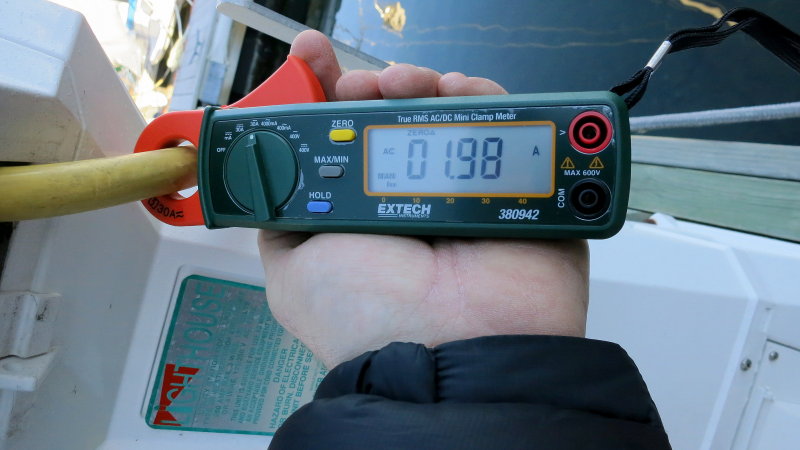
Current leakage in marinas is NOT at all unusual due to many factors but quite often our piss poor shore power cord standard which we use in the USA...... Remember a GFCI trips at 0.005A of leakage and this is 1.98A!!!!!! Even an RCD or ELCI marine breaker trips at just 0.030A
The GFI is there to protect you from becoming a conduit to ground for stray electricity. As others have very well explained it measures a difference in current between the Neutral and the Hot and assumes the difference is going elsewhere. If the appliance has a good ground connection it could safely be going there or it could be going to the appliance case where it could be dangerous. So much about theory; in practice finding an electrical leak can be harder than finding a water leak. I would suggest that you take a multimeter and test for a current in all those areas that you could come in contact with. To test the GFI and the wiring you may disconnect your wiring going to the charger and connect a lamp socket to it. If the lamp does not trip the GFI then your wiring and the GFI are good and the charger is the culprit. If it trips I would I would replace the GFI and redo the wiring for that circuit. We know that the problem seems to arise when you activate power to the charger area which converts ac current to dc. Your charger should have 2 or 3 sets of leads to the batteries. You may alternate them using only one set of leads at the time to see if any particular set of leads could be the culprit. If you narrow it down to the charger itself then I would test the case or any other part you may come in contact with to see if any stray current is being directed to it. If not you may need to make your own personal call about whether or not it would be safe to eliminate the GFI or replace the charger assuming it is working since you do not know that as it trips the GFI when you connect the batteries. You could even go as far as replacing the source of shorepower to see if the incoming current is good. Maine has shown that Marina power leaves much to be desired and that power cords can be a weak link. You may do that by connecting a generator to your shorepower inlet or taking the boat to a different Marina. I do not like to recommend removing a GFI but most of us have sailed in boats that never had them. You just always have to be careful when working with or around electricity.
Thank you all!
BTW, I'm docked at my home and I know the wiring is good.
First I'm going to check if another item will work and not pop the GFI. If it doesn't work then I'll replace the GFI. Otherwise, I'll do the following. First methodically test each individual battery on it's own. If that doesn't narrow it down then I'll systematically check each connection as well as trying to check if there is any leakage. Baring that, I'll double check I tried everyone's suggestion. Then if I find the problem I'll let you know what happened.. Otherwise I guess I'll still let you know what happened and hopefully we can come up with some more ideas. Thanks again and Happy Holidays to all!
BTW, I'm docked at my home and I know the wiring is good.
First I'm going to check if another item will work and not pop the GFI. If it doesn't work then I'll replace the GFI. Otherwise, I'll do the following. First methodically test each individual battery on it's own. If that doesn't narrow it down then I'll systematically check each connection as well as trying to check if there is any leakage. Baring that, I'll double check I tried everyone's suggestion. Then if I find the problem I'll let you know what happened.. Otherwise I guess I'll still let you know what happened and hopefully we can come up with some more ideas. Thanks again and Happy Holidays to all!
As a follow-up, I just finished replacing the batteries and have completely reconfigured and rewired everything up to the house panel. When I finally hooked up the charger this afternoon, it worked like a charm! No more Ground Faults! Thank you all for your help!
*&^&$#&^%(*&^!!! Doh! Arrrrrrrg!
Spoke too quickly!!! It's still popping... I'm going to set up a separate circuit for the charger on the panel.... Does anyone know what is a suitable breaker for the 1986 H34 that I can add to the panel? Thanks... -Jon
Spoke too quickly!!! It's still popping... I'm going to set up a separate circuit for the charger on the panel.... Does anyone know what is a suitable breaker for the 1986 H34 that I can add to the panel? Thanks... -Jon

you may want to take the charger loose from the boats wiring and rig up a plug on an extension cord from your house and plug it in to a ground fault circuit from the house and see if it blows that one ...if it does there may be something wrong with the charger

I think Benny is close.. It may be the wire from the panel to the charger.. I would suspect any sharp bend or pinched point. A way to investigate would be to unhook AC at the charger terminals and, with the panel breaker/switch off, take an ohm reading between white and black and black and green. You have to be careful to have the meter on a high enough scale to make a useful reading. It takes a "high resistance short" between white and black, or black and ground of about 24000 ohms to trip the Ground Fault. Make sure the meter is on a scale to read in that vicinity.. Any reading around that is telling you that the wire itself is compromised.. The suggested lamp test would tell, but it needs to be a fairly high power lamp, like in the 200 watt range.. to simulate the draw of the charger. On my 34, the wire feeding the charger runs a long and twisted route between the panel and the charger. Remember that the charger was not installed by the factory but by the dealer (probably) so the wire route may include a place where it got pinched.. If you've just installed a new complete feed wire for the charger, it may have gotten pinched or compromised in installation.. If the wire is good, then it may be that the charger is "leaking" only when under load, as when batts are connected.. The extension cord test should tell ..
EDIT: The Xantrex 20 pulls around 3.9 amperes on the AC side.. A breaker of around 10 amperes would be fine to run it.
EDIT: The Xantrex 20 pulls around 3.9 amperes on the AC side.. A breaker of around 10 amperes would be fine to run it.
Last edited:
Uncledom.... According to the manual the draw is 3.9 Amp....
Claude.... The PO has it plugged into the SB side 120v outlet close to the sink. I replaced the forward outlet with the GFI outlet which is then connected to the 2nd outlet where the Charger is plugged in via a short extension cord running under the galley counter. There is also a microwave connected in the same manner and when I plug that into the socket, it works fine. I'm beginning to become concerned that this is a charger issue.
In any case I think that a dedicated feed to the charger on a dedicated circuit which would mean I need to add a breaker to the panel. The owner manual indicates that in certain cities a double pole breaker might be required. Would this be a good choice? Not sure which breaker to buy. Is there a source for the breakers in the panel? If so which one fits? Thanks... Jon
Claude.... The PO has it plugged into the SB side 120v outlet close to the sink. I replaced the forward outlet with the GFI outlet which is then connected to the 2nd outlet where the Charger is plugged in via a short extension cord running under the galley counter. There is also a microwave connected in the same manner and when I plug that into the socket, it works fine. I'm beginning to become concerned that this is a charger issue.
In any case I think that a dedicated feed to the charger on a dedicated circuit which would mean I need to add a breaker to the panel. The owner manual indicates that in certain cities a double pole breaker might be required. Would this be a good choice? Not sure which breaker to buy. Is there a source for the breakers in the panel? If so which one fits? Thanks... Jon
I would not try to band-aid a charger that is potentially leaking current.. The most simple test is to simply wire the charger direct to one of your homes GFCI's. It will be a hassle but will easily confirm if the problem is on-board your vessel or with the charger. Which charger brand and model is it??Uncledom.... According to the manual the draw is 3.9 Amp....
Claude.... The PO has it plugged into the SB side 120v outlet close to the sink. I replaced the forward outlet with the GFI outlet which is then connected to the 2nd outlet where the Charger is plugged in via a short extension cord running under the galley counter. There is also a microwave connected in the same manner and when I plug that into the socket, it works fine. I'm beginning to become concerned that this is a charger issue.
In any case I think that a dedicated feed to the charger on a dedicated circuit which would mean I need to add a breaker to the panel. The owner manual indicates that in certain cities a double pole breaker might be required. Would this be a good choice? Not sure which breaker to buy. Is there a source for the breakers in the panel? If so which one fits? Thanks... Jon
Yup.. as you and Maine are saying.. starting to sound like a bad charger.. input transformer maybe?? if it has one. I have that same charger in my boat and it has been fine so far.
Breaker question is probably moot, but if running a dedicated circuit from the panel, I believe that a regular breaker is all that is needed. The reference to a double pole is on the power inlet to the boat before the distribution panel, I think.. Maine has a much better command of the electrical standards than I do and may comment on this .. I believe that the standard Blue Seas breakers fit the OEM panel on the 34.
Measure to be sure..
http://www.defender.com/product.jsp?path=-1|328|2289980|2289982&id=2436617
Breaker question is probably moot, but if running a dedicated circuit from the panel, I believe that a regular breaker is all that is needed. The reference to a double pole is on the power inlet to the boat before the distribution panel, I think.. Maine has a much better command of the electrical standards than I do and may comment on this .. I believe that the standard Blue Seas breakers fit the OEM panel on the 34.
Measure to be sure..
http://www.defender.com/product.jsp?path=-1|328|2289980|2289982&id=2436617
Just ran an extension cord from the house and it popped the GFI in the kitchen. Verified that the triplex wires to the unit were correct, but noticed that the manual called for the chassis to be grounded... I hooked up a jumper cable from the foot of the chassis to the ground... still popped...
I guess now, I'll remove the unit and hook it up to the car battery and see if that still causes the GFI to pop... Just thinking out loud here... If I were to wire it directly to the Panel (no GFI protection) would that be dangerous? Just a wonder if anyone actually has their charger connected to a GFI... Since the GFI doesn't pop when the batteries are not connected, possibly when the unit is connected to the batteries and their ground, somehow this back end ground trips the GFI and this tripping of the GFI is simply what happens. So maybe I should just wire it directly to the panel and bypass the GFI?
I guess now, I'll remove the unit and hook it up to the car battery and see if that still causes the GFI to pop... Just thinking out loud here... If I were to wire it directly to the Panel (no GFI protection) would that be dangerous? Just a wonder if anyone actually has their charger connected to a GFI... Since the GFI doesn't pop when the batteries are not connected, possibly when the unit is connected to the batteries and their ground, somehow this back end ground trips the GFI and this tripping of the GFI is simply what happens. So maybe I should just wire it directly to the panel and bypass the GFI?
When the batteries are not connected there is no load to cause the GFI to pop. You want to test it? Discharge one battery a little and then remove all the wires from its terminals and just connect a set of charging leads to it and turn it on. It will likely pop just as before. After you indicated you ran an extension cord to the charger leads and it popped your kitchen's GFI I'm inclined to say the charger is at fault. The problem with eliminating the GFI is that you do not know where the stray electricity is going to. You may test the charger's case or any other part of the circuit you may come into contact with and if no power is detected it might be safe to do so. But it might be practical only to by-pass a wiring problem as it has been my experience that once a charger starts leaking it will not be long before it fails altogether. You may contact the manufacturer and even if it is out of warranty they will usually offer to ship you a refurbished unit at a discount price but I would rather purchase a more modern unit that would likely provide better performance. Oh, I would also save the hassle and cost of installing a dedicated circuit when a replacement charger may be all that is needed.