Battery to starter switch question (do I need one)...

Apr 24, 2006
868
Aloha 32 Toronto, Lake Ontario
Sorry for no diagram (I'm working on one), but hopefully this is a simple question.

I currently have two battery switches - one on the house bank (on/off) and another to select what battery the starter connects to (start, house or both).

The only issue with this setup is that I can't run the panel (house circuits) from "just" the start battery. I can't see this as a big deal as I'd probably start the engine first if the start battery was my only source of power - before I'd consider drawing any power from it.

It was suggested that a better and simpler approach would be a single switch that selects house, start or both - and this feeds both the house/panel and the starter.

My question is - should I also have a switch that disconnects the starter? With the proposed change, the starter would always be connected when the house/panel was connected. I don't see a problem as everything can still be disconnected by turning the battery switch off (for example if the starter solenoid sticks "on").

Just curious if there are standards or common sense that I am not aware of?
I prefer simple but I do see many electrical systems set up to switch things into just about any configuration imaginable "just in case".

Thank you,

Chris
 
Apr 24, 2006
868
Aloha 32 Toronto, Lake Ontario
I think this has been answered - just looked at the diagram Maine Sail posted in the "Rewiring from scratch" thread. That diagram is essentially what was proposed.

The only issue I have is what to do with the hole when I remove the second switch.

Chris
 
Feb 6, 1998
11,759
Canadian Sailcraft 36T Casco Bay, ME


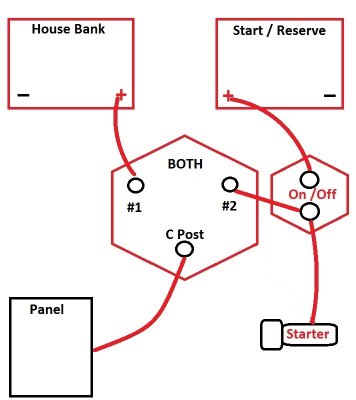
NORMAL EVERYDAY USE:

ISOLATED START & HOUSE

Note: Alternator charges HOUSE and Echo Charger or ACR charges START.
1/2/ALL = #1
ON/OFF = ON


EMERGENCY SCENARIOS:

START & HOUSE PARALLEL
Note: This overrides the Echo Charger or ACR & parallels HOUSE to START bank.
1/2/ALL = ALL
ON/OFF = ON


Emergency Situ #1 - START BATT Provides HOUSE & START Loads:
Note: Use if the HOUSE bank was to fail, for whatever reason. This isolates the HOUSE bank & uses the START bank for everything.
ON/OFF = ON
1/2/ALL = #2


Emergency Situ #2 - HOUSE BATT Provides HOUSE & START Loads:
Note: Use if the START bank was to fail, for whatever reason. This isolates the START bank & uses the HOUSE bank for everything..
ON/OFF = OFF
1/2/ALL = ALL
 
Feb 26, 2004
23,348
Catalina 34 224 Maple Bay, BC, Canada
Chris,

Maine Sail has posted that many times. It is also included in these threads, which explain why in more detail.

OEM 1-2-B Switch Wiring History http://c34.org/bbs/index.php/topic,4949.msg30101.html#msg30101

Basic Battery Wiring Diagrams This is a very good basic primer for boat system wiring: http://c34.org/bbs/index.php/topic,6604.0.html

This is another very good basic primer for boat system wiring: The 1-2-B Switch by Maine Sail (brings together a lot of what this subject is all about)
http://forums.catalina.sailboatowners.com/showthread.php?t=137615
 
Apr 24, 2006
868
Aloha 32 Toronto, Lake Ontario
Perfect - thank's for all the information.

It's interesting that my first "re-wiring" design is like Maine Sails diagram except for a reversal of the switches.
Instead of a "use switch" for house circuits, I had an on-off with the assumption I would almost always want to run house loads from the house bank.
For starting, I had an A/B as I may want to start from either the starting or house battery.
I could also run the house circuits from the starting battery in an emergency or combine batteries (not sure why I would combine as I agree totally with everything posted on combining a dead battery with a good one).

This forum has been excellent - I have also learned to combine my house batteries into a single bank, fuse each bank (within 7 inches on the positive side with ANL fuses), alternator output direct to house battery (fused and with service switch), all other charging direct to house bank and maintain starting battery with an ACR or equivalent.

My next task will be to ensure proper wire sizes, runs, fusing, terminations etc.

Thanks again,

Chris
 
May 24, 2004
7,213
CC 30 South Florida
I may not be understanding the problem. What is the need to switch off or disconnect the starter? The starter is controlled by a solenoid switch operated by the push starter button. This electric switch (solenoid) interrupts electrical flow to the starter whenever the push button is released. Once the circuit is switched off there is no draw on the batteries. When a solenoid fails it defaults to the open position so the chances of the starter running accidentally are practically nil. Do turn your battery switches to Off when leaving the boat unattended. I have had the throw-out bearing gear get stuck in the flywheel and had a running engine driving the starter but it was a mechanical failure where the failure to retract was not electrically induced.
 
Apr 24, 2006
868
Aloha 32 Toronto, Lake Ontario
I may not be understanding the problem. What is the need to switch off or disconnect the starter? The starter is controlled by a solenoid switch operated by the push starter button. This electric switch (solenoid) interrupts electrical flow to the starter whenever the push button is released. Once the circuit is switched off there is no draw on the batteries. When a solenoid fails it defaults to the open position so the chances of the starter running accidentally are practically nil. Do turn your battery switches to Off when leaving the boat unattended. I have had the throw-out bearing gear get stuck in the flywheel and had a running engine driving the starter but it was a mechanical failure where the failure to retract was not electrically induced.
That was pretty much my question. I didn't see a need for another switch - selecting "off" on the battery switch removes power from everything (with a single "use" switch).

But there may be reasons or standards that I'm not aware of - that was my reason for asking.

Chris
 
Feb 6, 1998
11,759
Canadian Sailcraft 36T Casco Bay, ME
That was pretty much my question. I didn't see a need for another switch - selecting "off" on the battery switch removes power from everything (with a single "use" switch).

But there may be reasons or standards that I'm not aware of - that was my reason for asking.

Chris

Some people want to have a dedicated / isolated start battery that only starts the engine under normal use..

Others simply use the house bank to start the motor. If you have a 1/2/BOTH then OFF is your bank isolation from the starter.

If you use a dedicated start battery it too should have an isolation switch. Having an isolation switch is also a requirement under current safety standards for boats of this size so insurance companies will want to see a way to isolate a battery from the starter.

In any good switch design for battery banks there are two main criteria you really want to address:

#1 Bank Isolation Capability - If a bank fails, has an issue or the wiring has issues you want the ability to isolate it (turn if off) not just combine a bad bank with a good one.

#2 Redundancy - If a bank fails, or has wiring issues, you can use the other one as back up until you can address the problems..