Battery bank and monitor question

Apr 24, 2006
868
Aloha 32 Toronto, Lake Ontario
The various battery monitors I have looked at treat the "house bank" as a single entity.
I tend to run one battery at a time - one during the day and night, then switch to the other in the morning (when the first battery is down to 50/60 percent.

If I start using a monitor that "meters" amps out, this will not help me avoid discharging a single battery below 50%. For my example, in the morning, my "house bank" will be at 75% state of charge - despite one of the batteries being discharged to 50% (and the other at 100%) .
So is it just a matter of always selecting "both" on my battery switch? In my example, this would have both batteries discharged to 75% in the morning - matching the state of charge on the battery monitor.
But - I like the idea of discharging one at time as this leaves one battery with enough charge in the morning to start the engine (if the engine battery fails).

Am I overthinking this? Do I just drain both house batteries simultaneously and then the monitor matches the individual battery state of charge?

I noticed that several monitors have input for a second battery - but both the ones I looked at only provided voltage readings for the second battery, not state of charge.

Chris
 
Jan 22, 2008
8,050
Beneteau 323 Annapolis MD
Sounds like you have my setup- almost. Two house batteries plus an engine battery. Yeah, leave both the house banks on. Shallower discharges help battery life. I don't follow how you'd charge the first (overnight) battery if you take it off line in the morning?
 
May 16, 2007
1,509
Boatless ! 26 Ottawa, Ontario
Hi Chris, I think the bigger the house bank is the better, connect both batteries together. I start my diesel off the house bank. I just keep the start battery for emergencies. It charges off an echo charger. I never switch anything unless there is a problem, and there never has been one in 4 years. I only switch the batteries off if I'm working on the electrics. I ran my alternator output direct to the house bank (through a fuse).
It is the simplest way to do this and I never have to remember to switch anything, my battery monitor tells me what is going on with the house bank.

Best wishes of the season, Bob
 
Feb 26, 2004
23,348
Catalina 34 224 Maple Bay, BC, Canada
Chris,

The issue you describe is almost a "generational situational awareness" one. :doh:

Two banks vs. one. Two was the "preferred" system for many years, until the 80s when folks started realizing, and Nigel Calder pointed out, that one larger house bank is actually better 'cuz the amount of lead you drag around simply lasts longer if a larger house bank is used.

The link explains why. And, there are other explanations, too.

Largest House Bank 101 (by Nigel Calder)

http://c34.org/bbs/index.php/topic,5807.msg45046.html#msg45046

Maine Sail has written on the subject, too.
 
Feb 6, 1998
11,759
Canadian Sailcraft 36T Casco Bay, ME
IS IT BETTER TO HAVE ONE OR TWO BATTERY BANKS FOR HOUSE USE?
Here's Nigels take..


Begin Quote - Nigel Calder

"The popular arrangement of having two house banks alternated in use needs scrutiny before I go any further.

LIFE CYCLES: As we have seen, the life expectancy of a battery in cycling service is directly related to the depth to which it is discharged at each cycle - the greater the depth of discharge, the shorter the battery’s life.

This relationship between depth of discharge and battery life is NOT linear. As the depth of discharge increases, a battery’s life expectancy is disproportionately shortened. A given battery may cycle through 10% of its capacity 2,000 times, 50% of its capacity 300 times and 100% of its capacity around 100 times.

Let’s say, for arguments sake, that a boat has two 200-ah battery banks, alternated from day to day, with a daily load of 80 Ah. Each bank will be discharged by 40% (80 Ah of one of the two 200 Ah banks) of its capacity before being recharged. The batteries will fail after 380 cycles, which is 760 days (since each is used every other day). If the two banks had been wired in parallel, to make a single 400 Ah battery bank, this bank would have been discharged by 20% of capacity every day, with a life expectancy of 800 days, a 5% increase in life expectancy using exactly the same batteries!

But now let’s double the capacity of the batteries, so that the boat has either two 400 Ah banks, or a single 800 Ah bank, but with the same 80 Ah daily load. The two separate banks will be cycling through 20% of capacity every other day, resulting in a total life expectancy of 1,600 days. Doubling the size of the battery banks in relation to the load has produced a 210% increase in life expectancy. The single 800 Ah bank will be cycling through 10% of capacity every day, resulting in a life expectancy of 2,000 days - a 25% increase in life expectancy over the two (400 Ah) banks, and a 250% increase in life expectancy over the single 400 Ah battery bank!

There are two immediate conclusions to be drawn from these figures:

1. For a given total battery capacity, wiring the (house) batteries into a single high capacity bank, rather than having them divided into two alternating banks, will result in a longer overall life expectancy for the batteries.

2. All other things being equal, any increase in the overall capacity of a battery bank will produce a disproportionate increase in its life expectancy (through reducing the depth of discharge at each cycle)."

End Calder Quote:


My additional thoughts are below:

One large bank is best for reasons beyond even what Calder touches on.

#1 It is far more efficient to charge one bank rather than two unless using 100% free energy. Even then "finishing" two banks is less efficient due to the longevity of the time acceptance limiting and "finishing" the battery takes while using free energy..

#2 The larger bank will also not be as dramatically affected by Peukert and you'll actually get some more usable amp hours out of a larger bank with the same load than you do with a smaller bank with the same load.

For example a bank with a Peukert of 1.2 and an average load of 8A looks like this, if you were to draw the bank to 10.5V and use all the capacity.

Note:
Increases in capacity at slow rate discharge are from mathematical formula and usually do not = actual chemical capacity. Gains at slow rates can range from 105% to 123% of capacity, but I've not seen much more...

100Ah bank, Peukert 1.2, load 8A = 91Ah's
200Ah bank, Peukert 1.2, load 8A = 209Ah's
400Ah bank, Peukert 1.2, load 8A = 480 Ah's
600Ah bank, Peukert 1.2, load 8A = 782Ah's
800Ah bank, Peukert 1.2, load 8A = 1104 Ah's

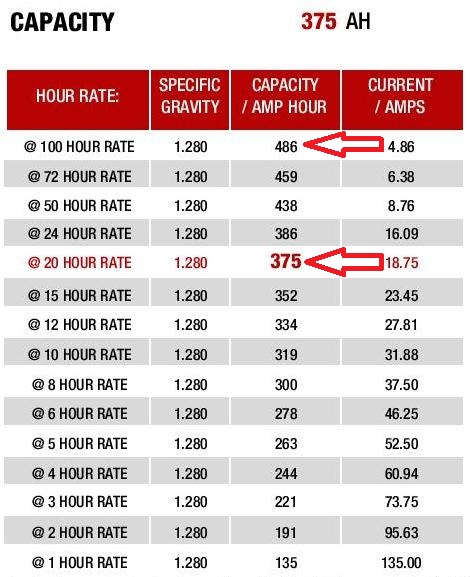
And here is an actual hourly rate chart from Rolls Battery that illustrates this extremely well. Note the usable capacity of this battery at a load of 4.86A vs. the 20 hour rated capacity load of 18.75A!

Boaters rarely if ever load their house banks at the 20 hour rate as an "average"... This would be an average load of 20A on a 400Ah bank when really the average boater with a 400Ah bank is pulling 2A - 8A, on average. By using the bank split in half you lose much of these Peukert gains, especially on thick plate deep cycle batteries.

Rolls Battery Hour Rate Chart CH375:


This means that your bank will have even shallower discharges, not just because it is one large bank, but if the load stays the same and you increase bank size you will actually get a bit more out of the larger bank due to Peukerts formula.

#3 An often overlooked benefit of a larger bank is the banks ability to support higher voltages for your equipment for longer periods. Things like heaters and refrigeration run more efficiently at higher voltages. Starter motors work better with less voltage sag as do windlass batteries. With a single larger bank you not only combine Ah's of capacity but you also combine cranking amperage. A larger bank even at 50% SOC will start the motor with less voltage sag than will a smaller bank at a higher state of charge.

#4 The batteries stay much better balanced so that when you do need them in parallel they are all working as evenly as they can be.

#5 The shallower the discharges, for the same load, the less sulfation you create and this is exactly why a single large bank, cycled less deeply, yields more cycles.

#6 Wiring *one large contiguous bank allows for more precision in keeping the bank wiring and current flowing through the bank balanced.

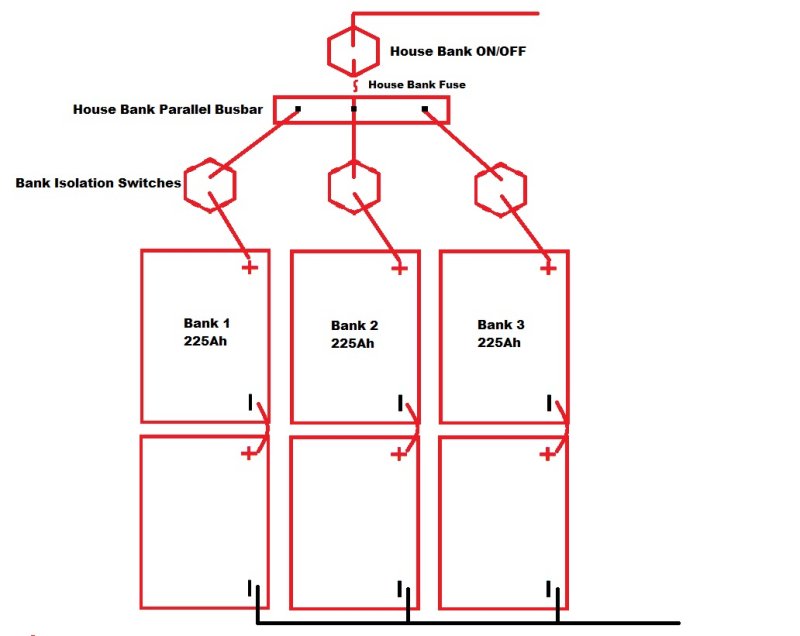
*Note: This does not mean that you can't have a means of emergency battery isolation such as shown below, just that the "emergency isolation switches" remain out of sight of guests and always remain ON, unless there is a bank failure:


#7 Splitting/alternating a house bank makes for a monitoring nightmare with a battery monitor or even a Smart Gauge.

*Charge efficiency is better
*Cycle life is much better
*The batteries ability to support voltage is much better
*You get slightly more usable capacity at the same average load

Battery Monitors:

If you are looking into a battery monitor they fall into two categories at this point.

Coulomb Counters = These count Ah's and require copious amounts of user input to get anywhere close to being accurate. They drift and become inaccurate over time. There are a lot of poor monitors out there so be sure to get one that fully allows you to program the Peukert's constant, charge efficiency etc... If splitting a bank you'd really need two battery monitors, one for each bank....

Smart Gauge =
The Smart Gauge does not use an ammeter and is quite amazingly accurate. Connect two wires, program the battery type and then simply leave it connected. It gets more accurate over time. It does however need to remain connected to the house bank 100% of the time or it can get out of accuracy...

Both types of monitor will need to be hard wired to the bank with no ability to switch or split the house bank..
 
Apr 24, 2006
868
Aloha 32 Toronto, Lake Ontario
Excellent advice - here is a little more info...

First off, I (now) fully understand the benefits of "one" house bank (regardless of how it is made up). I'm not sure why I started discharging my two house batteries independently.

Maine Sail - I plan to use the Balmar monitor, after reading your excellent article. In my previous life (electronic technologist) we always used voltage as a fairly good indication of capacity. It appears the Balmar unit applies the math and situation/history data to achieve a high order of accuracy. And with no shunt or periodic calibration, it's a winner for me.

One other question/comment. My current setup has two house batteries on a selector switch. The batteries are charged independently via a diode isolator (alternator) or multi-battery charger (shore power). There is even a "house 1 - house2" selector on the panel voltmeter.

I can simply use the "both" setting on the battery selector and all will be well - but is there a reason it was set up like this? Possibly the idea was to allow expansion of each battery into a "bank" of it's own? Even then, it makes sense to treat everything as one bank (for the reasons outlined previously).

Just curious, that's all. The previous owner paid a marine electrical firm considerable money to wire it this way. With a proper battery monitor, there should be no surprises i.e. running out of power and needing a fresh battery to switch to.

Oh - and there is a separate dedicated starter battery.

Thanks for the advice - I'll be using the "both" setting on my house switch and installing the Balmar monitor.

And this thread even reminded me I need to order some bed-it!

Thanks everyone,

Chris
 
Apr 24, 2006
868
Aloha 32 Toronto, Lake Ontario
OOPs - need to add that I should wire both batteries in parallel, at the batteries as per Main Sail's recommendation. Then the selector switch will simply be an off/on master (like in an aircraft).

Chris
 
Feb 6, 1998
11,759
Canadian Sailcraft 36T Casco Bay, ME
OOPs - need to add that I should wire both batteries in parallel, at the batteries as per Main Sail's recommendation. Then the selector switch will simply be an off/on master (like in an aircraft).

Chris
Bingo! Also lose the diode isolator if that is what you have. They are murder on charge performance... If it is a combiner or Echo type charger use it to keep the start bank charged..
 
Jan 22, 2008
8,050
Beneteau 323 Annapolis MD
If your batteries are already wired to 1-2-both, I'd leave it that way until you need to change it for some other reason. Say, one battery totally dies, you could switch it out of the circuit and live on the good battery. My 2$ worth.
 
Feb 6, 1998
11,759
Canadian Sailcraft 36T Casco Bay, ME
If your batteries are already wired to 1-2-both, I'd leave it that way until you need to change it for some other reason. Say, one battery totally dies, you could switch it out of the circuit and live on the good battery. My 2$ worth.
Unless you leave the switch on 100% of the time, even when you are not on/board it will not work well and will lead to inaccuracies in battery monitoring.
 
Apr 24, 2006
868
Aloha 32 Toronto, Lake Ontario
FYI - here is a diagram of my DC electrical

If I combine the two house batteries at the "battery terminal" level, then could I eliminate the diode isolator? Connect alternator output directly to the battery bank. Could I then use an isolator (single diode) to charge the starting battery from the alternator output as well?

Chris
 

Attachments

Feb 6, 1998
11,759
Canadian Sailcraft 36T Casco Bay, ME
If I combine the two house batteries at the "battery terminal" level, then could I eliminate the diode isolator? Connect alternator output directly to the battery bank. Could I then use an isolator (single diode) to charge the starting battery from the alternator output as well?

Chris
Yes, you could but you will still have the voltage drop across the diode and the drop in the wire. This can be upwards of 0.6V + by the time you get to the battery.. This leads to chronic undercharging. A simple Blue Sea ACR, Yandina Combiner or a Xantrex Echo Charger would be better. You can alternatively put the start batt on the #2 position of the existing batt switch and charge in parallel manually.
 
Apr 24, 2006
868
Aloha 32 Toronto, Lake Ontario
That makes sense but while we are on the subject, would it not also be effective to leave house and start batteries going through the isolator but with the alternator "sense " wire connected on the battery side? In theory, the alternator should increase output to achieve 13.8 volts at the battery terminal (and make up for the isolator's voltage drop)?

Then again, don't I require a "smarter" regulator so charging doesn't decrease significantly long before the battery is charged?

I realize I'm getting into an entirely new topic but one that seems to suffer from a lack of good information. In my "previous life" I was an electronics technician - so while I'm no expert in marine electrics, I "can be taught". I also hear the most incredible, inaccurate and down right dangerous stuff from other sailors. These forums are excellent for bringing together the people who know with the people who need to know :)

All the advice is greatly appreciated.

Chris
 
Feb 26, 2004
23,348
Catalina 34 224 Maple Bay, BC, Canada
As Maine Sail said, isolators are inherently stupid for charging batteries because they induce a voltage drop, the very last thing you want! :)

Why did they use them? It is way old technology, it's a hangover if you will. When I bought my boat (1986 model in 1998) the first thing I did was to remove one the PO had had installed. You're asking for a history of why they used them? Because they'd do the separation thing, but were horrible because of the voltage drop.

That's why they invented relays, whether activated by voltage itself or oil pressure, the relays didn't induce voltage drop in the charging circuit.

In all cases, make sure your battery sense wire from the regulator goes to the house bank.

Here's diagrams. I haven't reviewed yours, Chris, since these will give enough food for thought to do your own.

Basic Battery Wiring Diagrams This is a very good basic primer for boat system wiring: http://c34.org/bbs/index.php/topic,6604.0.html

This is another very good basic primer for boat system wiring: The 1-2-B Switch by Maine Sail (brings together a lot of what this subject is all about)
http://forums.catalina.sailboatowners.com/showthread.php?t=137615
 

slaume

.
Feb 21, 2014
105
Cape Dory 30 C Noank
I have two batteries in my house bank with a start battery on an Echo charger. I wired the house bank to the number one position on the selector switch and the start battery to the number two spot. I always start on the house bank.

One other thing I did do was to add another selector switch between the two house batteries. This stays permanently in the both position and sends power to the number one position on the main selector switch. This switch is hidden away in the cockpit locker, near the battery bank. It would allow me to isolate the two house batteries if one suffered a drastic failure, Steve.
 
Mar 20, 2012
3,983
Cal 34-III, MacGregor 25 Salem, Oregon
would it not also be effective to leave house and start batteries going through the isolator but with the alternator "sense " wire connected on the battery side? In theory, the alternator should increase output to achieve 13.8 volts at the battery terminal (and make up for the isolator's voltage drop)?
Chris
you are correct that this "old technology" will work if you have a dedicated sense wire from the alt... but the blue sea combiner at 65-80 bucks is much more efficient... and ensures an even and balanced charge.
you just connect it in place of the diode isolator and forget that it is there.
there is a small additional wire from it to the house bank and when this wire senses a discharge from the house bank it disconnects the feed to the start batt so no power can backfeed from it. it automatically reconnects as soon as there is input into the house bank...

you would still have the combiner switch in the system just in case you ever needed to combine the house and start batteries for any reason...
 
May 24, 2004
7,213
CC 30 South Florida
There is a tradeoff here. The benefits of a larger battery bank are only valuable if you use them. Giving up a source of backup power for a benefit you might not need is no fair trade. Consider your particular needs before following advise. Batteries foul up and people make mistakes so the idea of maintaining a backup battery has some merit. A friend of mine forgot to turn off his refrigerator at night and woke up to a large dead bank. I got in the dink and took over my backup battery and started his and then brought it back and started my boat. I was nice just having to carry a single battery and not a half discharged bank.
 
Feb 6, 1998
11,759
Canadian Sailcraft 36T Casco Bay, ME
There is a tradeoff here. The benefits of a larger battery bank are only valuable if you use them. Giving up a source of backup power for a benefit you might not need is no fair trade. Consider your particular needs before following advise. Batteries foul up and people make mistakes so the idea of maintaining a backup battery has some merit. A friend of mine forgot to turn off his refrigerator at night and woke up to a large dead bank. I got in the dink and took over my backup battery and started his and then brought it back and started my boat. I was nice just having to carry a single battery and not a half discharged bank.
He already has a back up bank, it's called the starting bank.. He was wired for a third back up bank... How many spare tires do you carry....:D
 

slaume

.
Feb 21, 2014
105
Cape Dory 30 C Noank
There was a time, way back when I was far more poor than today, that I carried two spare tires. Pretty much all of my tires were bald and I felt the need for an extra spare.

Raven only has one start battery and two good ones in the house bank.

I have a chart plotter and two hand held GPS units. One is always working and the other is in the ditch bag. There is no sextant to back up the GPS.

A lot depends on how much faith you have in your primary source, and how critical the system is.

I have a great alternator but am still a bit troubled by the fact that it is the only source available to charge my batteries, Steve.
 
Mar 20, 2012
3,983
Cal 34-III, MacGregor 25 Salem, Oregon
There was a time, way back when I was far more poor than today, that I carried two spare tires. Pretty much all of my tires were bald and I felt the need for an extra spare.

Raven only has one start battery and two good ones in the house bank.

I have a chart plotter and two hand held GPS units. One is always working and the other is in the ditch bag. There is no sextant to back up the GPS.

A lot depends on how much faith you have in your primary source, and how critical the system is.

I have a great alternator but am still a bit troubled by the fact that it is the only source available to charge my batteries, Steve.
backup equipment is good to have.... with the efficiency and cost of solar power today, there is very little excuse to NOT have it installed for charging our batteries..

and the actual need for any redundent system, would be dictated more by how you use the boat and where you are sailing (across the bay, across the ocean, or around the world).

but our desires to have redundency can be just as strong even if the boat never leaves the dock....
I can point out at least 2 "captains" in my marina that are exactly like that...
the boat may only be a day sailor, but its outfitted with all the toys and equipment and systems necessary for an around the world trip... and its just too much trouble to take out for a sail across the river once in awhile...
im NOT judging, but only saying... the guys are both great people and are very willing to lend a hand whenever necessary, but their boats seem to be only good for barbques and working on....:D:D