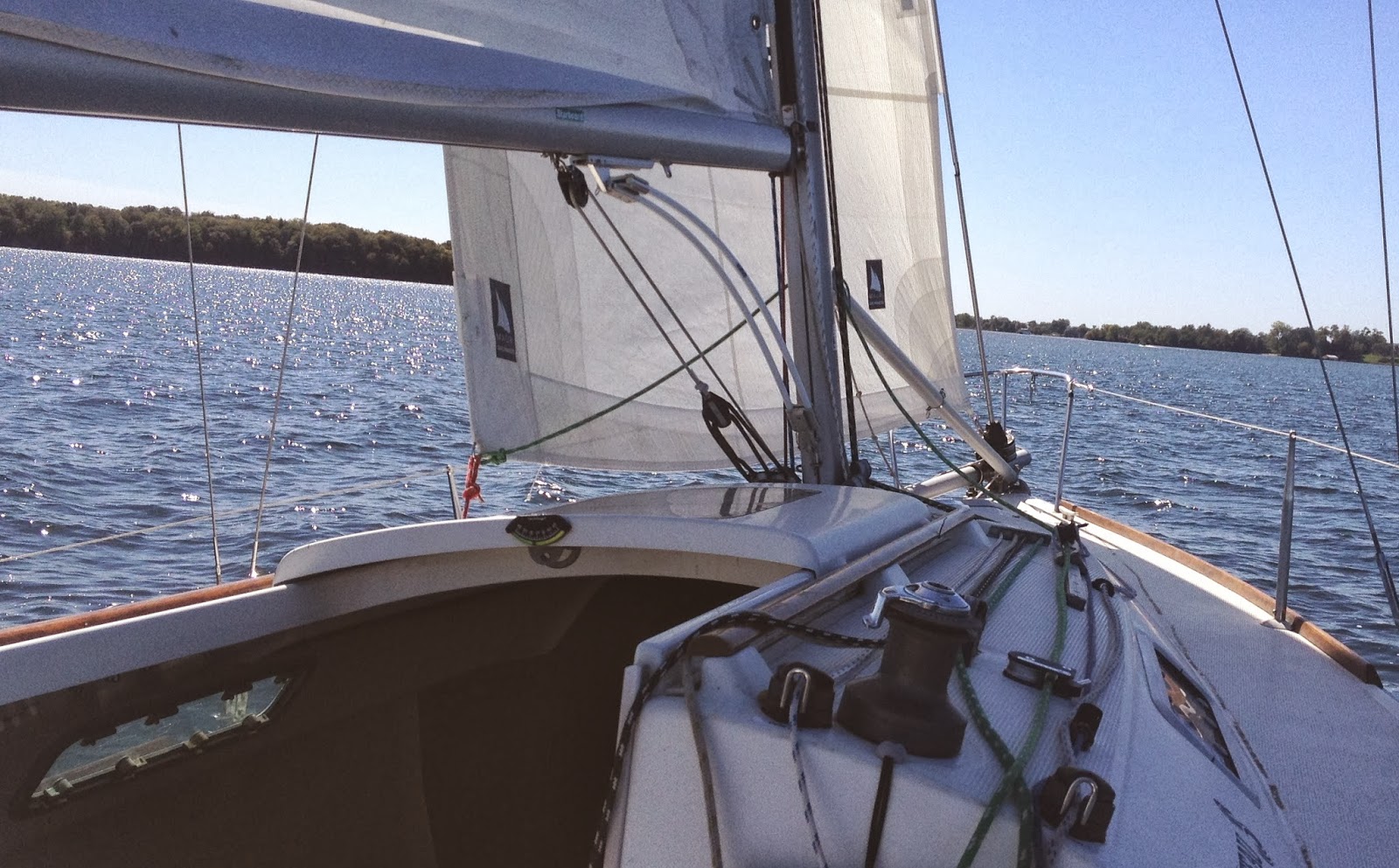
Critique my main

Aug 10, 2010
178
Catalina 25 The mountains
I would appreciate any helpful critiques.
Wind conditions were 10 knots gusting to 17-18. My boat needs to reef at 15. It doesn't have a traveler and I don't have adjustable fair leads so I can't reef the jib safely on the furler system (the manf recommends against it with no adjustable cars because the furler will lift up).
Anyway, this means I reef early and my boat has one single large reef.
The boat is a fractional set up and is a B&R rig so there's no backstay. Also, I don't have a Cunningham.
What I do have is the main sheet, halyard and an outhaul (reef line in this set up). One question I have is if the edge of the leech is okay? I would get some flutter when a gust would blow. It has a leech line but I don't have a cleat or any way to secure the tension I might use.

The wind was a bit squirrely otherwise I would have gotten a pic with the jib. The gusts would come from a different direction. i was sailing close hauled and the gusts had a lot of turbulence ahead of them or something. The sails would luff and if you bear off to fill your sails, the gust would suddenly hit your beam. Due to the shape of the lake, many were sailing close hauled and many were having trouble with this and would round up. I learned to just wait out the turbulence and head up just a little so we could ride the gust. It was strange. Anyone with experience like that? Normally you can get a nice reach across the lake so the turbulence doesn't blow you down I guess?
 

Attachments

Oct 26, 2008
6,432
Catalina 320 Barnegat, NJ
Well, you describe conditions to a "T" on Lake Hopatcong for Saturday and Sunday afternoon ... but it was quite fun, actually. We had a nice broad reach from Bertrand Island to Halsey Island and some long upwind tacks coming back with SW wind.

The leech of your sail does look too loose. It looks like your topping lift is loose but that might be the lens distorting the view. The TL may be lifting the end of the boom if you forgot to let it loose. It also looks like a fair amount of draft for a reefed main. Again, forgetting to release the TL could be contributing.
 
Nov 8, 2010
11,386
Beneteau First 36.7 & 260 Minneapolis MN & Bayfield WI
A couple of things.
First it sounds like the wind was oscillating, or shifting back and forth. When this happens first the wind comes forward to your bow, making you luff. you fall off to fix that and all is good for a minute, when it shifts back to your (now) beam and pushes you over.

Welcome to sailing! ;^)

The key is to watch for this. With practice not only can you see the new pressure in the wind, but the directional change that will so the above. In time you'll see that and trim accordingly. Then you'll be tacking into the bow shift (header) and make HUGE gains on your buddies.

Be sure to watch your talltails. Even if you miss seeing the shift come, you sails will react right away and you will need to also.

Now to you rig. You need some things.

You need a vang. BADLY.

A vang allows you to de-power the main the same way a traveler would; by decreasing the angle of attack.

Right now if a puff hits and you probably dump the mainsheet. The boom rises and the sail shape radically changes. With a vang you can control the boom rising, and the open sheet only allows the boom to travel to leewards (not up!) and the wind spills from the sail in a controlled manner over a well shaped sail.

This is called 'vang sheeting' and is a accepted way to manage pressure in the mainsail. I cannot image sailing with both a traveler and a vang.

When you get a vang for your boat (tomorrow??) try and rig it so you can set and release it from the cockpit while sitting in your normal position. Many vangs are set up for a 'pit' crewmember to control, but that does you little good while sailing 1 or 2-up.

You need a dedicated out haul. It helps control the shape of the sail. You want it tight in breezy conditions.
 

Joe

.
Jun 1, 2004
8,323
Catalina 27 Mission Bay, San Diego
Only to add emphasis to Jackdaw's comments..... get a vang rigged immediately. Sailing without a traveler is punishment enough in oscillating conditions.... but without a vang also? .... frustrating comes to mind.
 
Jun 6, 2006
6,990
currently boatless wishing Harrington Harbor North, MD
looks like you are over trimmed based on the windix. Could be the wind shift other poster talk about though. Otherwise, you can't see the tell-tails so it is hard to tell if the main is pulling its' weight.
What was your rudder angle?
 
Oct 26, 2008
6,432
Catalina 320 Barnegat, NJ
Yes, my vang had a workout in the gusty conditions, and sometime during the afternoon, the fiddle block broke on the body. I was heading downwind on my last reach and wondering why the line was so loose! Well, it is 30 years old and subjected to the sun's rays all that time ... I think it lasted long enough.
 
Aug 10, 2010
178
Catalina 25 The mountains
I have a vang and it was on. I have trouble unjamming it if I really wrench on it. It never has seemed to change much regarding the shape of the sail or closing the leech. How do people rig them when short handed?

I don't understand regarding the topping lift and it being too loose? I thought a tight topping lift would interfere with the sail shape? I've got it tied off so that the boom sits a little bit low so that when the sail is hoisted, the sail is what is holding up the boom. If the topping is tight enough to hold the boom, then it hits the leech of the sail.

As for the telltales, I was able to get them to fly like they should fairly easily. The windward telltale would lift occasionally, the leeward was streaming aft.

I had the reefing line as tight as I could get it. There's no mechanical advantage through winches or anything. You just have to tug and I got it as tight as I could. If anyone has ideas, I'm all ears. The deck doesn't allow for any additional hardware.
Of course, this isn't a blue water vessel, just a little trailer sailor on a lake. I'm just trying to make due with what I have.
 
Jan 1, 2006
8,008
Slickcraft 26 Sailfish
It's hard to get a sense of sail shape from the photo because the reefed flake is in the way. But a reefed sail should be very flat. Often the reefing line is pulling as much aft as down.
Some fluttering in the leech is OK but not desirable for the sail's lifespan. If there is no leech line cleat you're going to have that.
While you're boat should be reefed at 15 Kts. that means when the wind is steady at 15. If you are sailing in 10 kts. and experiencing gusts of 17-18 you should be able to manage them by releasing the mainsheet and or steering adjustments during gusts. You don't need a traveler to handle that. Or a backstay. You can live without a cunningham too. I would Rx that after hoisting the main, sail for five minutes then luff up and put on some more halyard tension. I don't like sailing with a saggy main.
Many times gusts are accompanied by a wind shift. In cold front conditions the wind can be from the NW and when a gusts hits the wind may shift as far as to W (45 degrees). You may have experienced that on Sunday. Steering through those is fine. Usually they don't last long enough to warrant a tack, which would be the thing to do if you had a significant knock. By the time you tack and get back up to speed the shift has ended and you would be sailing in a new knock relative to the the new tack. And there's nothing wrong with riding a roundup to gain ground to windward. Rather than apply a lot of rudder and slow the boat down it's sometimes better to let the boat go up and through momentum keep your speed. These are short lived events and you'll be able to bear off shortly and resume your course, a bit more to windward. That's sailing.
 
Oct 26, 2008
6,432
Catalina 320 Barnegat, NJ
I have a vang and it was on.

I don't understand regarding the topping lift and it being too loose? I thought a tight topping lift would interfere with the sail shape? I've got it tied off so that the boom sits a little bit low so that when the sail is hoisted, the sail is what is holding up the boom. If the topping is tight enough to hold the boom, then it hits the leech of the sail.

As for the telltales, I was able to get them to fly like they should fairly easily. The windward telltale would lift occasionally, the leeward was streaming aft.
I think my comment on the TL was misleading. I was looking at the curve and thinking that it doesn't appear that it is tight and it should be loose as you understand correctly. I was wondering, though, if it is actually tight and the photograph distorts the image. The reason I wonder if the TL is tight is because the end of the boom appears to be lifted, causing the loose leech and the draft in the main sail. Also, when you are reefed, the TL won't interfere with the leech because the position of the leech will be moved much closer to the mast, with lots of clearance (as shown). The photograph does seem to show that the end of the boom is lifted. If it's not because the TL is tight, then it has to be concluded that you aren't using a vang or the vang does not have enough tension to hold the boom down, as everybody is responding.

I think vangs are a little tricky to use. The purpose of the soft vang is to pull the boom down to close the leech. For one thing, the mechanical advantage is very inefficient because at best it is pulling down at less than a 45 degree angle (it is compressing the boom toward the mast more than it is pulling the end down) and the force is applied closer to the mast end of the boom, not the aft end where the force would be more effective. In my opinion, many boat manufacturers provide too little mechanical advantage to use the vang effectively. I found that in some circumstances, I can't get any effect without putting the line on the cabin-top winch. If you have your mainsheet sheeted in tightly, you won't be able to draw the boom down any more tightly with the vang, but, when you ease the mainsheet, the vang will then go to work and do what it is supposed to do - control the twist.

It could be that you have the mainsheet eased when you are attempting to apply the vang, but you may not have enough mechanical advantage to get the vang set appropriately. When you are close-hauled, try setting the vang with the mainsheet tight. That way, the vang should hold the boom for the correct shape when you ease the mainsheet.

Another thing to question is if the line on the vang is simply very stretchy. The inefficiency of the line configuration essentially means that the line is in a lot of tension, and if it is a stretchy line, it's working against you.
 
Aug 10, 2010
178
Catalina 25 The mountains
Okay, thanks all for you generous explanations as always. I have ideas to work on now!
 
Nov 8, 2010
11,386
Beneteau First 36.7 & 260 Minneapolis MN & Bayfield WI
I have a vang and it was on. I have trouble unjamming it if I really wrench on it. It never has seemed to change much regarding the shape of the sail or closing the leech. How do people rig them when short handed?
Two things you can do.

First is to add a block and a length of dyneema to your vang setup. As shown in the picture, this 2x block will convert a 4:1 into a powerful 8:1 vang.

Second is to remove the cleat from the bottom of the vang block and run the line through a deck organizer and back to a Harken 150 camcleat with an extreme angle release cage. On my boat it is the one closest to the companionway. It can be used from anywhere in the cockpit.


Joe

.
Jun 1, 2004
8,323
Catalina 27 Mission Bay, San Diego
Remember... a sudden increase in windspeed (a gust) will move the apparent wind direction aft.... This causes the vessel to heel... maybe even round up... With a traveler, you can easily change the main's angle of attack to reduce the heeling... then pull the sail back up when the gust passes. This way you don't have to change the trim/twist of the sail. Without a traveler, you set your twist with the vang, then you can use the mainsheet like a traveler in this scenario.
 
Oct 26, 2008
6,432
Catalina 320 Barnegat, NJ
Nice set-up

Since I broke a fiddle block over the weekend, that looks like a nice modification. I have the control line led thru a clutch ahead of the winch so I can load it with the winch. It was at 4 to 1 purchase. I imagine with 8 to 1, it should be manageable without the winch, and the cam cleat is probably more convenient for active adjustment. Once I have mine set for a particular heading, I don't normally adjust it.

My vang control line is obviously the blue line on port-side set of clutches.
 

Attachments

Sep 17, 2012
115
Morgan 383 Fairhaven, NY
More halyard tension needed. I *think* I see "speed wrinkles" along the luff, and scalloping of the leach. As a previous poster mentioned you want the main flat. Less draft.
 
May 16, 2007
1,509
Boatless ! 26 Ottawa, Ontario
I sailed a H260 for a few years. I'm no expert on sail shape so I'll not comment on yours, lots of good advice here.
In order to be able to adjust the sail shape I did make a few mods to my H260.
I moved all my lines to the cockpit.
I added a block to the outhaul.
I turned the vang around so it could be adjusted from the companionway.
I went with separate luff and leach reef lines on the mainsail using Harken plastic blocks in the sail grommets to ease the strain on the sail.

My other 260 mods are here, http://forums.hunter.sailboatowners.com/album.php?albumid=1031

Bob
 

Attachments