Victron Batt. Monitor - design flaw?

Jan 28, 2012
101
2006 Hunter 33 Santa Barbara
I'm using a Victron battery monitor and can't anymore imagine trying to get by without it!

However, I've run across what I think is a (significant?) problem with the way it works.

The Victron is important to me when battery charge is low - say 50 - 55%. I use it to decide whether to switch on the generator (which I hate to do unnecessarily) or wait until the sun comes up in the morning for solar, or otherwise micro-manage the current until fully charged again

However, often when I try to start the generator when the batt. charge is down, the starter momentarily pulls the battery voltage down so low that the Victron resets itself, and is then useless until it eventually resyncs as the battery gets full again. In other words, just when I need it, it isn't working!

It would be much preferable if the state-of-charge and other parameters were held in non-volatile memory that holds its value when the voltage drops to zero, and can be read again when voltage comes back up.

I'm thinking of installing a small battery pack that powers the Victron full time (even when the battery it is monitoring gets to low voltage). I'm thinking that the power that the Victron itself uses is very low, so I could perhaps use alkaline batteries. In fact, if the Victron didn't mind 18 volts, it would be simplest to use two 9V alkalines.

Anybody else come across this problem, or are there any comments on my potential solution?

Does anybody know if the Xantrax BM has this same problem?
 
Feb 6, 1998
11,759
Canadian Sailcraft 36T Casco Bay, ME
Really need more info. The Link and Victron both have similar input voltage ranges. I suspect you have a battery, programming/calibration or wiring issue not a batt mon issue as there are thousands of these out there not dropping out on low voltage.

How old are the batts
How many Ah's do you assume the bank is
What gauge starter / battery wire
Where does the Victron red fused wire connect into the system

The Victron needs to be connected to the bank it is monitoring...
 
Jan 22, 2008
8,050
Beneteau 323 Annapolis MD
Why let the batteries get down so low before doing something about it. That is alot of battery juice to be using between sundown and when you are 50-55. What is your battery supply?
 
Feb 26, 2004
23,348
Catalina 34 224 Maple Bay, BC, Canada
However, often when I try to start the generator when the batt. charge is down, the starter momentarily pulls the battery voltage down so low
By generator, do you mean the engine and alternator or a separate generator?
 

walt

.
Jun 1, 2007
3,550
Macgregor 26S Hobie TI Ridgway Colorado
check the manual but that instrument is probably doing a reset when the supply input voltage is near 8 volts - maybe 9 volts.

I'm thinking of installing a small battery pack that powers the Victron full time (even when the battery it is monitoring gets to low voltage). I'm thinking that the power that the Victron itself uses is very low, so I could perhaps use alkaline batteries. In fact, if the Victron didn't mind 18 volts, it would be simplest to use two 9V alkalines
.

This would just be masking some other problem but you could also probably just put a fairly large capactor - like 100 uf or 220 uf (at least 25 volt - these are polarity sensitive) on the DC supply voltage for the instrument - this would need to be close to the instrument to work best.
 
Nov 19, 2011
1,489
MacGregor 26S Hampton, VA
Your battery's shouldn't pull that far down to start a generator. Have you checked for loose or corroded connections or maybe you have a few dead cells?

How many volts/amps is your generator start demand? Real vs. Rated?
 
Feb 6, 1998
11,759
Canadian Sailcraft 36T Casco Bay, ME
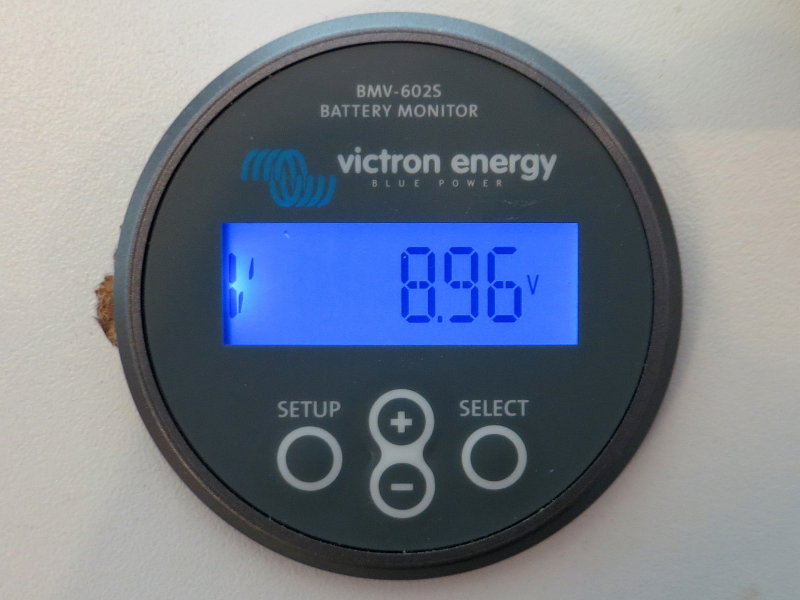
I was just in the shop and threw a dead battery on the test bench. Battery was at 3V.

I connected the battery to a variable power supply and slowly raised the voltage with the BMV-602S connected to the battery.

It turned on at 8.94V and this shot was taken at 8.96V


HOWEVER!!!!


When power is removed from the device, or if the voltage drops below 8.94V, there is a full 8 second delay before the unit drops out or loses data. Clearly it has its own built in capacitor to save memory in case of inrush loads pulling voltage momentarily below 9V...

8 seconds is not an in-rush duration, it is far longer..... There are many motors where the entire start duration, beginning to end, is around 0.75 seconds to just 1.0 seconds......

If your batteries are dropping to 9V under starting loads, and doing that for more than 8 seconds, the problem is most likely not the battery monitor it is probably your batteries.

Alternatively you may not have the Ah capacity you think you have. Instead of being at 50-55% you could really be at 15-20% SOC if your batteries no longer have the rated capacity you may have the monitor programmed for.

Approx 90% of the batteries that pass through my shop for capacity testing services do not have the rated capacity the owners think they do! This means that perhaps 90% of the boats with BM's on them out there, that have not had the batteries physically capacity tested, have battery monitors that are reading incorrect, sometimes by a huge margin.....
 

walt

.
Jun 1, 2007
3,550
Macgregor 26S Hobie TI Ridgway Colorado
Something like that may also have a "brownout" reset that can be triggered before the device just wont even power up.

I would guess that device actually does have non volitile memory - it would remember custom settings.

It just may be the power on reset function that gives you what you see?
 
May 6, 2010
472
1984 Oday 39 79 Milwaukee
...

When power is removed from the device, or if the voltage drops below 8.94V, there is a full 8 second delay before the unit drops out or loses data. Clearly it has its own built in capacitor to save memory in case of inrush loads pulling voltage momentarily below 9V...
.....
I inquired of Victron about this related to another issue I was having, and got this response:

"No , less than a second is enough to reset the bmv.

Regards,

Jaggat"
 
Feb 6, 1998
11,759
Canadian Sailcraft 36T Casco Bay, ME
I inquired of Victron about this related to another issue I was having, and got this response:

"No , less than a second is enough to reset the bmv.

Regards,

Jaggat"
I did not just make that up....;) I physically tested this using a NIST Calibrated Fluke 179 as a voltage reference and with a lab grade variable power supply.
The one I have in my shop took 7-8 seconds to wipe the data once voltage dropped below 8.94V-8.95V...... The BMV I have cuts out at right around 8.94V, will remain on at 8.96V, and once you drop below 8.94V it takes about 7-8 seconds to kill it.

This suggests there is some sort of capacitor in it. I can take the knob of my power supply and drop the voltage below 8V, quickly, and bring it back up, and the monitor does not lose data. This is actually about .5V better than Victron's specifications for the monitor which indicate a 9.5V voltage floor...

That said, if your batteries are dipping to that voltage........:doh:
 

walt

.
Jun 1, 2007
3,550
Macgregor 26S Hobie TI Ridgway Colorado
Also to consider..

An instrument like that may have a “brownout” spec that says the micro will get reset at a voltage HIGHER than where the instrument completely dies. The purpose is to make sure the micro gets a reset when it has good supply voltage. Without this, you might take the voltage down near where the power to the IC's is flaky and when you bring the voltage back up, the micro has lost its mind. The brownout reset just says to do a reset if the supply voltage gets even close to where the instrument voltage is flakey.

So for example, you saw it stay alive for some seconds after the voltage went below 8.94.

But is it still possible that the instrument did a reset at a higher voltage such as 9.1? If you were just looking for the display to go off, you may not have noticed a reset. I have no idea what the instrument does when reset.. but you would have to be specifically looking for the reset rather than watching for when the display goes off..
 
Feb 6, 1998
11,759
Canadian Sailcraft 36T Casco Bay, ME
Also to consider..

An instrument like that may have a “brownout” spec that says the micro will get reset at a voltage HIGHER than where the instrument completely dies. The purpose is to make sure the micro gets a reset when it has good supply voltage. Without this, you might take the voltage down near where the power to the IC's is flaky and when you bring the voltage back up, the micro has lost its mind. The brownout reset just says to do a reset if the supply voltage gets even close to where the instrument voltage is flakey.

So for example, you saw it stay alive for some seconds after the voltage went below 8.94.

But is it still possible that the instrument did a reset at a higher voltage such as 9.1? If you were just looking for the display to go off, you may not have noticed a reset. I have no idea what the instrument does when reset.. but you would have to be specifically looking for the reset rather than watching for when the display goes off..

It actually held data at (-Ah's) at 8.96V and when dipped and brought back up quickly it also held it...
 
Jan 28, 2012
101
2006 Hunter 33 Santa Barbara
I was the guy that originally posted the concern about the Victron. I had intended to review my situation based on Mainsail's finding that there is an 8 second period of low voltage before the Victron resets. My memory of the times it reset for me is that there could not have been as much as an 8 sec interval while I was starting the generator, but I have a lot of faith in Mainsail, so was willing to, and expecting to, prove myself wrong.

However I still haven't been able to get back to the boat with enough time to do a test. So rather that wait, I wanted to thank you all for your comments on my initial findings, especially Mainsail who took the time to do an experiment in his lab on the Victron.

Meanwhile, looking at the post from Seffuler that Victron say only one second of low voltage is enough to reset the instrument makes me a little more convinced that the problem, as I found it, may be real.

I certainly have no problem believing that a 50% run down battery could drop voltage to 8.94 while I have my finger on the generator start switch. The issue is whether that lasts for 1 sec or 8sec. Of course, I could eliminate the problem by never letting the battery go to 50% discharge, but that sort of strategy negates the whole principle of having batteries at all!

I'm also sensitive to the suggestion that my battery, spec'd at 110AH, may have less than that capacity in reality (although it is only 14 months old and hasn't been abused). Is there any simple and practical way to measure this?

When I get time to look more closely at my situation, I'll post again.


BTW it seems to me that the battery monitor has enough information available to it to calculate the actual AH capacity and modify the originally entered value as the battery gets older. But they don't purport to do that, so I suppose they don't. (perhaps that idea is patentable!)
 
Sep 28, 2008
922
Canadian Sailcraft CS27 Victoria B.C.
BTW it seems to me that the battery monitor has enough information available to it to calculate the actual AH capacity and modify the originally entered value as the battery gets older. But they don't purport to do that, so I suppose they don't. (perhaps that idea is patentable!)
They don't. The only way to find true remaining capacity is a 20 hour test at 5% of C.
 
Jan 28, 2012
101
2006 Hunter 33 Santa Barbara
mititempo,

could you tell me more about the 20 hr test at 5% of C, please
 
Sep 28, 2008
922
Canadian Sailcraft CS27 Victoria B.C.
mititempo,

could you tell me more about the 20 hr test at 5% of C, please
A battery is rated at 20 hour rate. In other words a battery of 100 AH will (when new) deliver 5 amps for 20 hours before reaching 10.5 volts which is considered a dead battery.

To do a 20 hour test you put a load equal to 5% of capacity on the battery and time how long it takes to get to 10.5 volts. If it takes 18 hours you are down 10% in capacity for example. This should take place at about 77 degrees F.

Charge to full immediately afterwards.
 
Nov 19, 2011
1,489
MacGregor 26S Hampton, VA
Hmmm good to know, learn something new every day. Thanks for the explanation.

So if I have twinned batteries, (parallel) is it a simple as doubling?
 
Jan 28, 2012
101
2006 Hunter 33 Santa Barbara
Yes, this is interesting!

How much harm is it doing to the battery to fully discharge it - even if you recharge immediately?

The other thought I had is to measure the specific gravity of the batt. fluid. Could you just take out half of the rated capacity, then measure the sp gr and see if it really is 50% down? If so, what sp gr would you look for at 50% charge?


A battery is rated at 20 hour rate. In other words a battery of 100 AH will (when new) deliver 5 amps for 20 hours before reaching 10.5 volts which is considered a dead battery.

To do a 20 hour test you put a load equal to 5% of capacity on the battery and time how long it takes to get to 10.5 volts. If it takes 18 hours you are down 10% in capacity for example. This should take place at about 77 degrees F.

Charge to full immediately afterwards.
 
Feb 6, 1998
11,759
Canadian Sailcraft 36T Casco Bay, ME
Yes, this is interesting!

How much harm is it doing to the battery to fully discharge it - even if you recharge immediately?

The other thought I had is to measure the specific gravity of the batt. fluid. Could you just take out half of the rated capacity, then measure the sp gr and see if it really is 50% down? If so, what sp gr would you look for at 50% charge?
As long as you recharge it immediately there after not much harm at all. A correctly done capacity test can be less harm than discharging to 50% SOC then hoovering between 50% and 80% for an entire weekend or three to four day cruise.....

After the discharge test if recharged slowly, at the 20 hour rate, and the voltage is allowed to go to 15.5V at the end, you can actually see some recovery of lost capacity. In the industry this type of charge is often called a "reforming" charge...

When I conduct a 20 hour capacity test batteries they are:

*Charged to full at recommended absorption voltage until current stops declining or .5% of Ah capacity is reached.

*Equalize if chemistry allows for it

*Rested for 24 hours at 75-77F

*Discharged at the 20 hour rate (capacity divided by 20) with a DC constant load battery tester at 75-77F

*Ah's & time delivered are recorded

*Charged at the 20 hour rate with a voltage limit of 15.5V (not for gel or non Lifeline AGM's)


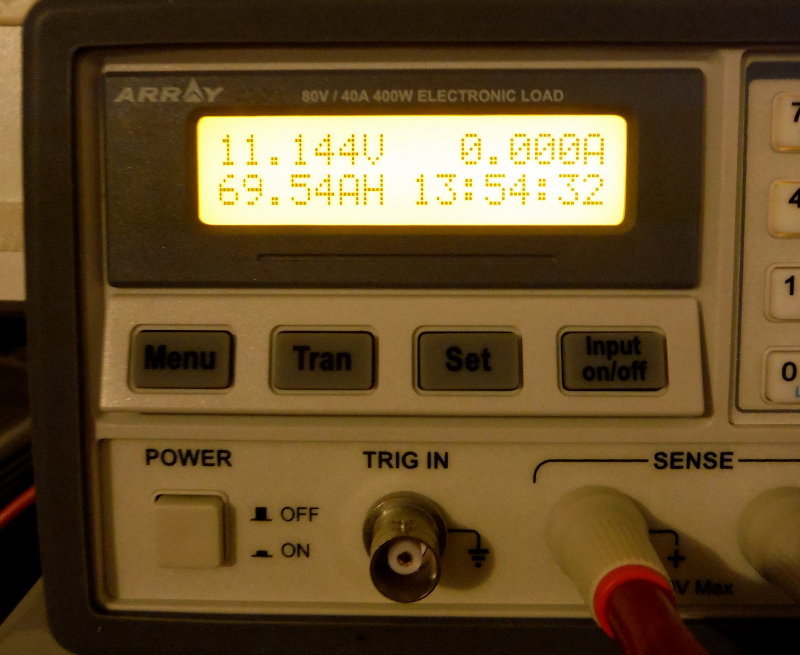
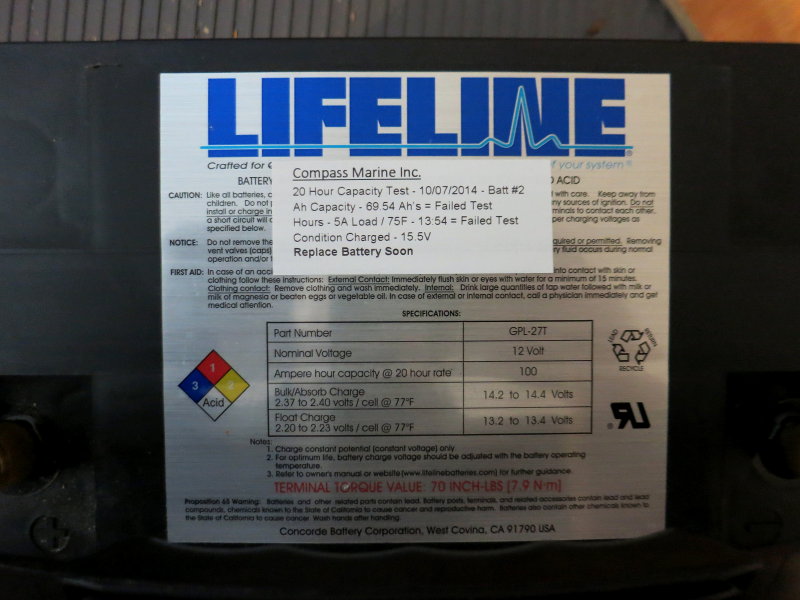
This was a 3.5 year old battery from a new customers boat that I tested a couple of weeks ago. Battery monitor was still programmed for the full 100Ah "rated" capacity. Needless to say his 3.5 year old very expensive Lifeline batteries are pretty much toast. When it told him 50% he was really at 35% SOC based on the actual Ah capacity. Course this was not the only "issue" but one of the pieces....

Bottom line is if your Ah counter is not programmed for your correct known and actual capacity you can actually be damaging your batteries far more than a yearly capacity test will...


At the end of the test I simply snap a shot of the testers screen and drop it into the owners folder on my computer...