Fog!!!

May 17, 2004
2,111
Other Catalina 30 Tucson, AZ
I've only sailed in fog on 2 occasions and I didn't like either of them. The first was a race in Long Beach, Ca. Why a race committee would allow a race in that condition is beyond me but we were out there. The skipper decided to drop out of the race but we were not sure where we were. In front of us I thought I heard a hammer hitting metal. Turned out it was a seaman chipping paint. Shortly thereafter a massive shape looms up -- it was a container ship!! If we weren't fore warned, we'd have crashed into the sucker.

The second occasion was again in Long Beach, Ca. It wasn't foggy when I left the dock for a 1 week vacation cruise to San Diego but it came in fast and I was stuck in it between the breakwater and land. Just before the fog closed in I saw a tug boat pushing a barge and coming in my direction. He could SEE me but I couldn't see him. The next thing I hear is 5 blasts of his horn so I turned away. Unfortunately, I turned the wrong way and I heard the horn again. At this point I didn't know which way to turn or even where I was. Fortunately, the fog lifted for a second and I got my bearings. The tug/barge was right behind me. I followed him back to the marina, unpacked the boat and drove to San Diego!!

We sail with 3 of our 5 senses: touch, sight and hearing. Of the 3 senses, SIGHT is the most important and when you loose that "sense" in fog, you're in trouble. I didn't have radar or GPS to help me out of the situation. When I lost "sight" and got turned around what followed next was I lost confidence and that put me in a dangerous situation.

How many of you have sailed in fog and what tips can you offer?
 
Apr 11, 2012
324
Cataina 400 MK II Santa Cruz
Fog is a way of life in San Francisco and Santa Cruz. GPS and Radar make a HUGE difference - but are only part of the plan. I don't have AIS, wish I did. Extra lookouts, fog horns and using your ears are a must. It's really important to know the flow of traffic (and keep to the proper side of the channel!), but never trust that others will do so also. Fog is often (but not always) accompanied by calm wind, so when I am motoring, I keep the revs a bit low so that I can hear better. Using the depth finder to keep track of your location really helps. Esential if you don't have a GPS. I try to avoid fog in my trip planning, and when it occurs if I can duck into a harbor or anchorage I'm going to take a break. That is not, however, always an option. A favorite family story is that my sister-in-law came up from down below to see that my brother was heading into a fog bank. "Turn this boat the **** around!" and back down the companionway she went. (disclaimer - my sis-in-law does not normally use any bad language)
 
Sep 25, 2008
7,686
Alden 50 Sarasota, Florida
Only two answers I can think of:
1.People either have radar or
2. they wished they had radar.

Of the two, wishing isn't usually a sound strategy.
 
Jan 1, 2006
7,980
Slickcraft 26 Sailfish
If you live in an area where fog happens, you really need a GPS chart plotter. This can't be news to anyone on this forum and certainly not to members who deal with fog. At least with that you can know your position. The other great danger is other traffic. Radar is helpful for that but I wouldn't say radar makes it safe or comfortable to be out in fog. My experience was that someone needed to be dedicated to the radar display to watch the bogies. To pilot the boat and keep your head out of the boat and follow the radar is very difficult. When I've done this there are bleeps that I eventually saw and there are some I didn't. There is also traffic I saw but never picked up on the radar. It's very stressful. Oh, and I used to practice quite a bit in clear whether. I always amazed me that my perception of where a target was based on the radar, and where I located it visually didn't coincide very well. The other thing I learned from radar is how much traffic there is in LIS or on the way to Block Island. Much of it is traveling way too fast. Radar showed me I should be way more concerned than I previously thought.
Not all boats have AIS so it's only partially useful.
I would post a crew member on the bow to look and listen. And to keep in sound signal contacts with nearby boats, which worked reasonable well once in Watch Hill Passage. My crew would toot and each nearby boat would report with a toot which was a comfort and I could keep track of their relative positions. You shouldn't toot so much that you can't hear anything else. We've located buoys by sound. And even if we never saw them, we heard them go by.
After one episode in the Sound, with the bone chilling blasts of the ferry horn and the approaching noise of the engines, I decided that the best way for me to deal with fog is to stay at the dock.
 

Joe

.
Jun 1, 2004
8,311
Catalina 27 Mission Bay, San Diego
Fog is a way of life in San Francisco and Santa Cruz. GPS and Radar make a HUGE difference - but are only part of the plan. I don't have AIS, wish I did. Extra lookouts, fog horns and using your ears are a must. It's really important to know the flow of traffic (and keep to the proper side of the channel!), but never trust that others will do so also. Fog is often (but not always) accompanied by calm wind, so when I am motoring, I keep the revs a bit low so that I can hear better. Using the depth finder to keep track of your location really helps. Esential if you don't have a GPS. I try to avoid fog in my trip planning, and when it occurs if I can duck into a harbor or anchorage I'm going to take a break. That is not, however, always an option. A favorite family story is that my sister-in-law came up from down below to see that my brother was heading into a fog bank. "Turn this boat the **** around!" and back down the companionway she went. (disclaimer - my sis-in-law does not normally use any bad language)
Awesome comment, sir. For those of us with smaller boats and limited resources, having a strategy for dealing with fog is paramount.
 
Apr 11, 2012
324
Cataina 400 MK II Santa Cruz
Another funny story ...

Went out under the Golden Gate in thick fog last summer (I don't want to do that again). The bridge's fog horn was the loudest thing I think I've ever heard.
 
Last edited:

slaume

.
Feb 21, 2014
105
Cape Dory 30 C Noank
I have a Raymarine chart plotter at the helm with a radar overlay. I also have AIS reception on my radio. The AIS is great for the big guys and figuring out who they are and what they are doing. It is much easier to interpret than the radar, even when it is overlaid on the plotter. I did a trip to Nova Scotia last year where I couldn't see anything for days. The radar was a savior. It would pick up the sea buoys and I could then sail close enough to see them, which was very close. I went a couple of days without any visuals and it wasn't too scary until I got very close to the rocky coast. When the wind vane was steering all was well in the world but my auto pilot was out of commission so hand steering when there was no wind was a huge challenge. Kind of like driving a bus on a mountain road by looking at the yellow line through a hole in the floor. I tend to space while hand steering anyway and the fog just made it worse.

Fog is bad, but fog in the dark is really bad if there are hard things nearby. I once had to motor out through some of the islands of Maine at night in a very thick fog to reach an anchorage. It was a matter of gong slow and trusting the chart plotter and compass. We arrived at our destination without seeing anything and dropped the anchor. We could hear people talking on shore but had no visual on how close we were. kind of spooky but all was well in the morning.

I worry most about the idiots who have no reguard for the fog or total faith in their radar as they fly along like it is just another sunny day, Steve.
 

Joe

.
Jun 1, 2004
8,311
Catalina 27 Mission Bay, San Diego
I worry most about the idiots who have no reguard for the fog or total faith in their radar as they fly along like it is just another sunny day, Steve.
That's absolutely my biggest concern. I've turned my motor off in the fog... just so I can hear other boats and give them the 5 blasts if I think they're too close and don't know I'm there. Coming in to Mission Bay channel once, I had to get up close to the south marker to find my way along the edge of the jetty.. maybe 100 ft visibility.. I sound my horn to let folks know I'm entering a channel.... no answer.. so I proceed.. all of a sudden out of the mist a 45 foot sport fisher with all the bells and whistles comes barreling in.. obviously just following radar image.. but not giving any warning that he is entering restricted channel area... scared the bejesus out of me ... then I got pissed. (as I often do at those thoughtless idiots.) I squawked the air horn and grapped my vhf, ready to ask him to slow down ... he seemed startled... just assumed I knew that he knew I was there.... but he did slow down once he realized the danger he had created.
 
Jul 27, 2011
5,180
Bavaria 38E Alamitos Bay
In my opinion, it's all a matter of degree of visibility, and knowing where you are in very low visibility. I have a few fog stories; none likely as "interesting" as the ones already posted. I'll go in and out of the channel in fog if I can keep at least one marker in sight along the way. Once out, I basically use my radar and GPS chart plotter to stay on course and avoid hitting something. I just installed a fog horn/hailer which tells other skippers who can hear it that I'm around and heading toward or away from them. Hopefully, they can see me on their radar if they have one. My earlier boat (1980 Pearson 30) did not have radar, a chart plotter, or a fog hailer. Once leaving Ventura Harbor on the 3rd day of socked-in conditions, the fog lifted just enough for us to visually transit the channel. Once outside we stayed offshore far enough to barely make out the shoreline, and then ran the ca. 30 ft isobath to Channel Islands Harbor and went in. Of course, we had a paper chart aboard. Not fun really; very stressful. But other sailors we've known haven't seemed too bothered by it.
 
Sep 29, 2012
27
Macgregor 26S It is trailored.
50 years ago, when I had my first sailboat, a 16' wooden sloop, I was sailing about a mile off of shore on the day of the Mackinac race on Lake Michigan, I was suddenly surrounded by fog. On Lake Michigan, all it takes is a change in the dew point.

As I could not afford anything other than my boy scout compass and a football game aerosol gas horn, I pulled out the horn and started a short blast every minute. I couldn't see more than 10' in front or behind my boat.

All of as sudden, two 40' racers popped out of the fog in front of me with spinnakers flying. One each passed me on my port and starboard side. I could here them sizzle thru the water on each side of my boat. I turned my head and looked back as they popped back into the fog and disappeared. Whew, I hoped they were going to tack soon. But, maybe they could see and I couldn't. Great little horn.
 
Jun 23, 2013
271
Beneteau 373 Newport
I've been sailing in fog since before chart plotters - paper charts & dead reckoning. I love all the electronics & wouldn't want to go back. My top fear is the boater going to fast for the conditions in a boat with a loud motor who won't hear another boats fog signal.
The best advice I ever read (many years ago) was in the book Practical Pilot by Eyges - when in fog never get closer to a navaid that required to ID it ( by sound if possible) WHY? Because there are another 30 boats approaching that same spot in the water.
 
Feb 6, 1998
11,759
Canadian Sailcraft 36T Casco Bay, ME
The best advice I ever read (many years ago) was in the book Practical Pilot by Eyges - when in fog never get closer to a navaid that required to ID it ( by sound if possible) WHY? Because there are another 30 boats approaching that same spot in the water.
Amen! The ONLY folks who set a course or get close to a nav aid in the fog are the ones who don't know what they are doing...

I try to stay at least 1/8 of a mile away and watch the humor at the mark on radar... Usually involves horns and some yelling but we can still hear it....

The LAST place you want to be in thick fog is where all the idiots are guaranteed to be...;)
 
May 17, 2004
2,111
Other Catalina 30 Tucson, AZ
As Joe from San Diego and a few other pointed out, the real danger is being hit by another boat. In my case (with the tug/barge), using my compass, as long as I stayed north/south I was safe from the LA breakwater and the rocks on shore but the tug's collision horn which got closer every time he blew it really through me off. I had no idea which way he was turning or even if he was turning at all or if he was slowing down, which turned out he wasn't. With my course changes to get out of his way, I lost my side to side perspective. I knew I wasn't near the breakwater because I couldn't hear the breakers so maybe I was near the rocks. For those of you familiar with this area -- I left Shoreline Marina, went past the cruise ship dock (used to be where the Spruce Goose was kept) and turned right. The reason for the turn was I was trying to determine, with the waves crashing over the breakwater, was is this trip a good idea. That area is a busy with ship traffic. While thinking about the waves, the very thick fog rolled in. While all this is going on my wife is yelling at me "to do something!!". As some of you married guys know, that's not a helpful suggestion.

Once the tug/barge passed me, I tucked in behind him and shoved the throttle to the firewall to keep up with him. Every time I think of that adventure, I get a stomach ache!!
 
Feb 6, 1998
11,759
Canadian Sailcraft 36T Casco Bay, ME
I posted this here back in 2009 but it all still applies today...


Ok this is going to be a little bit of a frustration rant but mostly at folks who probably do not participate in these forums anyway.. I'm sure you guys don't behave like this..

I just returned from a rather foggy cruise and the growth of the GPS plotter is causing some rather inflated man jewels, (brass balls), on the water. No, make that big reckless man jewells.

As one who grew up navigating in the fog, before the advent of GPS plotters, and also one who spent thousands of hours working the foggy waters of the North East as a commercial lobsterman & while fishing for Blue Fin Tuna, I am alarmed at the new quality of boaters who are willing to venture out in this stuff, totally ill prepared, being guided by nothing more than blind faith and a GPS screen.

Thick fog deserves RESPECT and you must use some common sense when out in the soup.

Here's a list of some things I witnessed, not just once, but many times over just one week, in visibilities from 70 feet to about 400 feet.

Boat #1 - Sailboat from MA in 100 feet of visibility = No running lights, no radar reflector, no radar, no fog signals/horn, boat not a good radar target & barely showing up about every third sweep, not monitoring VHF 16 or any of the standard channels.

Boat #2 - Sea Ray from South Portland doing 30+ knots in 150 feet of vis. Picked up at 1 mile out as a random sea clutter type of return, tracked it, and realized it was a vessel moving at a high rate of speed directly towards me. Made hard turn to stbd and Sea Ray passed seconds later within 70 feet. Did not slow down, did not respond to VHF 09, 13, 16 or 72 hails. No fog horn, no radar, no running lights no radar reflector boat showed up like sea clutter at best. If my radar screen was anywhere other than the helm he might have run us down.

Boat #3 - Center console from the mid coast doing close to 30 knots and heading straight for a nun. This is what all the "inexperienced in fog boaters" do in fog. Do yourself a favor and STAY AWAY FROM MARKS IN THE FOG! Set your course well proud of any widely used nav aids. All the "new bravado" guys with plotters & no radar head straight for them. "Hey baby, see how cool this GPS thingy is, we almost hit that can!":D

I could go on and on and on from just a short trip. Please don't get me wrong we did meet plenty experienced skippers of boats who were using proper fog etiquette, communications, lights & signals but there seem to me more and more people who have NO CLUE how dangerous they really are to themselves and others.

If your one and only tool for navigation in the fog is a plotter, please, please, please STAY PUT! You don't absolutely need radar, though more so today than in the 70's or 80's because inexperienced people did not go out in the fog as they do today, but you DO need some other items to communicate and let others know of your presence.

If you can afford a boat, and to risk your life and the life of others, in 100 foot visibility, you can certainly afford a VHF, a fog horn/signal, running lights and a radar reflector. Are these items too much to ask for? Apparently they are for many these days..:doh:

Things to do when in fog to be a good boater and to be courteous to others.

Radar Reflector
= BUY ONE AND USE IT!!!! Just because you choose not to have radar does not mean you should choose to be invisible or nearly invisible to the rest of the world who may be practicing good collision avoidance.

VHF = USE IT and by that I mean turn the darn thing on and monitor VHF 16. PLEASE! I don't have your cell number on speed dial...

Running Lights
= When the visibility drops USE THEM!!! They do help and can add another 50-100 feet of warning.

Fog Signals = For Christ sake Wal*Mart sells sports air horns for $6.00. Please get one and use it properly.

Slow Down = A single sailboat traveling at 6 knots is covering 10.1 feet per second. In 100 feet of visibility the collision time to a fixed object is roughly 11 seconds from your first physical sighting. Now take two sailboats converging, each traveling at 6 knots, your collision time in 100 feet of visibility, from your first physical sighting, becomes just 5 seconds.

A power boat traveling 30 knots, on a collision course, will collide with a sailboat doing six knots, at 100 feet of visibility, in under two seconds from the first sighting! You will NOT have enough reaction time to avoid a collision with a clown like this otehr than to have radar and been tracking him. Think people don't go fast in the fog? Think again..

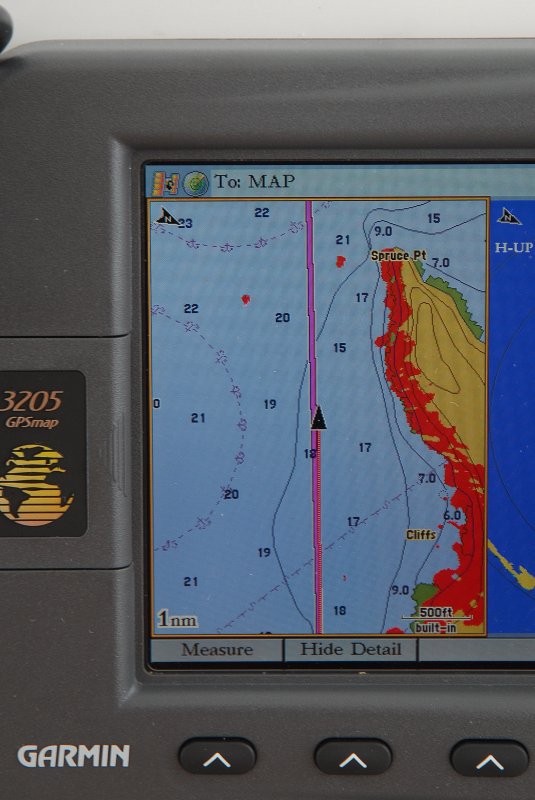
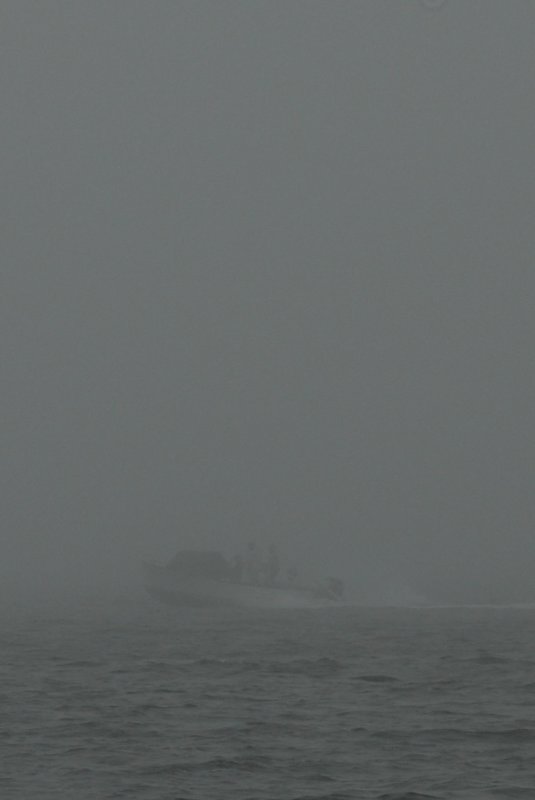
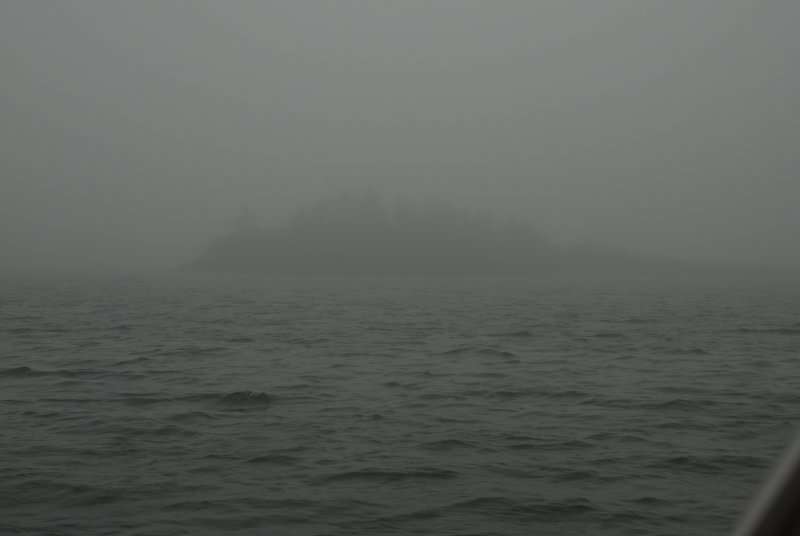
Some photo examples of what these reckless boaters look like:

There really is a boat here a few hundred feet off my stern. No radar, no reflector, no running lights, no horn signals and not even a VHF response. "Dumb dee dumb, sailing awayyyy, dumb dee dumb, doh', a boat, how'd that get there?":confused::confused::eek:

Here's a radar shot of that boat when it was actually showing up. It's the red spec just above the 18 foot spot off my stbd stern quarter. The two targets ahead and to port and stbd were two J Boats traveling together both of which had reflectors when they went by. SOME BOATS JUST DO NOT SHOW UP ON RADAR!!! The guy behind me owns one!


1st class clown (see speed above), no radar, no lights, no horn signals, no reflector and also not showing up well, and not monitoring VHF!


For reference this is 400 feet of visibility from yesterday morning (400 feet is generally fairly good vis for Maine fog):


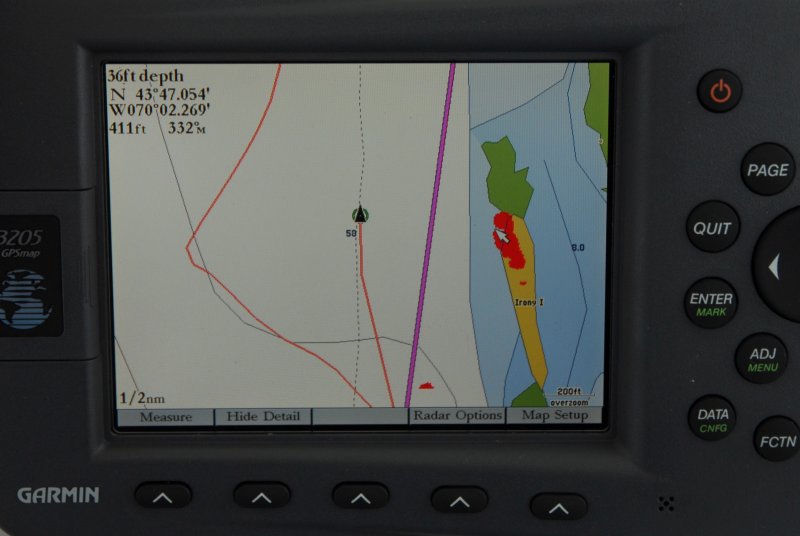
And here's the screen shot with the cursor just over the closest radar image at 411 feet (upper left corner measures distance).:


It scares me how many people are just plain dangerous and have no clue they are being so reckless. If they succeed once they do it again only this time with a greater level of comfort and confidence.
 

WayneH

.
Jan 22, 2008
1,121
Tartan 37 287 Pensacola, FL
Picked up my new-to-me boat on a February morning and had to move it to its new home 60 miles away. Motored out of Clear Lake on Galveston Bay into 100 foot visibility. We had already set up the chartplotter to avoid the Houston Ship Channel by turning before we reached the channel and staying on the outside of the old spoil banks. This was my most hair raising adventure as the boat was in no way ready for fog conditions.

The vhf at that time had no RAM mike and there was not a radar installed. So we ghosted along at 4 knots with the Admiral on the bow. That extra 35 feet came in handy when the oil platforms loom out of the fog.

We made the trip only because not going was not an option. The good thing was that everyone else decided to stay home that day so we never met anyone. Now the boat has the RAM mike, radar and an AIS transponder so we could move if we had to. I'm glad that being retired means I don't have to.
 
Jun 23, 2013
271
Beneteau 373 Newport
Maine sail
I think some of those boaters have moved to Newport ;-(


Many years ago I was sailing from Newport to Block Island on my mirage 24, heavy fog rolled in and I dropped hook off of
Narragansett in shallow water - out of shipping channel and chose enough to the beach to hear but not see to people playing in the water, while I waited for it to clear a little.
With visibility at about 70 ft I can hear an outboard approaching at high speed. As he gets closer I can hear the hull slap! Signaled with the horn but assumed he would not hear me over his engine noise. All of a sudden he pops out of the fog, luckily going parallel to me. Sees me as he screams by and swings around to come close. Points north and asks "Point Judith that way?" I had a great temptation to answer "YES!" ---point Judith harbor was 5 miles SOUTH, he had missed it completely and was on track to Jamestown or maybe even Providence. Needless to say he turned south and pushed the throttles to the limits! Always wondered if he missed it again and was on his way to the Azores
 

Kestle

.
Jun 12, 2011
702
MacGregor 25 San Pedro
My family had a good friend, since passed away, who was the best fisherman on Cape Cod (commercial guy, standup fellow, great family). One trip he was out in Nantucket Sound working his way back to Chatham in heavy fog, when one of these *******s comes out of the fog at 30 knots and cuts his boat in half. One crew member was killed, the first mate lost his leg, and my friend was barely able to jump clear.

CG caught the guy. He was drunk.

This crap does happen, and these *******s are still allowed to breed.

Jeff
 

YVRguy

.
Jan 10, 2013
479
Hunter 34 Vancouver, BC
My recent experience

On my trip to Barkley Sound this summer I was in fog for 5 days. Yes, it abated at times but the Strait of Juan de Fuca between Barcley and just east of Port Renfrew was completely socked in with maybe 100ft visibility.

We have no radar and as a result we seriously considered going back. Instead we chose to stay a little further offshore to avoid the biggest concentration of sport fishing boats but avoid the shipping lane. Our GPS tools were very reliable. We allowed for a very wide margin of error offshore, knowing that GPS can be inaccurate at times. I must say, in addition to our chart plotter, my i-Phone with INavX was incredibly useful and always has been. No cell service required.

We knew that motoring at 5 knots we were traveling at a safe speed. The only scare came when a sport fisherman, equipped with radar, came flying out of the fog at 20+knots headed directly at us. At the last minute he swerved violently and passed to starboard. He stopped dead in the water a little behind us and at first we thought he wanted to talk but he made no effort to turn around. In hindsight he may have been changing his shorts.

Radar in the hands of a fool is no protection - for anybody. Good GPS, traveling at a safe speed and keeping constant vigil was our primary way through it.
 
Sep 20, 2014
1,330
Rob Legg RL24 Chain O'Lakes
On a completely different note. I have a friend who was caught in heavy fog on Lake Michigan. A small bird landed on the boat. The bird eventually hopped over next to him, hopped up on his leg and then back off again. It then sat next to him until the fog lifted and then flew off. Strangest thing.